On 20–12 September, CERN hosted the fifth annual Mediterranean-Antarctic Neutrino Telescope Symposium (MANTS). For the first time, the meeting was organized under the GNN umbrella.
The idea to link more closely the various neutrino telescope projects under both water and ice has been a topic for discussion in the international community of high-energy neutrino astrophysicists for several years. On 15 October 2013, representatives of the ANTARES, BAIKAL, IceCube and KM3NeT collaborations signed a memorandum of understanding for co-operation within a Global Neutrino Network (GNN). GNN aims for extended inter-collaboration exchanges, more coherent strategy planning and exploitation of the resulting synergistic effects.
No doubt, the evidence for extraterrestrial neutrinos recently reported by IceCube at the South Pole (“Cosmic neutrinos and more: IceCube’s first three years”) has given wings to GNN, and is encouraging the KM3NeT (in the Mediterranean Sea) and GVD (Lake Baikal) collaborations in their efforts to achieve appropriate funding to build northern-hemisphere cubic-kilometre detectors. IceCube is also working towards an extension of its present configuration.
One focus of the MANTS meeting was, naturally, on the most recent results from IceCube and ANTARES, and their relevance for future projects. The initial configurations of KM3NeT (with three to four times the sensitivity of ANTARES) and GVD (with sensitivity similar to ANTARES) could provide additional information on the characteristics of the IceCube signals, first because they look at a complementary part of the sky, and second because water has optical properties that are different from ice. Cross-checks with different systematics are of the highest importance for these detectors in natural media. As an example, KM3NeT will measure down-going muons from cosmic-ray interactions in the atmosphere with superb precision. This could help in determining more precisely the flux of atmospheric neutrinos co-generated with those muons, in particular those from the decay of charmed mesons, which are expected to have particularly high energies and therefore could mimic an extraterrestrial signal.
A large part of the meeting was devoted to finding the best “figures of merit” characterizing the physics capabilities of the detectors. These not only allow comparison of the different projects, but also provide an important tool to optimize future detector configurations. The latter also concerns the two sub-projects that aim to determine the neutrino mass hierarchy using atmospheric neutrinos. These are both small, high-density versions of the huge kilometre-scale arrays: PINGU at the South Pole and ORCA in the Mediterranean Sea. In this effort a particularly close co-operation has emerged during the past year, down to technical details.
Combining data from different detectors is another aspect of GNN. A recent common analysis of IceCube and ANTARES sky maps has provided the best sensitivity ever for point sources in certain regions of the sky, and will be published soon. Further goals of GNN include the co-ordination of alert and multimessenger policies, exchange and mutual checks of software, creation of a common software pool, development of standards for data representation, cross-checks of results with different systematics, and the organization of schools and other forums for exchanging expertise and experts. Mutual representation in the experiments’ science advisory committees is another way to promote close contact and mutual understanding.
Contingent upon availability of funding, the mid 2020s could see one Global Neutrino Observatory, with instrumented volumes of 5–8 km3 in each hemisphere. This would, finally, fully raise the curtain just lifted by IceCube, and provide a rich view on the high-energy neutrino sky.
A key accelerator at the Synchrotron-light for Experimental Science and Applications in the Middle East (SESAME) facility in Allan, Jordan, has reached its top energy recently. After having successfully stored electrons in the Booster-Synchrotron in July, the SESAME team succeeded in accelerating electrons to their final energy of 800 MeV on 3 September.
The SESAME injector consists of a 20-MeV microtron and the 800-MeV booster synchrotron. Electrons are produced in the microtron and accelerated to 20 MeV before being transferred to the booster synchrotron. The microtron became operational in 2012 and installation of the booster was completed in 2013. Storage in the booster synchrotron of the electrons from the microtron in July saw them circulating several millions of turns at their initial energy of 20 MeV. Now, the electrons have been accelerated to 800 MeV, which is the top energy of the booster.
This success will lead towards the final goal, which is to make SESAME the first operational synchrotron light source in the Middle East.
Bringing SESAME’s booster synchhrotron successfully to full operation is of particular significance because this is the first high-energy accelerator in the Middle East. The achievement is thanks to a team of young scientists and technicians from the region, for whom accelerator technology is a new field. They were led in this work by Erhard Huttel, the technical director of SESAME.
This success will lead towards the final goal, which is to make SESAME the first operational synchrotron light source in the Middle East, and to confirm its position as a truly international research centre. When the facility starts operations – probably in early 2016 – scientists from the Middle East and neighbouring countries, in collaboration with the international synchrotron light community, will have the possibility to perform world-class scientific studies. They will be able, for example, to determine the structure of a virus to improve medical remedies, gain insight into the interior and the three-dimensional microstructure of objects such as materials that are of interest to cultural heritage and archaeology, and investigate magnetization processes that are highly relevant for magnetic data storage.
SESAME has had links with CERN from the start. Following a suggestion by Gus Voss (DESY) and Herman Winick (SLAC), Sergio Fubini (CERN and University of Turin, who chaired a Middle East Scientific Co-operation group) and Herwig Schopper (director-general of CERN in the years 1981–1987) persuaded the German government to donate the components of the then soon-to-be-dismantled Berlin synchrotron BESSY I for use at SESAME (CERN Courier September 2014 p46). At a meeting at UNESCO in 1999, an interim council was established with Schopper as president. SESAME is modelled closely on CERN, and shares CERN’s original aims and its governance structure. The current president of SESAME Council is Chris Llewellyn Smith, former director-general of CERN (1994–1998).
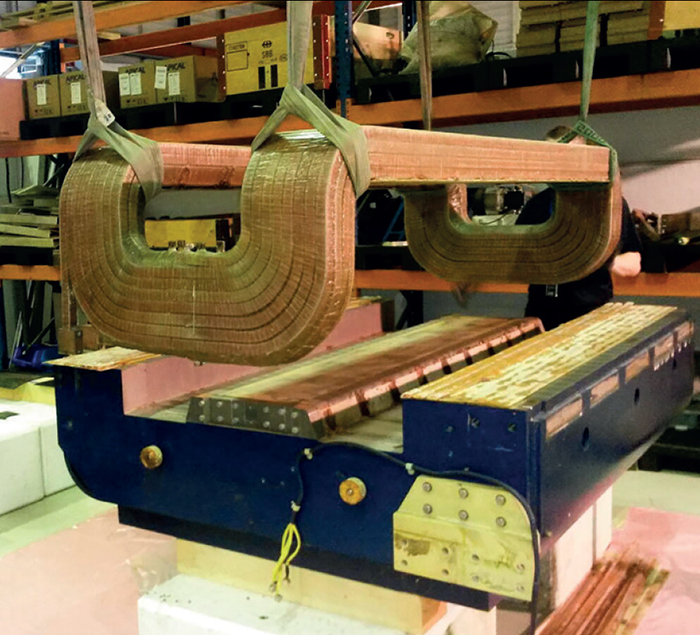
In July, a sextupole corrector magnet for the SESAME storage ring arrived at CERN for tests and magnetic measurements. It is the first unit out of 32 to be delivered by the CNE Technology Center, a Cypriot-based company under the EU-CERN CESSAMag project.
In November last year, a pre-series sextupole for SESAME was prepared at CERN, to check the design and to tune the manufacturing procedures before placing the order for the series production to industry. The contracts were then awarded to a Cypriot and a Pakistani company. The CERN team has been working closely with both companies to transfer the knowledge from CERN that is needed to build these magnets.
The first unit out of the 32 magnets from Cyprus has already arrived at CERN, where measurements carried out together with SESAME colleagues reveal a precise assembly, resulting in magnetic-field homogeneity of 0.2‰ within two thirds of the aperture. The unit is also mechanically, electrically and hydraulically sound, assuring good reliability during operation. This makes the magnet appropriate for the lattice of a synchrotron light source such as SESAME, and it is a major step in preparing the SESAME storage ring.
The Cypriot company has, in parallel, assembled more than 50% of the components needed for the rest of the contract. The first magnet from Pakistan is currently being assembled.
• CESSAMag is the FP7 project “CERN-EC Support for SESAME Magnets”, which aims at supporting the construction of the SESAME light source.
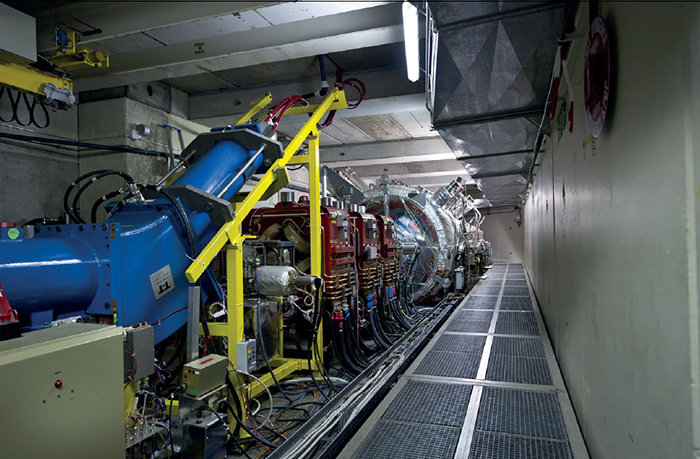
Antiprotons returned to CERN’s Antiproton Decelerator (AD) on 5 August and experiments have been receiving beams since mid-September, following an intensive consolidation programme during the first long shutdown (LS1) of the accelerator complex. Work has involved some of the most vital parts of the decelerator, such as the target area, the ring magnets, the stochastic cooling system, vacuum system, control system and various aspects of the instrumentation.
The AD uses antiprotons produced by directing the 26 GeV/c proton beam extracted from the Proton Synchrotron (PS) onto an iridium target. In the AD target area, these antiprotons are produced, collimated and momentum-selected to prepare for their injection into the decelerator, where their energy is reduced to the level requested by the experiments.
Although the AD started operations for the antimatter programme in 2000, it reuses almost entirely the components and configuration of an older machine – the Antiproton Collector (AC) – built in 1986. When the AC was designed, the target area needed a high repetition rate of one proton pulse every 2.4 s. Now, the AD’s repetition rate is just 90 s, so components wear out more slowly. Nevertheless, at the beginning of LS1 a problem was found in the transmission line for the electric pulse that goes into the magnetic horn – the device invented by Nobel laureate Simon van der Meer that focusses the diverging antiproton beam. As well as this, after 20 years of operation, the magnetic horn itself had been severely damaged by electric arcs.
The LS1 programme, involving teams of specialists from CERN’s technology, engineering and beam departments, replaced the transmission line and magnetic horn. The horn assembly is composed of three main parts: the horn itself, which consists of two concentric aluminium conductors, a 6-m-long aluminium strip line that carries the current from the generators to the horn, and a movable clamping system that ensures the electrical continuity between the horn and the stripline. Given the critical situation, the teams decided to replace all three components. They had only six months to re-assemble and test spares more than 20 years old, and to construct additional pieces. The consolidated system was assembled and tested on the surface before being installed underground in the target area.
While repairing the damaged components, the teams also examined the 20-tonne dipole magnets. One magnet was removed from the ring and opened up for the first time in 30 years. The coils were in good condition, but the shimming that holds the coils had been completely transformed into dust and needed repair.
The consolidation work on the AD was completed at the end of July, and the first beam was sent to the target on 5 August. Debugging, adjustments and fine tuning were then carried out to deliver antiproton beams to the experiments in mid-September. The work also included the installation of a brand-new beam line for the new Baryon Antibaryon Symmetry Experiment (BASE) experiment, which aims to take ultra-high-precision measurements of the antiproton magnetic moment. The programme has been prompted by the start of the Extra Low ENergy Antiproton ring (ELENA) project. Planned to be operational in 2017, ELENA will allow further deceleration, together with beam cooling of the antiprotons, resulting in an increased number of particles trapped downstream in the experiments.
Elsewhere at CERN, 12 September saw the Super Proton Synchrotron accelerate its first proton beam after LS1. At the LHC, work continues towards the restart. Of the eight sectors, sector 6-7 is the first to have been cooled down to its nominal temperature of 1.9 K. The first powering tests began there on 15 September. Five other sectors were in the process of being cooled during September, with the seventh on track to begin its cool down in early October. All sectors are first cooled to 20 K for the copper-stabilizer continuity measurement tests, which allow the performance of the circuits to be checked when they are not superconducting. The finish line is in sight for the LHC’s restart in spring 2015.
It looks like a small black button, but in tests at Fermilab’s High-Brightness Electron Source Lab it has produced beam currents 103–106 times greater than those generated with a large laser system. Designed by a collaboration led by RadiaBeam Technologies, a California-based technology firm actively involved in accelerator R&D, this electron source is based on a carbon-nanotube cathode only 15 mm across.
Carbon-nanotube cathodes have already been studied extensively in university research labs, but Fermilab is the first accelerator facility to test the technology within a full-scale setting. With its capability and expertise for handling intense electron beams, it is one of relatively few labs that can support a project like this.
Traditionally, accelerator scientists use lasers to strike cathodes to eject electrons through photoemission. With the nanotube cathode, a strong electric field pulls streams of electrons off the surface of the cathode though field emission. There were early concerns that the strong electric fields would cause the cathode to self-destruct. However, one of the first discoveries that the team made when it began testing in May was that the cathode did not explode. Instead, the exceptional strength of carbon nanotubes prevents the cathode from being destroyed. The team used around 22 MV/m to produce the target current of more than 350 mA.
The technology has extensive potential applications in medical equipment, for example, since an electron beam is a critical component in generating X-rays.
• A Department of Energy Small Business Innovation Research grant funds the RadiaBeam-Fermilab-Northern Illinois University collaboration.
On 9–10 September, representatives of about 70 institutes worldwide met at CERN to establish the International Collaboration Board (ICB) at the Future Circular Collider (FCC) study. The study covers the designs of a 100-TeV hadron collider and a high-luminosity lepton collider, the associated detectors and physics studies, and a lepton–hadron collider option. These generic and mostly site-independent studies will be complemented by a civil-engineering study for the Geneva area, requested in the context of the European Strategy for Particle Physics. The large attendance at the preparatory ICB meeting testifies to the attractiveness of the FCC approach, which aims to explore the energy scale of tens of teraelectronvolts.
Opening the meeting, CERN’s director-general, Rolf Heuer, outlined the planned organizational structure of the FCC study, which will operate as an international collaboration under the auspices of the European Committee for Future Accelerators. As the central overseeing body, the ICB will comprise representatives from all participating institutes. The proposed structure was endorsed by all attendees. Prior to the meeting, more than 20 institutes had already signed the FCC Memorandum of Understanding and become official members of the FCC collaboration. Several more institutes joined during the event. The institutes with confirmed participation endorsed Leonid Rivkin of Ecole polytechnique fédérale de Lausanne and PSI – a widely recognized accelerator expert – as interim chair of the ICB.
Delegates were impressed by the progress made on this design since the FCC kick-off event at the University of Geneva in February. The presentations reviewed the status of ongoing work for the study formation, accelerator designs, technologies, infrastructure, and experiments. They highlighted, in particular, the anticipated impact that the study should have on many different types of technologies, such as advanced cryogenics, new production procedures for RF cavities, novel surface treatments of vacuum-chamber materials, lower-cost and more compact high-field magnets. Representatives of most of the institutes participating also described their respective expertise and proposed contributions.
In parallel to the progress being made in forming the international FCC collaboration, a design-study proposal focused on the FCC hadron collider has been submitted to the European Commission in the context of the Horizon 2020 programme. The main technological R&D areas have been identified, and a work plan is being established with potential partners.
The coming months will see enhanced design activities aimed at convergence and down-selection between different alternative options for the overall collider layouts and beam parameters. The next major milestone for the FCC collaboration will be the first large annual workshop, which will take place in Washington DC on 23–27 March 2015.
In March 2001, the Brookhaven g-2 storage ring was retired, after producing the world’s best measurements of the muon’s anomalous magnetic moment, aμ = (g-2)/2. However, the experiment produced a cliffhanger: the experimental result differed by 3–4σ from the theoretical prediction for aμ, hinting potentially at the presence of new physics beyond the Standard Model.
Now, a new experiment to measure aμ is under construction at Fermilab, with the goal of confirming or refuting the evidence produced at Brookhaven. The new Muon g-2 collaboration will reuse Brookhaven’s storage-ring magnet and several of its subsystems to do the experiment with a precision four times better. In the summer of 2013, a company specializing in moving large objects brought the centrepiece of the storage-ring system – a 14-m-diameter electromagnet – from Brookhaven to Fermilab (CERN Courier July/August 2013 p11). Then, during summer this year, the next milestone was achieved as re-assembly of the storage ring began in the newly completed MC-1 building at Fermilab (figures 1 and 2).
The superconducting magnet – the design led by Gordon Danby, Hiromi Hirabayashi and Akira Yamamoto, beginning in the late 1980s – provides a highly uniform, essentially pure, 1.45-T dipole field throughout its 44.7-m circumference (Danby et al. 2001). The storage-ring system includes a unique superconducting inflector magnet that enables bunches of 3.1 GeV/cmuons produced in a pion-decay channel to enter the magnetic-field region along a nearly field-free path. A pulsed kicker applies a magnetic deflection to redirect the incoming muons into the ring’s storage volume. A set of four electric quadrupoles provide vertical focusing without perturbing the critical uniform magnetic field. This unique system of devices allows direct injection of the muons – a breakthrough compared with previous g-2 experiments – allowing the Brookhaven experiment to improve the precision by a factor of 14, compared with the series of experiments that took place at CERN in the mid 1970s. The final result from the Brookhaven E821 experiment is aμ = 116 592 089 (63) × 10–11 – a precision of 0.54 ppm – where the error is dominated by statistics, not systematics (Muon g-2 Collaboration 2006).
To measure g-2, polarized muons are injected into the storage ring and their spin evolution is tracked as they circulate. If g were exactly equal to 2, the muon spin would remain in the direction of its momentum. For g > 2, the spin advances, or precesses, proportionally to the anomalous part of the magnetic moment. In this particular storage ring, on every 29.4 revolutions, the spin orientation advances by one turn compared with the momentum. Parity violation in the weak decay of the muon then serves as the spin analyser. The higher-energy electrons in the μ → eνν decay chain are emitted preferentially in the direction of the muon spin at the time of the decay. Because the electrons have lower momentum compared with the muons, they curl to the inside of the storage ring, where they can be detected. Figure 3 shows a histogram of the arrival time vs the time after injection for the higher-energy electrons, measured when they struck one of 24 symmetrically placed electromagnetic calorimeters located just to the inside of the storage volume in the E821 experiment. The characteristic anomalous precession frequency is clearly visible. When combined with the integrated magnetic field that is measured using pulsed proton NMR, the ratio of these quantities – precession frequency to field – leads directly to the quoted result for g-2.
The g-2 measurement tests the completeness of the Standard Model, because aμ arises from quantum fluctuations, as figure 4 illustrates. The theory must account for the quantum fluctuation effects from all known Standard Model particles that influence the muon’s magnetic moment. If something is left out, or there is a contribution from new physics, the theory would not match the experiment. While the contributions from QED and the weak interaction are well known, those from hadronic terms drive the overall theoretical uncertainty of about 0.46 ppm. The largest uncertainty comes from hadronic vacuum-polarization contributions. They can be determined directly from cross-section measurements at e+e– colliders, and vigorous programmes are underway in Novosibirsk, Beijing and Frascati to improve these measurements. More difficult to assess, although much smaller in magnitude, is the (α/π)3 hadronic “light-by-light” diagram. However, a recent dedicated workshop reports significant progress and plans to improve this situation, including progress in lattice-gauge calculations (Benayoun et al. 2014).
The Brookhaven measurement differs from the prediction of the Standard Model by roughly 3–4σ, depending on the details of the hadronic contribution used in the comparison (Blum et al. 2013). While the present comparison is tantalizing, it does not meet the 5σ standard required for a discovery. Nevertheless, many theorists have speculated on what might be implied if it holds up to further scrutiny. Dominant themes include low-energy supersymmetry, dark gauge bosons, Randall–Sundrum models and others with large extra dimensions, to name a few. The impact of the result – whether it remains large and significant, or in the end agrees with the Standard Model – will constrain many theories of new physics.
To push further requires “more muons”. Following the completion of E821, a number of ideas were considered, but the winning concept came from a clever reuse of the Fermilab accelerator complex – in particular, much of the antiproton production facility – to produce a rapidly cycling injection of a pure, high-intensity muon beam, with nearly 100% polarization, into the storage ring. The plan, now part of a more global “Muon Campus” concept that includes the muon-to-electron search experiment (Mu2e), will result in a 20-fold increase in statistics compared with Brookhaven. The only obstacle was that the specialized storage-ring system was in New York and had not been powered for more than a decade. So, how to move it? And, once moved, would it still work? The delicate transcontinental move – by lorry, barge across sea and along river, and finally again by lorry – to deliver the 14-m-diameter superconducting coils to the Fermilab site enjoyed much publicity. With far less fanfare, 50 lorries hauled 650 tonnes of steel and other equipment westward.
The new Muon g-2 experiment at Fermilab, also known as E989, is now a mature effort. The collaboration of 36 institutions from eight countries will use or refurbish many of the components from the past. Nevertheless, much is totally new. With a higher expected beam rate, more rapid filling of the ring, and even more demanding goals in systematic uncertainties, the collaboration has had to devise improved instrumentation. The ring kicker-system will be entirely new, optimized to give a precise kick on the first turn only, to increase the storage fraction. The magnetic field will be even more carefully prepared and monitored. The detectors and electronics are entirely new, and a state-of-the-art calibration system will ensure critical performance stability throughout the long data-taking periods. New in situ trackers will provide unprecedented information on the stored beam. The first physics data-taking is expected in early 2017. The next critical milestone will be the cooling of the superconducting coils and powering of the storage-ring magnet, which is expected by spring 2015.
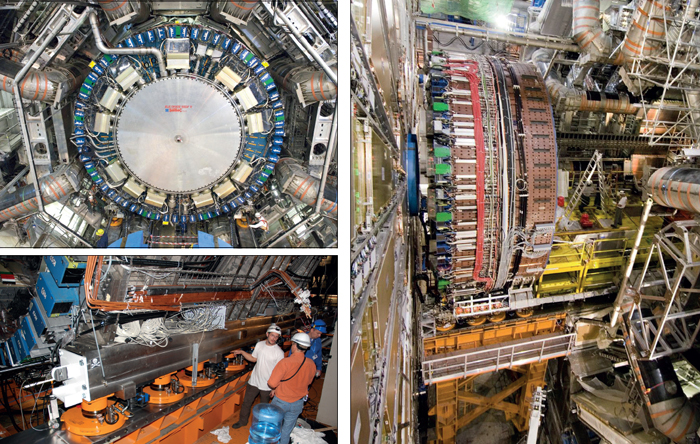
On 7 August, the technical teams in charge of closing activities in the ATLAS collaboration started to move the first pieces back into position around the LHC beam pipe. The subdetectors had been moved out in February 2013, at the beginning of the first LHC Long Shutdown (LS1) – a manoeuvre that was needed to allow access and work on the planned upgrades.
LS1 has seen a great deal of work on the ATLAS detector. In addition to the upgrades carried out on all of the subdetectors, when the next LHC run starts in 2015 the experiment will have a new beam pipe and a new inner barrel layer (IBL) for the pixel detector. For the work to be carried out in the cavern, one of the small wheels of the muon system had to be moved to the surface.
The various pieces are moved using an air-pad system on rails, with the exception of the 25-m-diameter big wheel (in the muon system), which moves on bogies. One of the most difficult objects to move is the endcap calorimeter: it weighs about 1000 tonnes and comes with many “satellites”, i.e. electric cables, cryogenic lines and optical fibres for the read-out. Thanks to the air pads, the 1000 tonnes of the calorimeter can be moved by applying a force of only 23 tonnes. During the movement, the calorimeter, with its cryostat filled with liquid argon, remains connected to the flexible lines whose motion is controlled by the motion of the calorimeter.
The inflation of the air pads must be controlled perfectly to avoid any damage to the delicate equipment. This is achieved using two automated control units –one built during LS1 – which perform hydraulic and pneumatic compensation. This year, the ATLAS positioning system has been improved thanks to the installation of a new sensor system on the various subdetectors. This will allow the experts to achieve an accuracy of 300 μm in placing the components in their final position. The position sensors were originally developed by Brandeis University within the ATLAS collaboration, but the positioning system itself was developed with the help of surveyors from CERN, who are now using this precision system in other experiments.
All of the equipment movements in the cavern happen under the strict control of the technical teams and the scientists in charge of the various subdetectors. It takes several hours to move each piece, not only owing to the weight involved, but also because several stops are necessary to perform tests and checks.
The closing activities are scheduled to run until the end of September. By then, the team will have moved a total of 12 pieces, that is, 3300 tonnes of material.
Work continues apace to ready the Super Proton Synchrotron (SPS) for its planned October restart, while beams are already being delivered to experiments at the Proton Synchrotron (PS) and PS Booster.
During July and August, SPS teams were kept busy with a range of start-up tests for the various equipment groups, including eight weeks of electrical power-converter tests. Since it began in February 2013, the Long Shutdown 1 (LS1) has seen the replacement and renovation of about 75% of the SPS powering, including major components such as 18 kV transformers, switches, cables and thyristor bridges that sit at the heart of the power converters. There have also been important upgrades to the control and high-precision measurement systems. The summer tests were to confirm that the renovated converters were operating correctly to power the SPS dipole and quadrupole magnets.
Slotted among this busy schedule of powering tests were the final checks of the accelerator’s magnets and beam dump. The SPS had one of each of the three main types of magnet fault: an electrical fault (short circuit) in a magnet circuit, a water leak (in the cooling system), and a vacuum-chamber leak. In addition, the main beam dump had to be replaced. Rather than stopping the tests for each move, the teams replaced all four elements in one go.
On 10–12 August, the three magnets and beam dump were removed and replaced with spares in the SPS tunnel. The logistics for this move were complex because of the weight of the magnets and beam dump, and also the 10-tonne chariot and lifting equipment. In addition, these large pieces of equipment fill the entire width of the tunnel, so co-ordinating which vehicles and teams were where and synchronizing their movements was vital.
Although the SPS teams are well-versed at replacing magnets – they can replace as many as four magnets during a two-day technical stop – replacing the beam dump proved to be a tougher challenge. Because the dump is radioactive, the length of transport had to be kept as short as possible and moving the dump from the tunnel to the radiation storage area could not take place if it rained. With this in mind, the operations team created detailed plans for the move, providing hourly updates and back-up solutions in case of rain.
Despite these extensive tests and replacements, the SPS remains on schedule to take beam from the PS in early September, with the accelerator operating again in October to provide beams to the North Area.
At the LHC, in late August the cooling of sector 1-2 was in progress, and the cooling of sector 5-6 beginning. Vacuum teams were checking for any final leaks and carrying out sealing tests in various sectors. At the same time, the copper-stabilizer continuity measurement tests were in progress in sector 8-1, before being carried out throughout the machine. The first power tests have begun in sector 6-7, which will be the first sector ready for beam. Elsewhere, electrical validation tests were in progress throughout the machine, together with instrumentation tests, particularly on the beam-loss sensors. All of the collimators, the kicker magnets and the beam instrumentation in the straight sections of the LHC were installed and under vacuum.
Work progresses on Linac4, the linear accelerator foreseen to take over from the current Linac2 as injector to the PS Booster. On 5 August, the first drift-tube linac (DTL) tank saw beams at 12 MeV. After seven years of design, prototyping and manufacturing, the Linac4 DTL, which comprises three tanks, underwent countless workshop-based measurements of the geometry, vacuum and magnet polarization of the tanks, before the first was installed in the Linac4 tunnel on 5 June. Beam commissioning tests ran until 21 August, and found the DTL operating with nominal transmission.
The National Synchrotron Light Source II (NSLS-II) is currently being commissioned at Brookhaven National Laboratory. When completed, it will be a state-of-the-art, medium-energy electron storage ring producing X-rays up to 10,000 times brighter than the original NSLS, which started operating at BNL in 1982 and will be shut down at the end of September.
The injector system includes a 200 MeV linac and booster with energy up to 3 GeV. The booster is a joint venture between the NSLS-II injector group and the Budker Institute of Nuclear Physics (BINP) in Novosibirsk, one of the NSLS-II partners. BINP has a solid relationship with the Brookhaven lab and has played a significant role in NSLS-II development, coming up with the final design of the booster. The institute has its own well-developed workshops and a variety of specialists, who are not only involved in many major international projects but also operate the VEPP-2000 and VEPP-4M colliders.
In May 2010, according to tender results, a contract was signed between Brookhaven and BINP on the manufacturing, installation and commissioning of the turnkey booster (except an RF system). One year later, Brookhaven staff visited BINP and accepted all first articles. Most of the components – including the magnets, power supplies, diagnostic systems, injection-extraction system – were made at BINP. However, BINP also engaged subcontractors, including European firms. For example, power supplies for the booster dipole magnets were produced by Danfysik A/S.
An 11-hour time difference between Novosibirsk and New York did not prevent good interaction between the laboratories. In the morning and evening, Brookhaven and BINP experts usually made contact to discuss the latest achievements and pose new questions. So the Sun never set over the booster project.
Booster parts arrived at Brookhaven from January through to August 2012. Most of the components came as girder assemblies with magnets aligned to tens of microns, and vacuum chambers installed. The journey of more than 10,000 km was made first by road from Novosibirsk to St Petersburg and then to New York by ship. Upon arrival at Brookhaven, all assemblies were thoroughly tested, but the long journey did not affect the alignment of magnets on the girders.
The testing and installation activities have spanned both organizations. The booster commissioning also involved staff from both NSLS-II and BINP. Following authorization, the commissioning of the booster started in December 2013 and was successfully completed in February 2014, ahead of schedule. The beam passing through booster was up to 95%, with all systems working according to design.
The commissioning of the main storage ring started in March and on 11 July, NSLS-II reached a current of 50 mA at 3 GeV, using a new superconducting radio-frequency cavity. The second cavity and other hardware are still to be installed before the accelerator reaches the full design current of 500 mA. The next step is commissioning insertion devices and front-ends.
To provide the best experiences, we use technologies like cookies to store and/or access device information. Consenting to these technologies will allow us to process data such as browsing behavior or unique IDs on this site. Not consenting or withdrawing consent, may adversely affect certain features and functions.
Functional
Always active
The technical storage or access is strictly necessary for the legitimate purpose of enabling the use of a specific service explicitly requested by the subscriber or user, or for the sole purpose of carrying out the transmission of a communication over an electronic communications network.
Preferences
The technical storage or access is necessary for the legitimate purpose of storing preferences that are not requested by the subscriber or user.
Statistics
The technical storage or access that is used exclusively for statistical purposes.The technical storage or access that is used exclusively for anonymous statistical purposes. Without a subpoena, voluntary compliance on the part of your Internet Service Provider, or additional records from a third party, information stored or retrieved for this purpose alone cannot usually be used to identify you.
Marketing
The technical storage or access is required to create user profiles to send advertising, or to track the user on a website or across several websites for similar marketing purposes.