This book aims to provide physical sciences students with the computational skills that they will need in their careers and expose them to applications of programming to problems relevant to their field of study. The authors, who are professors of physics at the University of Pittsburgh, decided to write this text to fill a gap in the current scientific literature that they noticed while teaching and training young researchers. Often, graduate students have only basic knowledge of coding, so they have to learn on the fly when asked to solve “real world” problems, like those involved in physics research. Since this way of learning is not optimal and sometimes slow, the authors propose this guide for a more structured study.
Over almost 900 pages, this book introduces readers to modern computational environments, starting from the foundation of object-oriented computing. Parallel computation concepts, protocols and methods are also discussed early in the text, as they are considered essential tools.
The book covers various important topics, including Monte Carlo methods, simulations, graphics for physicists and data modelling, and gives large space to algorithmic techniques. Many chapters are also dedicated to specific physics applications, such as Hamiltonian systems, chaotic systems, percolation, critical phenomena, few-body and multi-body quantum systems, quantum field theory, etc. Nearly 400 exercises of varying difficulty complete the text.
Even though most of the examples come from experimental and theoretical physics, this book could also be very useful for students in chemistry, biology, atmospheric science and engineering. Since the numerical methods and applications are sometimes technical, it is particularly appropriate for graduate students.
This book provides an excellent overview of the state of the art of quantum field theory (QFT) applications to condensed-matter physics (CMP). Nevertheless, it is probably not the best choice for a first approach to this wonderful discipline.
QFT is used to describe particles in the relativistic (high-energy intensity) regime, but, as is well known, its methods can also be applied to problems involving many interacting particles – typically electrons. The conventional way of studying solid-state physics and, in particular, silicon devices does not make use of QFT methods due to the success of models in which independent electrons move in a crystalline substrate. Currently, though, we deal with various condensed-matter systems that are impervious to that simple model and could instead profit from QFT tools. Among them: superconductivity beyond the Bardeen–Cooper–Schrieffer approach (high-temperature superconducting cuprates and iron-based superconductors), the quantum Hall effect, conducting polymers, graphene
and silicene.
The author, as he himself states, aims to offer a unified picture of condensed-matter theory and QFT. Thus, he highlights the interplay between these two theories in many examples to show how similar mechanisms operate in different systems, despite being separated by several orders of magnitude in energy. He discusses, for example, the comparison between the Landau–Ginzburg field of a superconductor with the Anderson–Higgs field in the Standard Model. He also explains the not-so-well-known relation between the Yukawa mechanism for mass generation of leptons and quarks, and the Peierls mechanism of gap generation in polyacetylene: the same trilinear interaction between a Dirac field, its conjugate and a scalar field that explains why polyacetylene is an insulator, is responsible for the mass of elementary particles.
The book is structured into three parts. The first covers conventional CMP (at advanced undergraduate level). The second provides a brief review of QFT, with emphasis on the mathematical analysis and methods appropriate for non-trivial many-body systems (as, in particular, in chapters eight and nine, where a classical and a quantum description of topological excitations are given). I found the pages devoted to renormalisation remarkable, in which the author clearly exposes that the renormalisation procedure is a necessity due to the presence of interactions in any QFT, not to that of divergences in a perturbative approach. The heart of the book is part three, composed of 18 chapters where the author discusses the state of the art of condensed-matter systems, such as topological insulators and even quantum computation.
The last chapter is a clear example of the non-conventional approach proposed by the author: going straight to the point, he does not explain the basics of quantum computation, but rather discusses how to preserve the coherence of the quantum states storing information, in order to maintain the unitary evolution of quantum data-processing algorithms. In his words, “the main method of coherence protection involves excitation, having the so-called non-abelian statistics”, which, going back to CMP, takes us to the realm of anyons and Majorana qubits. In my opinion, this book is not suitable for undergraduate or first-year graduate students (for whom I see as more appropriate, the classic Condensed Matter Field Theory by Altland and Simons). Instead, I would keenly recommend this to advanced graduate students and researchers in the field, who will find, in part three, plenty of hot topics that are very well explained and accompanied by complete references.
by Gordon Fraser. Oxford University Press. Hardback ISBN 9780199208463 £25 ($49.95).
The late Abdus Salam – the only Nobel scientist from Pakistan – came from a small place in the Punjab called Jhang. The town is also famous for “Heer-Ranjha”, a legendary love story of the Romeo-and-Juliet style that has a special romantic appeal in the countryside around the town. Salam turned out to be another “Ranjha” from Jhang, whose first love happened to be theoretical physics. Cosmic Anger, Salam’s biography by Gordon Fraser, is a new, refreshing look at the life of this scientific genius from Pakistan.
I have read several articles and books about Salam and also met him several times, but I still found Fraser’s account instructive. What I find intriguing and interesting about Cosmic Anger is first the title, and second that each chapter of the book gives sufficient background and historical settings of the events that took place in the life of Salam. In this regard the first three chapters are especially interesting, in particular the third, where the author talks about Messiahs, Mahdis and Ahmadis. This shows in a definitive way the in-depth knowledge that Fraser has about Islam and the region where Salam was born.
In chapter 10, Fraser discusses the special relationship between Salam and the former President of Pakistan, Ayub Khan. I feel that more emphasis was required about the fact that for 16 years, from 1958 to 1974, Salam had the greatest influence on the scientific policies of Pakistan. On 4 August 1959, while inaugurating the Atomic Energy Commission, President Ayub said: “In the end, I must say how happy I am to see Prof. Abdus Salam in our midst. His attainments in the field of science at such a young age are a source of pride and inspiration for us and I am sure that his association with the commission will help to impart weight and prestige to the recommendations.” Salam was involved in setting up the Atomic Energy Commission and other institutes such as the Pakistan Institute of Nuclear Science and Technology and the Space and Upper Atmosphere Research Commission in Pakistan.
Finally, I find the book to be a well written account of the achievements of a genius who was a citizen of the world, destined to play a memorable role in the global development of science and technology. At the same time, in many ways Salam was very much a Pakistani. In the face of numerous provocations and frustrations, he insisted on keeping his nationality. He loved the Pakistani culture, its language, its customs, its cuisine and its soil where he was born and is buried.
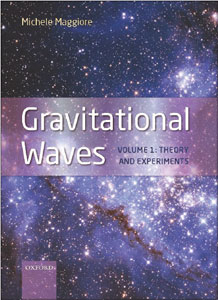
By Michele Maggiore, Oxford University Press. Hardback ISBN 9780198570745 £45 ($90).
This is a complete book for a field of physics that has just reached maturity. Gravitational wave (GW) physics recently arrived at a special stage of development. On the theory side, most of the generation mechanisms have been understood and some technical controversies have been settled. On the experimental side, several large interferometers are now operating around the world, with sensitivities that could allow the first detection of GWs, even if with a relatively low probability. The GW community is also starting vigorous upgrade programmes to bring the detection probability to certitude in less than a decade from now.
The need for a textbook that treats the production and detection of GWs systematically is clear. Michele Maggiore has succeeded in doing this in a way that is fruitful not only for the young physicist starting to work in the field, but also for the experienced scientist needing a reference book for everyday work.
In the first part, on theory, he uses two complementary approaches: geometrical and field-theoretical. The text fully develops and compares both, which is of great help for a deep understanding of the nature of GWs. The author also derives all equations completely, leaving just the really straightforward algebra for the reader. A basic knowledge of general relativity and field theory is the only prerequisite.
Maggiore explains thoroughly the generation of gravitational radiation by the most important astrophysical sources, including the emitted power and its frequency distribution. One full chapter is dedicated to the Hulse-Taylor binary pulsar, which constituted the first evidence for GW emission. The “tricky” subject of post-Newtonian sources is also clearly introduced and developed. Exercises that are completely worked out conclude most of these theory chapters, enhancing the pedagogical character of the book.
The second part is dedicated to experiments and starts by setting up a background of data-analysis techniques, including noise spectral density, matched filtering, probability and statistics, all of which are applied to pulse and periodic sources and to stochastic backgrounds. Maggiore treats resonant mass detectors first, because they were the first detectors chronologically to have the capability of detecting signals, even if only strong ones originating in the neighbourhood of our galaxy. The study of resonant bar detectors is instructive and deals with issues that are also very relevant to understanding interferometers. The text clearly explains fundamental physics issues, such as approaching the quantum limits and quantum non-demolition measurements.
The last chapter is devoted to a complete and detailed study of the large interferometers – the detectors of the current generation – which should soon make the first detection of GWs. It discusses many details of these complex devices, including their coupling to gravitational waves, and it makes a careful analysis of all of the noise sources.
Lastly, it is important to remark on a little word that appears on the cover: “Volume 1”. As the author explains in the preface, he is already working on the second volume. This will appear in a few years and will be dedicated to astrophysical and cosmological sources of GWs. The level of this first book allows us to expect an interesting description of all “we can learn about nature in astrophysics and cosmology, using these tools”.
This monograph discusses at length the structure of the general solution of the Einstein equations with a cosmological singularity in Einstein-matter systems in four and higher space–time dimensions, starting from the fundamental work of Belinski (the book’s lead author), Khalatnikov and Lifshitz (BKL) – published in 1969.
The text is organised in two parts. The first, comprising chapters one to four, is dedicated to an exhaustive presentation of the BKL analysis. The authors begin deriving the oscillatory, chaotic behaviour of the general solution for pure Einstein gravity in four space–time dimensions by following the original approach of BKL. In chapters two and three, homogeneous cosmological models and the nature of the chaotic behaviour near the cosmological singularity are discussed. In these three chapters, the properties of the general solution of the Einstein equation are studied in the case of empty space in four space–time dimensions. The fourth chapter instead deals with different systems: perfect fluids in four space–time dimensions; gauge fields of the Yang–Mills and electromagnetic types and scalar fields, also in four space–time dimensions; and pure gravity in higher dimensions.
The second part of the book (chapters five to seven) is devoted to a model in which the chaotic oscillations discovered by BKL can be described in terms of a “cosmological billiard” system. In chapter five, the billiard description is provided for pure Einstein gravity in four dimensions, without any simplifying symmetry assumption, while the following chapter extends this analysis to arbitrary higher space–time dimensions and to general systems containing gravity coupled to matter fields. Finally, chapter seven covers the intriguing connection between the BKL asymptotic regime and Coxeter groups of reflections in hyperbolic space. Four appendices complete the treatment.
Quite technical and advanced, this book is meant for theoretical and mathematical physicists working on general relativity, supergravity and cosmology.
Based on university lectures given by the author, this book provides an overview of gravitational lensing, which has emerged as a powerful tool in astronomy with numerous applications, ranging from the quest for extrasolar planets to the study of the cosmic mass distribution.
Gravitational lensing is a consequence of general relativity (GR): the gravitational field of a massive object causes light rays passing close to it to bend and refocus somewhere else. As a consequence, any treatment of this topic has to make reference to GR theory; nevertheless, as the author highlights, not much formalism is required to learn how to apply lensing to specific problems. Thus, using very little GR and not too complex mathematics, this text presents the basics of gravitational lensing, focusing on the equations needed to understand the phenomenon. It then dives into a number of applications, including multiple images, time delays, exoplanets, microlensing, cluster masses, galaxy shape measurements, cosmic shear and lensing of the cosmic microwave background.
Written with a pedagogical approach, this book is meant as a textbook for one-semester undergraduate or graduate courses. But it can also be used for independent study by researchers interested in entering this fascinating and fast-evolving field.
This book treats two fields of physics that are usually taught separately – quantum field theory (QFT) on one side and cosmology and gravitation on the other – in a more unified manner. Kachelriess uses this unusual approach because he is convinced that, besides studying a subject in depth, what is often difficult is to put the pieces into a general picture. Thus, he makes an effort
to introduce QFT together with its most important applications to cosmology and astroparticle physics in a coherent framework.
The path-integral approach is employed from the start and the use of tools such as Green’s functions in quantum mechanics and in scalar field-theory is illustrated. Massless spin-1 and spin-2 fields are introduced on an equal footing, and gravity is presented as a gauge theory in analogy with the Yang–Mills case. The book also deals with various concepts relevant to modern research, such as helicity methods and effective theories, as well as applications to advanced research topics.
This volume can serve as a textbook for courses in QFT, astroparticle physics and cosmology, and students interested in working at the interface between these fields can certainly appreciate the uncommon approach used. It was also the intention of the author to make the book suitable for self study, so all explanations and derivations are given in detail. Nevertheless, a solid knowledge of calculus, classical and quantum mechanics, electrodynamics and special relativity is required.
Peter Kosso states that his book is “about the science of gravity and the scientific method”; I would say that it is about how scientific knowledge develops over time, using the historical evolution of our understanding of gravity as a guiding thread. The author has been a professor of philosophy and physics, with expert knowledge on how the scientific method works, and this book was born out of his classes. The topic is presented in a clear way, with certain subjects explored more than once as if to ensure that the student gets the point. The text was probably repeatedly revised to remove any wrinkles in its surface and provide smooth reading, setting out a few basic concepts along the way. The downside of this “textbook style” is that it is unexpectedly dry for a book aimed at a broad audience.
As the author explains, a scientific observation must refer to formal terms with universally-agreed meaning, ideally quantifiable in a precise and systematic way, to facilitate the testing of hypotheses. Thinking in the context of a certain theory will specify the important questions and guide the collection of data, while irrelevant factors are to be ignored (Newton’s famous apple could just as well have been an orange, for example). But theoretical guidance comes with the risk that the answers might too easily conform to the expectation and, indeed, the nontrivial give-and-take between theory and observation is a critical part of scientific practice. In particular, the author insists that it is naïve to think that a theory is abandoned or significantly revised as soon as an experimental observation disagrees with the corresponding prediction.
Considering that the scientific method is the central topic of this book, it is surprising to notice that no reference is made to Karl Popper and many other relevant thinkers; this absence is even more remarkable since, on the contrary, Thomas Kuhn is mentioned a few times. One might expect such a book to reflect a basic enlightenment principle more faithfully: the price of acquiring knowledge is that it will be distorted by the conditions of its acquisition, so that keeping a critical mind is a mandatory part of the learning process. For instance, when the reader is told that the advancement of science benefits from the authority of established science (the structural adhesive of Kuhn’s paradigm), it would have been appropriate to also mention the “genetic fallacy” committed when we infer the validity and credibility of an idea from our knowledge of its source. The author could then have pointed the interested reader to suitable literature, one option (among many) being Kuhn vs. Popper; the struggle for the soul of science by Steve Fuller.
What goes up… is certainly an excellent guide to the science of gravity and its historical evolution, from the standpoint of a 21st-century expert. It is interesting, for instance, to compare the “theories of principle” of Aristotle and Einstein with the “constructive theory” of Newton. While Newton started from a wealth of observations and looked for a universal description, unifying the falling apple with the orbiting Moon, Einstein gave more importance to the beauty of the concepts at the heart of relativity than to its empirical success. I enjoyed reading about the discovery of Neptune from the comparison between the precise observations of the orbit of Uranus and the Newtonian prediction, and about the corresponding (unsuccessful) search for the planet Vulcan, supposedly responsible for Mercury’s anomalous orbit until general relativity provided the correct explanation. And it is fascinating to read about the “direct observation” of dark matter in the context of the searches for Neptune and Vulcan. It is important (but surely not easy) to ensure “that a theory is accurate in the conditions for which it is being used to interpret the evidence”, and that it is “both well-tested and independent of any hypothesis for which the observations are used as evidence”.
The text is well written and accessible. My teenage children learned about non-Euclidean geometry from figures in the book and were intrigued by the thought that gravity is not a force field but rather a metric field, which determines the straightest possible lines (geodesics) between two points in space–time. I think, however, that progress in humankind’s understanding of gravity and related topics could be narrated in a more captivating way. People who prefer more vivid and passionate accounts of the lives and achievements of Copernicus, Brahe, Kepler, Galileo, Newton and many others would more likely enjoy The Sleepwalkers by Arthur Koestler or From the Closed World to the Infinite Universe by Alexandre Koyré. I also vehemently recommend chapter one of Only the Longest Threads by Tasneem Zehra Husain, a delightful account of Newton’s breakthrough from the perspective of someone living in the early 18th century.
It is commonly believed that popular-science books should abstain as much as possible from using equations, apart from the most iconic ones, such as E = mc2. The three authors of Welcome to the Universe boldly defy this stereotype in a book that is intended to guide readers with no previous scientific education from the very basics (the first chapters explain the scientific notation, how to round-up numbers and some trigonometry) to cutting-edge research in astrophysics and cosmology.
This book reflects the content of a course that the authors gave for a decade to non-science majors at Princeton University. They are a small dream team of teachers and authors: Tyson is a star of astrophysics outreach, Strauss a renowned observational astronomer and Gott a theoretical cosmologist with other successful popular-science books to his name. The authors split the content of the book into three equal parts (stars and planets, galaxies, relativity and cosmology), making no attempt at stylistic uniformity. Apparently this was the intention, as they keep their distinct voices and refer frequently to their own research experiences to engage the reader. Despite this, the logical flow remains coherent, with a smooth progression in complexity.
Welcome to the Universe promises and delivers a lot. Non-scientist readers will get a rare opportunity to be taken from a basic understanding of the subject to highly advanced content, not only giving them the “wow factor” (although the authors do appeal to this a lot) but also approaching the same level of depth as a masters course in physics. A representative example is the lengthy derivation of E = mc2, the popular formula that everyone is familiar with but few know how to explain. And while that particular example is probably demanding to the layperson, most chapters are very pleasant to read, with a good balance of narration and analysis. The authors also make a point of explaining why recognised geniuses such as Einstein and Hawking got their fame in the first place. Scientifically-educated readers will find many insights in this volume too.
While I generally praise this book, it does have a few weak points. Some of the explanations are non-rigorous and confusing at the same time (an example of this is the sentence: “the formula has a constant h that quantises energy”). In addition, an entire chapter boasts of the role of one of the authors in the debate on whether Pluto has the status of a planet or not, which I found a bit out of place. But these issues are more irritating than harmful, and overall this book achieves an excellent balance between clarity and accuracy. The authors introduce several original analogies and provide an excellent non-technical explanation of the counterintuitive behaviour of the outer parts of a dying star, which expand while the inner parts contract.
I also appreciated the general emphasis on how measurements are done in practice, including an interesting digression on how Cavendish measured Newton’s constant more than two centuries ago. However, there are places where one feels the absence of such an explanation, for example, the practical limitations of measuring the temperatures of distant bodies are glossed over with a somewhat patronising “all kinds of technical reasons”.
This text comes with a problem book that is a real treasure trove. The exercises proposed are very diverse, reflecting the variety of audiences that the authors clearly target with their book. Some are meant to practice basic competences about units, orders of magnitude and rounding. Others demand readers to think outside of the box (e.g. by playing with geodesics in flatland, we see how to construct an object that is larger inside than outside, and have to estimate its mass using only trigonometry). For some of the quantitative exercises, the solution is provided twice: once in a lengthy way and then in a clever way. People more versed in literature than mathematics will find an exercise that demands you write a scientifically accurate, short science-fiction story (guidelines for grading are offered to the teachers) and one that simply asks, “If you could travel in time, which epoch would you visit and why?”
The book ends with a long and inspiring digression on the role of humans in the universe, and Gott’s suggestion of using the Copernican principle to predict the longevity of civilisations – and of pretty much everything – is definitely food for thought.
This book debates the topic of quantum information from both a physical and philosophical perspective, addressing the main questions about its nature. At present, different interpretations of the notion of information coexist and quantum mechanics brings in many puzzles; as a consequence, says the author, there is not yet a generally agreed upon answer to the question “what is quantum information?”.
The chapters are organised in three parts. The first is dedicated to presenting various interpretations of the concept of information and addressing the question of the existence of two qualitatively different kinds of information (classical and quantum). The links between this concept and other notions, such as knowledge, representation, interpretation and manipulation, are discussed as well.
The second part is devoted to the relationship between informational and quantum issues, and deals with the entanglement of quantum states and the notion of pragmatic information. Finally, the third part analyses how probability and correlation underlie the concept of information in different problem domains, as well as the issue of the ontological status of quantum information.
Providing an interdisciplinary examination of quantum information science, this book is aimed at philosophers of science, quantum physicists and information-technology experts who are interested in delving into the multiple conceptual and philosophical problems inherent to this recently born field of research.
To provide the best experiences, we use technologies like cookies to store and/or access device information. Consenting to these technologies will allow us to process data such as browsing behavior or unique IDs on this site. Not consenting or withdrawing consent, may adversely affect certain features and functions.
Functional
Always active
The technical storage or access is strictly necessary for the legitimate purpose of enabling the use of a specific service explicitly requested by the subscriber or user, or for the sole purpose of carrying out the transmission of a communication over an electronic communications network.
Preferences
The technical storage or access is necessary for the legitimate purpose of storing preferences that are not requested by the subscriber or user.
Statistics
The technical storage or access that is used exclusively for statistical purposes.The technical storage or access that is used exclusively for anonymous statistical purposes. Without a subpoena, voluntary compliance on the part of your Internet Service Provider, or additional records from a third party, information stored or retrieved for this purpose alone cannot usually be used to identify you.
Marketing
The technical storage or access is required to create user profiles to send advertising, or to track the user on a website or across several websites for similar marketing purposes.