When CERN was established in 1954 to provide European nations with forefront facilities for scientific research, its site was Meyin, a burgeoning satellite city near Geneva, and Switzerland was its sole host state.
In the 1960s, construction of the Intersecting Storage Rings (ISR) extended CERN’s site into France, but only in a limited sense. The land for the construction of the ISR was in France but was linked to the existing Swiss site and the boundary fence was simply extended. The only access to the French ISR territory was via the CERN main gate in Switzerland.
CERN extended into France in a major way with the construction of the 7 km SPS synchrotron in the early 1970s. Initially there were two CERNs: the original CERN I (including the ISR) on the Meyrin site and the new CERN II 3 km away in France at Prévessin. France also became a CERN host state.
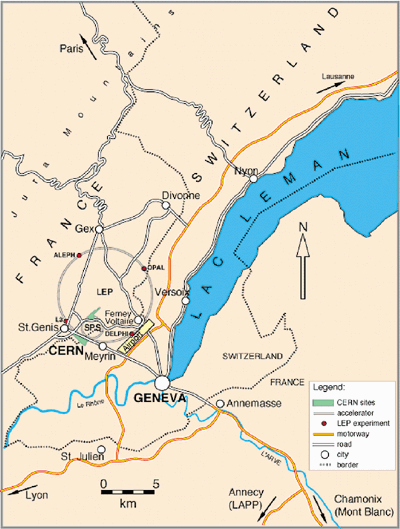
Subsequent construction work for the underground 27 km LEP electronpositron collider and the LHC collider enlarged the footprint of CERN both in France and in Switzerland.
With staff levels currently just less than 3000, with some 1000 industrial support staff and about 7000 migratory researchers all over the world who visit periodically, CERN makes a big impact on the local region, simply for day-to-day needs like housing, schooling, shopping, transport and leisure.
In addition is the industrial impact supplying the equipment and services that make CERN work. These contracts are now subject to strict rules that aim for a balanced return for all of CERN’s 19 member states,
and local concerns not to enjoy any particular advantage for purchasing requests and calls for tenders.
Impact on Geneva
During the first 15 years of CERN’s existence, Geneva and Switzerland were the laboratory’s front door. Geneva is a major city with its own commerce, banking, industry and university. The home of the international Red Cross since 1863, its importance increased after the First World War with the establishment of the headquarters of the League of Nations, which in 1946 became the European headquarters of the United Nations (UN) and led to the implantation of several major UN agencies in Geneva.
Throughout its history, Geneva has been a natural crossroads, and this is underlined today by a major airport with excellent links to all major European cities. While many airports are now constructed far from the towns they serve, every visitor to CERN is aware that the airport is only a few kilometres away.
In the 1960s, major international electronics and telecommunications specialists set up regional offices in Geneva. Although this was not directly because of CERN, the laboratory soon benefited. In the 1970s, Geneva established the ZIMEYSA (Zone industrielle Meyrin-Satigny) industrial park on CERN’s doorstep. Meyrin, the airport and the availability of land were the main factors behind this move, but the impressive vista of CERN across the valley undoubtedly helped to attract tenants.
The direct impact of CERN on Geneva is difficult to measure, but the spin-off benefits are huge, and the city is undoubtedly proud of its prestigious resident. On arrival in Geneva by road or by air, signs underline CERN’s presence.

CERN’s extension into France was in the pays de Gex. Cut off from the rest of France by the river Rhône and the Jura mountains, this area has always naturally looked towards Geneva, even though from 1815 Geneva became part of another country. The pays de Gex (département de l’Ain) remained largely rural until relatively recently, when the arrival of first the SPS and then LEP provided a new focus.
Building on these developments, the local authorities set up a new technology park, this time at CERN’s back door. Although a number of firms that had received CERN contracts came in, the authorities were conscious that CERN’s balanced return policy meant that these suppliers would not automatically benefit from increased business. Proximity to Geneva and its communications were the greater attraction.
Today some 60 companies employing some 1000 people work in this park. Only half of these have any relationship with CERN.
Neighbouring France – south of the Rhône
Looking at the map, the Geneva administrative area (canton) appears almost totally surrounded by France, joined to the rest of Switzerland by a neck of territory only a few kilometres wide. To the north of the Rhône, nearer CERN, the neighbouring French territory belongs to the pays de Gex. To the south, away from CERN, is the département of Haute Savoie. While the pays de Gex remained rural, Haute Savoie had a significant industrial tradition, with major towns and prestigious universities nearby at Chambery, Grenoble and Lyon.
An early development as a result of CERN was LAPP, the particle physics laboratory at Annecy, the administrative capital of Haute Savoie, which was set up to exploit both the proximity of CERN and the significant industrial and academic potential of the region. Annecy became home to university departments of the neighbouring département of Savoie.
Rising costs and a shortage of office space in Geneva led in the 1980s to the establishment of the Archamps Business Park in France, immediately south of the city, but from the start a university-level educational dimension and high technology were major features. However, on the other side of Geneva to CERN, the recent opening of a major Geneva ring road linking Haute Savoie with Geneva’s international airport has been a major improvement.
CERN regularly participates in several Archamps educational programmes. Although the impact of Archamps in Haute Savoie is hard to quantify, its concentration of computer expertise led to local secondary schools being prominent among the first to establish Internet use in France.