Science brings nations together, and synchrotron radiation facilities bring different kinds of science together. Thus SESAME (Synchrotron Light for Experimental Science and Applications in the Middle East) could help to strengthen valuable new ties and develop new ones.
In the aftermath of the Second World War, CERN was created under the auspices of UNESCO with two objectives: to promote science and to foster international co-operation. Both aims have been achieved spectacularly and CERN is not only considered to be a great European success, but also recognized worldwide as a leading international focus with enormous benefits for knowledge and technology transfer, providing a hub where scientists from different nations, races and creeds can work together peacefully.
This dream is now being renewed, this time in the Middle East, and again within the UNESCO framework. Important progress was made during a meeting of the SESAME Interim Council in December. There is now a good chance that the project will fly, with the participation of Armenia, Cyprus, Egypt, Greece, Iran, Israel, Jordan, Morocco, Oman, the Palestinian Authority and Turkey – a list that, hopefully, is not yet complete. In addition, some countries participate as active observers: Germany, Japan, the US, Sweden, Italy, Russia and Switzerland.
BESSY 1 resurrected
This newest offspring of CERN goes back to an initiative of Sergio Fubini, who, enjoying the confidence of both the Israelis and the Arabs, started a Middle East Scientific Cooperation with the original aim of organizing seminars and workshops. During a meeting in Turin in autumn 1997, Herman Winick from SLAC and Gustav-Adolf Voss from DESY suggested that BESSY I, a Berlin synchrotron radiation machine scheduled to be closed down in 1999, could be upgraded as the core facility for a new laboratory in the Middle East. Remembering the origin and aims of CERN, I suggested bringing this project under the valuable political umbrella of UNESCO.
However, experience in elementary particle physics has shown that only viable projects with a sound scientific basis are worth pursuing as international ventures. Thus last spring a meeting was organized by Tord Ekelöf at Uppsala to discuss a possible scientific and technical programme and to ascertain whether there is sufficient interest in the region.
The outcome was very positive and the SESAME plan was brought to the attention of the director-general of UNESCO (at that time Federico Mayor), who expressed enthusiastic support and agreed to invite all governments in the Middle East and in the Mediterranean region to a meeting at UNESCO headquarters in June 1999. The delegations unanimously adopted a resolution to launch the project. An Interim Council (chairman Herwig Schopper) was created, advised by a Technical Committee (co-chairs G A Voss of Germany and C Papanicolas of Greece), a Scientific Committee (co-chairs H Winick of SLAC and E Alp of Turkey/US), a Training Committee (co-chair M Virasoro of Argentina/Italy and R Mansouri of Iran) and a Finance Committee (co-chairs S Assaf of the Palestinian Authority and M Comsan of Egypt). The similarity of this structure to that of CERN is not accidental.
A detailed proposal has been tabled for upgrading BESSY I to a facility that is fully competitive with other machines. Some 10 beamlines are foreseen, with two superconducting wigglers, serving research that ranges from physics, material science, molecular biology, environmental, archaeological and medical studies through to the industrial production of micromechanical parts.
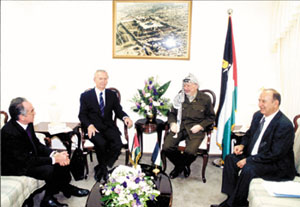
To explore and promote the project, assistant UNESCO director-general Maurizio Iaccarino and I recently visited Egypt, Israel, Jordan and the Palestinian Authority. The great interest that SESAME evokes in the region is not confined to scientists – we were received not only by several ministers but also by King Abdullah II of Jordan and President Arafat.
As with CERN, the next major problem to be solved is the selection of a site. All partners were asked to make site proposals. Some technical conditions had to be fulfilled, but, above all, free access to the laboratory for scientists from all over the world must be guaranteed. Proposals were received from Armenia, Egypt, Iran, Jordan, Oman, the Palestinian Authority and Turkey. Each proposal contained several possible sites.
Finding funding

A meeting of the Interim Council on 13 and 14 December agreed that political and financial criteria must be taken into account for a final site decision. A special committee chaired by the chairman of the Interim Council will meet this spring to prepare a proposal. In the meantime, discussions with and between governments will explore the possibility that one site might find support from several partners. The final decision should be taken before next summer.
The council meeting had to face a major problem. The German government had agreed to provide BESSY I as a gift – a decision that was much appreciated. However, at the same time, the funds for dismantling, packing and transport had to come from other sources and had to be found before the end of 1999, otherwise the components of BESSY I would be offered to other interested parties. To solve this problem, I asked each of the 11 SESAME partners to provide immediately US$20 000. This was agreed, with additional contributions coming from the US, Sweden and possibly Russia.
To complete the arrangements, I then had to beseech new UNESCO director-general, Koichiro Matsuura, who had been in office for only a few weeks, to underwrite an additional US$400 000.
With this initial funding in place, the dismantling of BESSY I can start. Experts from Armenia, Novosibirsk and from the region who will later install and operate the machine will be involved.
During all of the discussions, a remarkable and very pragmatic spirit of friendly co-operation prevailed, promising well for the future of the project. However, many problems remain, most notable of which is the funds for the creation of the laboratory and its operation.The installation and upgrading of the synchrotron are estimated at about US$20 million. Installing and equipping 10 beamlines within five years, together with putting in place the necessary infrastructure, will require a similar amount. Annual operating costs are estimated at US$3.5 million.
These hurdles will surely soon be overcome, and at the dawn of the century SESAME seems to be well on its way to becoming a “door opener” for a new wave of international co-operation, establishing a centre of excellence in a key region of the world.