Comsol -leaderboard other pages

Topics

Journeys Beyond the Standard Model

by Pierre Ramond, Perseus, 0738201162.

61Zw2gNj74L

Judging by this book, Pierre Ramond must be somebody who spends more time packing his suitcases than travelling. He must therefore be a very well prepared and careful traveller. Two-thirds of Journeys Beyond the Standard Model is devoted to the Standard Model of fundamental particle interactions. However, those first seven chapters contain much more than an introduction. The Standard Model is presented using a modern point of view – the one usually taken by researchers working to extend the theory to a more fundamental level.

The lessons of the first part of the book are of paramount importance in the construction of theories beyond the Standard Model. For instance, emphasis is given to an effective-theory approach, in which higher-dimensional operators are understood as the low -energy manifestation of a fundamental theory emerging at very short distances. The discussion of the approximate symmetries of the fermionic sector (baryon, lepton and flavour symmetries) and Higgs sector (custodial symmetry) not only provides a deeper understanding of the Standard Model structure but clarifies the basic problems encountered in its extensions.

The book requires a previous knowledge of field theory. Nevertheless, the first chapter contains a brief recollection of important results of the spinorial representations of the Lorentz group, of gauge fields with and without spontaneous symmetry breaking, and of group theory. The discussion of group theory, although short, is very lucid and instructive for particle physicists interested in theories beyond the Standard Model. It is written in “Dynkinese”, the group-theoretical language based on Dynkin diagrams. In the Standard Model the group structure is rather simple and the group-theoretical language is a matter of taste. However, research in Grand Unified theories uses Dynkinese, because keeping track of tensorial indices in large group representations is often totally impracticable.

After some history of the Standard Model, its Lagrangian is presented in its full glory. We learn about its astonishing simplicity in terms of principles and its impressive experimental confirmation. One emerges with the conviction that the Standard Model is one of the greatest intellectual achievements of mankind. The discussion in Ramond’s book is clear and complete – one of the best ever published. The studyof the electroweak vacuum is presented with a careful treatment of gauge fixing in theories with spontaneously broken and unbroken gauge symmetry. The book also contains many detailed examples of calculations of Standard Model processes (tree-level decays, loop corrections to electroweak observables and strangeness-changing kaon processes).

A full chapter is devoted to the chiral Lagrangian and its applications at a depth that is unusual for introductory books on the Standard Model. The author is thus able to introduce many concepts (construction of effective theories for strong interactions, non trivial vacuum structure of gauge theories and anomalous global symmetries) frequently used in attempts to formulate theories beyond the Standard Model. Many applications of these concepts are found in the chapter on axions towards the end of the book.

While the presentation of the Standard Model in Ramond’s book is systematic and of extremely high quality, the discussion of theories beyond the Standard Model is more episodic. Indeed, as suggested by the title of the book, Ramond is offering some journeys into the vast territory of new physics; he makes no claim to discuss the complete subject thoroughly.

The first journey describes possible theoretical explanations for neutrino masses, and the experimental evidence for neutrino oscillations in solar and atmospheric neutrino experiments. In the second journey theauthor investigates axion properties and  derives their effective interactions with matter and radiation. The third journey presents the minimal supersymmetric extension of the Standard Model.

All three chapters are successful introductions to their respective subjects. More advanced readers may remain dissatisfied with the space allotted to these topics – especially for supersymmetry, a subject by now too vast to be covered in any depth by a single chapter of a book.

Anybody who wants to start a journey beyond the physics of the Standard Model will find this book a wonderful travelling companion. It provides a clear and insightful description of the structure of the Standard Model and gives the necessary tools to approach the frontier research in the domain of new physics.

Ramond’s book is also very timely, because research in particle physics is now moving from the period of consolidation and confirmation of the Standard Model to a period in which both theoretical speculations and experimental activity will focus on understanding deep questions that lie beyond the Standard Model’s predictability, such as the mechanism of electroweak breaking, the origin of masses and the unification of forces.

Imaginative physicists have produced many possible “ultimate” theories to extend the Standard Model. What are now needed are data to test these hypotheses and guide the speculations. There will be much to gain by the unprecedented investigation of nature at distances of less than 10-19m. Considerable understanding of the fundamental principles of physical laws can be revealed by undertaking the journeys described in Pierre Ramond’s book, provided that the traveller invests in the Standard Model groundwork excellently surveyed in the book’s initial chapters.

Supersymmetry – Unveiling the Ultimate Laws of Nature

by Gordon Kane, Helix/Perseus, 0 7382 0203 7, 224 pages, hbk $26.

cernbooks2_6-00

Gordon Kane’s opus offers the general reader an introduction to supersymmetry. In a brief foreword, Ed Witten describes the search for supersymmetry as “one of the great dramas in present-day physics”, and Kane invites the reader to join him in a “leisurely walk” towards a grasp of this theory.

The author is certainly a well qualified guide. The book contains no technical passages inaccessible to the ordinary reader and there are few equations. A number of more arcane concepts relegated to short appendices will be of benefit to the physicist. The ascent is gradual, with many pauses for breath to enjoy the view, and in the final chapters the reader can be assured of acclimatization to the rarefied atmosphere of superstring theory, M-theory and what Kane terms “primary” theory.

From the outset the author distinguishes between well established areas of knowledge, such as the Standard Model, and what he refers to as speculative Research in Progress, as in the case of supersymmetry (SUSY). Similarly, he divides the answers provided by theories into “how” things happen and, on a higher level, “why” they happen.

The foundation of the Standard Model is clearly presented – the forces, the particles and the fields, as well as their governing theoretical principles. The reader is initiated into a straightforward use of Feynman diagrams to understand the processes that occur. The role of spin is underlined, as well as the difference between fermions and bosons, which supersymmetry will by definition associate as “mirrors” of each other. The “how” of the Higgs mechanism in the Standard Model is covered, with details consigned to an appendix.

Kane makes full use of the notion of organizing effective theories by distance scales. A theory valid up to a certain scale is improved, at smaller distances, by its successor, answering the “why” where its predecessor merely addressed the “how”.

An effective theory needs a number of parameters (masses, coupling intensities, etc) that it cannot predict. This will be as true for supersymmetry as it is for the Standard Model, despite the progress that it will bring. Beyond these levels would be a theory not requiring such external props, which Kane calls the “primary theory”. Could this already be in our sights withM-theory? If not, how  many more stages are there?

Kane provides a straightforward and pertinent description of supersymmetry, underlining the importance of the new answers that it will bring. Supersymmetry explains the “why” of the Higgs mechanism, predicting that the top quark must be heavy, which has already been verified experimentally.

Supersymmetry explains why the mass scales between that of observed particles and the distant Planck scale are stable, a serious stumbling block for the Standard Model. It offers possible unification of the various forces observed at very high energy. It also proposes an ideal candidate to explain the “hidden mass” of the universe. It isclearly a broken symmetry because the anticipated  partners of known particles have yet to be observed. One of the main goals of existing accelerators (such as LEP and the Tevatron), and subsequently of the LHC, is to flush out these hidden supersymmetric partner particles.

Naturally the author looks at the most predictive aspect of SUSY phenomenology. Although our understanding of the mass of superparticles is still hazy, current theory in its minimal version predicts at least one Higgs boson, and very light, according to Kane lighter than one-and-a-half times the mass of the Z.

The search for the Higgs boson is naturally the main objective of current experiments. If the theory is right, Kane predicts that the first SUSY signals should be found soon, with a bit of luck even at LEP and probably at Fermilab’s Tevatron.

Finally, Kane unflinchingly tackles the most fundamental questions in an overview of current attempts to formulate a primary theory – superstrings and their synthesis in M-theory. Having attained this vantage point, the reader will discover that the evident beauties of the landscape are overshadowed by further mountain ranges whose peaks are still wreathed in clouds.

Kane also speculates on the future of particle physics and cosmology. Convinced that epistemological scepticism regarding the practical limits of knowledge is not founded on solid arguments, and that the funding for such research should be recognized as a good investment, he hopes that we will achieve a true understanding of the physical universe. He shows that the progress of theories, by increasingly correlating parameters previously considered as independent, will enable us to see the world as less and less accidental and improbable, and will gradually eliminate the temptation to have recourse to anthropic principles.

Particle physics and cosmology research could then be wound up, not because we will have failed to attain the primary theory, but because we will have succeeded in constructing it. One may not share the author’s faith, but his optimism is reassuring.

Kane hopes that the book will remain useful even after the discovery of supersymmetry. Whether and whenever that discovery is made, this instructive, cogent and well written text can in any case be highly recommended.

Jordan is first choice for SESAME synchrotron site

In a meeting at CERN on 10-11 April, a restricted interim council of the SESAME (Synchrotron Radiation Light for Experimental Science and Applications in the Middle East) project, after extensive discussions on the technical, political and financial considerations and by a series of votes, selected Jordan as its first choice by a large majority and Armenia as its second choice.

Proposals were received from seven members, namely Armenia, Egypt, Iran, Jordan, Oman, the Palestinian Authority and Turkey. Egypt and Iran withdrew their proposals before the final round of voting.

In recommending Jordan as the preferred host nation, it was understood that collaboration will take place with other members, in particular with the Palestinian Authority, to assist the recommended host nation in fulfilling its commitments. The recommendation of the restricted interim council is now forwarded to the interim council for final ratification. The SESAME interim council operates under the auspices of UNESCO.

The BESSY I synchrotron facility at Berlin was decommissioned in 1999 and the German government was prepared to make it available for another project. The decision to upgrade and relocate this facility to a Middle East nation to promote peace through science gave birth to the SESAME Project.

The interim council sought proposals from Middle East nations interested in housing the SESAME project. A restricted meeting of the interim council, with one representative from each of the 11 members, was charged with the task of evaluating the merits of each proposal and making a final recommendation to the full interim council.

The meeting at CERN was chaired by former CERN director-general Herwig Schopper and was attended by delegates from Armenia, Cyprus, Egypt, Greece, Iran, Israel, Jordan, Oman, the Palestinian Authority and Turkey; by the co-chairmen of the technical committee, the UNESCO secretary of the interim council and the director of the UNESCO regional office in Cairo.

Cosmology: the Science of the Universe 

by Edward Harrison, Cambridge University Press, ISBN 0 521 66148 X (£32.50/$54.95).

51ZU7+5Vr9L._SX328_BO1,204,203,200_

A great deal has happened to our understanding of the universe in the almost 20 years since the first edition of “Cosmology” became a bestseller. Now Prof. Harrison has produced this updated and extended second edition. It has many new sections and revisions and it is wonderfully informative and authoritative on an amazingly wide range of topics.

My own particular favourites are his treatment of Special Relativity – just the way particle physicists like it – and his explanation of Olbers’ paradox – the clearest I’ve ever seen. The entire book is quirky and entertaining, peppered with historical facts, extremely perceptive questions, and provocative and challenging issues for discussion. All of this comes with essentially no mathematics in a very satisfactory and readable introductory overview of modern cosmology.

Lucifer’s Legacy: the Meaning of Asymmetry 

by Frank Close, Oxford University Press, ISBN 0 19 850380 6.

513A5GG4A3L._SX317_BO1,204,203,200_

Communicating science is difficult. In contrast with other fields, it needs long experience before being able to contribute. While creativity in science or the arts is often left to younger people with open minds, when it comes to explaining new developments to  a wide audience, the science communicator first has to master the science itself, its teaching and its popular dissemination.

Frank Close, who has already provided several popular science standards, has all it requires. Here he takes us on a tour of modern science, following a theme, the study of which started early in 19th century: the fascination and appeal of the underlying symmetry of nature, and its attendant asymmetry.

The tour begins and ends in Paris, in a French garden where almost perfect symmetry appears slightly broken, that day, by a damaged statue of Lucifer. With this metaphor of our entire world, accidentally asymmetric but governed by apparently symmetric laws, Close embarks on a journey through the history of the quest to understand where the asymmetry of the universe comes from.

This governs even our own existence: matter overcoming antimatter was a necessary step for there to be anything at all. Moreover, life on Earth, seen through the basic structure of organic molecules, is asymmetric. The mystery of life cannot be understood by physics alone, yet asymmetry is a property of life itself, and this thread continues throughout the book.

First the author reviews symmetry at large, with examples taken from everyday life, featuring common notions and clichés. One of the enigmas dealt with is my own favourite, Martin Gardner’s puzzle: why does a mirror invert left and right, but not top and bottom? Here the author adds much of his own insight and wit (“the muscles which close a mouth are stronger than those which open it – as is well known to all who have sat in committees”). The result is a fascinating panorama, down to the molecular level, of the asymmetries around us, which have first to be discovered before being explained.

The remainder of the book covers the history of the tools needed to explore matter and to reveal its hidden asymmetries. Following the pioneer work of Biot (polarization of light) and Pasteur (study of racemic acid), the end of the 19th century brought major discoveries by scientists investigating the true nature of electricity, continuing the route taken by Faraday and Maxwell.

First came the discovery of X-rays by Roentgen, a key tool for decoding DNA structure half a century later. Immediately after X rays came the discovery of the electron by Thomson, and then of radioactivity (Becquerel and the Curies) and the nucleus (Rutherford). The major cornerstones of modern physics were revealed during those few “magic” years, and they are narrated by Close in a way that reveals the hesitations and inspirations of the actors, the banal errors of those who “could have found” (Lenard, Crookes) but were not quite ready, and the genius of those who made sure that they were in the right place at the right time with the right ideas. What better plea could there be for fundamental research?

All of this leads to modern physics, exploiting the concept of symmetry in a profound way, revealing hitherto unsuspected laws through delicate symmetry breaking. We are introduced to unification schemes based on symmetries broken at our energy scale, but revealed in high-energy experiments. Close explains this in detail and with amusing anecdotes, and how it guided physicists during their major discoveries of the secrets of the matter, right up to the next foreseen step – the quest to find the Higgs boson.

The instrumentation and apparatus required for this quest are impressive. The incredible effort of a worldwide community at CERN for the LHC and its giant experiments help the reader to become familiar with this ultimate search for the origin of mass.

On the way, the chapter on antimatter deserves admiration: antimatter is one of the most difficult notions scientists have to explain. I remember a colleague beginning a public talk by unapologetically defining antimatter as “the negative energy solution to Dirac’s equations”. What is exact is not always clear, and Frank Close takes the time to introduce antimatter, to draw its human side through Dirac’s character and by noting the time it took, from Dirac’s work in 1928 to Anderson’s discovery of the positron in 1932.

The violation of “mirror” P symmetry by the weak force, how this was discovered, the violation of CP symmetry and recent evidence for the violation of time symmetry are all clearly explained, illustrated by analogies with Escher prints to help the mind see patterns in abstract spaces.

We then understand that the universe, once fully symmetric, exhibited asymmetries when freezing, which enabled life to be. Life, intrinsically related to asymmetries, is the theme of this book, and Close revisits what has already been written on this theme, offering us an absorbing and scientifically correct account of symmetry and its deep implications.

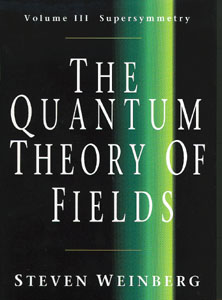
The Quantum Theory of Fields III: Supersymmetry

by Steven Weinberg, Cambridge University Press, ISBN 0 521 66000 9 (hbk £32.50/$49.95).

cernbooks1_5-00

The third volume in Steven Weinberg’s very successful collection on “The Quantum Theory of Fields” covers the topical area of supersymmetry and appears three years after the celebrated opening ones on “Foundations”(1995) and “Modern applications (1996). If these two volumes were considered masterpieces in a modern and original presentation of the basics of quantum field theory and its penetration in the recent development of particle physics, with the machinery of spontaneously broken gauge theories, the new volume embraces the wide subject of supersymmetry in Weinberg’s typical style, which always means a self contained treatment of the subject, from its foundations and motivations, to its most recent application as a possible scenario for new physics beyond the Standard Model (SM).

Weinberg’s main motivation for “Supersymmetry”as a quest for a unified theory relies on the possible solution of the so-called hierarchy problem, that is, the explanation of the “mystery” of the enormous ratio between the electroweak scale (around 300 GeV) and the Planck scale (1019GeV). It is worth noticing that such a fine-tuning problem, which calls for new physics at the TeV scale and is one of the main reasons for future searches at the LHC under construction at CERN, was raised by Weinberg himself in a famous paper with Eldad Gildener (1976 Phys. Rev.D13, 3333), and by two more of the main contributors to the modern theory of electroweak and strong interactions, Martinus Veltman (1981 Acta Phys. Polon.B12 437) and Luciano Maiani (1979 Proc. Summer School of Gif-sur-YvetteIN2P3 1).

Supersymmetry is the only known example of the enlargement of the space-time symmetry of physical laws (the so-called Poincaré symmetry based on Einstein’s special relativity), which is consistent with all axioms of relativistic quantum field theory. In so doing it unites particles of different spin, thus predicting a variety of new species when applied to the SM of the electroweak and strong interactions.

Weinberg’s exposition (in chapters 24-32) starts with a synthetic but complete presentation of the mathematical foundations of supersymmetry, called “graded Lie algebras”, which is a generalization of the concept, more familiar to physicists, of Lie algebras and continuous Lie groups (chapter 25).

As a preliminary to the above, he recalls in chapter 24, with an original presentation, the “no-go” theorems, which are the basis of the (failed) attempts, prior to supersymmetry, to unite space-time with internal symmetries (such as isospin or SU(3) eightfold way symmetries). He then undertakes, in chapter 26, supersymmetric field theories, using superfields, that is fields living in superspace, an abstract space that unifies space-time points with anticommuting coordinates, able to encompass multiplets of particles with different statistics and spin. In chapter 27, he develops the subject of supersymmetric gauge theories, which realize the remarkable marriage between the principle of local Yang-Mills symmetry with supersymmetry.

The way in which Weinberg exposes the subject, with all of its subtleties and technical details, is spectacular. He covers non renormalization theorems, supersymmetry breaking and extended supersymmetry with an original, clear and self-contained presentation. He then develops, in chapter 28, supersymmetric versions of the SM, covering most of the problems at the core of today’s search forsupersymmetry in particle physics, namely the scale of supersymmetry breaking, the minimal supersymmetric SM, possible baryon- and lepton-number violation and gauge-mediated supersymmetry breaking.

In the last four chapters, Weinberg develops more theoretical aspects of supersymmetric field theories, which are, however, tremendously important to the theoretical motivation of supersymmetry and its role in the formulation of quantum theories of gravity.

General aspects of supersymmetry beyond perturbation theory are touched on in chapter 29, with the modern developments of electric-magnetic duality. The latter allows us to give “exact results” for the low-energy action of certain supersymmetric field theories that exhibit a Coulomb phase for the Higgs field (the Seiberg-Witten solutions).

The following chapters are devoted to Feynman rules for supersymmetric field theories (chapter 30), an elegant presentation of supergravity theory (chapter 31) and its essential aspects, from the weak-field limit to local supersymmetry to all orders and the basic role of the gauge field predicted by supergravity, the spin-3/2 gravitino, in gravity-mediated supersymmetry-breaking scenarios.

The final chapter is devoted to supersymmetry in high space-time dimensions and the merging role of extended objects, called p- branes, in the description of modern gauge theories as coming from more general schemes such as higher-dimensional supergravities, M-theory and string theory.

The book also contains, at the end of each chapter, “problems” for the reader to exercise in the subject, even giving alternative proofs of derived results. In this respect the book, like the two preceding volumes, is well suited to graduate students in physics and applied mathematics as well as researchers who want to get acquainted with the fascinating subject of supersymmetry.

The author has achieved in a superb way the important task of producing a volume on supersymmetry, building a bridge between a formal development and its most important applications in particle physics, through a self-contained and very original sequence of subjects and topics.

To conclude this review, let us recall some indirect experimental signals, alluded to also in different parts of Weinberg’s book, indicating that supersymmetry is a plausible scenario for new physics beyond the SM:

* the non-observation of proton decay via a neutral pion and a positron, excluding a minimal Grand Unified Theory (GUT);
* the LEP precision measurements, incompatible with gauge-coupling unification for conventional minimal GUTs, but in reasonable agreement with minimal supersymmetric GUTs, with supersymmetry broken at the TeV scale;
* the large top Yukawa coupling, unusually large compared with all other quark and lepton couplings;
* the possible solution of the dark-matter problem with some of the natural supersymmetric particles (the neutralinos) as natural dark-matter candidates (WIMPs).

Although none of these facts is per se a compelling reason for supersymmetry and alternative explanations may be found, it is fair to say that they can all be interpreted in the context of a supersymmetric extension of the SM. Whatever the final theory for quantum gravity may be, supersymmetry remains a deep and non-trivial extension of our concept of space-time symmetries.

Brookhaven and China to join forces in research

cernnews4_5-00

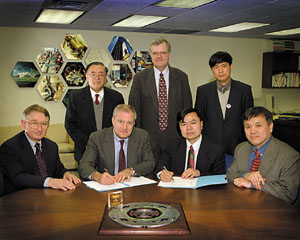
Representatives of the National Natural Science Foundation of China (NNSFC) visited Brookhaven on 23-25 February to learn more about the scientific programme of Brookhaven’s new RHIC heavy ion collider and to explore opportunities for increased collaboration. A possible upgrade to the STAR experiment, to extend its particle identification capability, was a major focus of the discussion. The delegation also visited the Lawrence Berkeley National Laboratory, and a joint symposium to discuss practical aspects of the STAR upgrade is planned for Beijing this fall. The visit culminated in the signing of an agreement to cultivate future interest and collaboration on the RHIC scientific programme between institutions supported by the NNSFC and Brookhaven.

Swedish accelerators take a look at the past

cernuppsala1_5-00

The first cyclotron in Sweden was a small 80 cm device built in 1938 at the Nobel Institute in Stockholm and capable of accelerating deuterons to 7 MeV. After the Second World War, an ambitious new machine at Uppsala took energies into a new domain.

The 50th anniversary of accelerator-based research at Uppsala, on 8 December 1999, merited a jubilee symposium. Gunnar Tibell, Sven Kullander and Arne Johansson looked back, while Bo Höistad, Göran Possnert, Nils Olsson, Jörgen Carlsson and Curt Ekström surveyed the present scene and looked to the future.

The first two copies of a new book (in Swedish), relating half a century of accelerator-based activities in Uppsala and edited by Torsten Lindqvist, was handed to the vice-chancellor of the university, Bo Sundqvist, and to Helge Tyrén, former professor of high-energy physics.

In the early 1940s, Tyrén, a student of 1926 Nobel Chemistry Laureate Theodor Svedberg, had constructed a neutron generator for the production of radionuclides. In Svedberg’s discussions with the main customer of these radionuclides, gynaecology professor John Naeslund, plans emerged for a more powerful accelerator – a cyclotron – to increase the quantities of radioactive substances.

Naeslund’s wife knew Göteborg textile magnate Gustaf Werner, who was the richest person in Sweden at that time and known for his generosity. The firm Werner & Carlström offered to finance a cyclotron, and one of its research objectives was to see how synthetic fibres were affected by neutron irradiation.

From cyclotron to synchrocyclotron

In 1945 Tyrén visited cyclotron laboratories in the US. The original intention was to obtain drawings of a cyclotron with an energy of about 20 MeV for radioisotope production. However, during the visit he found that a new principle of accelerating particles to much higher energies had just been invented by E McMillan.

This principle of phase stability was tested and shown to work during the spring of 1946, while Tyrén was in Berkeley. The question was whether it was too early to implement this new idea in Uppsala. Tyrén managed to convince Svedberg that, instead of a cyclotron, a synchrocyclotron should be built, and Werner & Carlstroem had no objections. The instrument’s energy of 200 MeV was above the threshold energy for the production of the newly discovered pi meson. Protons of this energy also have a sufficiently short wavelength to interact with individual nucleons in the nucleus, and the range in tissue is 25 cm, which is important for proton therapy.

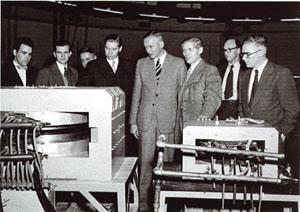
On 8 December 1949, Crown Prince Gustaf Adolf inaugurated the Gustaf Werner Institute for Nuclear Chemistry (GWI). Exactly two years later, on 9 December 1951, Ernest O Lawrence, the inventor of the cyclotron, pressed the button to initiate the first beam circulating in the new synchrocyclotron.

For a few years, scientists in Uppsala could access protons of the highest energy in Western Europe. Several foreign physicists visited to familiarize themselves with these high-energy projectiles.

Meanwhile, CERN was founded and construction began for its first two accelerators: the synchrocyclotron (SC) and the proton synchrotron (PS). A large percentage of the Uppsala staff were recruited to take part in the build up of CERN’s new European laboratory. The Uppsala group, under Bengt Hedin, was responsible for the construction of the SC magnet.

cernuppsala2_5-00

A spectrum of research

A milestone in the development of the GWI was the extraction of the proton beam in 1955, giving more flexibility to the arrangement of nuclear physics experiments. Nuclear spectroscopy was always an important part of the research, both off line and on line. Among the intermediate-energy physics experiments were the first studies of quasi-free proton-proton reactions, and later studies of pion production on atomic nuclei – so-called sub threshold reactions.

cernuppsala3_5-00

Biomedical research began under the leadership of Börje Larsson, who was later to become professor of radiobiology. He was one of the pioneers in the history of radiosurgery, as well as in other therapeutic and diagnostic uses of the proton beam at the GWI. On 23 November 1957, in a pioneer proton irradiation of a malignant human cancer, he and physician Stig Stensson irradiated a woman suffering from a large malignant tumour of the uterus. In 1958 Boerje Larsson also participated, together with medical doctors Lars Leksell and Bror Rexed, in the first neurosurgery on patients.

For well over two decades, a large number of physics and biomedical research projects were carried out at the Uppsala machine. In 1977 it was closed for a major overhaul and also modification into a sector-focusing synchrocyclotron. It was reopened in 1986, with much improved performance. The energy can be varied in the 20-190 MeV range for protons, and a variety of different ions can be accelerated.

From ICE to CELSIUS

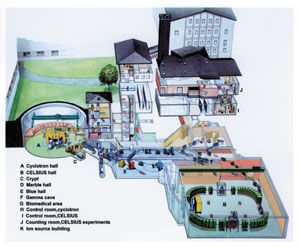
As well as providing beams for physics and biomedical research, the cyclotron is an injector for the cooler storage ring CELSIUS (Cooling with Electrons and Storing of Ions from the Uppsala Synchro-cyclotron). The CELSIUS proton energy can be raised to well over 1 GeV, making a new field of research available to the physicists.

CELSIUS uses the lattice magnets of the Initial Cooling Experiment (ICE), which was built at CERN in the late 1970s. The decision to send the equipment to Sweden was taken by CERN Council in December 1982, and additional funding for the ring was included in the 1983/4 budget of the Swedish Ministry of Education.

Ongoing work to improve the machine and extend laboratory space was accelerated so that the “new” ring could be accommodated. In the summer of 1983, 20 trucks transported the 40 magnets and 4 coils from Geneva to Uppsala. The experience acquired in building the ICE ring was of value to the CELSIUS project, and in particular the contributions by CERN’s Heiner Herr and Alfredo Susini should be mentioned. The first CELSIUS proton beam circulated in 1988.

The GWI ceased to exist in 1986, when it, together with the Tandem Accelerator Laboratory, formed a new national laboratory – the The Svedberg Laboratory (“The” is an abbreviation of Theodor), and a new university department, the Department of Radiation Sciences, with units in high-energy physics, nuclear physics, ion physics and physical biology.

Today around 300 physicists and medical researchers, from Sweden and abroad, use the two The Svedberg Laboratory accelerators. The Programme Advisory Committee can only accept a fraction of the proposed experiments. Notable experiments are those performed by two large collaborations – WASA and CHICSi, both at CELSIUS, and operating with light and heavy ions, respectively. The storage ring has two internal target stations – one for a gas jet target and one for pellets of frozen hydrogen or deuterium. Among the SC projects, international teams are using a neutron beam for both fundamental and applied research.

CERN contributions

Scientists from the GWI, and since 1986 from the Department of Radiation Sciences, have been very active in research at CERN. At the end of the 1960s, accelerator physicists contributed to the improvement of the SC, where experiments were initiated by an Uppsala group in 1967. Later SC experiments were carried out on pi mesic atoms and muon-induced fission.

At CERN’s LEAR antiproton ring, the production of heavy hypernuclei and lambda-antilambda pairs were studied. Pion-helium and proton-helium interactions were studied at the PS between 1967 and 1976. In 1977 the Uppsala group took part in one of the first experiments at the SPS proton synchrotron: hadron-hydrogen elastic scattering in the Coulomb interference region.

Since 1980 the group has collaborated in studies using CERN’s high-energy muon beam for the determination of polarized and unpolarized structure functions from nucleons and nuclei. A significant contribution to the build-up of the RICH detectors for the Delphi experiment at LEP has been made, as well as the running and analysis of Delphi. For the future LHC collider, the Uppsala group contributes to the semiconductor tracker for the ATLAS collaboration.

Dynamics of Heavy Electrons

by Y Kuramoto and Y Kitaoka, Oxford University Press, ISBN 0 19 851767 X (hbk £75)

31EAfRe96jL._SX313_BO1,204,203,200_

In this context “heavy electrons” means electrons in rare-earth and actinide metals that acquire very large effective masses owing to strong local correlations.

Introductory Statistical Mechanics

by Roger Bowley and Mariana Sanchez, Oxford University Press (2nd edn), ISBN 0 19 8505760 (pbk, £21.99).

51Nv2U3k+pL._SX456_BO1,204,203,200_

This text offers an introduction to the theory of condensed matter and first appeared in 1996. This edition includes three additional chapters on phase transitions and more examples.

bright-rec iop pub iop-science physcis connect