Bluefors – leaderboard other pages

Topics

ATLAS makes a smooth changeover at the top

CCint1_04_09

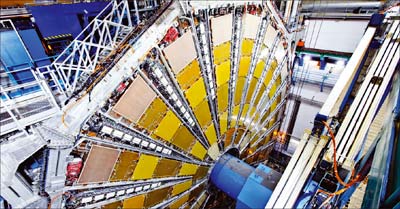
If you think that it might be time to retire after more than 15 years of leading a constantly growing international collaboration and of constructing the world’s largest-volume particle detector, then Peter Jenni would disagree. Nicknamed the “father of ATLAS” by his colleagues, Jenni was there in 1992 when the ATLAS collaboration was born out of two early proto-collaborations. Initially co-spokesperson, he was spokesperson from 1995 until March 2009, when he handed over to Fabiola Gianotti. Now he looks forward to getting back to the main purpose of ATLAS: the physics.

“I am very proud to have helped the collaboration to construct ATLAS. Twenty years ago we could only imagine the experiment in our dreams and now it exists,” says Jenni. “I could lead the collaboration for so long because I was supported by very good ATLAS management teams where the right people, such as Fabiola Gianotti, Steinar Stapnes, Marzio Nessi and Markus Nordberg over the past five years, were in the right places.”

As with most particle-physics experiments, the management of one of the two largest detectors at the LHC is a challenge that changes during the lifetime of the collaboration: it starts with the design phase, continues with the R&D and the construction and ends up with the data-taking and analysis. “Over the years I tried to balance the emphasis given by the collaboration to the different aspects, that is, the hardware part (initially very strong), the data preparation, computing and software,” confirms Jenni.

Originally “only” about 800-strong, the ATLAS collaboration today has almost 3000 members from all over the world. “Keeping the groups united, inviting new groups to join the collaboration, negotiating to find the funds necessary for the construction… these have been among my key tasks during the past 15 years,” he explains. “My efforts also went into keeping groups whose technologies were not retained in the collaboration. Most of the time we managed to have everyone accept the best arguments, but unfortunately there were a few exceptions.”

With such a vast amount of experience, what does Jenni regard as the key element for managing a successful collaboration? “Talking with as many people as possible is a key factor,” he says. “ATLAS members, even the youngest ones, knew that I was available to discuss all problems or issues at any time. With the exception of the Christmas period, I have tried to reply to all e-mails within 24 hours. By the way, that is why my son thinks physics is crazy and decided to study microtechnologies instead!”

While Jenni’s functions have changed, his engagement with ATLAS definitely has not. “A significant part of my work remains the same, particularly in the relationships of ATLAS with the outside world. My main duty is to help obtain a smooth transition, which is facilitated by the fact that Fabiola was one of my two deputies – and I have enjoyed working with her before.” Indeed, having more freedom now, he can think of doing more than just sharing some management duties. “In the medium term I have the ambition to study physics with ATLAS,” he says. “I am already ‘selling’ LHC physics in many public talks but I would like to contribute some real physics myself.”

The ATLAS collaboration is clearly appreciative of its father’s dedication over the years. At the party organized in Jenni’s honour on 19 February, the Collaboration Board (CB) chairs directed by Katie McAlpine – the author and singer of the LHC rap – sang: “We’ve been CB chairs/and we’re here to affirm /Peter’s time was more an era/ than just a few terms/ leading ATLAS to completion/ like no one else can/ Of course he did it/ Jenni is the man.”

The changeover

Now with the construction complete, it’s Gianotti’s turn to fill the spokesperson’s many shoes, after Jenni passed her the leadership baton in March. At the very beginning she joined LHC R&D activities and then the proto-ATLAS collaboration in 1990. “Heading such an ambitious scientific project, and a large and geographically distributed collaboration, is certainly a big honour, responsibility and challenge,” she says. “However, I have inherited a very healthy situation from Peter: the experiment has already shown that it performs well, the collaboration is united and strong, and we can continue to prepare for the first collisions without any major worry.”

Indeed, activity on ATLAS hasn’t stopped since the LHC incident on 19 September 2008. “The first single beams that circulated in the machine before the incident were very useful for studying several aspects of the experiment, such as the timing of the trigger system. After the LHC stopped, we decided to focus on some repairs to the detector and on the optimization of the software and computing infrastructure, of the data distribution chain, and of the event simulation and reconstruction,” confirms Gianotti.

An effective distribution of data to the worldwide community is a key point for the new ATLAS spokesperson because she thinks that this is the prime requisite for a motivated and successful collaboration. “The crucial challenge for me is to make sure that each single member of ATLAS can participate effectively and successfully in the adventure that this experiment represents. ATLAS has a very exciting future ahead, with many possible discoveries that will change the landscape of high-energy physics. I consider it very important that each individual in this experiment can actively participate in the data analysis, regardless of whether he or she can physically be at CERN or not. In particular, we have to make sure the younger generations are nurtured in a stimulating environment, share the excitement for the wonderful physics opportunities and are given visibility and recognition,” she explains.

While the sharing of data relies mostly on the performance of the Grid and the software and computing infrastructure put in place by the collaboration, it cannot occur without the other side of the coin – effective and open communication in real-time with all members of the collaboration. “The solution we have envisaged is a web space where ATLAS people will be able to find updated ‘on-line’ news about the machine, the experiment, the physics results, anything that is relevant to ATLAS’ life,” explains Gianotti.

Asked about the potential “competition” among many people working on the same analysis, she says: “I think it is healthy that people from different groups work on the same topic with a collaborative and constructive spirit. This will allow us to produce solid, verified and fully understood results.” Regarding the relationship with CMS, the other general-purpose LHC experiment, she says, “There is a healthy competition, but also collaboration. For instance, ATLAS and CMS have set up a common group that works on statistics tools and how to combine the information coming from both experiments.”

The excitement about the restart of the LHC is growing again at CERN and around the world, and the experiments all have their own plans and strategies. “Before undertaking the path towards discoveries, we will need to understand the performance of our detector in all details and ‘rediscover’ the Standard Model,” says Gianotti. “I believe that we will be ready to start investigating new territories when we have observed top-quark production. Indeed, final states arising from the production of top quark–antiquark pairs contain most of the interesting physics objects, from leptons to missing energy and light- and heavy-flavour jets. In addition, this process is the main background to many searches for new physics. Being able to reconstruct these events successfully, and perform our first measurements of the top production cross-section and mass, will give us a clear indication that we are ready for discoveries.”

When does Gianotti expect ATLAS to release the first results? “It all depends on the performance of the machine – and its luminosity and energy profile. If everything goes well we expect to have first results, mainly addressing the detector performance, for the winter physics conferences early in 2010; then we hope to present the first interesting physics results at the summer conferences of the same year.”

Franco Bonaudi: wise spirit of the early CERN

CCbon1_03_09

Franco Bonaudi, who died on 21 December 2008, was one of the first electronic engineers to work for CERN. In July 1952, two years before the organization was formally created, he was sent from Rome by Edoardo Amaldi to Liverpool, to learn about synchrocyclotrons. Speaking only some basic English, he arrived in Liverpool with Frank Krienen, assistant to Cornelis Bakker, the newly appointed team leader for the 600 MeV Synchrocyclotron (SC) that was to be CERN’s first accelerator facility. Bonaudi got on so well with his hosts and his new boss that, as well as perfecting his English and learning about accelerators, he acquired valuable training in dealing with industrial firms, as Krienen had earlier worked in the research laboratories of Philips at Hilversum. Krienen and Bonaudi left Liverpool when the CERN staff started to gather close to the Geneva site where the new European laboratory was to be built. Most of the SC team were housed in barracks at Geneva’s airport, but Bonaudi, with Joop Vermeulen, was soon dispatched to a hut on the Meyrin site to oversee the construction of the accelerator. The staff of the infant CERN numbered around 150 at that time and were of many different nationalities and nearly all strangers to the region. Communicating in poor English, they worked together as family and friends – the first CERN telephone directory contained private numbers. Bonaudi said of that period: “We made real friendships”. At the same time, they rapidly completed their professional task and the first beam circulated in the SC on 1 August 1957.

Meanwhile, a much larger undertaking was progressing well, with the construction of the 24 GeV PS. Before the machine saw its own first beam on 24 November 1959, Bonaudi had become leader of the Apparatus Layout Group and so taken his first steps from machine builder towards experimental support, which was to become his greatest strength. Theo Kröwerath, a charismatic figure who progressed from driving a tank to being responsible for CERN’s Transport Group, still remembers the trips to suppliers that he made with Bonaudi at that time and believes that he owes his professional success to those, like Bonaudi, whose approach epitomized the spirit of the early CERN. This ethos was grounded in a tremendous respect for the work of all members of a team, whether they were engineers, physicists, technicians, mechanics or crane drivers, with – an added speciality of CERN – the more nationalities in a group, the better.

CCbon2_03_09

In 1963, with construction of the SLAC 20 GeV linear accelerator just beginning, Bonaudi went to California for a year to help to design the experimental areas. He shared an office with David Coward, who remembers that Bonaudi’s experience proved invaluable. He made significant contributions to designs of radiation shielding, for both personnel and experimental equipment, and to the design of the distribution of utilities throughout the SLAC experimental areas. He also actively participated in the physics meetings that helped to establish the nascent SLAC experimental physics programme. At the same time, Bonaudi made friends for life and helped to initiate a successful series of exchanges of physicists and engineers.

Back at CERN, Bonaudi was asked to design the experimental areas for the Intersecting Storage Rings (ISR), based on the space and facilities indicated by some initial ideas for experiments. Construction began in 1966, with CERN’s Meyrin site extended into France to accommodate the machine. Bonaudi, as head of the ISR General Layout Group, was responsible for building the halls for experiments and the tunnels for the whole machine.

The group included its own civil engineering section and later had sections for both electrical cabling and power distribution. Taking over responsibility for the control and signal cabling – invariably underestimated for physics and machines alike – revealed another insight into Bonaudi’s way of solving problems. When cabling teams fell behind schedule, he would invite all of the members of the group to join him on a cable-pulling weekend. Such was his popularity that it was always a huge success, with everybody knowing that “the boss” would be working harder than anyone, on the worst part of the task. His unspoken motto was: “Let’s get the job done as simply and quietly as possible.”

From the ISR to LEP

With the ISR construction satisfactorily completed and first beams colliding in January 1971, Bonaudi converted his construction team into the ISR Experimental Support Group, which offered extensive assistance to the many and diverse experiments. It is worth noting that, while it was necessary to excavate a few pits to create more space under the collision regions for some of the later, larger experiments, the halls proved to be correctly dimensioned, though some of the built-in flexibility, such as demountable machine piers, was never needed.

CCbon3_03_09

Both John Adams and Léon Van Hove, as executive and research directors-general respectively, recognized Bonaudi’s success at the ISR. As a result, he became a much appreciated member of the directorate with responsibility for the entire CERN accelerator complex. His mandate included the period when the SPS was converted into a proton–antiproton collider, following the proposal by Carlo Rubbia. Bonaudi chaired the committee of accelerator experts that defined the final layout of the whole project and chose stochastic cooling, invented by Simon van der Meer at the ISR, to produce the low-emittance, 3.5 GeV beams of antiprotons. This latter choice, together with the decision to accelerate the antiproton beam in the PS before injection into the SPS – an essential point that Bonaudi recognized and finally decided – was the key to the success of the Nobel Prize-winning project.

After completing his three-year term in the directorate, Bonaudi was delighted to be invited to join the UA2 experiment and work hands on with particle detectors, namely the central calorimeter, from testing to data taking. Pierre Darriulat, who was the spokesman of the UA2 experiment, recalls that Bonaudi’s colleagues on UA2 liked him a lot, and respected him highly for his wisdom. On many occasions where a difficult decision had to be made, his advice was taken and followed. In Darriulat’s words: “He visibly enjoyed the exciting research atmosphere and the contacts with younger colleagues, and his relations with the members of the collaboration were of a very close and profound friendship.” Bonaudi’s wisdom was soon required again by CERN for the LEP project. He was invited to join the project management team with responsibility for the experimental areas. The four, deep, underground areas in CERN’s first project to be classified as an Installation Nucléaire de Base by the French government required a new approach to safety throughout the construction and installation phase. Bonaudi took these aspects seriously and the low accident rates during the project show how successful he was.

The director-general of the time, Herwig Schopper, notes that Bonaudi’s responsibilities for the infrastructure of the LEP experiments – which involved getting the complicated detectors and all of the necessary services installed in time – represented a formidable challenge. It was made particularly tricky by the changing time-schedule that arose from difficulties with the LEP tunnelling. “If the experiments were ready to take data at the turn on of the machine, it was in great part thanks to the untiring efforts of Franco,” says Schopper. Both Schopper and Emilio Picasso, the LEP project leader, stress the importance of Bonaudi’s presence on the LEP Management Board. “Franco’s regular contributions at meetings were always appreciated for the competence of his intervention, and we always followed his suggestions,” Picasso recalls. “I also greatly appreciated that, thanks to him and his group, the collaboration with the physics community was smooth and successful.”

CCbon4_03_09

Once the LEP beams were successfully circulating in 1989, Bonaudi’s attention returned to particle detectors, this time taking on the task of scientific secretary of the Detector Research and Development Committee, which advised the director-general on the numerous detector R&D projects being launched for the future high-luminosity LHC. While some might see this as a routine task, for Bonaudi it was an opportunity to work with friends and colleagues from the detector community, as he prepared for retirement from CERN in March 1993.

Retirement meant more time to devote to helping people in other ways, and Bonaudi immediately became involved in training and education, in particular in his home city of Turin, where he was appointed a member of the Academy of Science in 1991. He gave lectures on detectors and accelerators at both Turin University and the Politecnico, where he had completed his own studies in 1950. Even before retiring, in 1988 he became an active member of the scientific committee of the Associazione Sviluppo Piemonte (ASP: the Association for the Development of Piedmont), taking care of the relationship between ASP and CERN.

Throughout the 1990s, Bonaudi gave seminars and lectures to complement courses at Turin University on accelerators and detectors. In 1991 he was one of the founding organizers of the successful school for Italian young researchers and doctoral students, Giornate di studio dei Rivelatori. Emilio Chiavassa, professor of physics at Turin, recalls: “Franco was not only a promoter and organizer of the school, but actively participated every year with enthusiasm and competence.” Now in its XIX edition, the school held on 10–13 February was subtitled “Scuola F Bonaudi” in his memory. In addition, he gave many courses on accelerator physics and detectors at the Politecnico, where he was, says Piero Quarati, “a reference point for all the engineering students who went to work at CERN for their laurea or PhD”. Elsewhere, Bonaudi was sought after as a member of several advisory committees, notably at the INFN-Frascati Laboratory.

Andrew Hutton, director of the Accelerator Division at the US Thomas Jefferson Laboratory, who chaired the DAΦNE Machine Advisory Committee, particularly appreciated his experience at the interface between the accelerator builders and the experimenters. “While Franco had the technical understanding of both groups,” says Hutton, “more importantly, he had the personality to be able to bridge the mutual incomprehension between them. Franco always aimed to help everyone see the best way forward and to understand the point of view of the other side, so everyone left his meetings with the sense that they had gained something – a rare talent.” Bonaudi organized a series of meetings between the DAΦNE accelerator builders and the future experimenters, bringing to the Machine Advisory Committee the results of the consensus that he had engineered. “In the committee he was always low key, adding a word here and there to facilitate the discussions,” remembers Hutton. “What I came to realize only later was that he was aware that I had never chaired a committee like this before, and he was steering me away from pitfalls and mistakes without anyone, including me, being aware of it.”

This ability was also appreciated outside Italy. For a number of years Bonaudi was invited ad personam to be a member of more than one advisory committee for the European Southern Observatory (ESO), and he also chaired a working group. Per Olof Lindblad, who was the representative of the ESO Council on another group, recalls that Bonaudi made particularly constructive contributions concerning the roles of a project scientist and the need for a project manager for the Very Large Telescope.

Bonaudi’s concern for others was always evident, whether driving the elderly and needy for a Swiss charitable organization or actively participating in the Middle East Scientific Collaboration (MESC). Eliezer Rabinovici, professor of physics at the Racah Institute of Physics, the Hebrew University, Jerusalem, recalls: “The group of scientists and interested people that gathered under the umbrella of the MESC was very colourful. We prepared together the activities highlighted by the very special meetings in Dahab and Turin.” In particular, the meeting in Turin was the first occasion when the idea of the Synchrotron-light for Experimental Science and Applications in the Middle East – SESAME, the synchrotron radiation laboratory created under the auspices of UNESCO in Jordan – was introduced to a middle-eastern audience.

Franco Bonaudi’s contribution to CERN is obvious and inestimable. He helped to shape the successful, world-renowned research organization that we know today. His influence went far beyond the boundaries of CERN and, no matter where, all of his colleagues remember him as a great friend, the wisest of men, who will be sorely missed. It was a privilege to know and work with him.

Knowledge transfer: from creation to innovation

There have been many studies of economic returns to member states from purchasing. The most recent report to be published clearly indicates that European industry values highly the benefits that result from technological learning. In the LHC experiments almost half of the participants are from non-member states of CERN and many contracts are placed in nonaffiliated countries. Thus the spillover of technological learning from high-energy physics now extends worldwide. However, CERN’s potential may well be underutilized when it comes to industry.

It could probably enhance the spectrum of its technological impact by paying more attention to the management of technological learning and by fostering more-explicit exchanges of new technological developments outside the needs of just the purchasing sphere. This is particularly important today because developments in high energy physics can take up to 20 years before their impact is felt outside the field.

The basis for the study

A recent study by Helsinki University and CERN, entitled Knowledge Creation and Management in the Five LHC Experiments at CERN: Implications for Technology Innovation and Transfer, has made a detailed analysis of knowledge transfer in the context of the LHC experiments ALICE, ATLAS, CMS, LHCb and TOTEM. This both conceptualizes and confirms with quantitative data CERN’s role in the creation of knowledge.

Each year hundreds of young people join CERN as students, fellows, associates or staff members taking up their first employment. This continuous flow of people – who come to CERN, are trained by working with CERN’s experts and then return to their home countries – provides a useful example of knowledge and technology transfer through people. The new study provides evidence that the social process of participation in meetings, the acquisition of skills in different areas and the development of interests through interaction with colleagues are key elements in the learning process.

The study analysed 291 replies to a questionnaire handed out during LHC-experiment collaboration meetings, which asked questions concerning individual perception and assessment of knowledge acquisition and transfer, as well as the means used to communicate knowledge. The respondents consisted of CERN users (79%) and staff members (21%), with 80% of them physicists. Some 70% of respondents were younger than 40.

CCktt1_03_09

Figure 1 illustrates the model for the pattern of knowledge acquisition and transfer on which the study was based. It is important to underline that within this scheme, and indeed in general, only individuals can create knowledge, which expands from tacit-to-explicit knowledge through social interaction. Tacit knowledge is essentially individual and cannot necessarily be communicated and shared in a systematic or logical manner. It has to be converted into words or numbers that are understood easily enough to be shared and become explicit. However, not all individual tacit knowledge becomes explicit. Explicit knowledge is something more formal and systematic. It can be expressed in words and numbers, is easily communicated and shared in the form of written and spoken language, hard data, scientific formulae and codified procedures.

For organizations to be effective in the process of knowledge transfer they must provide a context in which individuals can hold both formal and informal discussions to steer new ideas as well as foster collective learning. Economists and sociologists see this knowledge generation as being particularly important because it underlies societal and technological innovation and is of relevance to the industrial and wider world. One of CERN’s core assets is individual and organizational learning – the latter being the social process where a group of people collectively enhance their capacities to produce an outcome. The creation of organizational knowledge amplifies the knowledge that is created by individuals who spread it at the group level through dialogue, discussion, experience sharing or observation.

Learning benefits

CCktt2_03_09

Large experiments, such as those at the LHC, form the hub of an institutional and organizational network. The interactions between individuals – both among teams and within teams that share a common interest – as well as between experiments, are important routes for knowledge transfer, according to the study (figures 2a and 2b).

Such interactions are enabled by the organizational structure of the collaboration and by the frequent use of modern communication tools, such as e-mail and websites. Furthermore, the results indicate that knowledge acquisition in the multicultural environment plays a mediating role in the interaction between social capital constructs (social interaction, relationship quality and network ties) and outcomes related to competitive advantage (invention development and technological distinctiveness). In short, the fertile environment of the LHC experiments fosters a dynamic, interactive and simultaneous exchange of knowledge both inside and outside the collaborations (figure 2c).

Individuals can create and expand knowledge through the social process, which also involves industry at various phases of project development. The study was unable to assess the interaction with industry completely because it was carried out towards the end of the installation phase, when R&D was over and most of the important, challenging orders had already been placed. There was, therefore, not much need of follow-up and contact with industry. Nevertheless, the respondents generally agreed that they had benefited from relationships with and knowledge of industry (figure 2d). It was clear that only a select group of people had been in charge of relations with industry; the scarcity of data (for the reasons explained previously) did not allow their profile to be characterized.

The study also assessed the personal outcomes of knowledge transfer, which were found to be substantial in all of the experiments. These were evaluated in terms of the widening of scientific interests and knowledge; the expansion of social networks; and the enhancement of scientific skills at many different levels (planning, data analysis, paper writing) with the acquisition of new technical and technological skills. These positive outcomes span a wide age-range, demonstrating a benefit to both young and experienced physicists. The domains of useful technological learning ranged from physics to detector technologies, electronics, information technologies and management. The many innovative developments can be categorized as follows: 41% in detector technologies; 33% in computing; 25% in electronics: and 1% in other areas.

The results also show the importance of management in large physics collaborations (94 of 291 respondents had a management and co-ordination role in addition to their physics or engineering functions). Almost 50% of the respondents underlined the positive effect on their career of having performed managerial functions.

The development of these personal skills, which fall into four categories (learning technical skills, learning scientific skills, improving social networking, and increasing employment potential in the labour market) should be managed, used and catalysed to target individual development to improve opportunities in the labour market for individuals working in high-energy-physics environments. The researchers who responded to the study also showed a certain amount of entrepreneurship, with a positive approach towards going to work for companies or towards creating their own company (˜6%). Of those who would consider going to work for a company, about half are below the age of 55. These results should encourage further research studies into how best to foster learning and innovation of “big science” enterprises.

Relativity: A Very Short Introduction

by Russell Stannard, Oxford

University Press. Paperback ISBN 9780199236220, £7.99.

CCboo1_03_09

In the series of Very Short Introductions by Oxford University Press there have been nuggets and non-nuggets. The book Relativity is definitely a nugget. We can all do the simple maths and use Pythagoras’s theorem but I have always found it difficult – even from Albert Einstein’s popular little book – to gain some “more intuitive” understanding of relativity. Russell Stannard’s text is the best that I have read.

He begins with the familiar: simultaneity, constancy of the speed of light, the paradox of the twin astronauts and so on. In each case he goes straight to the heart of the phenomenon – and each time I felt that I came out with a deeper understanding and better appreciation of how simple it all is. Stannard has in this short work collected all of the best analogies that I have come across while also managing to keep the reader smiling with some tongue-in-cheek remarks. There are a number of mathematical expressions sprinkled throughout the text; and they are not beyond the abilities of the interested layperson. The drawings and formulae are good, with artwork that is vastly better than in some of the other volumes in the series.

However, OUP has still not got it all entirely right. For example, the square root symbol – important in this particular text – is just a V symbol. Weird. In all, this is a pleasant book to read. It reminds one of how strange reality really is and how difficult it is for us humans to make simple mental models. This book is to be recommended.

Cosmic Impressions: Traces of God in the Laws of Nature

by Walter

Thirring, Templeton Foundation Press. Paperback ISBN 9781599471150, $19.95.

CCboo2_03_09

This is a translation from German of Kosmische Impressionen: Gottes Spuren in der Naturgesetzen so, in principle, I should have little to add to the excellent review by Herwig Schopper (CERN Courier March 2005 p48). The book is a presentation of the universe, its history and its laws, as well as covering cosmology, physics, chemistry and biology. It describes the fantastic progress of our knowledge from the end of the 19th century to the present. Thirring’s point of view is that the structure of the universe is so beautiful, and the conditions of our existence on Earth so miraculously set, that it is difficult not to see the signs of a superior architect behind it all. Whether or not you agree with the author (I do), this volume is extremely informative for everybody. It also contains colourful accounts of the encounters between Thirring (not only a witness but an important player) and the great men who made these incredible changes to our views of the world. (For more details, see Schopper’s review.)

The book makes it clear to all, including atheists, that naive positivism à la August Comte is dead. First you have the probabilistic nature of quantum mechanics: if you take a uranium nucleus you cannot predict if it will decay tomorrow or in one million years. Even in purely classical mechanics, you cannot predict the evolution of a complex system from initial conditions known with an arbitrarily small uncertainty beyond the “Lyapounov time”. Moreover, in nature you find spontaneously broken symmetries, which break in an unpredictable way. Many people, such as Murray Gell-Mann, think that the universe can be randomly projected on certain states at random times. Therefore we are far from the “clockmaker” God of Descartes. Despite all of this, however, the predictivity of physics has never been as fantastic as now: the calculated value of the magnetic moment of the electron given to 12 digits agrees perfectly with the experimental value.

Like Schopper, I can only recommend this book. The author makes a considerable effort to avoid technicalities. As a scientist, I am not in a position to say whether someone without a scientific background could follow it, but I believe that it is ideally suited to engineers, especially accelerator engineers, who aren’t always aware of the beautiful endeavour to which they contribute so much.

The Thermodynamic Universe: Exploring the Limits of Physics

by B G Sidharth, World Scientific. Hardback ISBN 9789812812346, £29 ($58).

51WHuwC+qEL._SX332_BO1,204,203,200_

This text examines developments that are leading to a paradigm shift and a new horizon for physics, at a time when the underlying principle of reductionism is being questioned. Presenting the new paradigm in fuzzy space–time, it is based on some 100 published journal papers and two recent books. This work has predicted correctly epoch-turning observations, for example, that the universe is accelerating with a small cosmological constant driven by dark energy – when the prevalent line of thinking was the exact opposite. Regarding a unified description of gravitation and electromagnetism via fluctuations, several other highlighted features presented are in complete agreement with experiments.

Mémoires d’un Déraciné, Physicien, Citoyen du Monde

by Georges Charpak, Odile Jacob. Paperback ISBN 9782738121844, €23.

Eighty-five years and at least three lives’ worth of living unfold in the three sections of these memoirs by Georges Charpak with the contributions from François Vannucci, Roland Omnès and Richard L Garwin.

Uprooted as a child from his native town on the Polish–Ukrainian border during the anti-Semite persecutions of the Russian civil war, he narrates the tribulations of a central-European immigrant in the first part of the book, entitled “Déraciné” (Uprooted). This is the account of his incredible early destiny, from his arrival in France at the age of seven, through his brilliant secondary studies in Paris to his engagement in the struggle against Fascism and subsequent imprisonment, and finally his survival of deportation to Dachau.

CCboo2_03_09

Charpak’s career as a physicist “started at age 24 and was more complex than that of most young French scientists”. This sets off the second part “Physicien”, which is entirely devoted to physics and – through the account of his career – a golden age of physics. After liberation, he first joined the Ecole des Mines (“not the right choice,” he says on p24) before finally moving to the laboratory of Frédéric Joliot Curie at the Collège de France, where he specialized in particle detection. A detailed account follows of all the steps in the invention of the multiwire chamber, from Curie’s lab through Charpak’s career at CERN to applications in medicine. This is all complete with images, anecdotes and original documents. “One of the ambitions of the book,” Charpak writes on the back cover, “is to show the extraordinary construction of particle physics in the space of one century”. For this reason he asked Vannucci to write an in-depth but accessible explanation of the meaning of the Standard Model, which is included in this section.

Another objective of the book is to “throw light on the imminent threat to all the treasures accumulated by civilizations over thousands of years, if we do not change radically the way that mankind manages its material and spiritual richness, its creativity and the education we give to children”. The last part, “Citoyen du monde” (Citizen of the world), written with Richard Garwin, details another chapter of Charpak’s life, devoted to the teaching of science to the young and towards the cause of total nuclear disarmament – “le danger toujours plus pressant … non seulement pour la paix mais pour la survie même de l’humanité” (the most pressing danger, not only for peace but for the survival of mankind).

Personal anecdotes provide another enjoyable feature of the book. As Charpak says, he “did not hesitate to describe … his short-term dreams”, such as his research on fossil sound in ancient objects and his attempts to sell a comedy scenario inspired by Dr Strangelove to Hollywood.

The Black Hole War: My Battle with Stephen Hawking to Make the World Safe for Quantum Mechanics

by Leonard Susskind, Little Brown and Company. Hardback ISBN 9780316016407, $27.99.

Despite appearances, you will not encounter Stephen Hawking in an armoured wheel chair, Lenny Susskind wearing a short spade and a net, or Gerard ’t Hooft with a spear and a shield; all three in the gladiator’s arena. This book contains a lot of drama, but most of it happens in the heads of these physicists and in their discussions. All three, the main characters of the book, are good friends and respect each other profoundly.

In the 1970s Hawking studied quantum mechanics near black holes and made the remarkable discovery that they are not black after all. They radiate energy with an apparently thermal spectrum, the temperature of which is inversely proportional to the mass of the hole. For the black holes that occur in nature at the centre of galaxies, or as the final products of the deaths of supermassive stars, this radiation is completely negligible. So, what was the point? Elaborating on his computations, Hawking concluded that in this process, if some information is gobbled up by the hole once it passes its event horizon, it will be forever lost. There is no way to retrieve it.

This was the starting shot in the war, and what a shot it was. As Susskind explains in great detail, it rocked the boat of physics so badly that it almost caused it to sink.

CCboo1_03_09

The claim was made in the late 1970s but ’t Hooft and Susskind learnt about it in a special meeting in 1981, in the attic of Werner Erhard (of “est” fame). Many physicists at the time dismissed the problem, but our two heroes recognized the mortal blow that it represented to the heart of quantum mechanics. A basic feature in the quantum description of nature is the conservation of information. In more technical terms, we believe that no matter how complex a process, it will never violate the unitarity of quantum evolution in time. The formation of a black hole out of ordinary stuff – and its subsequent evaporation – should not represent an exception despite its complexity. Hawking put his finger on a fundamental issue that hindered the possible unification of general relativity and quantum mechanics, which was a major preoccupation of Albert Einstein and many after him.

Hawking had clearly won, by surprise, the first battle. This we learn at the beginning of the book. The rest describes Susskind’s strategy of attrition until he could claim victory a quarter of a century later.

In sharing the author’s path to victory you will learn a lot of deep physics: the basis of quantum mechanics; the fundamental characteristics of black holes; the need to use string theory and some of its tools developed in the 1990s – arcane notions such as the principles of black-hole complementarity, the discovery of D-branes by Joe Polchinski and, above all, the holographic principle that appeared first in the study of the problem by Susskind and ’t Hooft, but that was masterfully formulated in string theory by Juan Maldacena. There are many other heroes in this story: Strominger, Vafa, Sen, Witten, Callan, Horowitz, Giddings, Harvey, Thorlacius and Russo etc. – who all provided the ammunition necessary to demolish Hawking’s edifice, to the point that he surrendered by around 2003.

In parts three and four of the book, the going gets necessarily rough. The ideas are deeply unfamiliar and one may from time to time feel some form of mental saturation. Being a consummate storyteller, the author punctuates the more difficult passages with a good deal of irreverent and iconoclastic humour. Read the chapter “Ahab in Cambridge”. His description of life and academia in Cambridge, England, is hilarious. Indeed, throughout the book you will get a good number of laughs.

In all, the book presents a fascinating and intellectual adventure in accessible terms where you can learn some of the more challenging ideas in modern theoretical physics. The author follows to the letter Einstein’s mandate of making things as simple as possible, but not simpler. It is original, honest, profound and fun. You could hardly ask for more.

MSU will host new rare-isotope facility…

The US Department of Energy (DOE) has selected Michigan State University (MSU) to design and establish the Facility for Rare Isotope Beams (FRIB), a new research facility to advance the understanding of rare nuclear isotopes and nuclear astrophysics. It should take about a decade to design and build at an estimated cost of $550 million. FRIB will serve an international community of around 1000 researchers. MSU currently hosts the National Superconducting Cyclotron Laboratory (NSCL). Its director, Konrad Gelbke, will lead the team to establish the FRIB on the MSU campus.

The joint DOE–National Science Foundation Nuclear Science Advisory Committee (NSAC) first recommended as a high priority the development of a next-generation nuclear structure and astrophysics facility in its 1996 Long Range Plan. Since then, the FRIB concept has undergone numerous studies and assessments within DOE and by independent parties such as the National Research Council of the National Academy of Sciences. These studies – in addition to NSAC’s 2007 Long Range Plan – concluded that such a facility is a vital part of the US nuclear-science portfolio. It complements existing and planned international efforts, providing capabilities unmatched elsewhere.

The DOE issued a Funding Opportunity Announcement (FOA) on 20 May 2008 to solicit applications for the conceptual design and establishment of the FRIB, to enable fair and open competition between universities and national laboratories. The proposals received were subject to a merit-review process conducted by a panel of experts from universities, national laboratories and federal agencies. The appraisal included rigorous evaluation of the proposals based on the merit review criteria described in the FOA, presentations by the applicants and visits by the merit review-panel to each applicant’s proposed site.

CERN sets course for new horizons

Rolf-Dieter Heuer is no stranger to CERN. He first joined the laboratory’s staff in 1984 to work on the OPAL experiment at LEP. Nor is he a stranger to top-level management in particle physics. Having been spokesman of the 330-strong OPAL collaboration from 1994, he took up a professorship at the University of Hamburg in 1998 and became research director for particle physics and astrophysics at DESY in 2004. For the past 10 years he has steered DESY’s participation in projects such as the LHC and a future international linear collider. He has also fostered the restructuring of German particle physics at the high-energy frontier. Now he faces new challenges and new opportunities as he takes over the reins at one of the world’s largest scientific research centres.

As Heuer begins his five-year mandate as CERN’s director-general the first goal is clear: to see LHC physics in 2009. The immediate priority is to repair the machine following the damaging incident that occurred soon after the successful start-up last September. Heuer recalls how smoothly the machine operators established beam on 10 September, with the experiments timing in on the same day (CERN Courier November 2008 p26). “This was a big success,” he asserts. “When you look back to LEP, it’s amazing how fast it went.” For Heuer, the start up demonstrated not only that the LHC works, but that it works well. “The LHC as a project is now completed,” he adds. In his view, the repairs underway are part of the continuing commissioning process and he has full confidence in the team to have the LHC operating again as expected later this year.

A machine for the world

Longer term, Heuer’s vision for CERN stretches to horizons beyond the LHC, not just in time but also in terms of the broader particle-physics arena. This wider view includes several aspects with a common underlying theme of communication, from external relations with other high-energy physics laboratories to the transfer of technology and knowledge to society. One of his first acts as director-designate was to propose a management structure that includes a highly visible external relations office. This is to be a conduit for communication with laboratories and institutes not only in CERN’s 20 member states but also in the other nations with which the organization has relations at one level or another.

Another way in which CERN reaches beyond its boundaries as a centre for particle physics is through knowledge and technology transfer (KTT). Here Heuer believes that there should be more emphasis on knowledge, which he feels has not been sufficiently exploited in the past. He stresses that the goal should not primarily be potential funding, but to make a big impact on global society. “It’s great to have additional funding, but that should be secondary. It’s not funding that should drive KTT” he says.

The LHC will be the world machine for many years

Rolf Heuer

However, Heuer’s most ambitious – and perhaps contentious – goals are arguably his aspirations for CERN positioned as a laboratory for the world. In some respects that process has already begun. “We are about to enter the terascale in particle physics,” he says. “The LHC will be the world machine for many years.”

A first priority will be to strengthen CERN’s intellectual contribution, so that it has a role beyond that of a service laboratory. “CERN has to provide a service,” Heuer explains. “But to provide the best results we need the best people and therefore there needs to be an intellectual challenge.” A first step will be to create a new centre at CERN for the analysis and interpretation of LHC data. The idea is to create close contact between staff and users, between experiment and theory. “It should be a focal point in addition to other centres,” says Heuer. In particular, he envisages “a centre that fosters open discussion between theorists and experimenters, where people can discuss and perhaps develop common tools”. He acknowledges that it will be a challenge, but as he says: “I want to challenge people.”

A global view

Out on the broader world stage, Heuer hopes to influence the current panorama in particle physics. He believes that it is important to combine the strengths of the particle-physics laboratories around the world and to co-ordinate the various programmes. In general, “we need breadth with coherence”, he says. Starting at home, there are plans for a workshop on “New Opportunities in the Physics Landscape at CERN” in May to look at the future for fixed-target experiments at the CERN.

In this context, breadth also means to venture beyond the conventional boundaries of particle physics, particularly to overlaps with astroparticle physics and nuclear physics, where there are common aspects of experimental methods and theoretical ideas. “We need a closer dialogue with other communities,” he explains. “We should not separate fields too much. There are differences but we should emphasize the commonalities and aim for a ‘win–win’ scenario.”

Co-operation and collaboration are key words in Heuer’s view. “High-energy physics facilities are becoming larger and more expensive,” he points out, “and, to state it positively, funding is not increasing.” However, long-term stability in funding is going to be a necessary condition for the future survival of the field. “We need new approaches from funding agencies,” he says, “which look beyond national and regional boundaries.” One step could be for funding agencies to meet on a more global basis. Here the CERN Council provides a model that these agencies are already studying for, as Heuer notes, “it seems to work”.

More generally, keeping particle physics and CERN on track for a fulfilling future will no doubt require an organizational form that has yet to be defined. “We need to be open and inventive,” says Heuer. “A key word is partnership.” He argues that it will be crucial to retain excellent national and regional projects in addition to global initiatives to maintain expertise world wide; for example, he believes that it is essential to have accelerator laboratories in all regions.

“May you live in interesting times” is a supposedly a curse, but taken at face value it could also be a blessing. CERN, and Heuer as director-general, are certainly experiencing interesting times. The hope at CERN and in the wider particle-physics community must be that the future is not only interesting but global and bright.

bright-rec iop pub iop-science physcis connect