Comsol -leaderboard other pages

Topics

Cosmology’s golden age

CCnew9_05_09

La verità è il destino per il quale siamo stati fatti (Truth is the destiny for which we were made)”. This article gives an example of how “truth” is achieved through “discovery” – the method used in science. By revealing nature, discovery is the way in which we can achieve truth, or at least glimpse it. But how can we know or have confidence that we have made a correct discovery? Here we can look to the major architect of the scientific method, Galileo Galilei: “La matematica è l’afabeto nel quale Dio ha scritto l’Universo” (Mathematics is the language with which God has written the universe). A discovery will be described best – and most economically and poetically – mathematically.

Virtual space flight

There has never been a more exciting time for cosmologists than now. Through advanced techniques and ingenious, and often heroic observational efforts, we have obtained a direct and extraordinarily detailed picture of the universe – from very early times to the present. I recently had the pleasure of using a specially outfitted planetarium at the Chabot Observatory Space and Science Center in Oakland, California, and taking a virtual flight through the universe on a realistic (though often faster-than-light) journey based on real astronomical data.
CCcos1_05_09

We took off from the surface of the Earth and zoomed up to see the International Space Station at its correct location in orbit. When we first arrived we could only see a dark region moving above the Earth but soon the space station’s orbit brought it out of the Earth’s shadow into direct Sun light. We circled round, looking at it from all sides and then swiftly moved on to see the solar system with all the planets in their correct current locations. After a brief visit to the spectacular sight of Saturn we continued out to see the stars in our neighbourhood before moving on, impatient to see the whole galaxy with all the stars in the positions determined by the Hipparchos Satellite mission. After that we travelled farther out to see our local group of galaxies dominated by our own Milky Way and the Andromeda galaxy.

Moving more and more quickly we zoomed out and saw many clusters of galaxies. I was having trouble deciding quickly enough which supercluster was Coma, Perseus-Pisces or Hydra-Centaurus when viewed from an arbitrary location and moving through the universe so fast. Then, using the latest galaxy survey data, we went out farther to where we were seeing half-way to the edge of the observable universe. All the galaxies were displayed in their observed colours and locations – millions of them, admittedly only a fraction of the estimated 100 billion in the visible universe, but still incredibly impressive in number and scope, revealing the web of the cosmos.

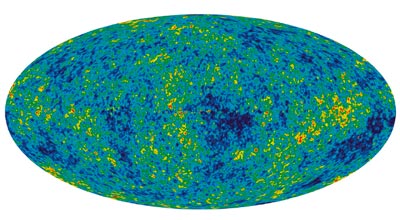
We were actually moving through time as well as space. As we went farther away from the Earth we were at distances where light takes a long time to reach our own planet, so we were looking at objects with a very much younger age (earlier in time). It was fun flying round through the universe at hyperfaster-than-light speed and seeing all of the known galaxies. Soon I asked to see to the edge (and beyond). The operator brought up the data for the cosmic microwave background (CMB) – at the time, the 3-year maps from the Wilkinson Microwave Anisotropy Probe – and it appeared behind the distance galaxies. I asked to move right to the edge, and in the process of zooming out we went past the CMB map surface and were looking back at the sphere containing the full observable universe. Where were we? Out in the part from which light has not had time to reach Earth and – if our current understanding is correct – will never reach us. But still we wonder about what is out there, and we have some hope of understanding.

The second reason why this is such an incredibly exciting time in cosmology is that these observations, combined with careful reasoning and an occasional brilliant insight, have allowed us to formulate an elegant and precisely quantitative model for the origin and evolution of the universe. This model reproduces to high accuracy everything that we observe over the history of the universe, images of which are displayed in the planetarium.
CCcos2_05_09

We now have precise observations of a very early epoch in the universe through the images made using the CMB radiation and we hope to start a newer and even more precise and illuminating effort with the launch of the Planck Mission on 14 May. However, we also have many impressive galaxy surveys and plans for even more extensive surveys using new ideas to see the relics of the acoustic oscillations in the very, very early universe, as well as the gravitational lensing caused by the more recently formed large-scale structures, such as clusters of galaxies that slightly warp the fabric of space–time by their presence. Each will give us new images and thus new information about the overall history of the universe.

However, the model invokes new physics; some explicitly and some by omission. First, we put in inflation, the physical mechanism that takes a small homogeneous piece of space–time and turns it into something probably much larger than our currently observable universe but with all its features, including the very-small-amplitude fluctuations discovered with the Differential Microwave Radiometers on the Cosmic Background Explorer, which are the seeds of modern galaxies and clusters. Second, we put in dark matter, which plays the key role in the formation of structure in the universe and holds the clusters and galaxies together. This is a completely new kind of matter – unlike any other with which we have experience. It does not interact electromagnetically with light but apparently does interact gravitationally, precisely the property needed for it to form structure. A third additional ingredient is dark energy, which is used to balance the energy budget of the universe and explain the accelerating rate of expansion observed in the more recent history of the universe. Last, we need baryogenesis, the physical mechanism that explains the dominance of matter over antimatter. We have good reason to believe that there were equal amounts of matter and antimatter at the very beginning, but now matter prevails.

If we add these four extra ingredients in the simplest possible form we can reproduce the observable universe in our simulations or analytic calculations to an accuracy that is equal to (and probably better than) the current observational accuracy – at roughly the per cent level.

There are other things that we don’t put in so explicitly but have reason to suspect might be there. For example, we work with a universe constrained by three large dimensions of space and one of time, even though we know that more dimensions are possible and may be necessary. We do not deal with our confinement to 4D. We also stick with the four known basic forces even though there is plenty of opportunity for new forces; and likewise for additional relics from earlier epochs.

Universal ingredients

The success of the standard cosmological model has many consequences that puzzle us and also raises several key questions, which are far from answered. The observation of dark energy demonstrates that our well established theories of particles and gravity are at least incomplete – or not fully correct. What makes up the dark side of the universe? What process, in detail, created the primordial fluctuations? Is gravity purely geometry as Albert Einstein envisaged, or is there more to it (such as scalar partners and extra dimensions)? An unprecedented experimental effort is currently being devoted to address these grand-challenge questions in cosmology. This is an intrinsically interdisciplinary issue that will inevitably be at the forefront of research in astrophysics and fundamental physics in the coming decades. Cosmology is offering us a new laboratory where standard and exotic fundamental theories can be tested on scales not otherwise accessible.

The situation in cosmology is rife with opportunities. There are well defined but fundamental questions to be answered and new observations arriving to guide us in this quest. We should learn much more about inflation from the observations that we can anticipate over the next few years. Likewise we can hope to learn about the true nature of dark matter from laboratory and new accelerator experiments that are underway or soon to be operating, as at the LHC. We hope to learn more about possible extra dimensions through observations.

We continue to seek and encourage new ideas and concepts for understanding the universe. These concepts and ideas must pass muster – like a camel going through the eye of a needle – in agreeing with the multitude of precise observations and thereby yield an effective version of our now-working cosmological model. This is the key point of modern cosmology, which is fully flowering and truly exciting. It is the natural consequence and culmination of the path that Galileo started us on four centuries ago.

A MAGIC touch brings astronomical delights

CCnew9_05_09

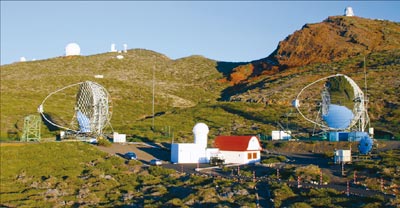
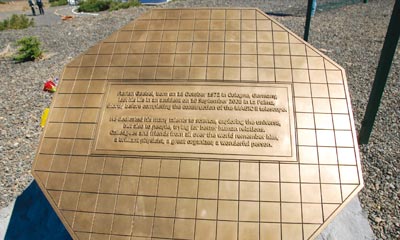
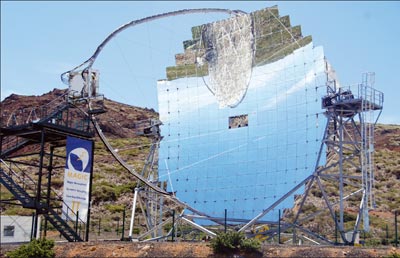
In a simple ceremony on a mountaintop under blue skies and bright sunlight on 25 April, a small group of colleagues, family and friends paused in silence in memory of a young physicist who died there last September. Florian Goebel suffered a fatal accident while putting the finishing touches to the MAGIC-II telescope at the Roque de Los Muchachos Observatory on the Canary Island of La Palma. He had been the project manager and it is fitting that the two MAGIC telescopes were named the Florian Goebel Telescopes at the ceremony. Shortly afterwards, Florian’s brother helped to cut the white, blue and yellow ribbons that symbolically held the telescope, releasing it for its “first light”.

MAGIC-II thus joined its older sibling, MAGIC-I, in exploring the gamma-ray sky, each with a larger segmented mirror than any other reflecting telescope. While MAGIC-I has already made major discoveries, together the two telescopes will make simultaneous observations and achieve a sensitivity three times greater than when working independently.

CCmag1_05_09

The Major Atmospheric Gamma-Ray Imaging Cherenkov (MAGIC) project is one of four around the world that use reflecting telescopes to detect the short bursts of Cherenkov light emitted by the showers of charged particles produced when a high-energy gamma ray interacts in the Earth’s upper atmosphere. The High Energy Stereoscopic System (HESS) has been operating in the highlands of Namibia since September 2004; the Very Energetic Radiation Imaging Telescope Array System (VERITAS) in Arizona began it first observations in 2003; and the CANGAROO collaboration between Australia and Japan, which has been observing gamma-ray sources since 1992, began full operation of its most recent telescopes in 2004.

A textbook example

CCmag2_05_09

Gamma-rays reveal the highest-energy phenomena in the universe, but a major goal for MAGIC is to extend observations to lower gamma-ray energies, which will allow it to see deeper into the universe and farther back in time. At lower energies, the gamma rays are less likely to interact with other light on their long journey through space.

The story of the MAGIC project is a textbook example of the merging of particle physics and astronomy into the modern field of astroparticle physics. For many years, Eckart Lorenz from MPI Munich was a familiar face at CERN and other particle physics laboratories, working in a number of well known collaborations involving the Munich group. By the 1990s he began to apply his expertise in particle-detection techniques to the study of high-energy cosmic gamma rays, in particular by using imaging atmospheric Cherenkov telescopes.

Detecting the Cherenkov light emitted as charged particles pass through a medium faster than light does is a well known technique in particle physics. The method is used to identify charged particles according to their velocities, as implemented for example in the LHCb experiment at CERN. The radiation forms a cone about the particle’s path; the angle of the cone depends on the refractive index of the medium, n, and the particle’s velocity, v. The higher the velocity, the larger the angle, θ, with cosθ = c/nv, where c is the speed of light in free space. For Cherenkov telescopes the medium used is the Earth’s atmosphere, and in gamma-ray showers the particles are primarily electrons and positrons travelling close to the limiting velocity, c.

The showers develop to contain a maximum number of particles around 10 km above sea level; the Cherenkov light that they emit forms a “disc” typically a metre or so thick, with a diameter of about 250 m when it arrives at the Earth’s surface. This disc of light is like an image of the shower. It contains essential information about the direction and the energy of the original gamma-ray and – because gamma-rays are uninfluenced by magnetic fields in space – in effect points back to the gamma-ray source.

An imaging atmospheric Cherenkov telescope with its axis pointing in the direction of the source will intercept a small part of the disc of Cherenkov light and form an image of it at the focal point. The main challenge lies in detecting very low intensity light at the level of single photons, because the Cherenkov radiation from the shower is spread across the whole disc. Moreover, the showers from charged primary cosmic rays (hadrons, mainly protons) produce a substantial background with a rate some 10,000 times greater than that of gamma-ray-induced showers. Fortunately, the shape and structure of the two types of shower differ sufficiently for the image in the telescope to have different characteristics. Appropriate image-analysis techniques can ultimately reject the unwanted hadronic showers.

Bridging the energy gap

The Cherenkov radiation from cosmic-ray showers constitutes only about 0.01% of the light in the night sky – but it is detectable, as Bill Galbraith and John Jelley first showed at Harwell in the UK in 1953 with not much more than a dustbin with a 60 cm diameter mirror and a photomultiplier tube (PMT) at its focus. Using the same principle each MAGIC telescope, with its diameter of 17 m, has an array of hundreds of PMTs at the focus – 576 in the case of MAGIC-I and 1039 for MAGIC-II.

The potential for observing cosmic gamma-ray sources through the detection of air showers was first suggested in 1959 by Giuseppe Cocconi, who also proposed that the Crab nebula should be a strong source of high-energy gamma rays. This inspired Aleksandr Chudakov to build a pioneering Cherenkov telescope in Crimea in the early 1960s. It took 30 years before Trevor Weekes and colleagues could finally claim observation of the Crab with the Whipple imaging air Cherenkov telescope in 1989. With its 10 m segmented mirror viewed by an array of PMTs, Whipple pioneered the use of this technique in studies of the gamma-ray sky at energies from around 100 GeV to 10 TeV. It discovered the first source of gamma rays beyond our galaxy, with the detection of very high-energy emission from the active galaxy Markarian 421 (Mkn 421).

Around the same time the High-Energy Gamma-Ray Astronomy (HEGRA) project was also observing air showers with a range of detectors at the Roque de Los Muchachos Observatory. These included five atmospheric Cherenkov telescopes, each with an area of 8.5 m2, which operated in coincidence to achieve better angular resolution and a much improved rejection of background, in particular from hadron showers. The system successfully detected gamma rays up to more than 10 TeV in energy, emitted by the active galactic nuclei Mkn 421 and Mkn 501, which are prime examples of the variable and intense gamma-ray sources known as “blazars”.

CCmag3_05_09

While Whipple and HEGRA searched for sources of very high-energy gamma rays, the Energetic Gamma Ray Emission Telescope (EGRET) on board NASA’s Compton Gamma Ray Observatory was collecting a wealth of data on the gamma-ray sky at lower energies, from 20 MeV to 10 GeV. Being above the Earth’s atmosphere it could detect gamma-rays directly. However, with a small detection area and because the number of gamma rays per unit area falls steeply with energy, a small detector becomes inefficient at higher energies, with a practical limit of about 10 GeV.

It was around this time that Lorenz, who was a member of the HEGRA project, began to dream of bridging the gap in energy accessed by the ground-based and space-based instruments. This would require a larger-area mirror to collect more light, making it more sensitive to showers from the gamma rays below 100 GeV; the minimum detectable energy varies more or less inversely with the area of the mirror. At first the idea did not seem too promising because a large telescope looked likely to cost as much as a satellite. However, Lorenz and colleagues discovered that the German solar-power research programme had built a 17 m reflector dish using a relatively simple construction – and the first ideas for the MAGIC telescope were soon sketched out in a Munich beer garden.

Making MAGIC

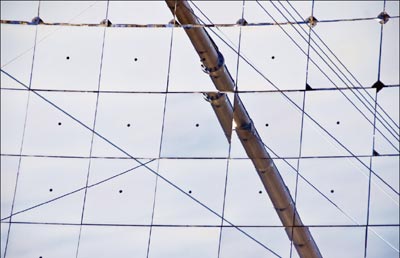
The main features of the 17 m telescope for MAGIC were clear from the outset. It had to be lightweight to react and move quickly in searches for gamma-ray bursts (GRBs) – the puzzling, powerful phenomena discovered some 30 years ago. At the same time the structure had to be rigid enough to avoid deformations. The chosen solution was to build a framework of carbon-fibre tubes and the reflector was constructed of light-weight aluminium mirrors, with diamond-machined surfaces and an active control system to adjust each mirror to counteract any small deformations arising in the frame. In addition, the aim was to use the telescope to collect as much data as possible; on moonlit nights and at large zenith angles, close to the horizon, where the Cherenkov radiation reddens, like sunlight, as it travels farther through the atmosphere to the detector. This would require novel phototubes with high quantum efficiency to improve on the light collection and to increase sensitivity

CCmag4_05_09

Lorenz first presented MAGIC publicly at the International Cosmic Ray Conference in Rome in 1995. The project had many new ideas – possibly too many. It initially met with resistance: critics said that the construction was too light and it would blow over; the carbon fibre would be too expensive and so on. However, there were supporters such as the Italian National Institute for High Energy Physics (INFN) and the Spanish Institute for High Energy Physics (IFAE), which joined the project in 1997, took part in the R&D and participated in the technical design report published in 1998. By this time the collaboration counted nearly 50 members mainly from Germany, Italy and Spain.

The eventual site for MAGIC was undecided at the time of the technical proposal but it was evident that, like other Cherenkov telescopes, it should be at high altitude in a location with skies clear enough to “see” the faint Cherenkov light. The site at 2200 m on La Palma, already used for HEGRA, had the added advantage of offering relatively stable temperatures, which is important for minimizing thermal stress on the telescope structure.

Funding for construction on La Palma was approved towards the end of 2000, although MAGIC had already benefited from a misfortune that had befallen HEGRA. In 1997 a forest fire had destroyed one third of the detectors; they were insured, and the insurance company stipulated that the money had to be used for ongoing research.

Construction of MAGIC-I began in August 2001 and its inauguration took place on October 2003. The telescope has since observed dozens of high-energy gamma-ray sources: mainly active galactic nuclei like Mkn 421 and Mkn 501 and nebulae around pulsars, but also supernova remnants and binary systems.

CCmag5_05_09

The observations include impressive “firsts” and exciting discoveries. On 13 July 2005, for example, the telescope demonstrated its ability to respond rapidly to a GRB alert from NASA’s Swift satellite, locating GRB050713A only 40 s after its explosion. This allowed the first simultaneous observation of a GRB in both high-energy gamma rays and X-rays. In June 2006 the collaboration reported the detection of variable high-energy gamma-ray emission from the microquasar LSI+61 303, a gravitationally bound binary-star system consisting of a massive ordinary star and a compact object of a few solar masses. More recently, in June 2008, MAGIC discovered gamma-ray emission from 3C 279, a quasar more than 5000 million light-years from Earth – making it the most distant source of very high-energy gamma rays yet known. Detecting the gamma radiation from so far away poses interesting questions because, over such great distances, even gamma rays should interact with the background light from stars and galaxies. The universe, it seems, is darker than current theories suggest.

MAGIC-I was always viewed as the project’s first telescope, which would focus resources on an advanced design aiming at as low a detection energy as possible, while maximizing the potential for discoveries. Its success laid the foundations for MAGIC-II – a “twin” to allow studies of greater sensitivity and precision. The design began in 2005 and the construction was finally completed in 2008.

CCmag6_05_09

In designing MAGIC-II, the collaboration has benefited both from the experience with MAGIC-I and from technological developments. While the mounts of the two telescopes are essentially the same, the differences lie in the reflecting surface and in particular in the PMTs for the “camera”. MAGIC-II has the same overall surface as MAGIC-I, but is made of fewer, larger plates: 140 1m2 diamond-milled aluminium plates, with 100 additional coated glass mirrors at the outer edges. While the aluminium mirrors have some excellent properties, their technology is not easy to extend to mass production. For MAGIC-II the collaboration turned to glass mirrors and formed a partnership with industry to trial the production of a total of 100 m2.

The camera for MAGIC-II has more smaller-size PMTs of a new design with 10% higher quantum efficiency. MAGIC-I has 396 1″ PMTs to cover the inner area, surrounded by 180 1.5″ PMTs for the outer region. With 1039 1″ PMTs, the MAGIC-II camera covers the same area with more pixels and hence has higher resolution.

Working alone in a special low-energy mode, MAGIC-I has already observed gamma rays down to 25 GeV. Operating in unison, the two telescopes will provide better coverage of such low energies and see deeper into the Universe. The pioneering space-borne EGRET now has a more powerful successor in the Large Area Telescope (LAT) on the recently launched  Fermi Gamma-Ray Space Telescope, which has an energy range from 20 MeV up to 300 GeV. With the MAGIC twins and the Fermi-LAT, Lorenz’s dream of closing the energy gap is coming close to realization.

The MAGIC collaboration currently consists of some 150 researchers from 24 institutes in Croatia, Bulgaria, Finland, Germany, Italy, Poland, Spain, Switzerland and the US.

Spin and snakes come to the land of Jefferson

CCspi1_05_09

The International Spin Physics Symposia series started at the Argonne National Laboratory in 1974, just after its 12 GeV Zero Gradient Synchrotron (ZGS) had accelerated the world’s first polarized proton beam. Paul Dirac gave the keynote lecture in which he reviewed the history of spin, starting with the first ideas in the 1920s. The 18th Symposium, SPIN 2008, was held in October 2008 at the University of Virginia, which was founded by Thomas Jefferson in 1821. Jefferson became third president of the US and is best known as the main author of the US Declaration of Independence. He had a keen interest in science and was president of the American Philosophical Society. As a fitting tribute, an appropriately-dressed person – who claimed to be Jefferson – gave the after-dinner talk at SPIN 2008. Speaking with a polite 1800s Virginian accent, he gave wise scientific advice that is as relevant now as it was in the early 19th century.

Symposia highlights

SPIN 2008 was attended by 282 high-energy and nuclear spin physicists from around the world. There were 195 parallel talks and 37 plenary talks, so this report mentions only a few of the exciting highlights. After the welcoming talks, the ever-enthusiastic Elliot Leader of Imperial College, London, opened the symposium with a rousing lecture on “The power of spin: a scalpel-like probe of theoretical ideas”. He was followed by Klaus Rith of Erlangen, who gave a detailed experimental overview in his talk that addressed selected highlights of spin experiments and their technological challenges.

CCspi2_05_09

The main highlight of the symposium was the success of Brookhaven’s RHIC in its operations as a polarized-proton collider. The machine has produced a great deal of high-quality data in 100 GeV-on-100 GeV collisions and had a brief but successful test of stored 250 GeV polarized protons. For this impressive achievement, Thomas Roser, Mei Bai and their team of polarized-beam experts used two Siberian snakes in each RHIC ring together with two partial Siberian snakes in the venerable Alternating Gradient Synchrotron, which serves as the injector for RHIC. These operations were possible thanks to some vital external contributions. James Simons, mathematics professor at Stony Brook, a Brookhaven trustee and now a “renaissance-technologies” billionaire, provided $13 million to allow a 6 month polarized run of RHIC. Moreover, the long-term support of Akito Arima – a nuclear theorist who became a member of the Japanese Diet and science minister – resulted in more than $20 million for RHIC’s four superconducting Siberian snakes and other essential hardware. The funds were transferred from Japan to Brookhaven via the RIKEN research institute.

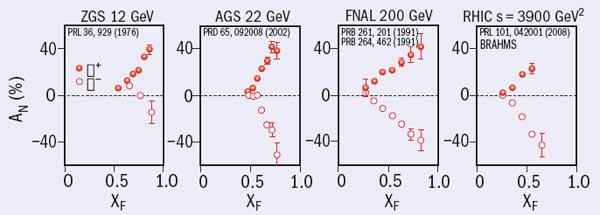
One interesting result was the measurement by the BRAHMS experiment at RHIC of the left–right spin asymmetry, An, in the inclusive production of π+ and π mesons, which was presented by Christine Aidala of the University of Massachusetts at Amherst. The data show that, despite the prediction of perturbative QCD (PQCD) that spin would be unimportant at high energy, the inclusive An at large Feynman-x reached the same value of about 40% at 3900 GeV2 (PLab ≈ 2 TeV/c) as at Argonne’s ZGS, Brookhaven’s AGS and Fermilab at momentum values of 12, 22 and 200 GeV/c, respectively (figure 1). This result might encourage PQCD theorists to define more clearly what is meant by “high” energy.

CCspi3_05_09

In an overview of the transverse spin structure of the nucleon, Mario Anselmino of Turin reported on the very large observed transverse spin effects, which are still not fully understood. Karl Slifer of the University of Virginia gave a talk on what polarized electron scattering has revealed about the spin content of the nucleon. He discussed the theoretical implications of recent polarized-electron experiments, many of which were done at the 6 GeV polarized-electron ring at the Thomas Jefferson National Accelerator Facility (Jefferson Lab). The use of polarized radioactive beams was the subject of an interesting talk by Koichiro Asahi of Tokyo Institute of Technology.

Speakers also covered the more experimental aspects of spin studies, namely the production of polarized beams and polarized targets. Richard Milner of the Massachusetts Institute of Technology gave an excellent review of the progress towards a future polarized-electron ring, which would allow collisions with either polarized protons or polarized nuclear ions stored in a much larger ring – possibly one of the rings at RHIC. Erhard Steffens of Erlangen, the new chair-elect of the International Spin Physics Committee, summarized the discussions at the second workshop on ‘How to Polarize Antiprotons’, held in August 2007 at the Cockcroft Institute at the Daresbury Laboratory in the UK. There has been significant progress on this challenging topic during the 22 years since Owen Chamberlain and Alan Krisch organized the first Polarized Antiproton Workshop in 1985 at Bodega Bay near Berkeley, but there is still no clearly defined solution to this difficult problem.

CCspi4_05_09

Werner Meyer of Bochum reviewed the continuing progress, since SPIN 2006 in Kyoto, on cryogenic polarized proton and deuteron targets. Brookhaven’s Anatoly Zelenski then described the recent progress on polarized-ion sources – the subject of a joint paper with Alexander Belov of the Institute for Nuclear Research, Troitsk. This progress is important because these polarized sources feed RHIC. Indeed, Brookhaven and the Spin Physics Committee sponsored a recent workshop on this topic at Brookhaven. Matt Poelker of Jefferson Lab reviewed progress on polarized-electron sources and polarimeters, which was the subject of another recent spin workshop at the laboratory. These sources and polarimeters are vital to progress in polarized-electron experiments.

Anatoly Kondratenko of Novosibirsk, who along with Yaroslav Derbenev invented Siberian snakes in the 1970s, gave an interesting talk on his more recent idea, now named Kondratenko Crossing (KC). This uses a symmetric spin-resonance crossing pattern that forces the resonance’s depolarizing effects to cancel themselves. Richard Raymond of Michigan reported on new data from the SPIN@COSY team at the Cooler Synchrotron (COSY) at the Forschungszentrum in Jülich. The results show that KC works, at least for RF-solenoid-induced resonances with deuterons. In the same parallel session accelerator pioneer Ernest Courant, of Brookhaven, still going strong at 89, discussed his new theoretical work on the behaviour of stored polarized beams.

There was also a special evening plenary session where the director (or proxy) of each of the major laboratories involved in spin-physics studies reported on their plans at GSI-Darmstadt, Brookhaven, Jefferson Lab, IHEP-Protvino, JINR-Dubna, J-PARC, and COSY-Jülich. On the last day, Thomas Roser, the new past-chair of the Spin Physics Committee, gave an excellent lecture on the future of high-energy polarized beams. The symposium ended with closing remarks from committee chair, Kenichi Imai of Kyoto. He announced that SPIN 2010 would be hosted by Forschungszentrum Jülich, while a high priority would be given to SPIN 2012 being hosted somewhere in Russia.

• For more information about SPIN 2008, see www.faculty.virginia.edu/spin2008/.

Laser-pulse blasts set antiparticle production record

CCnew2_04_09

The latest record for antiparticle density created in the laboratory has not come from an accelerator facility but from the Lawrence Livermore National Laboratory’s Jupiter laser facility. Hui Chen and colleagues blasted picosecond laser pulses carrying 1020 Wcm–2 from the Titan laser onto gold targets some 1 mm thick. Part of each laser pulse created a plasma and part drove the plasma’s electrons into the gold. The gold nuclei then slowed down the electrons, producing photons that converted into electron–positron pairs. The result was an estimated 1016 positrons/cubic centimetre.

In addition to being intrinsically interesting this work could aid better understanding of astrophysical phenomena such as gamma-ray bursts. It could also lead to new ways to produce positron sources, which at present are limited to positron-emitting radioisotopes and pair-creation from high-energy photons at accelerators.

NSCL researchers constrain nuclear symmetry energy at low density

By analysing collisions between several combinations of tin nuclei, researchers at the Michigan State University National Superconducting Cyclotron Laboratory (NSCL) have refined the understanding of nuclear symmetry energy. Their work marks the first successful theoretical explanation of common observables that are related to symmetry energy in heavy-ion experiments. The results should help in discerning the properties of neutron stars, particularly in the crust region.

CCnew6_04_09

The nuclear attraction between a neutron and a proton is, on average, stronger than that between two protons or two neutrons. The nuclear contribution to the difference between the binding energy of a system of all neutrons and another with equal numbers of protons and neutrons is known as the symmetry energy. To allow for this difference, formulae to calculate nuclear masses include a symmetry-energy term. This term often takes a form that assumes the symmetry energy to be independent of density, even though its value inside the nucleus, at normal density, should exceed its value at the surface, where the density is lower and the ratio of proton to neutron densities differs from that for the nuclear interior.

The symmetry energy of a stable nucleus reflects typical nuclear densities of about 2–3 × 1014 g/cm3; it contributes modestly to the binding energy but influences significantly the stability of nuclei against beta decay. Despite the sensitivity of nuclear masses to its average value, the precise understanding of the dependence of symmetry energy on density has proved elusive, leading to large uncertainties in theoretical predictions for properties of nuclei that are very rich in neutrons. The effects of symmetry energy loom even larger in environments that have unusual ratios of protons to neutrons and much larger ranges of density, such as in neutron stars. There, the dependence of the symmetry energy upon density is one of the most uncertain parts of the mathematical palette describing the forces at play.

Now, Betty Tsang, Bill Lynch, Pawel Danielewicz and colleagues have helped to constrain understanding of the density dependency of symmetry energy by studying how it affects heavy-ion reactions at NSCL’s Coupled Cyclotron Facility (Tsang et al. 2009). In two experiments, the team directed various beams of tin nuclei at stationary targets of tin. The four combinations included a beam of 124Sn (50 protons and 74 neutrons) on a target of 124Sn, 112Sn (62 neutrons) on 112Sn, 124Sn on 112Sn, and 112Sn on 124Sn. This allowed the researchers to create and study nuclear matter with different neutron-to-proton ratios over a range of density, which could be varied by adjusting the energy of the beam and the centrality of the collisions.

The team collected data on several observables, including isospin diffusion, which probes the neutron-to-proton ratio of neutron-rich projectile nuclei after collisions with neutron-deficient target nuclei. During grazing collisions at relative velocities of 0.3 c, a neck region with reduced density can form between projectile and target nuclei through which neutrons and protons can diffuse. The stronger the symmetry energy is in this neck region, the more likely the neutron-to-proton ratios in the projectile and target nuclei will equilibrate and become equal. A second observable involves comparisons of the energy spectra of neutrons and protons in central head-on collisions. In this case the symmetry energy expels neutrons from the central overlap region of the projectile and target nuclei; the ratio of neutron-to-proton emission then provides a probe of the variation in symmetry energy as the system compresses and expands during the collision.

By comparing the experimental data to results obtained with theoretical models developed by their Chinese colleagues, YingXun Zhang and Zhuxia Li at the China Institute of Atomic Energy, the team obtained constraints on the density dependence of symmetry energy at densities ranging from normal down to around one third nuclear matter density. The results will help to describe the inner crust of neutron stars, where the density of nuclear matter is in the 1–2 × 1014 g/cm3 range. The role of symmetry energy at the cores of such stars, where the density of nuclear matter reaches 8 × 1014 g/cm3, is currently associated with the largest uncertainty in descriptions of neutron stars.

New Zealand meeting looks at dark matter

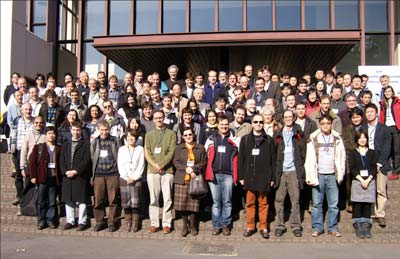
The 7th Heidelberg International Conference on Dark Matter in Astrophysics and Particle Physics – Dark 2009 – was held at Canterbury University in Christchurch on 18–24 January. The event saw 56 invited talks and contributions, which provided an exciting and up-to-date view of the development of research in the field. The participants represented well the distribution of dark-matter activities around the world: 25 from Europe, 11 from the US, 5 from Japan and Korea, 14 from Australia and New Zealand, and 1 from Iran. The programme covered the traditionally wide range of topics, so this report looks at the main highlights.

CCdar1_04_09

The conference started with an overview of searches for supersymmetry at the LHC and dark matter by Elisabetta Barberio of the University of Melbourne. To date, the only evidence for cold dark matter from underground detectors is from the DAMA/LIBRA experiment in the Gran Sasso National Laboratory, as Pierluigi Belli from the collaboration explained. This experiment, which looks for an expected seasonal modulation of the signal for weakly interacting massive particles (WIMPs), now has a significance of 8.4 σ. Unfortunately, all other direct searches for dark matter do not currently have the statistics to look for this signal. Nevertheless, Jason Kumar from Hawaii described how testing the DAMA/LIBRA result at the Super-Kamiokande detector might prove interesting.

Later sessions covered other searches for dark matter. Tarek Saab from Florida gave an overview of ongoing direct searches in underground laboratories, including recent results from the Cryogenic Dark Matter Search experiment in the Soudan mine, and Nigel Smith of the UK’s Rutherford Appleton Laboratory presented results from the ZEPLIN III experiment in the Boulby mine. Irina Krivosheina of Heidelberg and Nishnij Novgorod discussed the potential offered by using bare germanium detectors in liquid nitrogen or argon for dark-matter searches, on the basis of the results from the GENIUS-Test-Facility in the Gran Sasso National Laboratory. Chung-Lin Shan of Seoul National University reported on how precisely WIMPs can be identified in experimental searches in a model-independent way.

Searching for signals from dark-matter annihilation in X-rays and weighing supermassive black holes with X-ray emitting gas were subjects for Tesla Jeltema of the University of California Observatories/Lick Observatory and David Buote of the University of California, Irvine. Stefano Profumo of the University of California, Santa Cruz, provided an overview of fundamental physics with giga-electron- volt gamma rays. Iris Gebauer of Karlsruhe addressed the excess of cosmic positrons indicated by the Energetic Gamma Ray Experiment Telescope, which are still under discussion, as well as the new anomalies observed by the Payload for Antimatter Matter Exploration and Light-Nuclei Astrophysics (PAMELA, PAMELA finds an anomalous cosmic positron abundance ) satellite experiment and the Advanced Thin Ionization Calorimeter (ATIC) balloon experiment. These results and the limits that they set on some annihilating dark matter (neutralino or gravitino) models were also discussed by Kazunori Nakayama of Tokyo and Koji Ishiwata of Tohoku.

Other presentations outlined results and prospects for the AMANDA, IceCube and ANTARES experiments, which study cosmic neutrinos – though there is still a long way to go before they have conclusive results. Emmanuel Moulin of the Commissariat à l’énergie Atomique/Saclay presented results from imaging atmospheric Cherenkov telescopes, in particular the recent measurements from HESS, which exploited the fact that dwarf spheroidal galaxies, such as Canis Major, are highly enriched in dark matter and are therefore good candidates for its detection. Unfortunately, the results do not yet have the sensitivity of the Wilkinson Microwave Anisotropy Probe in restricting either the minimal supersymmetric Standard Model or Kaluza–Klein scenarios.

Leszek Roszkowski of Sheffield gave an overview of supersymmetric particles (neutralinos) as cold dark matter, while scenarios of gravitino dark matter and their cosmological and particle-physics implications were presented by Gilbert Moultaka of the University of Montpellier and Yudi Santoso of the Institute for Particle Physics Phenomenology, Durham. Dharam Vir Ahluwalia of the University of Canterbury put the case for the existence of a local fermionic dark-matter candidate with mass-dimension one, on the basis of non-standard Wigner classes. However, as the proposed fields, as outlined in detail by Ben Martin of Canterbury, do not fit into Steven Weinberg’s formalism of quantum-field theory, this suggestion led to dispute between other experts. An interesting candidate for dark matter was presented by Norma Susanna Mankoc-Borstnik of the University of Ljubljana, who proposed a fifth family as candidates for forming dark matter.

Dark energy and the cosmos

Dark energy was a major topic at the conference. Chris Blake of Swinburn University of Technology in Melbourne presented the prospects for the WiggleZ survey at the Anglo-Australian Telescope, the most sensitive experiment of this kind, and Matt Visser of Victoria University in Wellington gave a cosmographic analysis of dark energy. On the theoretical side there are diverging approaches to dark energy, including attempts to explain it in a “radically conservative way without dark energy”, as David Wiltshire of Canterbury University, Christchurch, explained.

A particular highlight was the presentation by Terry Goldman of Los Alamos, which discussed a possible connection between sterile fermion mass and dark energy. His conclusion was that a neutrino with mass of 0.3 eV could solve the problem of dark energy. This possibility was qualitatively supported by results of non-extensive statistics in astroparticle physics that Manfred Leubner of the University of Innsbruck presented, in the sense that dark energy is expected to behave like an ordinary gas. Goldman’s suggestion is also of interest with respect to the final result of the Heidelberg–Moscow double-beta-decay experiment, reported by Hans Klapdor-Kleingrothaus, which predicts a Majorana neutrino mass of 0.2–0.3 eV.

Danny Marfatia of the University of Kansas discussed mass-varying neutrinos in his presentation about phase transition in the fine structure constant. He proposed that the coupling of neutrinos to a light scalar field might explain why Ωdark energy is of the same order as Ωmatter. Possible connections between dark matter and dark energy with models of warped extra dimensions and the hierarchy problem were outlined by Ishwaree Neupane of the University of Canterbury and Yong Min Cho of Seoul National University.

Dark mass and the centre of the galaxy was the topic of a special session in which Andreas Eckart of the University of Cologne presented recent results on the luminous accretion onto the dark mass at the centre of the Milky Way. Patrick Scott of Stockholm University discussed dark stars at the galactic centre, while Benoit Famaey of the Université Libre de Bruxelles and Felix Stoehr of the Space Telescope European Coordinating Facility/ESO in Garching discussed the distribution of dark and baryonic matter in galaxies. Primordial molecules and the first structures in the universe were the topics addressed by Denis Puy of the Univesité Montpellier II. Youssef Sobouti of the Institute of Advanced Studies on Basic Science in Zanjan, Iran, presented a theorem on a “natural” connection between baryonic dark matter and its dark companion, while Matthias Buckley of the California Institute of Technology put forward ideas about dark matter and “dark radiation”.

Gravity also came under scrutiny. David Rapetti of SLAC explored the potential of constraining gravity with the growth of structure in X-ray galaxy clusters, while Agnieszka Jacholkowska of IN2P3/Centre National de la Recherche Scientifique gave an experimental view of probing quantum-gravity effects with astrophysical sources. In a special session on general relativity, Roy Patrick Kerr of Canterbury University gave an interesting historical lecture entitled “Cracking the Einstein Code”.

To conclude, the lively and highly stimulating atmosphere of Dark 2009 reflected a splendid future for research in the field of dark matter in the universe and for particle physics beyond the Standard Model. The proceedings will be published by World Scientific.

Nara workshop looks at heavy quarkonia

The 6th International Workshop on Heavy Quarkonia took place in Nara in December 2008, attracting some 100 participants. It was the latest in a series organized by the Quarkonium Working Group (QWG), a collaboration of theorists and experimentalists particularly interested in research related to the physics of quarkonia – bound states of heavy quark–antiquark pairs (Brambilla et al. 2004). The talks and discussions in three round tables emphasized the latest advances in the understanding of quarkonium production, the discovery of the ηb, the properties of the X, Y and Z narrow resonances, as well as the use of quarkonium states as probes of the QCD matter formed in high-energy nuclear collisions. The meeting ended with a series of talks about how the Antiproton Annihilations at Darmstadt (PANDA) experiment and the LHC experiments should improve and complement present knowledge.

New states

CCqua1_04_09

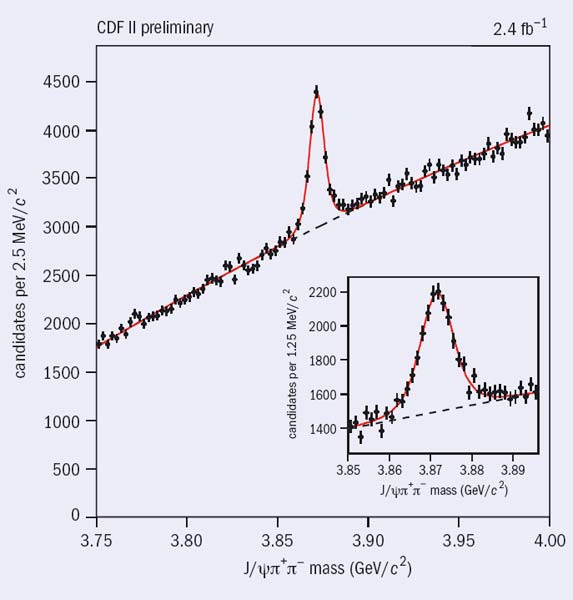
The nature and properties of the X, Y and Z narrow resonances, recently discovered in B-factories (and thought to be quarkonium states), were extensively discussed at the workshop. Presentations from the Belle, BaBar and CDF collaborations provided new information on the masses, branching ratios, quantum numbers and production properties of these particles. Using approximately 6000 signal events in J/ψ → π+π decays, CDF obtained the most precise determination of the X(3872) mass: 3871.61±0.16(stat.) ±0.19(syst.) MeV/c2, a value extremely close to the D0D*0 mass threshold, 3871.8±0.36 MeV/c2 (figure 1). Given present uncertainties, the interpretation of the X(3872) as a “molecular” D0D*0 bound state remains possible but not compulsory. In addition the CDF collaboration reported a very accurate mass measurement for the Bc± of 6275.6±2.9(stat.) ±2.5(syst.) MeV/c2, obtained by studying the mass spectrum of Bc+ → J/ψπ+ decays (and the charge conjugates). The CDF and D0 experiments also measured the Bc lifetime, through the study of semileptonic decays. The measurements are of comparable precision, leading to a world average lifetime of 0.459±0.037 ps for the only observed charged quarkonium.

CCqua2_04_09

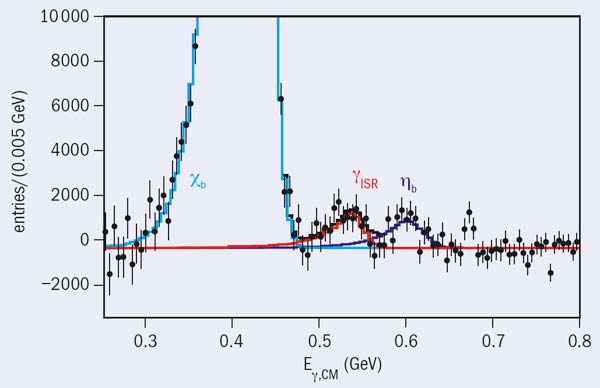
Another hot topic was the BaBar experiment’s discovery of the long-sought-after bottomonium ground state, the ηb. On the basis of a record amount of event samples collected early in 2008 (more than two hundred million U(2S) and U(3S) events), the BaBar collaboration announced in July the observation of the ηb in the rare magnetic-dipole transition U(3S) → γηb. At the Nara workshop, BaBar showed preliminary evidence for the U(2S) → γηb decay, which confirms the earlier observation (figure 2). The measured mass for the ηb is 71.4 (stat.) ±2.7(syst.) MeV smaller than the U(1S) mass. This mass difference is almost twice the value calculated in perturbative QCD, 39±11(theor.) (δαs) MeV, hence challenging the expectation that non-perturbative corrections should be only a few million electron-volts.

The Belle collaboration reported an improved measurement of the inclusive cross-section for the production of a J/ψ meson plus additional charmed particles. The new result is around 15% lower than their previous value and, in combination with a new calculation of next-to-leading-order (NLO) corrections, brings theory and experiment into reasonable agreement – albeit with large uncertainties – potentially solving a long-standing quarkonium-production puzzle.

The workshop also heard about new calculations of NLO corrections to the colour-singlet quarkonium-production mechanism, which confirm that the ratio between the colour-singlet and colour-octet production rates is larger than previously thought. The same calculations predict that J/ψs produced via the colour-singlet mechanism should exhibit a stronger longitudinal polarization in the helicity frame than is observed in the data from CDF. In the case of J/ψ photoproduction, new NLO calculations of the colour-singlet contribution fail to reproduce the polarization measurements made at HERA. If it turns out that feed-down effects do not modify the observed polarizations significantly then these discrepancies might indicate that a colour-octet contribution is required to bring the polarization predictions and experiment into agreement. There was also a discussion on the consistency of the measurements of the J/ψ polarization by the E866, HERA-B and CDF experiments. The seemingly contradictory data sets are surprisingly well reproduced if one models the polarization along the direction of relative motion of the colliding partons by assuming that, for directly produced J/ψs, it changes continuously from fully longitudinal at low total momentum to fully transverse at asymptotically high total momentum.

Heavy ions

Another interesting line of research in the QWG’s activities has to do with the use of heavy-quarkonium states as particularly informative probes of the properties of the high-density QCD matter produced in high-energy heavy-ion collisions. Contrary to early expectations, however, currently available J/ψ suppression measurements cannot be seen as “smoking-gun signatures” that would show beyond reasonable doubt the creation of a deconfined state of quarks and gluons. Indeed, the present experimental picture is blurred by several “cold nuclear matter” effects, including shadowing of the parton densities, final-state nuclear absorption of fully formed charmonium states (or of pre-resonances) and initial-state parton-energy loss. Furthermore, there needs to be a careful evaluation of feed-down contributions to the production yields of the J/ψs (and their own “melting” patterns). Presentations in Nara showed recent progress in the understanding of these topics and there were detailed discussions concerning the quarkonium properties in finite-temperature QCD. Future measurements of the U family at the LHC should open a better window into this interesting landscape.

CCqua3_04_09

The next International Workshop on Heavy Quarkonia will take place at Fermilab in May 2010. Meanwhile, quarkonium aficionados are eagerly awaiting the first results from the LHC. More than 30 years after the serving of the charmonium and bottomonium families as revolutionary entrées, quarkonium physics remains high in the menus of many physicists, providing a table d’hôte where to test the properties of perturbative and non-perturbative QCD and validate the continually improving computational tools. Sprinkled with enough puzzles to spice up the meal, quarkonium physics will continue to please the most discerning appetites for years to come.

PAMELA pins down cosmic antiproton flux

CCnew3_03_09

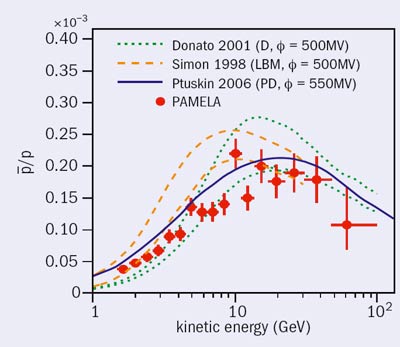
The satellite experiment Payload for Antimatter Matter Exploration and Light-nuclei Astrophysics (PAMELA) has made a new measurement of the antiproton-to-proton flux ratio in cosmic rays with energies up to 100 GeV. The results, which represent a great improvement in statistics compared with data published previously, provide significant constraints on exotic sources of cosmic antimatter.

The PAMELA experiment has been in low Earth-orbit on the Resurs-DK1 satellite since its launch in June 2006. During 500 days of data collection it has identified 1000 antiprotons with energies in the range 1–100 GeV, including 100 antiprotons with an energy above 20 GeV. This is a larger data sample at higher energies than any other experiment has obtained.

Cosmic antiprotons can be made in particle (mainly proton) collisions with interstellar gas but they could also have more exotic origins, for example, in the annihilation of dark-matter particles. Finding out more about the actual production mechanisms requires detailed studies of the antiproton energy spectrum over a wide energy range, which in turn depend on data with good statistics, as PAMELA now provides.

Analysis of the data from PAMELA show that the antiproton-to-proton flux ratio rises smoothly to about 10 GeV, before tending to level off. The results match well with theoretical calculations that assume only secondary production of antiprotons by cosmic rays propagating through the galaxy. This places limits on contributions from other, more exotic sources.

ISOLTRAP weighs in with new noble results

CCnew4_03_09

Georg Christoph Lichtenberg , the 18th-century philosopher scientist, said: “To see something new, you must build something new.” This adage certainly applies on the nuclear scale at CERN’s On-Line Isotope Mass Separator, ISOLDE, the pioneering rare-isotope factory. Measurements with the Penning-trap mass spectrometer ISOLTRAP, have determined new masses for several isotopes of the noble gases, xenon and radon, while discovering a new isotope of radon along the way.

ISOLDE is CERN’s longest-running facility and has always been at the forefront of development. Now the facility is the key player in the European sixth framework design study for EURISOL, a next-generation facility for isotope separation online (ISOL). At ISOLDE the short-lived nuclides are created using 1.4 GeV protons from CERN’s PS Booster. Once produced in the target, these rare species must be ionized efficiently to form secondary beams that can be accelerated and mass-separated for use in experiments. Thus, all ISOLDE targets have a built-in chemically selective ion source.

CCnew5_03_09

One of the tasks of EURISOL (in conjunction with the HighInt Marie-Curie Training programme) is the development of an efficient ion source that can accommodate the 50-fold increase in proton beam intensity that will become available at CERN through the upcoming Linac 4 and Superconducting Proton Linac upgrades. This has led to a prototype, the Versatile Arc Discharge Ion Source (VADIS). Its principle rests on the optimization of both the discharge-current densities within the ion-source geometry and the extracted ion-beam intensities (figure 1). The version designed for the selective ionization of noble gases increases ionization efficiency by over an order of magnitude.

VADIS was employed at ISOLDE in 2008 with spectacular results. The experiment in question involved another pioneering facility, ISOLTRAP. ISOLTRAP in effect weighs radioactive nuclides created by ISOLDE using the elegant technique of exciting the cyclotron motion of a single ion in a magnetic field. Knowledge of the mass gives access to the nuclear binding energy, which is not only a rich source of information for nuclear structure, size and shape, but also determines the amount of energy available for radioactive decay and for reactions of major importance for modelling nucleosynthesis, the cooking of elements in stars.

ISOLTRAP first weighed isotopes of xenon ionized by VADIS, determining masses for four more of them. The team then focused its efforts on the neutron-rich isotopes of radon, with impressive results. The experiment determined seven new masses, one for an isotope, 229Rn, that had never previously been observed in the laboratory. As there was no information to confirm this isotope’s identity, the experimenters needed to take particular care to make sure it was indeed what they thought it to be. As a result, they also determined the half live of this nuclide (figure 2), marking the first discovery of a nuclide by Penning-trap mass spectrometry (Neidherr et al.). To make things even more interesting, the new radon masses show a unique pattern that provides a link to a special type of nuclear octupole deformation, predicted to occur in this region of the nuclear chart.

Finding the way to polarized antiprotons

CCnew6_03_09

The QCD physics potential of experiments with high-energy polarized antiprotons is enormous, but until now high-luminosity experiments have been impossible. This situation would change dramatically with the production of a stored beam of polarized antiprotons, and the realization of a double-polarized high-luminosity antiproton–proton collider. Recent measurements at the Cooler Synchrotron (COSY) at Jülich have for the first time studied the influence of unpolarized electrons on polarized protons, settling a puzzle over the magnitude of such effects.

The collaboration for Polarized Antiproton Experiments (PAX) has proposed a physics programme that would be possible with a double-polarized proton–antiproton collider at the new Facility for Antiproton and Ion Research (FAIR), which is to be built at GSI in Darmstadt (PAX Collaboration 2006). The original idea was to use polarized electrons to produce a polarized beam of antiprotons (Rathmann et al. 2005). This triggered further theoretical work on the subject and a group from Mainz proposed using co-moving electrons or positrons (e) at slightly different velocities from the orbiting protons or antiprotons (p) as a means to polarize the stored beam (Walcher et al. 2007). When the relative velocities, v, between the e and p are adjusted so that v/c is about 0.002, a numerical calculation by the Mainz group predicts the cross-section for the ep spin-flip to be as large as about 2 × 1013 b. Analytical predictions for the same quantity by a group from Novosibirsk, however, yield a range well below one millibarn (Milstein et al. 2008).

CCnew7_03_09

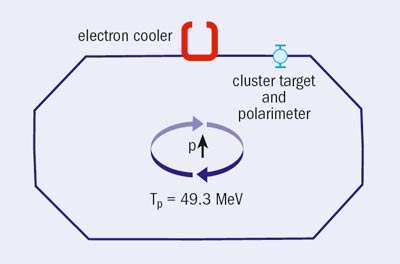
To provide an experimental answer to the puzzle, the collaborations for PAX and for the Apparatus for Studies of Nucleon and Kaon Ejectiles experiment joined forces at COSY, where they mounted an experiment that used the electrons in the electron cooler as a target and measured the effect of the electrons on the polarization of a 49.3 MeV proton beam orbiting in COSY. Instead of studying the build-up of polarization in an unpolarized beam, the teams studied the inverse by observing the depolarization of an initially (vertically) polarized beam; they measured the proton-beam polarization using the analysing power of proton–deuteron elastic scattering on a deuterium cluster jet target (figure 1).

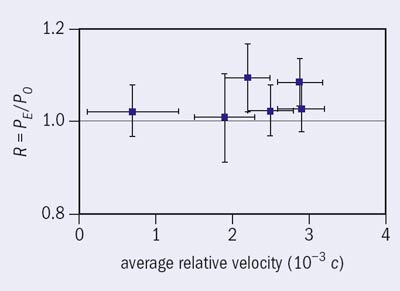
Figure 2 shows the results, with the ratio of the measured beam polarizations, PE and P0 (Oellers et al. 2009). PE represents the measured polarization corresponding to well defined changes of the electron velocity with respect to the protons. This was achieved by detuning the accelerating voltage in the electron cooler by a specific amount compared to the nominal voltage. P0 is the polarization measured when the electron beam was off (i.e. no electron target was present). No depolarization effect on the proton beam could be detected within the statistical precision of the measurement. This translates into an upper limit for the ep transverse and longitudinal spin-flip cross-sections of 1.5 × 107 b at a relative velocity of v = 0.002, six orders of magnitude below the numerical predictions. After the completion of the experiment, the Mainz group uncovered a numerical overestimation in their original estimates (Walcher et al. 2009).

The result rules out the practical use of polarized leptons to polarize a beam of antiprotons with present-day technologies. This leaves spin-filtering as the only proven method to polarize a stored beam in situ, a technique that exploits the spin- dependence of the strong interaction using a polarized internal target (Rathmann et al. 1993). At present, a complete quantitative understanding of all underlying processes is lacking, so the PAX collaboration aims to use stored protons in COSY for high-precision polarization build-up studies with transverse and longitudinal polarization. Under these circumstances, the build-up process itself can be studied in detail because the spin-dependence of the proton–proton interaction around 50 MeV is completely known. The internal polarized target and the target polarimeter required for these investigations are currently set up to be installed together with a large-acceptance detector system for the determination of the beam polarization in a dedicated low-β section at COSY.

In contrast to the proton–proton system, the experimental basis for predicting the polarization build-up by spin filtering in a stored antiproton beam is practically non-existent. Therefore, it is of high priority to perform a series of dedicated spin- filtering experiments using stored antiprotons. The Antiproton Decelerator at CERN is a unique facility at which stored antiprotons in the appropriate energy range are available with characteristics that meet the requirements for the first-ever antiproton polarization build-up studies.

bright-rec iop pub iop-science physcis connect