The CMS collaboration achieved an important milestone this summer with completion of the analysis of the last of the five main channels that contributed to the discovery of a Higgs boson in July 2012. The subsequent measurements of the particle’s properties are now complete.
The results of the final analysis in the decay channel into a photon pair, H → γγ, were presented at the 2014 International Conference on High Energy Physics in Valencia and, at the same time, submitted for publication (CMS 2014a). This is one of the two Higgs-decay channels – the other being H → ZZ → four leptons – that have very good mass resolution and therefore allow the unquestionable detection of the Higgs boson and the precise measurement of its mass. However, H → γγ is probably the most difficult decay to exploit at the LHC. It requires a great deal of effort on the optimization and calibration of the electromagnetic calorimeter for photon identification and energy measurement, as well as highly sophisticated analysis methods designed to beat the large backgrounds from sources other than the Higgs.
The first preliminary results on the full Run 1 data were presented by CMS in March 2013. Since then, a large amount of work has gone into all aspects of the analysis: the understanding of the energy scale for photons was greatly improved, exclusive selections addressing all possible production processes were deployed, and major improvements in the statistical treatment of the background estimation were achieved. All of these changes have led to an increase in sensitivity of approximately 25% and to a reduction of the systematic uncertainty in the mass measurement by a factor three.
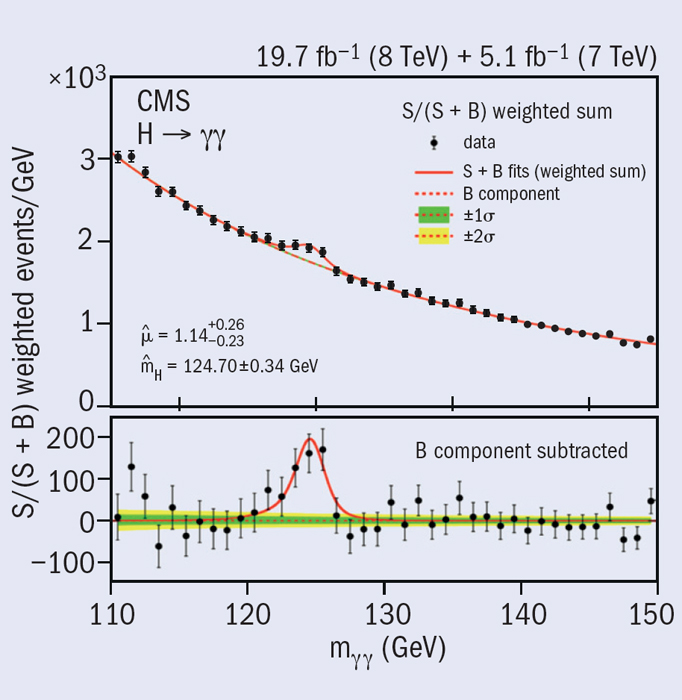
The analysis is based on various multivariate discriminants that are mainly used to separate events into a total of 25 exclusive categories that not only increase the sensitivity but also allow measurement of the different production processes for the Higgs boson in the H → γγ channel alone. The expected final sensitivity for the observation has increased from 4.2σ for the preliminary result to 5.2σ. The data show a 5.7σ excess at the Higgs boson mass of 125 GeV, therefore providing the definitive observation of the Higgs boson in the diphoton decay channel alone.
The final results of the analysis indicate that the yield of diphoton decays relative to the predictions of the Standard Model (the signal strength modifier) is 1.14+0.26–0.23 – in very good agreement with the Standard Model. In addition, the mass of the Higgs boson is measured to be 124.70±0.34 GeV – the most precise measurement to date.
The figure shows the combined weighted diphoton mass distribution, where a large excess in the region of 125 GeV is clearly visible. The publication presents a host of additional measurements, including the signal-strength modifiers associated with different production mechanisms, direct upper bounds on the Higgs boson width, the search for quasi-degenerate states decaying into two photons, and a spin analysis.
CMS also performed a preliminary combination of these results with the previously published results for the other channels (CMS 2014b). The overall signal strength from this combination is found to be 1.00±0.13, again in striking agreement with the predictions of the Standard Model.
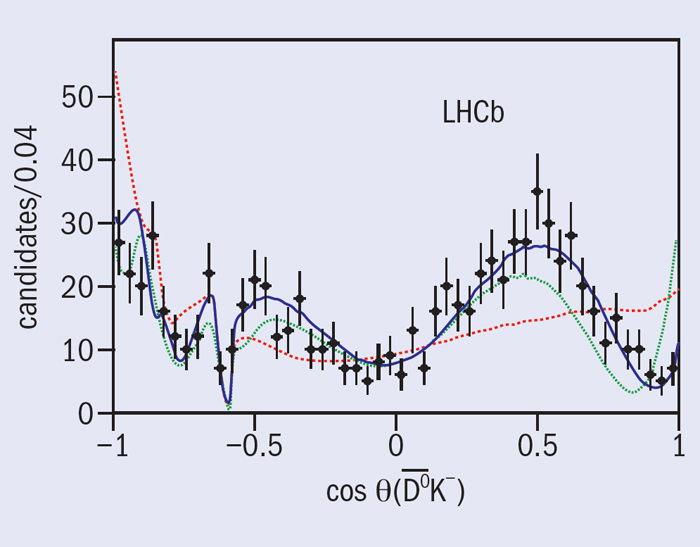
The LHCb collaboration has shown that a D0K– structure with invariant mass 2860 MeV/c2 is composed of two resonances, one with spin 1 and the other with spin 3. This is the first time that a heavy flavoured spin-3 particle has been observed, and it should lead to new insights into hadron spectroscopy.
The LHCb experiment is designed primarily to study CP violation and rare decays of b hadrons. However, the large samples of decays collected are also allowing detailed studies into the spectroscopy of lighter particles that are produced in various different decay channels. LHCb has already determined the quantum numbers of the X(3872) particle and established that the Z(4430)+ state is indeed a resonance. Now, for the first time, the collaboration has used amplitude analysis techniques to study Bs0 → D0K–π+ decays. The well-defined initial and final states allow the determination of the spin and parity of any intermediate D0K– resonance through the angular orientation of the decay products.
The figure shows the angular distribution of events seen in a peak with D0K– invariant mass around 2860 MeV/c2. The data points are well fitted by a model that includes both spin-1 and spin-3 particles (solid blue curve). The models with either only a spin-1 (red curve) or a spin-3 (green curve) resonance are excluded with significance more than 10σ. A similar analysis of the angular distribution for events around the D*s2(2573)– peak establishes, for the first time, that this resonance is indeed spin 2. In addition, the mass of this resonance is determined much more precisely than previous measurements, suggesting that renaming as D*s2(2568)– might be in order.
The identification of a spin-3 resonance at a mass of 2860 MeV/c2 fits with the theoretical expectation for, in spectroscopic notation, the 2S+1LJ = 3D3 state, where S is the sum of the quark spins, L is the orbital angular momentum between the quarks and J is the total spin. It remains to be seen whether the production rate can be explained, because states with spin greater than two have never previously been observed in B-meson decays. With further analyses of the large samples available from LHCb and its upgrade, a new era of heavy-flavour spectroscopy could be beginning.
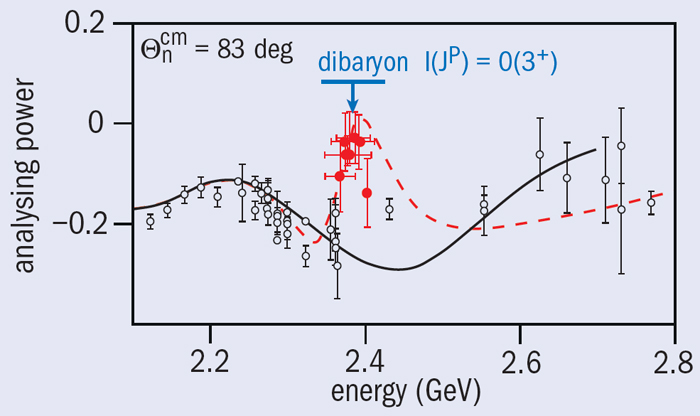
Experiments at the Jülich Cooler Synchrotron (COSY) have found compelling evidence for a new state in the two-baryon system, with a mass of 2380 MeV, width of 80 MeV and quantum numbers I(JP) = 0(3+). The structure, containing six valence quarks, constitutes a dibaryon, and could be either an exotic compact particle or a hadronic molecule. The result answers the long-standing question of whether there are more eigenstates in the two-baryon system than just the deuteron ground-state. This fundamental question has been awaiting an answer since at least 1964, when first Freeman Dyson and later Robert Jaffe envisaged the possible existence of non-trivial six-quark configurations.
The new resonance was observed in high-precision measurements carried out by the WASA-at-COSY collaboration. The first signals of the new state had been seen before in neutron–proton collisions, where a deuteron is produced together with a pair of neutral pions. Now this state has also been observed in polarized neutron–proton scattering and extracted using the partial-wave analysis technique – the generally accepted ultimate method to reveal a resonance. In the SAID partial-wave analysis, the inclusion of the new data produces a pole in the 3D3 partial wave at (2380±10 – i 40±5) MeV.
The mass of the new state is amazingly close to that predicted originally by Dyson, based on SU(6) symmetry breaking. Moreover, recent state-of-the-art Faddeev calculations by Avraham Gal and Humberto Garcilazo reproduce the features of this new state very well. The quantum numbers favour this state as a dibaryon resonance – the “inevitable” non-strange dibaryon predicted by Terry Goldman and colleagues in 1989.
A German/Japanese collaboration working at the University of Mainz has performed the first direct high-precision measurement of the magnetic moment of the proton – which is by far the most accurate to date. The result is consistent with the currently accepted value of the Committee on Data for Science and Technology (CODATA), but is 2.5 times more precise and 760 times more accurate than any previous direct measurement. The techniques used will feature in the Baryon-Antibaryon Symmetry Experiment (BASE) – recently approved to run at CERN’s Antiproton Decelerator (AD) – which aims at the direct high-precision measurement of the magnetic moments of the proton and the antiproton with fractional precisions at the parts-per-billion (ppb) level, or better.
Prior to this work, the record for the most precise measurement of the proton’s magnetic moment had stood for more than 40 years. In 1972, a group at Massachusetts Institute of Technology measured its value indirectly by performing ground-state hyperfine spectroscopy with a hydrogen maser in a magnetic field. This experiment measured the ratio of the magnetic moments of the proton and the electron. The results, combined with theoretical corrections and two additional independent measurements, enabled the calculation of the proton magnetic moment with a precision of about 10 parts in a billion.
In an attempt to surpass the record, the collaboration of scientists from Mainz University, the Max Planck Institute for Nuclear Physics in Heidelberg, GSI Darmstadt and the Japanese RIKEN institute applied the so-called double Penning trap technique to a single proton for the first time (see figure 1). One Penning trap – called the analysis trap – is used for the non-destructive detection of the spin state, through the continuous Stern-Gerlach effect. In this elegant approach, a strong magnetic inhomogeneity is superimposed on the trap, so coupling the particle’s spin-magnetic-moment to its axial oscillation frequency in the trap. By measuring the axial frequency, the spin quantum state of the trapped particle can be determined. And by recording the quantum-jump rate as a function of a spin-flip drive frequency, the spin precession frequency νL is obtained. Together with a measurement of the cyclotron frequency νc of the trapped particle, the magnetic moment of the proton μp is obtained finally in units of the nuclear magneton, μp/μN = νL/νc.
This approach has already been applied with great success in measurements of the magnetic moments of the electron and the positron. However, the magnetic moment of the proton is about 660 times smaller than that of the electron, so the proton measurement requires an apparatus that is orders of magnitude more sensitive. To detect the proton’s spin state, the collaboration used an extremely strong magnetic inhomogeneity of 300,000 T/m2. However, this limits the experimental precision in the frequency measurements to the parts-per-million (ppm) level. Therefore a second trap – the precision trap – was added about 45 mm away from the strong magnetic-field inhomogeneity. In this trap the magnetic field is about 75,000 times more homogeneous than in the analysis trap.
To determine the magnetic moment of the proton, the first step was to identify the spin state of the single particle in the analysis trap. Afterwards the particle was transported to the precision trap, where the cyclotron frequency was measured and a spin flip induced. Subsequently the particle was transported back to the analysis trap and the spin state was analysed again. By repeating this procedure several hundred times, the magnetic moment was measured in the homogeneous magnetic field of the precision trap. The result, extracted from the normalized resonance curve (figure 2), is the value μp = 2.792847350(9)μN, with a relative precision of 3.3 ppb.
In the BASE experiment at the AD the technique will be applied directly to a single trapped antiproton and will potentially improve the currently accepted value of the magnetic moment by at least a factor of 1000. This will constitute a stringent test with baryons of CPT symmetry – the most fundamental symmetry underlying the quantum field theories of the Standard Model of particle physics. CPT invariance implies the exact equality of the properties of matter–antimatter conjugates and any measured difference could contribute to understanding the striking imbalance of matter and antimatter observed on cosmological scales.
With the discovery of a Higgs boson at the LHC two years ago, the last piece of the Standard Model puzzle fell into place. Yet, several mysteries remain, one of which is the enigma of the origin of dark matter. One of the most popular classes of models predicts that the dark matter is made of weakly interacting neutral and colourless particles, χ, with mass ranging from a few to a few hundred giga-electron-volts. The LHC, with its high-energy collisions, provides an excellent pace to search for such particles, and the CMS collaboration has been taking a new look at ways in which they could be produced.
Until recently, the main experimental method to look for dark-matter particles was to exploit their elastic scattering on nuclei inside sensitive detectors, working typically at low temperatures. These direct-detection experiments aim to observe the scattering by measuring the momentum of the recoiling nucleus. While interesting hints for dark-matter detection in various mass ranges have been reported by some of these experiments, none of these hints have been confirmed by later, more precise measurements.
Several years ago, a new idea appeared: to look for the production of pairs of dark-matter particles in high-energy particle collisions, like those at the LHC, via a process described by the same Feynman diagram as the scattering of the dark-matter particles on quarks inside the nuclei, but “rotated” by 90°. While such direct-detection experiments look for the process qχ → qχ, experiments at the LHC can look for qq → χχ. The challenge is to trigger on these events, because dark-matter particles would leave no trace in the detector. One possibility is to search for a more complicated process, where an additional particle, for example a gluon or a photon, is produced together with the dark matter.
The CMS experiment has performed a number of such searches, which are referred to collectively as mono-X searches, because they look for a single object, X, recoiling against the invisible particles. Recently, these searches have been extended to more complicated signatures, for example the production of dark matter in association with a pair of top quarks, which are produced in abundance at the LHC. The new analysis looks for top-quark pairs that are recoiling against a large amount of “missing” transverse momentum, carried away by dark-matter particles.
As figure 1 shows, a new measurement by CMS of the production of top-quark pairs in association with missing transverse momentum sets stringent limits in the plane of the dark-matter particle mass Mχ vs an effective interaction energy scale, M* (CMS Collaboration 2014a). The interaction of dark matter with the known particles is usually assumed to be carried by new “messenger” particles. If the messengers are heavy – which would be a good reason why they have not yet been seen – the interaction can be approximated via a point-like interaction with an effective energy scale of M*. This is similar to Enrico Fermi’s effective theory of muon decay, where the messenger – a W boson – is much heavier than the muon.
Another interesting way to look for dark matter is based on precision measurements of the properties of the Higgs boson. If the mass of the dark-matter particle is less than roughly half of the Higgs boson mass, for instance, Mχ < 60 GeV, then it is possible to look for a direct decay of the Higgs boson into a χχ pair. This decay is called “invisible” because its products are not detected.
The CMS collaboration recently published a search for such invisible Higgs-boson decays, where the production of the Higgs is tagged either by the presence of a Z boson (associated ZH production), or by the presence of two forward jets, characteristic of vector-boson fusion (CMS Collaboration 2014b). The upper limits set on the invisible branching fraction of the Higgs boson are 51% and 58% at a 90% and 95% confidence level, respectively. The former limit can be translated to limits on the mass of the dark-matter particle vs its interaction cross-section with a nucleon, which allows for a direct comparison with the limits coming from various direct-detection experiments, as figure 2 shows. The limits are set for various types of dark-matter particle: scalar, vector, or a Majorana fermion. They are significantly more stringent than the direct-detection limits for low masses for dark matter, emphasizing the complementarity of the searches by the LHC and the direct-detection experiments.
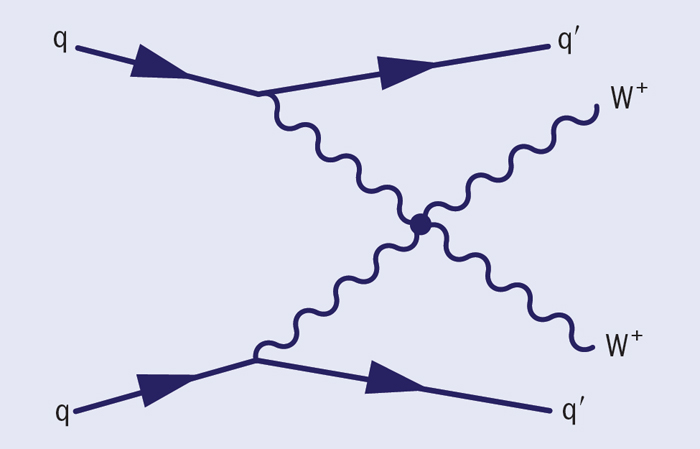
The Standard Model of particle physics has been extremely successful in predicting a vast variety of phenomena – so successful, that it is easy to forget that some of its predictions have not yet been verified. A very important one, related intimately to electroweak symmetry breaking, is that the gauge bosons (γ, W and Z) can interact with each other through quartic interactions. Four such interactions are allowed in the Standard Model: WWWW, WWZZ, WWZγ and WWγγ. The other boson combinations are forbidden on symmetry grounds. Now the ATLAS collaboration has found evidence for a process involving the first of these three – the WWWW interaction.
The WWWW and WWZZ interactions, in particular, are of great theoretical interest. If there were no Higgs boson, the rate of these processes would become unphysically large. With the discovery of a Higgs boson, they have remained interesting as a way to study electroweak symmetry breaking and even to probe for new heavier Higgs bosons. At the LHC, the WWWW interactions can be studied through the radiation of W bosons from quarks (see figure). This is a rare process, making the interaction of W bosons particularly rare and difficult to detect.
The ATLAS collaboration has presented the first evidence of this rare process involving a quartic WWWW interaction in a paper submitted to Physical Review Letters. The ATLAS analysis selected events with two same-charge W bosons (reconstructed through their leptonic decays to electron or muon and their respective (anti)neutrinos) and two jets. The background from other Standard Model processes is reduced by using the fact that these processes rarely produce two leptons with the same electric charge, together with the knowledge that the quarks that recoil off the radiated W bosons will produce jets that are separated widely and have a particularly large invariant mass.
Data collected by the ATLAS experiment show an excess of these events across the predicted background, with a statistical significance of 3.6σ. The measured fiducial cross-section is 1.3±0.4 fb, in agreement with the Standard Model expectation of 0.95±0.06 fb, and provides the first step into a previously untouched segment of the Standard Model.
At the Quark Matter 2014 conference, held in Darmstadt on 19–25 May, ATLAS presented a variety of new results based on lead–lead (PbPb) and proton–lead (pPb) data collected during Run 1 of the LHC. The PbPb results included new measurements of event-by-event correlations and fluctuations of collective flow, high-statistics measurements of photon and W production, and studies of jet quenching using charged particles, single jets, nearby jet pairs and jet-fragmentation functions. The results from pPb data included precision measurements of long-range pseudorapidity correlation and associated azimuthal structures, and high-pT production of charged particles, Z bosons and jets. Here are some of the highlights.
Following the first observation of highly asymmetric dijets in PbPb collisions, the study of jet quenching has been an essential part of the heavy-ion physics programme at the LHC. Measurements of the production of electroweak bosons provide important control data for the study of jet quenching, as well as for investigating nuclear modifications to parton distribution functions. ATLAS presented new results on the measurement of W-boson production via the electron and muon decay modes in PbPb collisions at √sNN = 2.76 TeV, with yields of W bosons obtained as a function of centrality and pseudorapidity. A good agreement was found between the two decay channels. The yields are in agreement with the predictions based on modified next-to-leading-order calculations, while leading-order calculations underestimate the yield.
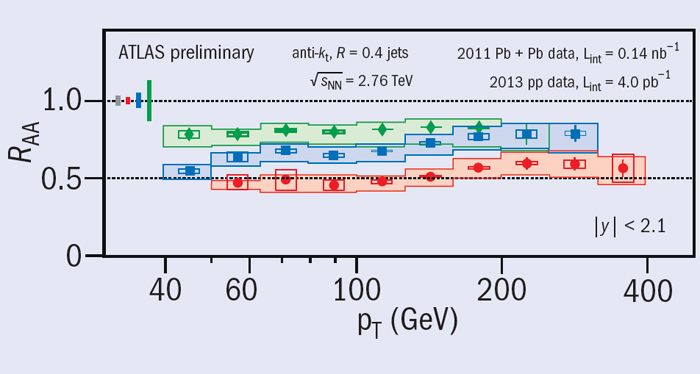
Jets produced in heavy-ion collisions can interact with the medium that is produced in the collisions and lose energy through the phenomenon of jet quenching. This energy loss suppresses the rate of jets produced in these collisions, relative to proton–proton collisions, where no such effects are present. Using the high-statistics proton–proton data set from 2013 as the new reference, ATLAS presented the most precise measurement of jet suppression to date. In central collisions, the jet yields are suppressed by more than a factor of two below a jet transverse momentum, pT, of around 150 GeV (see figure 1), but the suppression is found to be reduced at higher pT.
ATLAS presented first results on direct correlations between the elliptic flow coefficient, v2, and higher-order flow harmonics, v3, v4 and v5, in PbPb collisions. This correlation is obtained via an event-shape engineering technique, in which events within the same centrality interval are divided into different classes according to the observed ellipticity in the forward pseudorapidity. The correlation in v2 for two different ranges in pT (figure 2(a)) shows non-trivial centrality dependence but is linear within a narrow centrality interval. This linearity indicates that viscous effects are controlled by the size of the system, and not its overall shape. The v3–v2 correlations, shown in figure 2(b), reveal a surprising anticorrelation between the ellipticity and triangularity of the initial geometry, which is not accessible via the traditional measurements. The v4–v2 and v5–v2 correlations provide the most direct and detailed picture of the interplay between the linear and nonlinear collective dynamics in the final state of the PbPb collisions.
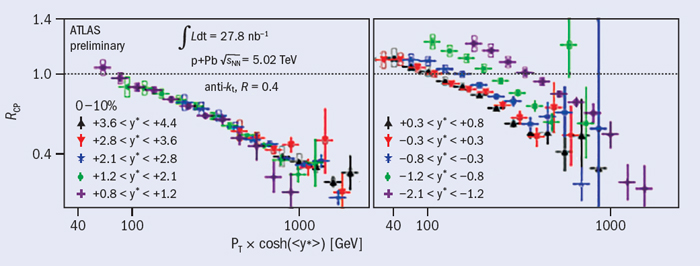
Turning to the pPb runs, the large data sample collected at √sNN = 5.02 TeV in 2013 allowed ATLAS to measure the jet production over the widest kinematic range ever probed in proton–nucleus collisions. This measurement has the potential to reveal how the hard partonic content inside matter is modified deep inside the high-density nucleus, and explores the interplay between hard processes and collision geometry – a major topic at the conference. When considering collisions of all impact parameters, the rate of jets was found to be slightly above what would be expected just from the proton’s collisions with individual nucleons in the lead nucleus. This slight excess is generally consistent with models of the modified parton densities in nuclei. However, when pPb collisions are selected by “centrality”, unexpected effects appear (figure 3). The rate of jets is suppressed strongly in apparently central events (with small impact parameter) and enhanced in those that appear peripheral (large impact parameter). Furthermore, the modifications of the jet rate have a striking pattern as a function of the energy and rapidity, implying that the modifications might originate in the proton, rather than the nuclear, wave function.
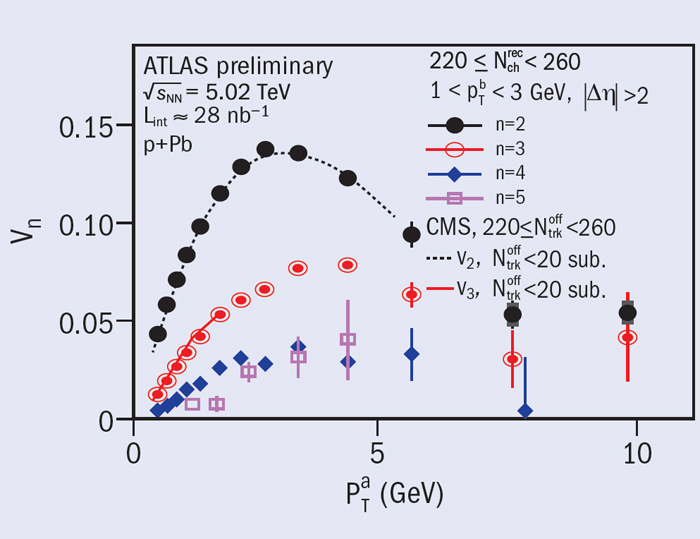
Using the same pPb data set, ATLAS also performed a detailed study of the long-range pseudorapidity correlation and its azimuthal structure, as characterized by the first five Fourier harmonics, v1–v5. The study extended the previous measurements at the LHC of v2 and v3 to higher pT and events with higher charged-particle multiplicities. Moreover, the measurements of v1, v4 and v5 were presented in this context for the first time. As figure 4 shows, the pT dependences of vn are found to be similar to PbPb collisions with comparable multiplicities, suggesting that the collective flow – the main attribute of the dense system created in PbPb collisions – might also be present in pPb interactions.
In the summer of 1964, at the International Conference on High-Energy Physics (ICHEP) in Dubna, Jim Cronin presented the results of an experiment studying neutral kaons at Brookhaven National Laboratory. In particular, it had shown that the long-lived neutral kaon can decay into two pions, which implied the violation of CP symmetry – a discovery that took the physics community by surprise. The news was greeted with some scepticism and met a barrage of questions. Everyone wanted to be satisfied that nothing had been overlooked, and that all other possibilities had been considered carefully and ruled out. People need not have worried. Cronin, together with Val Fitch, visiting French physicist René Turlay and graduate student Jim Christenson, had spent months asking themselves the same questions, testing and cross-checking their results thoroughly. There was, in the end, only one conclusion that they could draw from their observations: CP symmetry was not a perfect symmetry of nature. Only when the researchers were completely satisfied did they make their findings known to the physics community. It is testament to their patience and the quality of their work that the result was so robust to scrutiny. It was 15 years later that Cronin and Fitch received the 1980 Nobel Prize in Physics for the discovery.
The announcement of a broken symmetry was not new to the physics community, having first occurred only a few years previously, when the maximal non-conservation of parity (P) in the weak interaction was discovered by Chien-Shiung Wu and her colleagues in 1957, following the proposal by Tsung-Dao Lee and Chen-Ning Yang that parity violation might explain puzzles in the decays of charged kaons. The disturbing conclusion that the laws of physics depend on the frame of reference was evaded, however, because experiments soon showed that symmetry under charge-conjugation (C) was also maximally violated. Therefore, as long as the combined operation, CP, was a good symmetry, the possibility of an absolute distinction between left-handed and right-handed co-ordinate systems would be prevented, being compensated exactly by the asymmetry between particles and antiparticles. CP invariance had already been suggested as the means to restore symmetry conservation by Lev Landau, and by Lee and Yang, so the situation seemed to be resolved neatly.
No elegant alternative was available to replace CP invariance
When the news came in 1964 that CP was also a broken symmetry, it was harder to accept, because no elegant alternative was available to replace CP invariance. There was also the issue of the treasured CPT theorem: if CPT holds, then CP violation implies violation of time-reversal (T) symmetry. The discovery of CP violation led to the unsettling conclusion that the microscopic laws of physics do indeed allow absolute distinctions between left- and right-handed co-ordinate systems, between particles and antiparticles, and between time running forwards and backwards.
By the early 1960s, the neutral kaon system had already proved to be a rich testing ground for new physics. Its “strange” behaviour had been a matter for scrutiny since its discovery in cosmic rays in 1946. Neutral kaons were found to be produced copiously through the strong interaction, while their long lifetimes suggested decays via the weak interaction. In 1953, Murray Gell-Mann assigned the K0 a “strangeness” quantum number, S = 1, which was conserved by the strong force but not by the weak force. This implied that there must exist a distinct anti-K0, K0, with S = –1. However, because both the K0 and K0 appeared to decay to two pions, the distinction between the particles was blurred somewhat. The situation prompted Gell-Mann and Abraham Pais to propose, in 1955, that the states of definite mass and lifetime, labelled K1 and K2, were instead an admixture of the two particles, and were even and odd, respectively, under the CP transformation. Under the assumption of CP invariance, the K2 was forbidden to decay to two pions. This gave it a much longer lifetime than the K1, as observed.
The primary motivation for the experiment at Brookhaven was to study a phenomenon peculiar to the kaon system called regeneration (see box). Fitch, an expert on kaons, had approached Cronin, who with Christenson and Turlay had built a state-of-the-art spectrometer based on spark chambers, which could be operated with an electronic trigger to select rare events. It was just what was needed for further tests of regeneration. Finding a “new upper limit” for K2 decaying to 2π was a secondary consideration, listed under “other results to be obtained”. The experiment was approved for 200 hours of run-time, and about half of this was devoted to the “CP invariance run”, across five days towards the end of June 1963. Turlay began the analysis of the CP run in the autumn. By the time it was complete, early in 1964, it was clear that 2π decays were present, with 45±10 events, corresponding to about one in 500 of K2 decays to charged modes. In the conclusion of their seminal paper, published in July 1964, the team stated: “The presence of a two-pion decay mode implies that the K2 meson is not a pure eigenstate of CP” (Christenson et al. 1964).
During the year that followed, there was feverish activity in both the experimental and theoretical communities. The discovery of CP violation raised many questions about its origins, and the size of the effect. In particular, it was unclear from experiment whether the effect was occurring in the kaon decays (direct CP violation) or in neutral kaon mixing (indirect CP violation). Indeed, the results could be explained solely by invoking indirect CP violation, which was achieved by the simple, but ad hoc, addition of a small admixture of the CP = +1 eigenstate to the mass eigenstate of the long-lived neutral kaon. This was parameterized by the small complex parameter ε, which had a magnitude of about 2 × 10⁻³. The two states of distinct (short and long) lifetime were then KS = K1 + εK2 and KL = K2 + εK1 (to order ε2).
Among the many theoretical papers that followed in the wake of the discovery of CP violation was that by Lincoln Wolfenstein in August 1964, which proposed the “superweak” model. This was the minimal model, which accounted for the observed effect by adding a single CP-violating contribution to the ΔS = 2 mixing-matrix element between the K0 and the K0. There was no CP-violating contribution to the kaon decays themselves, hence the model offered a prediction that the phenomenon would be seen only as a feature of neutral kaon mixing. Alternatively, a “milliweak” theory would include direct CP-violating contributions to neutral kaon decays (ΔS = 1), as well as to the kaon mixing-matrix element. Another proposal was that the action of an all-pervading long-range vector field of cosmological origin could cause the observed decay to 2π without invoking CP violation. This was a relatively easy option to test experimentally, because it predicted that the decay rate would depend on the energy of the kaons.
The experimental confirmation of the π+π– decay of the long-lived kaon came early in 1965, from groups at the Rutherford Laboratory in the UK and at CERN. These experiments also dispensed swiftly with the vector-field proposal. There was no evidence for the variation of the decay rate with energy. Experiments were now needed to determine the CP-violating parameters η+– and η00 – the ratios of the amplitudes for the KL and KS decays into π+π– or π0π0, respectively (see box in“NA31/48: the pursuit of direct CP violation”) – the measurable quantities being the related magnitudes (|η+–|, |η00|) and phases (φ+–, φ00).
In 1964, Jack Steinberger had realized that the interference between KS and KL decaying to the same final state (π+π–) could provide a valuable way to study CP violation. Results published in 1966 from two such experiments at CERN’s Proton Synchrotron provided measurements of |η+–| and φ+–. The more difficult challenge of measuring decays to π0π0 was taken up by spark-chamber experiments at CERN, Brookhaven and Berkeley. In another experiment at CERN, a beam of KL passed along a pipe through the Heavy-Liquid Bubble Chamber (HLBC), in which the photons from the π0 decays would convert. First results from the spark-chamber experiments seemed to indicate that |η00| was much larger than |η+–|. However, in late 1968 the HLBC collaboration presented a result that was compatible with |η00| = |η+–|. After some confusion, the spark-chamber experiments confirmed this result and also measured φ00.
More refined experiments were to follow, giving more precise measurements for the different decay modes. By the time of the 13th ICHEP in London in 1974 – 10 years after the announcement in Dubna – all results agreed perfectly with the predictions of the superweak model, with no need for direct CP violation. However, a new theory that accounted for CP violation was already in the air – and with it new challenges for a new generation of experiments.
Neutral kaon mixing, oscillations and regeneration
Because the weak interaction does not conserve strangeness, second-order weak-interaction processes mediate transitions between the strangeness eigenstates K0 and K0 . Therefore, the physical particles (eigenstates of mass and lifetime) are linear combinations of K0 and K0 , and states born as one or the other “oscillate” between these two eigenstates before decaying. The two physical eigenstates are called KS and KL – short and long – reflecting their different lifetimes. Allowed to propagate for long enough, a mixed beam of neutral kaons will evolve into a pure beam of KL. Because K0 and K0 have different interactions with matter, if an initially pure KL beam enters matter, the K0 component will interact preferentially, forming a different admixture of K0 and K0 . This admixture must be different from the pure KL that entered the matter, which means that a component of KS is “regenerated” in the beam. Regeneration is not an effect of CP violation, but it is used extensively in “regenerators” in kaon experiments.
In 1973 – almost 10 years after the surprising discovery of CP violation – Makoto Kobayashi and Toshihide Maskawa produced the first theory of the phenomenon in the context of the Standard Model. They proposed a bold generalization of a mechanism that Sheldon Glashow, John Iliopoulos and Luciano Maiani had put forward in 1970. The “GIM mechanism” suppressed strangeness-changing weak neutral currents through the introduction of a fourth quark – charm – and was, in turn, an extension of ideas that began with Nicola Cabibbo. Kobayashi and Maskawa introduced a third generation of quarks (b and t), and a full 3 × 3 unitary matrix parameterizing complex couplings between the quark-mass eigenstates and the charged weak gauge bosons (W±). In this model, a single complex phase in the matrix accounted for all observed CP-violating effects in the kaon system, and provided for CP violation in matrix elements, both for mixing and for decays – that is, for both indirect and direct CP violation.
The discovery of the b quark in 1977 brought the theory of Kobayashi and Maskawa well and truly into the spotlight, and the hunt began to search for the predicted CP violation in the b-quark system (“What’s next for CP violation?”). In kaon physics, the crucial experimental question now was to disprove the superweak model for CP violation (“CP violation’s early days”), which had no need for direct CP violation. In contrast, in the Kobayashi-Maskawa model, the parameter describing direct CP violation, ε´, was nonzero. However, considerable theoretical uncertainty remained concerning its value, which was potentially too small to be measured by the existing experimental techniques. This provided fresh impetus to the search for direct CP violation, and prompted renewed efforts at CERN and at Fermilab to meet the experimental challenges involved.
At CERN, the NA31 experiment was proposed in 1982 with the explicit goal of establishing whether the ratio ε´/ε was nonzero. This required measuring all four decay rates of KS and KL to the charged and neutral 2π final states (see box). The concept behind NA31 was to measure KS and KL decays at the same locations (binned in momentum) to provide essentially the same acceptance for each set of events, and so reduce the dependence on Monte Carlo simulation. The experiment employed a mobile KS target, able to move along a 50-m track, with data-taking stations every 1.2 m. Additionally, beam and detector fluctuations were limited by rapidly alternating the data-taking between KS and KL. The experimental limitations were determined by statistics and background suppression. In both cases, a liquid argon calorimeter was used to achieve the stable, high-quality energy and position resolution that was crucial for reconstructing the π0π0 decays. The calorimeter was developed by exploiting the expertise acquired by the group of Bill Willis at CERN with the first liquid-argon calorimeter at the Intersecting Storage Rings.
In 1988, NA31 found the first evidence for direct CP violation, with a result that was about three standard deviations from zero. However, shortly after this the E731 experiment at Fermilab reported a measurement that was consistent with zero. These conflicting results increased the importance of answering the question on the existence of direct CP violation, and prompted the design of a new generation of detectors, both at CERN (NA48) and at Fermilab (KTeV).
The NA48 experiment was designed to handle a 10-fold increase in beam intensity and event rates compared with NA31. It incorporated a magnetic spectrometer to reduce background in the charged-pion mode and a new calorimeter to replace the liquid-argon original. The novel liquid-krypton calorimeter was fully longitudinally integrating, and had fine granularity in two dimensions to provide faster detection with superior resolution for neutral-pion decays. Systematic effects were also greatly reduced in NA48 by observing all four decay modes concurrently.
In 1999, both the KTeV and NA48 experiments were successful in measuring direct CP violation in the decay of neutral kaons, clearly establishing that CP violation was not just confined to kaon mixing (CERN Courier September 1999 p32). The discovery was later recognized by honours in both Europe and the US. In 2005, the European Physical Society’s High-Energy Physics Prize was awarded jointly to CERN’s Heinrich Wahl, for his “outstanding leadership of challenging experiments on CP violation”, and to the NA31 collaboration as a whole, for having shown, for the first time, direct CP violation in the decays of neutral K mesons. Wahl, who was spokesman of NA31, had a long association with CP-violation experiments since his arrival at CERN in 1969, and was also a major proponent of NA48. Two years later, Italo Mannelli, Wahl and Bruce Winstein, leader of the KTeV collaboration, were awarded the W K H Panofsky prize of the American Physical Society, in recognition of their “leadership in the series of experiments that resulted in a multitude of precision measurements of properties of neutral K mesons, most notably the discovery of direct CP violation”.
During the past 50 years, the study of the neutral-kaon system has gone hand-in-hand with the development of the Standard Model
During the past 50 years, the study of the neutral-kaon system has gone hand-in-hand with the development of the Standard Model. In particular, CP violation in neutral kaons provided the experimental stimulus for Kobayashi and Maskawa to propose the third generation of quarks. That boosted the motivation to search for direct CP violation, which in turn motivated improvements in experimental techniques. The search for direct CP violation across several generations of experiments led to the tantalizing hint of a result in NA31, before the effect was eventually nailed down by KTeV and NA48.
Victor Hugo wrote in Les Misérables: “La symétrie, c’est l’ennui”. A less succinct but more poetic sentiment was expressed by Wolfenstein at the conference on CP violation at Chateau de Blois in 1989, which celebrated the 25th anniversary of the discovery of the unexpected effect. He described broken symmetry as “something more intriguing and perhaps more beautiful than perfect symmetry”. Another 25 years on, that sentiment is stronger than ever.
Measuring direct CP violation in the neutral-kaon system
CP violation in general manifests itself as a difference between the behaviours of particles and antiparticles (apart from the obvious charge inversion). In the original experiment at Brookhaven, the observation of the decay of a KL to two pions could be explained by one effect or by a combination of two effects:
• The KL is an exact eigenstate of CP with eigenvalue –1. Its decay is mediated by an interaction that violates CP, allowing it to decay to a CP = +1 final state (e.g. two pions). Such direct CP violation is parameterized by a complex quantity, ε´.
• The KL eigenstate is an admixture of CP = –1 and CP = +1 components, the CP = +1 part being a (complex) fraction ε of the total. This is the case if the mixing amplitude (which causes transitions between K0 and K0) violates CP. This is called indirect CP violation.
The parameter ε measures the admixture of the CP = +1 eigenstate in the KL mass eigenstate, so if this were the only source of CP violation, the fraction of KL decays with a two-pion final state normalized to Kswould be independent of whether the two pions were π+π–or a π0π0. Any observed difference between the amplitude ratios η+– and η00would be evidence for direct CP violation, and the deviation from unity of their squared-ratio (which depends on the respective event rates) can be shown to be six times the real part of ε´/ε. This is given experimentally by the ratio-of-ratios of event rates. Therefore, to make a measurement of the direct CP violation parameter, the four rates must be measured. Because ε´/ε is of the order of 10–3, the measurements are particularly difficult.
The observation of CP violation was first revealed to an unsuspecting physics community in July 1964 (“CP violation’s early days”). Since then, as figure 1 shows, interest in this puzzling phenomenon has grown significantly. So what is driving this interest and what remains to be studied?
One reason that the field remains so vibrant is the connection with the existence of our matter-dominated universe. As Andrei Sakharov showed in 1967, the absolute distinction between matter and antimatter provided by C and CP violation is – together with baryon number violation and a period of thermal inequilibrium – one of the necessary conditions to generate a net baryon asymmetry from an initially symmetrical state (Sakharov 1967). Moreover, because the Standard Model provides only a small amount of CP violation, and also constrains strongly the amount of baryon number violation and the phase transitions that cause inequilibrium, it cannot account for the amount of matter surviving the almost total annihilation that must have occurred in the early universe. This mystery strikes a chord among scientists and the general public alike, because it points to a way to search for physics beyond the Standard Model and hints at a connection to one of the biggest questions in science: why is there something rather than nothing?
The model introduced by Makoto Kobayashi and Toshihide Maskawa predicted that CP-violation effects should occur also in the B sector
Although answers to such grandiose questions are by their nature elusive, there has been significant progress in understanding CP violation during the past 50 years, and there are excellent prospects for further advances. Perhaps the two most important experimental results in the field, since the discovery, occurred around the turn of the millenium, corresponding to the peak in figure 1. The first was the long-sought observation of direct CP violation through the measurement of a nonzero value of the parameter Re(ε’/εK) of the neutral kaon system (see “NA31/48: the pursuit of direct CP violation”). The second was the discovery of CP violation in the B system.
The model introduced by Makoto Kobayashi and Toshihide Maskawa predicted that CP-violation effects should occur also in the B sector (Kobayashi and Maskawa 1973). Specifically, as Ikaros Bigi, Ashton Carter and Tony Sanda showed, a potentially large asymmetry could be expected between the decay rates of B0 and B0 mesons to the J/ψ KS final state, as a function of time after production (Carter and Sanda 1981, Bigi and Sanda 1981).
To make the observation, however, would require much larger numbers of B mesons than had been produced in previous experiments. Moreover, it would be necessary to have a precise measurement of the decay time, together with knowledge of the flavour of the B meson at production – that is, “flavour tagging”. To meet these challenges, several different designs were put forward, with the preferred solution being a high-luminosity asymmetrical e+e– collider, with a detector equipped with a silicon vertex detector and particle-identification capability. By colliding electrons and positrons at the centre-of-mass energy of the ϒ(4S) meson, the facilities could exploit the resonant production of quantum entangled B–B meson pairs, while the decay vertices of the two particles could be separated owing to the beam-energy asymmetry. Two such “B factories” were built – the PEP-II and KEKB accelerators, with their associated detectors BaBar and Belle, at SLAC in California and KEK in Japan, respectively. In 2001, the first results from the two experiments were enough to establish that CP is indeed violated in the B system (CERN Courier April 2001 p5).
By the time that the research programmes at the B factories had been completed, the accelerators had broken records for the highest instantaneous and integrated luminosities of any particle collider, allowing the measurement of the CP-violation parameter in B0 →J/ψ KS decays to be improved to a precision of better than 3%. This parameter is referred to as sin(2β), because it is sensitive to the angle β of the Cabibbo-Kobayashi-Maskawa (CKM) unitarity triangle, which represents in the complex plane the relation VudVub* + VcdVcb* + VtdVtb* = 0 between elements of the CKM quark-mixing matrix. Other measurements of the properties (angles and sides) of this triangle are all consistent, as figure 2 shows, where the constraints all overlap at the apex of the triangle. This astonishing agreement between data and theory led to the award of the 2008 Nobel Prize in Physics to Kobayashi and Maskawa.
The data represented in figure 2 are the result of enormous effort from experimentalists and theorists alike. Indeed, because the properties of quarks can be studied only through final states containing hadrons, detailed knowledge of the properties of the strong interaction specific to each interaction is necessary to obtain quantitative information about CP violation. In a few “golden modes”, such as the measurement of sin(2β), the associated uncertainties are negligible. But for others such as εK, input from, for example, lattice QCD calculations, is essential.
The large samples of B mesons available at BaBar and Belle allowed several further milestones in CP-violation studies to be achieved. One notable result is the observation of direct CP violation in B0 →Kπ decays (CERN Courier September 2004 p5). Further advances have become possible more recently because an even more copious source of b hadrons has become available – the LHC at CERN. In particular, the LHCb experiment is designed to exploit the potential for heavy-flavour physics at the LHC by instrumenting the forward region of proton–proton collisions, and therefore optimizing the acceptance of the b quark–antiquark pairs produced.
As with BaBar and Belle, LHCb is equipped with excellent vertexing and particle-identification capabilities. An additional challenge for an experiment at a hadron collider is the efficient rejection of minimum-bias events that occur at a high rate. This is achieved in LHCb by exploiting signatures of the decay products of heavy flavoured particles, such as muons with comparatively high transverse momentum and a secondary vertex that is significantly displaced from the proton–proton interaction point. Unlike the B factories, LHCb can study all types of b hadron – a feature that allowed it to make the first observation of direct CP violation in B0s meson decays (CERN Courier June 2013 p7). LHCb has also discovered very large – and rather puzzling – CP-violation effects in decays of B mesons to three particles (pions or kaons) (CERN Courier November 2012 p7), which need to be understood with further experimental and theoretical investigations.
Future prospects
What, then, remains for studies of CP violation? One important point is that the measurements shown in figure 2 are, on the whole, not limited by theoretical uncertainties. Because the consistency of the measurements provides strong constraints on theories of physics beyond the Standard Model, there is good motivation to continue to improve them. For example, the measurement of the angle γ achieved by studying CP-violation effects in B → DK decays has negligible theoretical uncertainty. The current constraint, combining results from BaBar, Belle and LHCb, gives an uncertainty of about ±10°. Reducing this uncertainty by an order of magnitude will either further constrain models that contain new sources of CP violation or, perhaps, reveal the presence of new physics. This is one of the main objectives of the next generation of B-physics experiments: the upgraded SuperKEKB accelerator and Belle2 detector at KEK, and the LHCb upgrade at CERN.
There are several other important CP-violating observables in the B system, where the Standard Model predicts small effects, but new physics could result in much larger values being measured in experiments. One good example is the decay mode B0s →J/ψ φ, which is the B0s sector equivalent of B0 →J/ψ KS, and probes a parameter labelled βs. In the Standard Model, βs is expected to be around 1°, whereas the latest results from LHCb and other experiments limit its value to less than about 4°. Similarly, the parameters describing CP violation in the B0– B0 (and B0s–B0S) mixing amplitudes, which are the B-system equivalents of εK, are expected to be vanishingly small. This has been a topic of considerable interest during the past few years, because the D0 experiment based at Fermilab’s Tevatron reported an anomalous charge asymmetry in events with two same-sign muons (CERN Courier July/August 2010 p6). These same-sign muons occur in events where both particles resulting from the hadronization of a b quark–antiquark pair decay semileptonically, but one of them decays only after oscillating into its antipartner. The inclusive asymmetry could, therefore, be caused by CP violation in either or both of the B0– B0 and B0s–B0S mixing amplitudes. However, measurements of the parameters describing CP violation in each of the two amplitudes individually do not reveal any discrepancy with the Standard Model, as figure 3 shows. Improved measurements are needed to resolve the situation and are eagerly anticipated.
Contemporary CP-violation searches are not confined to B mesons. Heavy-flavour experiments are abundant sources of charm hadrons, which can be used to investigate matter–antimatter asymmetries. Indeed, D0–D0 oscillations provide a particularly interesting “laboratory” for such searches, because this is the only system involving up quarks in which phenomena similar to those measured in the K0–K0 and B0–B0 systems can be probed. Within the Standard Model, the CP-violating effects are tiny, which provides a potential opportunity for new physics signatures to appear. The small mixing rates make these measurements extremely challenging, but experiments have now been able to establish the mixing phenomena at a high level of significance (CERN Courier November 2012 p7). Consequently, charm-physics experiments are becoming more focused on CP violation, and further progress can be foreseen as the accumulated data samples increase.
Because the top quark does not hadronize, it must be studied in different ways from the lighter heavy quarks. It is also, of course, an excellent tool for probing beyond the Standard Model. Among the many tests of the top sector being performed with the unprecedented samples collected by the ATLAS and CMS experiments are studies of CP violation in both the production and decays of top quarks. The discovery of a Higgs boson also provides the opportunity for ATLAS and CMS to search for CP violation in the Higgs sector, which is absent in the Standard Model.
Indeed, the description of CP violation within the context of the Standard Model is highly restrictive: it appears only among the flavour-changing interactions of the quarks. As a consequence, tests of CP violation in other sectors can be carried out with zero Standard Model background, and are therefore particularly sensitive to new sources of asymmetry. In addition to the examples given above, searches for nonzero electric dipole-moments of fundamental particles such as the electron are sensitive to flavour-conserving CP-violation effects. Owing to the amazingly high precision that is achieved in experiments, the measurements are sensitive to the small effects that are expected to be induced by new physics at the tera-electron-volt scale (Baron et al. 2014). As yet, however, there are no hints of a nonzero electric dipole-moment.
Perhaps the best chance of a discovery of a new source of CP violation in the medium-term future is in the lepton sector. Neutrino oscillations can be described by the Pontecorvo-Maki-Nakagawa-Sakata mixing matrix in an analogous way to the CKM matrix of the quark sector. (However, because the leptons do not couple to the strong interaction, the phenomenology of quark and lepton mixing is, in essentially all other respects, completely different.) The recent measurement of a nonzero value of the mixing angle θ13 by Daya Bay (CERN Courier April 2012 p8) and other experiments shows that all three flavours of neutrino mix with each other to give the physical eigenstates, which is a prerequisite for CP violation to be observable.
The parameter that describes CP violation in neutrino mixing, δCP, can be measured by comparing the probabilities for electron (anti)neutrino appearance in a muon (anti)neutrino beam. The MINOS experiment, which detects neutrino beams from Fermilab with a far detector at a baseline of 735 km in the Soudan mine in Minnesota, and the T2K experiment, which uses neutrinos from the Japan Proton Accelerator Complex (J-PARC) and a far detector 295 km away in the Kamioka mine, have already made first steps in this direction. Now the NOvA experiment is also under way in the US, using the upgraded beam at Fermilab with a baseline of 810 km (“NOvA takes a new look at neutrino oscillations”). However, far better sensitivity will be needed. For this reason, new and upgraded experiments have been proposed. These include the Long Baseline Neutrino Facility (“US particle-physics community sets research priorities”) in the US and Hyper-Kamkiokande (Hyper-K) in Japan, as well as possible projects in Europe and elsewhere. Example sensitivities to δCP in these experiments are shown in figure 4. Because the observation of CP violation in the lepton sector would give the possibility to explain the baryon asymmetry of the universe, through a mechanism known as leptogenesis, these projects are among the highest-priority science goals in the international particle-physics community. The construction and operation of such projects might take 20 years, but if CP violation is discovered in the lepton sector, it will be worth the wait.
Nonetheless, no one knows currently in which, if any, of these sectors the new sources of CP violation that must exist will appear first. It is therefore essential to continue to explore on as many fronts as possible. In this regard, it might be that the next big breakthrough in the field comes from the same particle that started the whole field off 50 years ago. Decays of kaons to final states containing a pion and a neutrino–antineutrino pair can provide a theoretically clean measurement of the height of the unitarity triangle, and therefore of the amount of CP violation described by the CKM matrix. Moreover, because these decays are highly suppressed, they are highly sensitive to physics beyond the Standard Model. Within the next few years, the NA62 experiment at CERN and the KOTO experiment at J-PARC will improve significantly on previous measurements of these decays, and might, therefore, start to provide hints of CP violation beyond the Standard Model. Such a discovery would provide fertile ground for investigations for the next 50 years.
To provide the best experiences, we use technologies like cookies to store and/or access device information. Consenting to these technologies will allow us to process data such as browsing behavior or unique IDs on this site. Not consenting or withdrawing consent, may adversely affect certain features and functions.
Functional
Always active
The technical storage or access is strictly necessary for the legitimate purpose of enabling the use of a specific service explicitly requested by the subscriber or user, or for the sole purpose of carrying out the transmission of a communication over an electronic communications network.
Preferences
The technical storage or access is necessary for the legitimate purpose of storing preferences that are not requested by the subscriber or user.
Statistics
The technical storage or access that is used exclusively for statistical purposes.The technical storage or access that is used exclusively for anonymous statistical purposes. Without a subpoena, voluntary compliance on the part of your Internet Service Provider, or additional records from a third party, information stored or retrieved for this purpose alone cannot usually be used to identify you.
Marketing
The technical storage or access is required to create user profiles to send advertising, or to track the user on a website or across several websites for similar marketing purposes.