The existence of particles with fractional charges and fractional baryon numbers was a hard sell in 1964 when Gell-Mann and Zweig independently proposed the quark model. Physicists remained sceptical until the discovery of the J/ψ meson 10 years later. Heavier than anything previously seen and extremely narrow, with a width of just 0.1 MeV and a mass of 3097 MeV, the J/ψ pointed to the existence of a new quark with its own quantum number. This confirmed Glashow, Iliopoulos and Maiani’s 1970 hypothesis, which they cooked up to explain peculiarities in rare kaon decays. Any doubt as to the existence of a charm–anticharm system was eliminated by observing narrow excitations of the J/ψ, which lined up as expected in non-relativistic quantum mechanics. The spectrum of charmonium mesons soon became populated by states with widths up to hundreds of MeV as their masses surpassed the threshold for decaying to a pair of “open-charm” mesons with a single charm quark each.
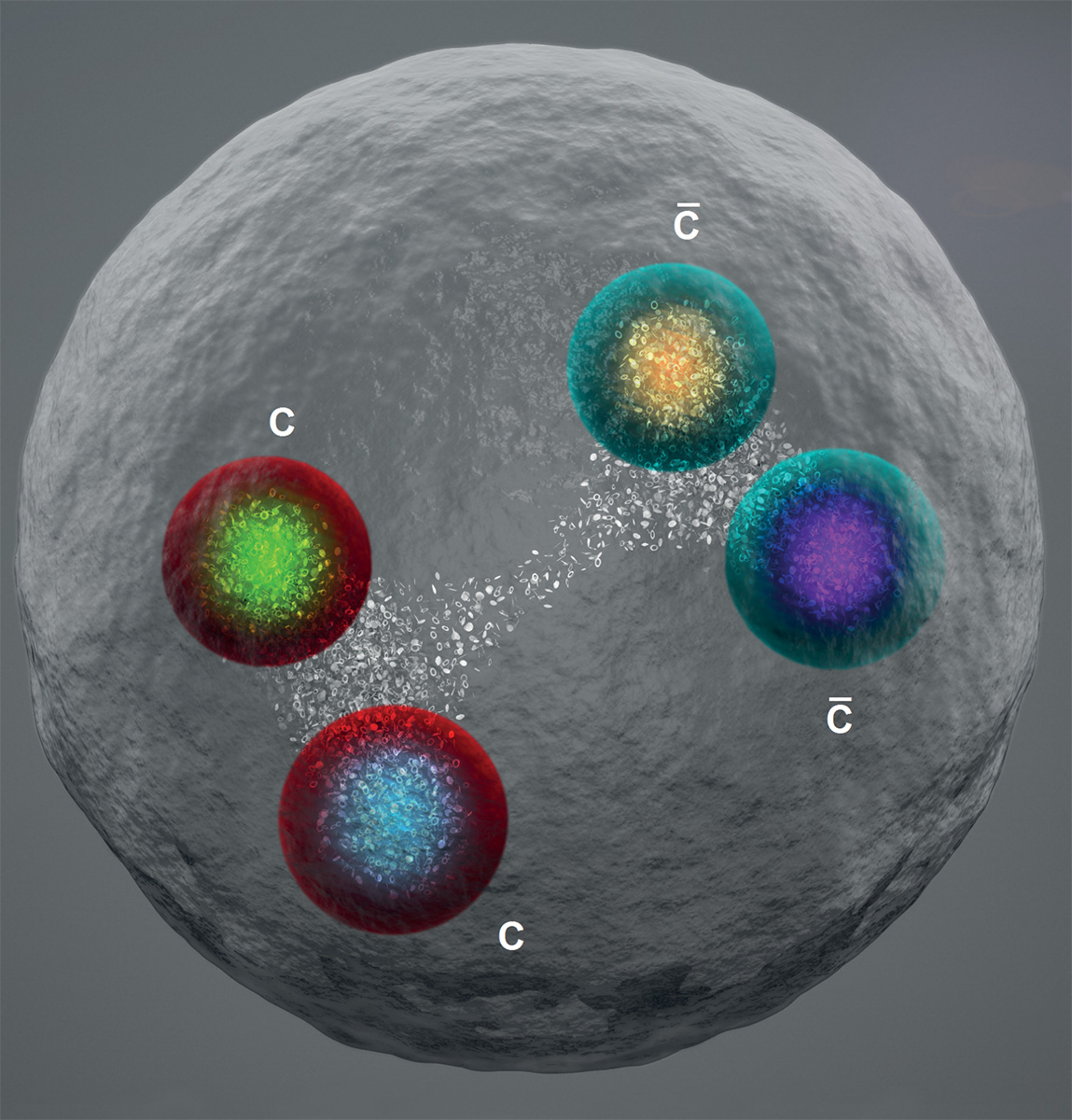
Hadron spectroscopy continues to be a rich area of fundamental exploration today, with results from collider experiments over the past two decades revealing the existence of multi-quark states more exotic than the familiar mesons and baryons (CERN Courier April 2017 p31). The LHCb experiment at CERN is at the forefront of this work. Now, a structure in the J/ψ-pair mass spectrum consistent with a tetraquark state made up of two charm quarks and two charm antiquarks has been observed by the collaboration. With doubly hidden charm, the new cccc state is the most significant evidence so far for the existence of tightly bound tetraquarks composed of a pair of colour-charged “diquarks”, and sheds light on a difficult-to-model regime of quantum chromodynamics (QCD).
Multi-quark states
Gell-Mann and Zweig both acknowledged that the symmetries which led to the quark hypothesis allowed for more complicated quark configurations than just mesons (qq) and baryons (qqq). Tetraquarks (qqqq), pentaquarks (qqqqq) and hexaquarks (qqqqqq or qqqqqq) were all suggested. In the early 1970s, a deepening understanding of the dynamics of strong interactions brought about by QCD only furthered the motivation for seeking new multi-quark states. QCD not only predicted attractive forces between a quark and an antiquark, and between three quarks, but also between two quarks.
The attraction between two quarks can easily be proven when they are close together and the strong coupling constant is small enough to allow perturbative calculations. Similar interactions also likely occur in the non-perturbative regime. Such systems, known as diquarks, have the colour charge of an antiquark. (For example, red and blue combine to make an anti-green diquark.) As coloured objects, they can be confined in hadrons by partnering with other coloured constituents. A diquark can attract a quark to create a simple baryon. Alternatively, a diquark and an antidiquark can attract each other to create a tetraquark. As a result of their direct colour couplings, such compact tetraquarks can have binding energies of several hundreds of MeV.
Compact two-diquark tetraquarks stand in stark contrast to the alternative “molecular” model for tetraquarks, which was named by loose analogy with the exchange of electrons between atoms in molecules. In this picture, the tetraquark is arranged as a pair of mesons that attract each other by exchanging colour-neutral objects, such as light mesons and glueballs – an idea first proposed in 1935 by Hideki Yukawa, in the context of interactions between nucleons. Such exchanges only provide a binding energy of a few MeV per nucleon.
Molecular tetraquarks are therefore expected to be only loosely bound, with masses near the sum of the masses of their constituent mesons, however they could have rather narrow widths if their mass lies below the “fall-apart” threshold. As such states are most likely to be created without angular momentum between the mesons, the spin-parity combinations available to them are highly restricted. In contrast, a rich spectrum of radial and angular momentum excitations between the coloured constituents is predicted for diquark tetraquarks. The widths of these states could be large, as they can easily fall apart into lighter hadrons, with their binding energy transformed into a light quark–antiquark pair.
Unfortunately, it is difficult to rigorously apply QCD in the confining regime of multi-quark states. It is therefore up to experiments to discover which multi-quark states actually exist in nature. There have been some hints of tetraquark states built out of light quarks, though without definite proof. This is largely because additional light quark pairs can easily be created in the decay process of simple mesons and baryons, and the highly relativistic nature of such states makes model predictions for their excitations unreliable. Hidden charm states have proved helpful again, however, as the charmonium spectrum and the properties of such states are well predicted.
Experiments to the fore
Molecular tetraquark proposals were fuelled in 2003 by the unexpected discovery by the Belle collaboration, at the KEKB electron–positron collider in Tsukuba, Japan, of a new narrow state, right at the sum of the masses of a charmed-meson pair. Unlike other charmonium states near its mass, the state is surprisingly narrow, with a width of the order of just 1 MeV. Originally named X(3872), it is now conventionally referred to as χc1(3872), reflecting its nature as a possible triplet P-wave state with hidden charm and one unit of total angular momentum. Despite subsequent results from collider experiments around the world, there is no consensus about its exact nature, as it variously exhibits features of simple charmonium or a loosely bound molecule.
It is up to experiments to discover which multi-quark states actually exist in nature
Stronger evidence for the loose meson–meson binding of multi-quark states was provided by observations in 2013 of a hidden-charm tetraquark candidate Zc(3900) by the BES III collaboration at the BEPC II electron–positron collider in Beijing, China, and by Belle, and of the Zc(4020), also by BES III. Since they have electrically charged forms, they cannot be counted as charmonium states. They are both relatively narrow states near meson–meson thresholds for open charm, with widths of the order of tens of MeV. They are definitely tetraquarks, though it is still a moot point if they are genuinely bound states or merely manifestations of non-binding hadron–hadron forces that manifest in complicated forms. The molecular interpretation had also been reinforced in 2012 by Belle’s observations of the hidden-beauty Zb(10610) and Zb(10650) tetraquarks. These states also have relatively narrow widths of the order of tens of MeV and masses near the threshold for falling apart, in this case to “open-beauty” mesons.
Pentaquark observations have also weighed in on the debate. Last year’s observation of three narrow hidden-charm pentaquarks by the LHCb collaboration, with widths below tens of MeV and masses close to the charm meson-baryon threshold (CERN Courier May/June 2019 p15), also points to loose hadron–hadron binding, in this case between a meson and a baryon.
Bucking the trend
Yukawa-style bindings cannot, however, explain a large number of broader tetraquark-like structures with hidden charm, with widths of hundreds of MeV, which are not near any hadron–hadron threshold. Such states include the charged Zc(4430) observed by Belle in 2008 and later confirmed by LHCb in 2014, and a family of states that decay to a J/ψ φ final state, including X(4140) and X(4274), which were observed by the CDF collaboration at Fermilab in 2009 and later by CMS and LHCb at CERN. These states could be either manifestations of diquark interactions or kinematic effects near the fall-apart threshold. No single simple model can account for all of them.
Reaching states with hidden double charm (cccc) now promises new insights into multi-quark dynamics, as all the quarks are non-relativistic. Furthermore, there is no known mechanism for two charmonium mesons to be loosely bound, according to a molecular model, as no light valence quarks are available to be exchanged. Compact diquark-type tetraquarks have been predicted for such quark combinations, but it is not clear whether they might lead to experimentally detectable signatures – the tetraquarks could be too broad or their production rate too small. While collisions at the LHC provide enough energy to simultaneously produce pairs of charm–anticharm quark combinations, getting them close enough together to form diquarks is a tall order. Additionally, while observations of beauty-charm mesons such as Bc and doubly charmed baryons such as Ξcc showed that LHCb has reached the sensitivity to detect the interactions of two heavy quarks, it was unclear until recently if the interactions of diquark-model tetraquarks could be detected. The observation, reported in July, by LHCb, of a highly significant J/ψ-pair mass structure is therefore an exciting moment for the study of multi-quark dynamics.
Introducing the X(6900)
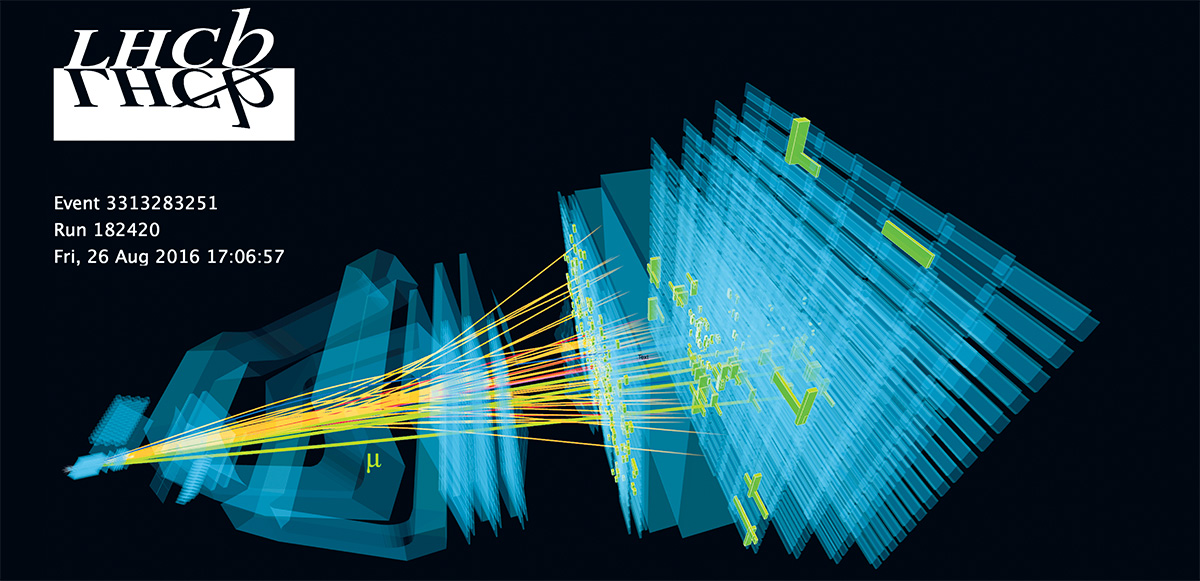
Exploiting the full data set collected from 2011 to 2018, LHCb investigated the J/ψ-pair invariant mass spectrum, where J/ψ meson candidates are reconstructed from the dimuon decay mode. A narrow peaking structure at 6900 MeV and a broader structure at approximately twice the J/ψ mass threshold was observed. The structure of X(6900) is consistent with the signature of a resonance (see figure), suggesting a four-charm-quark state.
While the peaking X(6900) structure is close to the χc0χc1 meson-pair threshold, its width, of the order of a hundred MeV, seems too large to fit into the loose-binding scheme, wherein decay modes other than the “fall-apart” topology are expected to be strongly suppressed, and in any case, there is no known loose binding mechanism between two charmonium states. Charmonium-pair re-scattering effects are also disfavoured due to the requirements of such interactions. This observation is therefore the most intriguing experimental indication so far for hadrons made out of diquarks.
It is less clear if the observed structure is made of one state, or several that may or may not interfere with each other. There is no information on the spin-parity of the observed structure. Neither do we yet know if mass structures also appear in the invariant mass spectra of other charmonium or doubly charmed baryon pairs.
This observation is the most intriguing experimental indication so far for hadrons made out of diquarks
The first LHCb upgrade is currently in progress and data taking will recommence at the beginning of LHC Run 3 in 2022, with a second upgrade phase planned to collect a much larger data set by 2030. The ATLAS and CMS experiments have highly performing muon detectors too, and could also make significant contributions to the study of the new X(6900) structure, with both existing and future data. A key contribution may also be made by Belle’s successor, Belle II, currently in its start-up phase, which observes electron–positron collisions at the SuperKEKB collider at energies above the observed J/ψ-pair mass structure. It is unclear, however, if the collision energy, luminosity and electromagnetic production cross sections will be high enough to achieve the required sensitivity.
Research is already moving forward quickly, with further evidence for diquark tetraquarks coming from an even more recent discovery by LHCb of two “X(2900)” states with widths between 57 and 110 MeV. As they decay to a D+K– final state, they are both openly charming and openly strange. Their most likely composition is that of a (cs)(ud) diquark tetraquark. While the X(2900) states decay strongly, similar heavy-light diquark systems, such as (cc)(ud), (bc)(ud) and (bb)(ud), have been studied theoretically, resulting in varying degrees of confidence that some may be stable with respect to strong interactions, and instead decay weakly, with measurable lifetimes. Hunting for such states is an exciting prospect for the upgraded LHCb experiment.
LHCb’s new tetraquark observations have once again thrown open the debate on the nature of multi-quark states. With the theory still mired in non-perturbative calculations, experimental observations will be decisive in leading the development of this subject. The community is waiting eagerly to see if other experiments confirm the LHCb observation, and shed light on its nature.
Steven Weinberg’s continuous leadership in particle physics, gravity and cosmology, has been recognised by a Special Breakthrough Prize in Fundamental Physics. While his contribution to the genesis of the Standard Model has undoubtedly been Weinberg’s greatest single achievement, states the selection committee for the $3M prize, he would be recognised as a leader in the field even if he had not made this particular contribution. “Steven Weinberg has developed many of the key theoretical tools that we use for the description of nature at a fundamental level,” said Juan Maldacena of the Institute for Advance Study in Princeton, chair of the selection committee.
Weinberg’s 1967 paper “A Model of Leptons” determined the direction of high-energy particle physics through the final decades of the 20th century and is one of the most cited in theoretical physics. The paper applied the notion of spontaneous symmetry breaking to the weak interaction, revealing that it is unified with the electromagnetic interaction and predicting the existence of the W, Z and Higgs bosons – all of which went on to be discovered at CERN. Weinberg also used spontaneous symmetry breaking to account for the masses of elementary fermions, which the LHC experiments are now probing. The electroweak theory won Weinberg, Abdus Salam and Sheldon Lee Glashow the 1979 Nobel Prize in Physics.
There was a special pleasure in being awarded the prize, because the selection committee is composed of a younger generation
Steven Weinberg
“Of course, nothing compares with the Nobel Prize in prestige, if only because of the long history of great scientists to whom it has been awarded in the past,” says Weinberg, when asked to compare the two awards, “but for me there was a special pleasure in being awarded the Breakthrough Prize, because the selection committee is composed of a younger generation of outstanding physicists who are today playing a leading role in research.”
The prize committee also cites Weinberg’s achievements in communicating science. His teaching and “meticulously written textbooks” have had a major influence on succeeding generations, they say, while also acknowledging Weinberg’s highly visible public role as a spokesman for science and rationality.
Weinberg is currently the Jack S Josey – Welch Foundation Chair in Science at the University of Texas at Austin.
Breakthrough Prize for Eöt-Wash group
On the same day, September 10th, the 2021 Breakthrough Prize in Fundamental Physics was announced. Also worth $3M, it is shared between Eric Adelberger, Jens H Gundlach and Blayne Heckel, the leaders of the Eöt-Wash group at the University of Washington, “for precision fundamental measurements that test our understanding of gravity, probe the nature of dark energy and establish limits on couplings to dark matter”. The trio have built equipment sensitive enough to measure the force of gravity on unprecedentedly low scales to test the inverse square law, with results earlier this year showing that the law holds true down to distances of 52mm.
Three New Horizons in Physics Prizes, each worth $100,000 and designed to recognise early-career researchers, were awarded to: Tracy Slatyer (MIT) “for major contributions to particle astrophysics, from models of dark matter to the discovery of the ‘Fermi Bubbles'”; Rouven Essig (Stony Brook University), Javier Tiffenberg (Fermilab), Tomer Volansky (Tel Aviv University) and Tien-Tien Yu (University of Oregon) “for advances in the detection of sub-GeV dark matter especially in regards to the SENSEI experiment”; and Ahmed Almheiri (IAS), Netta Engelhardt (MIT), Henry Maxfield (UC Santa Barbara) and Geoff Penington (UC Berkeley) “for calculating the quantum information content of a black hole and its radiation”.
The Breakthrough Prize in Fundamental Physics, which has taken place annually for the past nine years, was created “to recognize those individuals who have made profound contributions to human knowledge”, while the Special Breakthrough Prize in Fundamental Physics has only been handed out on six occasions and is not limited to recent discoveries. Last year, theorists Sergio Ferrara, Dan Freedman and Peter van Nieuwenhuizen received a Special Breakthrough Prize for their 1976 invention of supergravity. Other past winners include Steven Hawking (2013); the LIGO collaboration (2016); and seven CERN scientists (2013) for the discovery of the Higgs boson. The 2021 prize ceremony is due to take place in March.
The first evidence for the coupling of the Higgs boson to a second-generation fermion, the muon, has been reported at the LHC. At the 40th International Conference on High Energy Physics, held from 28 July to 6 August, CMS reported a 3σ excess of H → μμ decay candidates compared to the expected sample under the hypothesis of no coupling between the Higgs boson and the muon. A similar analysis by the ATLAS collaboration yielded a 2σ excess for the coupling.
The latest measurements of the Higgs boson by ATLAS and CMS follow 5σ observations of its coupling to the tau lepton in 2015 and to the top and bottom quarks in 2018, all of which are third-generation fermions. Its couplings to W and Z bosons have also been established at 5σ confidence. Within present experimental accuracy, all couplings between the Higgs boson and other Standard Model particles correspond to the strength of interaction that would give the particles their observed masses, according to the Brout–Englert–Higgs mechanism. In this model, the particles acquire mass through spontaneous symmetry breaking; the W and Z as a result of a local gauge symmetry and the fermions, such as the muon, as a result of Yukawa couplings to the Higgs field – a novel type of interaction among fundamental particles that is not derived from a symmetry principle. Any deviation from the expected couplings would imply that the Higgs sector is more complicated than this minimal scenario.
Couplings to lighter particles are expected to be proportionately smaller and more difficult to observe. The decay to two muons, H → μμ, is expected to occur with a branching fraction of just one in 5000 Higgs-boson decays, and is overwhelmed by backgrounds from the Drell–Yan process.
The new results sharpen the question of why there is a hierarchy of particle masses
John Ellis
The new ATLAS and CMS analyses, which deploy the entire 13 TeV Run-2 data set, include events where the Higgs boson was produced according to four topologies gluon fusion, which accounts for the creation of 87% of the Higgs bosons observed at the LHC; vector-boson fusion; the production of a Higgs boson in association with a weak vector boson; and its production in association with a top quark–antiquark pair. Uniquely, CMS simulated the background to the vector-boson-fusion signal rather than fitting it from data – a procedure that would have incurred additional statistical uncertainty – resulting in the topology contributing roughly equal statistical power compared to gluon fusion.
Machine learning
“The first evidence in CMS was reached thanks to the excellent performance of our muon and tracking systems, and an improved signal/background discrimination with machine-learning techniques,” says Andrea Rizzi, CMS physics co-coordinator.
The signature for the decay is a small excess of events near a muon-pair invariant mass of 125 GeV – the mass of a Higgs boson. CMS reports an overall signal strength of 1.2 ± 0.4, while ATLAS finds a signal strength of 1.2 ± 0.6, with the uncertainties dominated by their statistical component. “Both measurements are compatible with the Standard Model,” says ATLAS physics coordinator Klaus Mönig. “Assuming the H → μμ coupling predicted by the Standard Model, and extrapolating the current results, the combined sensitivity could get near the observation threshold of 5σ at the end of Run 3, from 2022 to 2024.”
If there is only a single Higgs field, it should provide the masses for all the Standard-Model particles, but there may be additional Higgs fields that could make contributions to their masses. The new results therefore reduce the scope available to such multi-Higgs models, and sharpen the question of why there is a hierarchy of particle masses, says John Ellis of King’s College London. “Why is the Higgs coupling to the muon so different from its coupling to the tau lepton, whereas the couplings of the W boson to tau leptons and muons are equal to within a couple of percent? The more we learn about the Higgs, the more mysterious it seems!”
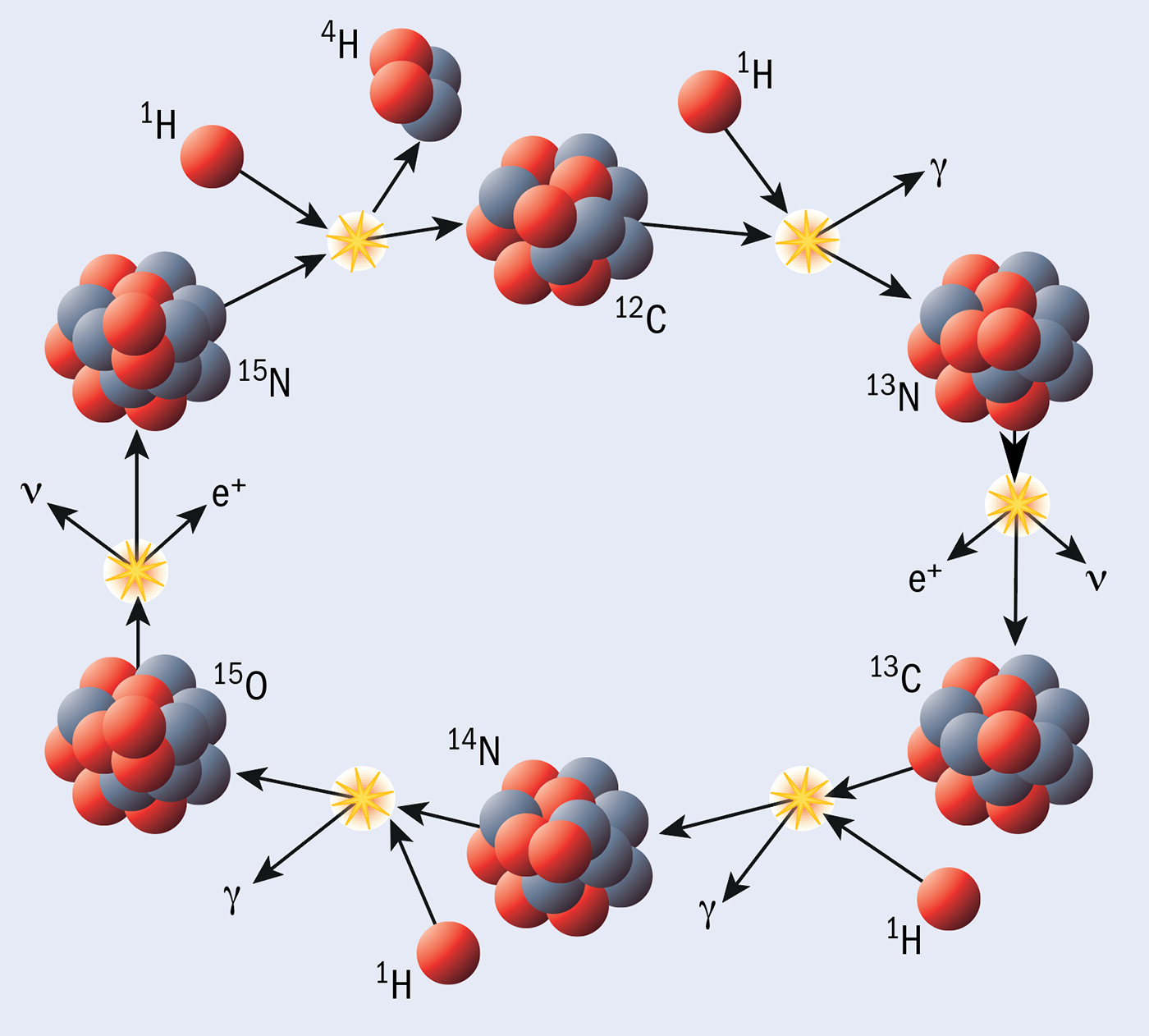
Despite being our closest star, much remains to be learned about the exact nature of the Sun and how it produces its energy. Two different fusion processes are thought to be at play in the majority of stars: the direct fusion of hydrogen into helium, which is thought to be responsible for approximately 99% of the Sun’s energy; and the fusion of hydrogen into helium via the six-stage carbon-nitrogen-oxygen (CNO) process (see diagram below). Although theorised in the 1930s, direct proof of this fusion process was missing. As a result, the amount of energy produced through the CNO cycle and the amount of elements such as carbon and nitrogen in the Sun’s core could only be estimated from models. Recently, the international Borexino collaboration directly detected neutrinos produced in the CNO cycle, providing the first direct proof of this process.
The Borexino detector was specifically developed to detect the extremely rare interactions between solar neutrinos and a highly pure liquid scintillator. It comprises 278 tonnes of scintillator held in a nylon balloon deep under the mountains at Gran Sasso National Laboratory in Italy. In 2012 the experiment detected neutrinos from the main solar fusion process. Now, one year before the end of its scheduled operations, the Borexino team has fully probed the solar energy production. The discovery of the CNO process was complicated both by the lower flux of neutrinos compared to that from the main fusion process, and by the large similarity between the signal and one of the main irreducible background processes taking place in the detector.
Battling background Despite minimising backgrounds from cosmic rays, trace amounts of radioactive nuclei which leak into the active volume of Borexino produce a background of the same magnitude as the sought-after signal. The most important background for the CNO analysis was 210Bi, a product of 210Pb of which trace amounts can diffuse into the scintillator from the nylon balloon surface. Since the energy spectrum of the beta-decay of 210Bi resembles that induced by neutrinos produced in the CNO process, the key to detecting the CNO neutrinos was to directly measure the 210Bi-induced background. This was made possible by delving into the fluid dynamics of the liquid scintillator.
The 210Bi in Borexino’s scintillator produces 210Po, which undergoes alpha decay with a half-life of 134 days. As the alpha decay is relatively easy to identify, the team used 210Po decays to deduce the number of 210Bi decays in the detector. However, as the different isotopes move around in the liquid it cannot be guaranteed that the 210Bi distribution is equal to 210Po unless the flow in the detector is well understood. To overcome this, the collaboration had to reduce the flow of the scintillator material by stabilising the temperature, both through insulation and direct temperature regulation. After the 210Po decay distribution inside the detector was found to be stable over times exceeding its half-life, an area with low 210Po activity was identified and used to measure the CNO neutrinos with a well-understood and relatively low background.
This was made possible by delving into the fluid dynamics of the liquid scintillator
The spectral measurements performed of the CNO cycle exclude a non-detection with a statistical significance of more than five sigma. The measured solar-neutrino flux (7.2+3.0−1.7 counts per day per 100 tonnes of target, at 68% confidence) furthermore agrees with models which predict that 1% of the energy produced in the Sun comes from the CNO process. Additionally, the results shine light on the density of elements other than hydrogen and helium — the metallicity — of the Sun’s core, which in recent years has been debated to potentially differ from that on the solar surface. The Borexino results indicate that the density is likely similar although more precise measurements with future detectors are required for precision measurements.
This groundbreaking study, which required not only some of the most precise techniques used in particle physics but also complex fluid-dynamics simulations, confirms predictions made almost a century ago. In doing so it provides a first probe into the processes at the core of the Sun and thus of other stars. Although it has now been proved that the CNO process is responsible for only a fraction of the Sun’s energy, for heavier and therefore hotter stars it is predicted to be the dominant fusion process, making future high-precision studies important to understand the evolution of the universe in general.
Protons accelerated by the LHC generate a large flux of quasi-real high-energy photons that can interact to produce particles at the electroweak scale. Using the LHC as a photon collider, the ATLAS collaboration announced a set of landmark results at the 40th International Conference on High Energy Physics last week, among which is the first observation of the photo-production of W-boson pairs.
As it proceeds via trilinear and quartic gauge-boson vertices involving two W bosons and either one or two photons, the production of a pair of W bosons from two photons (ɣɣ → WW) tests a longstanding prediction of the Standard Model (SM). This process is extremely rare but predicted precisely by electroweak theory, such that any observed deviation would suggest that new physics is at play. The measurement relies on the large 139 fb–1 dataset of proton–proton collisions recorded by ATLAS in LHC Run 2.
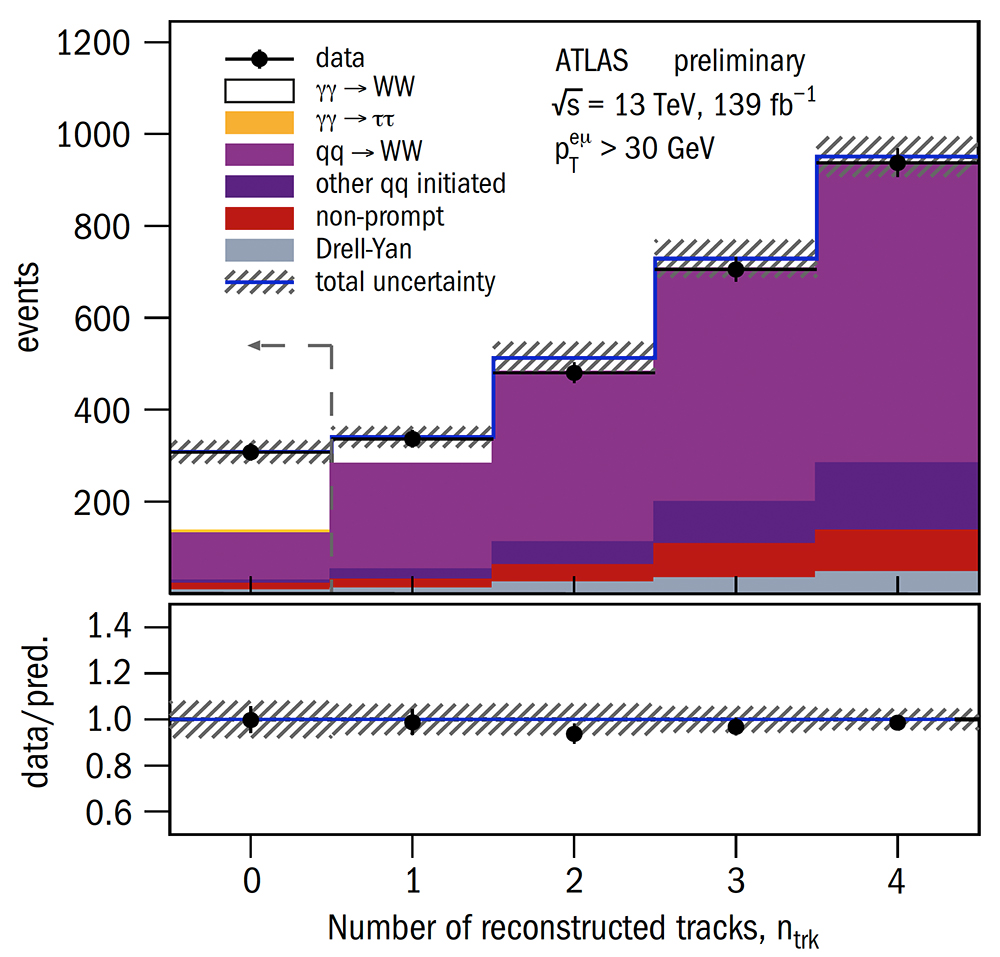
Protons usually remain intact or are excited into a higher energy state in photon collisions, with the products of any subsequent decay not reaching the innermost components of the ATLAS detector. In these cases, the electron and muon decaying from the W bosons – an event topology chosen to avoid the high background for same-flavour lepton pairs – are the only particles detected in the vicinity. However, if charged particles arise from nearby proton–proton collisions, the clean ɣɣ → WW signal can be missed. The main background is W-boson pairs produced in head-on proton–proton collisions where particles from the break-up of the protons are not detected due to imperfect detector coverage or reconstruction (figure 1). A total of 127 background events were predicted compared with 307 events observed in the data, corresponding to a signal excess of 8.4 standard deviations. This establishes the existence of light transforming into particles with weak-scale masses – a remarkable and previously unobserved phenomenon.
Innovation
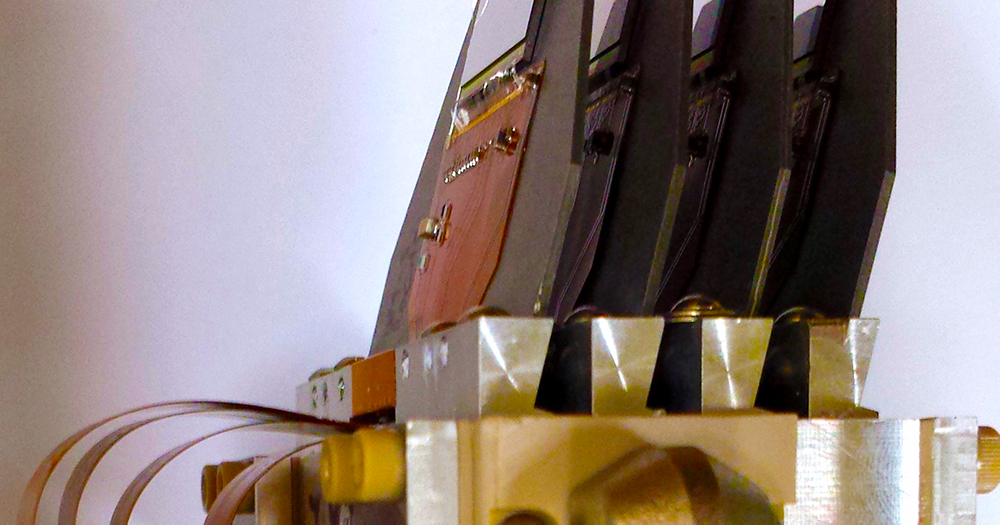
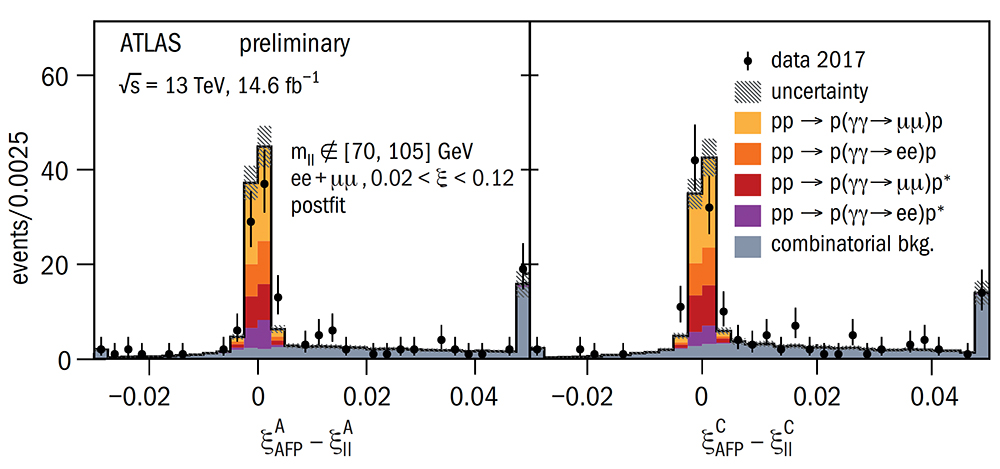
Precisely testing SM predictions of photon collisions requires accurate knowledge of the rate protons remain intact relative to those that break apart. This is challenging to predict theoretically and probing these rates unambiguously requires directly detecting the intact protons. The ATLAS forward-proton spectrometer (AFP) is becoming increasingly indispensable for this task. Among the newest additions to the ATLAS experiment, and located a few millimetres from the beam 210 m either side of the collision point, the AFP can detect protons that have been scattered in photon–photon collisions but which have nevertheless been focused by the LHC’s magnets. Its pioneering results so far analyse a standard-candle process where a proton is scattered in photon collisions that produce electron or muon pairs (ɣɣ → ℓℓ). For these signals, the measured proton energy loss is equal to that predicted from the lepton pairs measured in the main ATLAS detector (figure 2). ATLAS reported 180 events with a proton having matched kinematics to the lepton pair with an expected background of about 20 events. This corresponds to a significance exceeding nine standard deviations for both lepton flavours, establishing the presence of the signal and the successful operation of the AFP spectrometer in high-luminosity data. The detectors were sufficiently well understood to measure the cross sections of these processes.
Observing ɣɣ → WW and scattered protons in ɣɣ → ℓℓ interactions are long-awaited milestones in an emerging experimental programme studying photon collisions. These complement recent heavy-ion results where ATLAS measured muon pairs from photon collisions and the kinematic properties of light-by-light scattering – a very rare process predicted by quantum electrodynamics. Interestingly, the latter was also used to search for the axion-like particles predicted by certain extensions of the SM.
Observing ɣɣ → WW and scattered protons in ɣɣ → ℓℓ interactions are long-awaited milestones
The techniques developed to study ɣɣ → WW and ɣɣ → ℓℓ interactions lay the groundwork for future, more detailed tests of the SM. Further results using the AFP spectrometer can improve theoretical understanding of photon collisions that will also benefit future measurements of ɣɣ → WW production. These landmark experimental feats will only become more interesting with the increased dataset of Run 3 and the high-luminosity LHC.
CERN’s NA62 collaboration has presented its latest progress in the search for K+→π+νν̄ – a “golden decay” with exceptional sensitivity to physics beyond the Standard Model. The new analysis, which includes the full dataset collected until 2018, provides the strongest evidence yet for the existence of this ultra-rare process, at 3.5σ significance. Presenting the result today during the penultimate plenary session of the 40th International Conference on High-Energy Physics, which is being virtually hosted from Prague, lead-analyst Giuseppe Ruggiero of Lancaster University described the result as a great achievement. “After several years of a very challenging analysis, battling ten orders of magnitude of background over the signal, we are proud to have achieved the first statistically significant evidence for a process which has great sensitivity to new physics,” he says.
An important virtue of K+→π+νν̄ is its clean theoretical character
Andrzej Buras
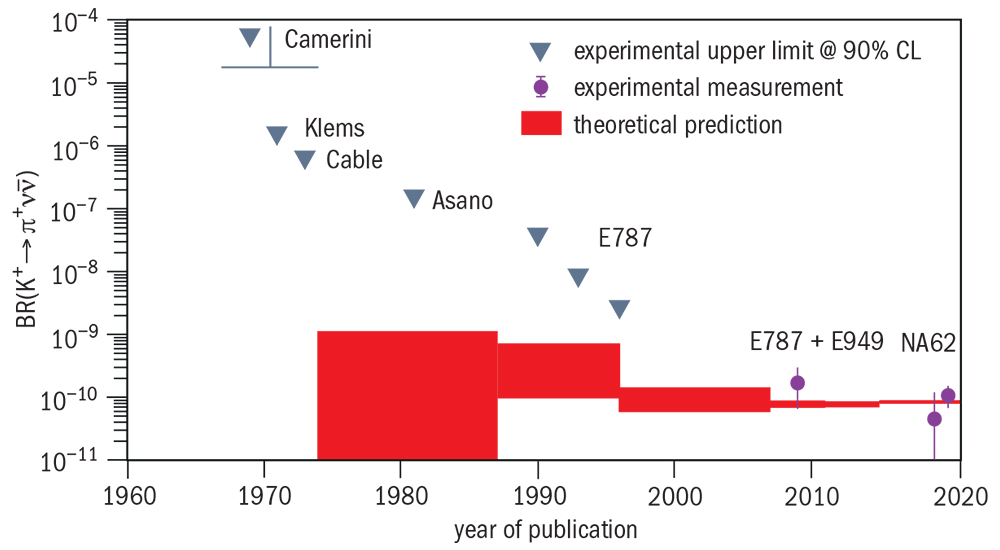
A flavour-changing, neutral-current process, K+→π+νν̄ is highly suppressed in the Standard Model, with contributions from Z-penguin and box diagrams with W, top quark and charm exchanges. The measured branching fraction of 110+40-35 per trillion K+→π+νν̄ decays is in agreement with the Standard Model prediction of 84 ± 10 per trillion (JHEP11 033). “A particular and very important virtue of K+→π+νν̄ is its clean theoretical character, which can only be matched among meson decays by KL→π0νν̄, and possibly Bs,d→μ+μ–,” says Andrzej Buras of the Institute for Advanced Study in Garching, Germany. “This is related to the fact that the low-energy hadronic matrix elements are just those of the quark currents between the hadronic states, which can be extracted from the leading semileptonic decay K+→π0e+ν,” he explains, noting that higher-order QCD and electroweak corrections are already well known, and lattice QCD calculations should soon tackle the small, “long-distance” contributions to the amplitude.
NA62 observes the 6% of positively charged kaons that are produced when 450 GeV protons from the Super Proton Synchrotron strike a beryllium target. The analysis is challenging because of the tiny branching fraction and the presence of a neutrino pair in the final state. Pioneering the technique of observing kaon decays in flight, the collaboration measures the kinematics of both the initial kaon and the final-state pion to isolate the kinematic signature of K+→π+νν̄, before then suppressing other decay modes by a further eight orders of magnitude using particle-identification techniques.
The collaboration’s new result adds a further 17 events to its previous analysis (arXiv:2007.08218, submitted to JHEP), wherein three events observed in 2016 and 2017 yielded an estimated branching fraction of 47 +72-47 decays per trillion. The previous best measurement was by Brookhaven National Laboratory’s E787 and E949 experiments in the 2000s, which together inferred a branching fraction of 173 +115-105 per trillion (Phys. Rev. Lett.101 191802).
Meanwhile in Japan
The NA62 result is expected soon to be complemented by a measurement of the related CP-violating KL→π0νν̄ decay by the KOTO collaboration at the J-PARC research facility in Tokai, Japan. This even rarer process has a predicted Standard Model branching fraction of just 34 ± 6 per trillion. KOTO’s 2015 data yielded no event candidates and a 90% confidence upper limit on the branching fraction of 3.0 per billion (Phys. Rev. Lett.122 021802). The collaboration is now finalising its results from the 2016–2018 run, and plans to improve its sensitivity to less than 0.1 per billion by increasing the beam intensity and upgrading the KOTO detectors.
As experimental uncertainties are expected to approach the theoretical precision in coming years, explains Buras, K+→π+νν̄ and KL→π0νν̄ decays can probe scales as high as a few hundred TeV – beyond the reach of most B-meson decays. “K+→π+νν̄ is most sensitive to hypothetical Z′ gauge bosons, vector-like quark models, supersymmetry and some leptoquark models,” he says. “LHCb studies of KS→ μ+μ– and Belle II studies of B→ K(K*)νν̄ will also have a part to play, allowing a global analysis to test not only the concept of minimal flavour violation, but also probe new CP-violating phases and right-handed currents.”
Theorists expect to reach an accuracy of 5% on the predicted K+→π+νν̄ branching ratio towards the end of the decade. In the same period, the NA62 team is seeking to hone its resolution from the current 30% down to 10%. The collaboration will resume data taking in 2021, following upgrades to both beam and detector taking place during the ongoing second long shutdown of CERN’s accelerator complex.
Sensitivity to decay rates below the 10–11 level is now in sight
Cristina Lazzeroni
“The horizon of a new-physics programme with a sensitivity to decay rates well below the 10–11 level is now in sight,” says NA62 spokesperson Cristina Lazzeroni of the University of Birmingham, UK. “The instruments and techniques developed for the NA62 experiment will lead to the next generation of rare-kaon-decay experiments. For the longer term future, a high-intensity kaon-beam programme is starting to take shape at CERN, with prospects to measure the K+→π+νν̄ decay to a few per cent, address the analogous decay of the neutral kaon, and reach extreme sensitivities to a large variety of rare kaon decays that are complementary to investigations in the beauty-quark sector.”
4,350 people from every continent, including Antarctica, participated from 22 June to 2 July in the XXIX International Conference on Neutrino Physics and Astrophysics, which was hosted online by Fermilab and the University of Minnesota. Originally planned as a five day, in-person June meeting at a large hotel in Chicago city centre, the organisers quickly pivoted in March, due to COVID-19, to an online programme with eight half days over two weeks, four poster sessions with both web-based and virtual-reality displays, and the use of the Slack platform for speaker questions and ongoing discussions.
A highlight of the conference was the first observation of solar CNO neutrinos
A highlight of the conference was the first observation of solar CNO neutrinos by the Borexino collaboration, which operates a 280-tonne liquid-scintillator detector in Italy’s Gran Sasso Laboratory. Dominant in stars more than 1.3 times the mass of the sun, the CNO cycle accounts for about 1% of the sun’s energy and generates a difficult-to-detect neutrino flux similar to backgrounds due to decays in the detector of 210Bi and its daughter nucleus 210Po. Gioacchino Ranucci (INFN, Milano) explained that the spectral fit to the observed data returns only the sum of CNO and 210Bi neutrinos. “The quest for CNO is turned into the quest for 210Bi through 210Po,” he emphasised. “With this outcome, Borexino has completely unravelled the two processes powering the Sun—the pp chain and the CNO cycle.” The final data analysis yielded a 5.1σ statistic against a hypothesis of no CNO neutrinos, and a CNO flux at the Earth of 7.0-1.9+2.9 × 108 cm-2 s-1.
Another highlight from Gran Sasso was the report from the Gerda collaboration on the search for neutrino-less double beta decay. If observed, this process would confirm the long-suspected Majorana rather than Dirac-fermion nature of neutrinos – a beyond the Standard Model feature with intriguing implications for why the neutrino mass is so small. Since Neutrino 2018, Gerda has nearly doubled its Phase 2 exposure and added a liquid-argon veto and a new detector string. The now complete Phase 2 result is a 90% confidence level half-life of >1.8 x 1026 years according to a frequentist analysis, or >1.4 x 1026 years, according to a Bayesian analysis with additional prior assumptions. Talks describing a half-dozen other double-beta-decay experiments displayed the high level of interest in this field.
Sterile neutrinos
Searches for additional “sterile” neutrinos with no Standard-Model gauge interactions were also featured. Takasumi Maruyama (KEK) described the liquid-scintillator JSNS2 experiment as a direct test of the controversial LSND Experiment result, first reported about 25 years ago. JSNS2 collected its first data during the three weeks before Neutrino 2020. Adrien Hourlier (MIT) reported on the now complete analysis of data from MiniBooNE that was collected during the past 17 years. Combining neutrino and anti-neutrino modes, MiniBooNE reports a 4.8σ excess. Hourlier presented soon-to-be published detailed distributions which the collaboration hopes “will guide theorists to explain our data”. Minerba Betancourt (Fermilab) then described the Fermilab Short-Baseline Neutrino (SBN) programme, which will use three detectors to obtain a definitive result on neutrino oscillations for an LSND and MiniBooNE-like ratio of oscillation distance to energy of ~1 m/MeV. The beam neutrino energy peaks at 700 MeV. A new liquid-argon near detector (SBND) will be placed 110 m from the target. The existing MicroBooNE is located at 470 m and the ICARUS Detector, moved from Gran Sasso, is installed at 600 m. Thomas Carroll (Wisconsin) reported on sterile-neutrino limits by muon disappearance determined by the now completed long-baseline MINOS/MINOS+ collaboration. These limits are in tension with the appearance data from both LSND and MiniBooNE when analysed as evidence for sterile neutrinos.
Two talks described the world’s two hundred-kilometre-scale neutrino-oscillation experiments, NOvA and T2K. The degeneracy of mass difference, mixing angle, hierarchy and possible CP violation make interpretation of these experiments’ results quite complex. Interestingly, there is mild tension, albeit only at the 1σ level, between the NOvA and T2K results regarding leptonic CP conservation and the neutrino mass hierarchy. The two collaborations are now working together on a combined analysis. Several talks discussed future initiatives. Lia Merminga (Fermilab) reported on LBNF and PIP-II, which will result in a new neutrino beam from Fermilab to the Sanford Laboratory in South Dakota for the DUNE experiment. Combined, these two projects will result in beam power of 2.4 MW, more than three times the intensity of the current NuMI beam. Michael Mooney (Colorado State) reported on the enormous progress of the DUNE project with two successful prototype detectors operating at CERN and pre-excavation work progressing at Sanford Laboratory. Complementary to the liquid-argon technology of DUNE is the recently approved Hyper-Kamiokande water-Cherenkov detector, which was described by Masaki Ishitsuka (Tokyo University of Science). Hyper-K will have a total mass of 260 kilo-tonne and 8.4 times the fiducial volume of the current Super-Kamiokande detector.
The VR feature attracted 3,409 conference participants
While much of Neutrino 2020 was modelled after the usual features of an in-person conference, the Virtual Reality (VR) poster presentation was novel and unique. Marco Del Tutto (Fermilab) created multiple virtual “rooms” for five posters each, along with additional rooms for topical discussions, sightseeing in Chicago and visiting Fermilab. The most enabling feature of the VR was that the software facilitated dialogue between participants whose avatars could move around the space and speak with one another. For example, if a group of avatars clustered around a poster, the participants could discuss the poster as a group. The VR feature attracted 3,409 participants. The VR was also supplemented by two-minute videos from presenters which enabled 5,800 YouTube views and 60,600 web displays.
In closing remarks, the organisers acknowledged the challenges of an online conference, but also emphasised the strengths of this novel approach. The exciting physics of Neutrino 2020 was made available to an extensive and diverse audience, including many scientists who would not have been able to attend an in-person conference because of funding, visas, family concerns or other issues. About 60% of participants were students or post-docs and the conference reached participants from 67 countries. The Slack discussions and posts on social media indicated wide-spread praise that the online format worked as well as it did. Some aspects of Neutrino 2020 may well affect the planning and organisation of future in-person and online conferences.
In traditional Balinese music, instruments are made in pairs, with one tuned slightly higher in frequency than its twin. The notes are indistinguishable to the human ear when played together, but the sound recedes and swells a couple of times each second, encouraging meditation. This is a beating effect: fast oscillations at the mean frequency inside a slowly oscillating envelope. Similar physics is at play in neutrino oscillations. Rather than sound intensity, it’s the probability to observe a neutrino with its initial flavour that oscillates. The difference is how long it takes for the interference to make itself felt. When Balinese musicians strike a pair of metallophones, the notes take just a handful of periods to drift out of phase. By contrast, it takes more than 1020 de Broglie wavelengths and hundreds of kilometres for neutrinos to oscillate in experiments like the planned mega-projects Hyper-Kamiokande and DUNE.
The zeitgeist began to shift to artificially produced neutrinos
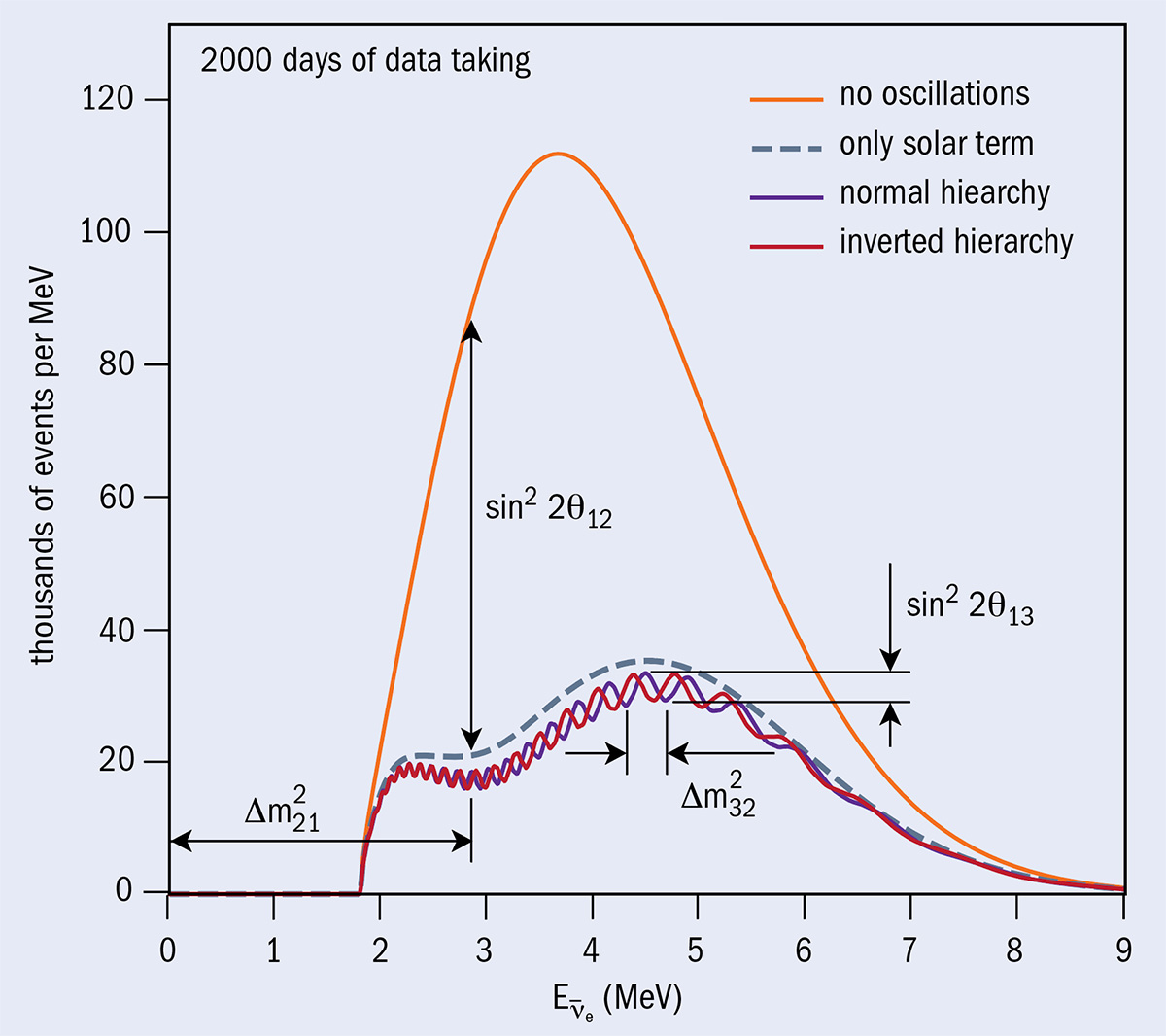
Neutrino oscillations revealed a rare chink in the armour of the Standard Model: neutrinos are not massless, but are evolving superpositions of at least three mass eigenstates with distinct energies. A neutrino is therefore like three notes played together: frequencies so close, given the as-yet immeasurably small masses involved, that they are not just indistinguishable to the ear, but inseparable according to the uncertainty principle. As neutrinos are always ultra-relativistic, the energies of the mass eigenstates differ only due to tiny mass contributions of m2/2E. As the mass eigenstates propagate, phase differences develop between them proportional to squared-mass splittings Δm2. The sought-after oscillations range from a few metres to the diameter of Earth.
Orthogonal mixtures
The neutrino physics of the latter third of the 20th century was bookended by two anomalies that uncloaked these effects. In 1968 Ray Davis’s observation of a deficit of solar neutrinos prompted Bruno Pontecorvo to make public his conjecture that neutrinos might oscillate. Thirty years later, the Super-Kamiokande collaboration’s analysis of a deficit of atmospheric muon neutrinos from the other side of the planet posthumously vindicated the visionary Italian, and later Soviet, theorist’s speculation. Subsequent observations have revealed that electron, muon and tau neutrinos are orthogonal mixtures of mass eigenstates ν1 and ν2, separated by a small so-called solar splitting Δm221, and ν3, which is separated from that pair by a larger “atmospheric” splitting usually quantified by Δm232 (see “Little and large” figure). It is not yet known if ν3 is the lightest or the heaviest of the trio. This is called the mass-hierarchy problem.
“In the first two decades of the 21st century we have achieved a rather accurate picture of neutrino masses and mixings,” says theorist Pilar Hernández of the University of Valencia, “but the ordering of the neutrino states is unknown, the mass of the lightest state is unknown and we still do not know if the neutrino mixing matrix has imaginary entries, which could signal the breaking of CP symmetry,” she explains. “The very different mixing patterns in quarks and leptons could hint at a symmetry relating families, and a more accurate exploration of the lepton-mixing pattern and the neutrino ordering in future experiments will be essential to reveal any such symmetry pattern.”
Today, experiments designed to constrain neutrino mixing tend to dispense with astrophysical neutrinos in favour of more controllable accelerator and reactor sources. The experiments span more than four orders of magnitude in size and energy and fall into three groups (see “Not natural” figure). Much of the limelight is taken by experiments that are sensitive to the large mass splitting Δm232, which include both a cluster of current (such as T2K) and future (such as DUNE) accelerator-neutrino experiments with long baselines and high energies, and a high-performing trio of reactor-neutrino experiments (Daya Bay, RENO and Double Chooz) with a baseline of about a kilometre, operating just above the threshold for inverse beta decay. The second group is a beautiful pair of long-baseline reactor-neutrino experiments (KamLAND and the soon-to-be-commissioned JUNO), which join experiments with solar neutrinos in having sensitivity to the smaller squared-mass splitting Δm221. Finally, the third group is a host of short-baseline accelerator-neutrino experiments and very-short-baseline reactor neutrino experiments that are chasing tantalising hints of a fourth “sterile” neutrino (with no Standard-Model gauge interactions), which is split from the others by a squared-mass splitting of the order of 1 eV2.
Experiments with artificial sources of neutrinos have a storied history, dating from the 1950s, when physicists toyed with the idea of detecting neutrinos created in the explosion of a nuclear bomb, and eventually observed them streaming from nuclear reactors. The 1960s saw the invention of the accelerator neutrino. Here, proton beams smashed into fixed targets to create a decaying debris of charged pions and their concomitant muon neutrinos. The 1970s transformed these neutrinos into beams by focusing the charged pions with magnetic horns, leading to the discovery of weak neutral currents and insights into the structure of nucleons. It was not until the turn of the century, however, that the zeitgeist of neutrino-oscillation studies began to shift from naturally to artificially produced neutrinos. Just a year after the publication of the Super-Kamiokande collaboration’s seminal 1998 paper on atmospheric–neutrino oscillations, Japanese experimenters trained a new accelerator-neutrino beam on the detector.
Operating from 1999 to 2006, the KEK-to-Kamioka (K2K) experiment sent a beam of muon neutrinos from the KEK laboratory in Tsukuba to the Super-Kamiokande detector, 250 km away under Mount Ikeno on the other side of Honshu. K2K confirmed that muon neutrinos “disappear” as a function of propagation distance over energy. The experiments together supported the hypothesis of an oscillation to tau neutrinos, which could not be directly detected at that energy. By increasing the beam energy well above the tau-lepton mass, the CERN Neutrinos to Gran Sasso (CNGS) project, which ran from 2006 to 2012, confirmed the oscillation to tau neutrinos by directly observing tau leptons in the OPERA detector. Meanwhile, the Main Injector Neutrino Oscillation Search (MINOS), which sent muon neutrinos from Fermilab to northern Minnesota from 2005 to 2012, made world-leading measurements of the parameters describing the oscillation.
With νμ→ ντ oscillations established, the next generation of experiments innovated in search of a subtler effect. T2K (K2K’s successor, with the beam now originating at J-PARC in Tokai) and NOvA (which analyses oscillations over the longer baseline of 810 km between Fermilab and Ash River, Minnesota) both have far detectors offset by a few degrees from the direction of the peak flux of the beams. This squeezes the phase space for the pion decays, resulting in an almost mono-energetic flux of neutrinos. Here, a quirk of the mixing conspires to make the musical analogy of a pair of metallophones particularly strong: to a good approximation, the muon neutrinos ring out with two frequencies of roughly equal amplitude, to yield an almost perfect disappearance of muon neutrinos – and maximum sensitivity to the appearance of electron neutrinos.
Testing CP symmetry
The three neutrino mass eigenstates mix to make electron, muon and tau neutrinos according to the Pontecorvo– Maki–Nakagawa–Sakata (PMNS) matrix, which describes three rotations and a complex phase δCP that can cause charge–parity (CP) violation – a question of paramount importance in the field due to its relevance to the unknown origin of the matter–antimatter asymmetry in the universe. Whatever the value of the complex phase, leptonic CP violation can only be observed if all three of the angles in the PMNS matrix are non-zero. Experiments with atmospheric and solar neutrinos demonstrated this for two of the angles. At the beginning of the last decade, short-baseline reactor-neutrino experiments in China (Daya Bay), Korea (RENO) and France (Double Chooz) were in a race with T2K to establish if the third angle, which leads to a coupling between ν3 and electrons, was also non-zero. In the reactor experiments this would be seen as a small deficit of electron antineutrinos a kilometre or so from the reactors; in T2K the smoking gun would be the appearance of a small number of electron neutrinos not present in the initial muon-neutrino-dominated beam.
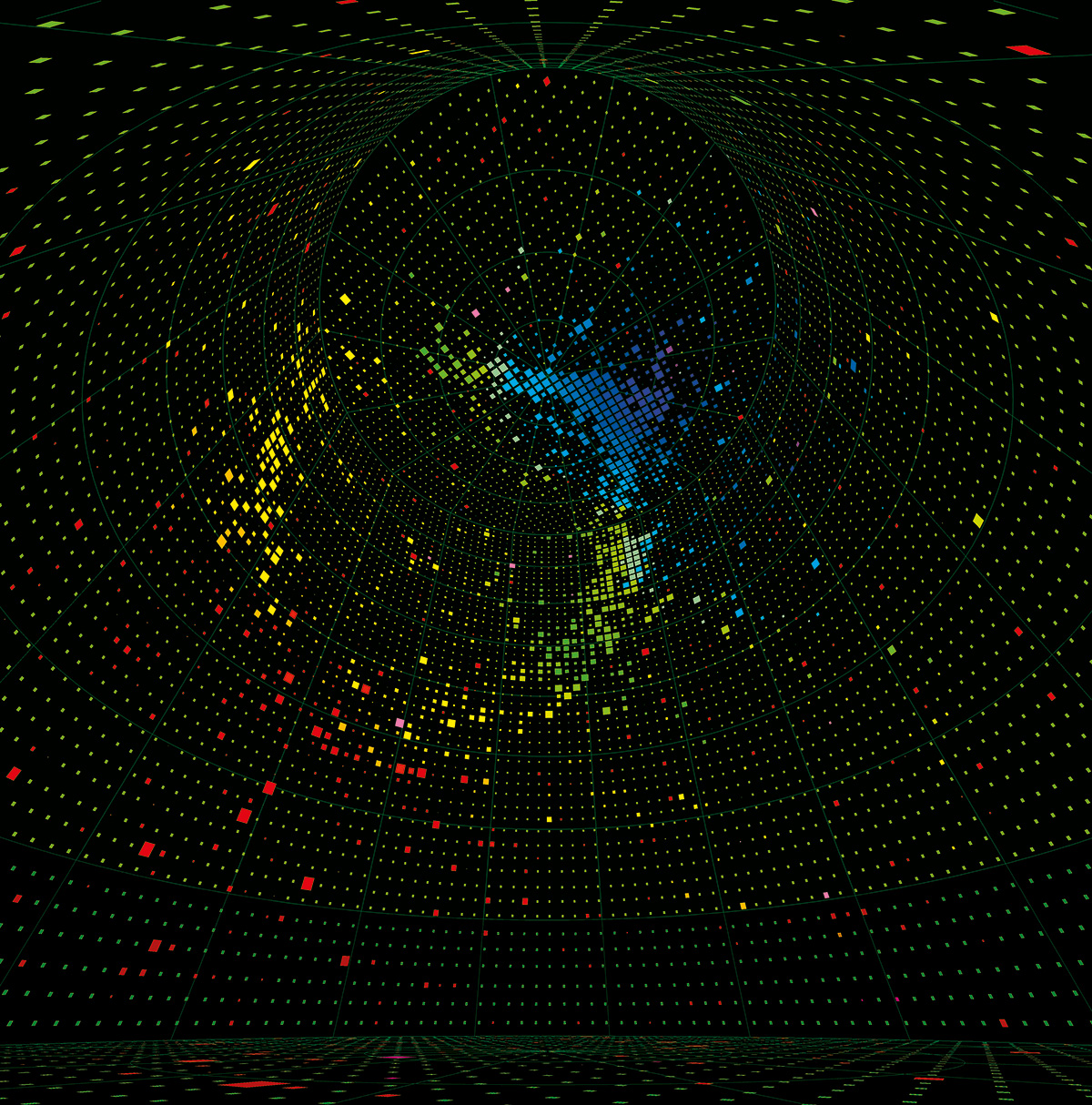
After data taking was cut short by the great Sendai earthquake and tsunami of March 2011, T2K published evidence for the appearance of six electron-neutrino events, over the expected background of 1.5 ± 0.3 in the case of no coupling. Alongside a single tau-neutrino candidate in OPERA, these were the first neutrinos seen to appear in a detector with a new flavour, as previous signals had always registered a deficit of an expected flavour. In the closing days of the year, Double Chooz published evidence for 4121 electron–antineutrino events, under the expected tally for no coupling of 4344 ± 165, reinforcing T2K’s 2.5σ indication. Daya Bay and RENO put the matter to bed the following spring, with 5σ evidence apiece that the ν3-electron coupling was indeed non-zero. The key innovation for the reactor experiments was to minimise troublesome flux and interaction systematics by also placing detectors close to the reactors.
Since then, T2K and NOvA, which began taking data in 2014, have been chasing leptonic CP violation – an analysis that is out of the reach of reactor experiments, as δCP does not affect disappearance probabilities. By switching the polarity of the magnetic horn, the experiments can compare the probabilities for the CP-mirror oscillations νμ→ νe and νμ→ νe directly. NOvA data are inconclusive at present. T2K data currently err towards near maximal CP violation in the vicinity of δCP = –π/2. The latest analysis, published in April, disfavours leptonic CP conservation (δCP = 0, ±π) at 2σ significance for all possible mixing parameter values. Statistical uncertainty is the biggest limiting factor.
Major upgrades planned for T2K next year target statistical, interaction-model and detector uncertainties. A substantial increase in beam intensity will be accompanied by a new fine-grained scintillating target for the ND280 near-detector complex, which will lower the energy threshold to reconstruct tracks. New transverse TPCs will improve ND280’s acceptance at high angles, yielding a better cancellation of systematic errors with the far detector, Super-Kamiokande, which is being upgraded by loading 0.01% gadolinium salts into the otherwise ultrapure water. As in reactor-neutrino detectors, this will provide a tag for antineutrino events, to improve sample purities in the search for leptonic CP violation.
T2K and NOvA both plan to roughly double their current data sets, and are working together on a joint fit, in a bid to better understand correlations between systematic uncertainties, and break degeneracies between measurements of CP violation and the mass hierarchy. If the CP-violating phase is indeed maximal, as suggested by the recent T2K result, the experiments may be able to exclude CP conservation with more than 99% confidence. “At this point we will be in a transition from a statistics-dominated to a systematics-dominated result,” says T2K spokesperson Atsuko Ichikawa of the University of Kyoto. “It is difficult to say, but our sensitivity will likely be limited at this stage by a convolution of neutrino-interaction and flux systematics.”
The next generation
Two long-baseline accelerator-neutrino experiments roughly an order of magnitude larger in cost and detector mass than T2K and NOvA have received green lights from the Japanese and US governments: Hyper-Kamiokande and DUNE. One of their primary missions is to resolve the question of leptonic CP violation.
Hyper-Kamiokande will adopt the same approach as T2K, but will benefit from major upgrades to the beam and the near and far detectors in addition to those currently underway in the present T2K upgrade. To improve the treatment of systematic errors, the suite of near detectors will be complemented by an ingenious new gadolinated water-Cherenkov detector at an intermediate baseline: by spanning a range of off-axis angles, it will drive down interaction-model systematics by exploiting previously neglected information on the how the flux varies as a function of the angle relative to the centre of the beam. Hyper-Kamiokande’s increased statistical reach will also be impressive. The power of the Japan Proton Accelerator Research Complex (J-PARC) beam will be increased from its current value of 0.5 MW up to 1.3 MW, and the new far detector will be filled with 260,000 tonnes of ultrapure water, yielding a fiducial volume 8.4 times larger than that of Super-Kamiokande. Procurement of the photo-multiplier tubes will begin this year, and the five-year-long excavation of the cavern has already begun. Data taking is scheduled to commence in 2027. “The expected precision on δCP is 10–20 degrees, depending on its true value,” says Hyper-Kamiokande international co-spokesperson Francesca di Lodovico of King’s College, London.
In the US, the Deep Underground Neutrino Experiment (DUNE) will exploit the liquid-argon–TPC technology first deployed on a large scale by ICARUS – OPERA’s sister detector in the CNGS project. The idea for the technology dates back to 1977, when Carlo Rubbia proposed using liquid rather than gaseous argon as a drift medium for ionisation electrons. Given liquid-argon’s higher density, such detectors can serve as both target and tracker, providing high-resolution 3D images of the interactions – an invaluable tool for reducing systematics related to the murky world of neutrino–nucleus interactions.
Spectacular performance
The technology is currently being developed in two prototype detectors at CERN. The first hones ICARUS’s single-phase approach. “The performance of the prototype has been absolutely spectacular, exceeding everyone’s expectations,” says DUNE co-spokesperson Ed Blucher of the University of Chicago. “After almost two years of operation, we are confident that the liquid–argon technology is ready to be deployed at the huge scale of the DUNE detectors.” In parallel, the second prototype is testing a newer dual-phase concept. In this design, ionisation charges drift through an additional layer of gaseous argon before reaching the readout plane. The signal can be amplified here, potentially easing noise requirements for the readout electronics, and increasing the maximum size of the detector. The dual-phase prototype was filled with argon in summer 2019 and is now recording tracks.
The final detectors will have about twice the height and 10 to 20 times the footprint. Following the construction of an initial single-phase unit, the DUNE collaboration will likely pick a mix of liquid-argon technologies to complete their roster of four 10 kton far-detector modules, set to be installed a kilometre underground at the Sanford Underground Research Laboratory in Lead, South Dakota. Site preparation and pre-excavation activities began in 2017, and full excavation work is expected to begin soon, with the goal that data-taking begin during the second half of this decade. Work on the near-detector site and the “PIP-II” upgrade to Fermilab’s accelerator complex began last year.
Though similar to Hyper-Kamiokande at first glance, DUNE’s approach is distinct and complementary. With beam energy and baseline both four times greater, DUNE will have greater sensitivity to flavour-dependent coherent-forward-scattering with electrons in Earth’s crust – an effect that modifies oscillation probabilities differently depending on the mass hierarchy. With the Fermilab beam directed straight at the detector rather than off-axis, a broader range of neutrino energies will allow DUNE to observe the oscillation pattern from the first to the second oscillation maximum, and simultaneously fit all but the solar mixing parameters. And with detector, flux and interaction uncertainties all distinct, a joint analysis of both experiments’ data could break degeneracies and drive down systematics.
“If CP violation is maximal and the experiments collect data as anticipated, DUNE and Hyper-Kamiokande should both approach 5σ significance for the exclusion of leptonic CP conservation in about five years,” estimates DUNE co-spokesperson Stefan Söldner-Rembold of the University of Manchester, noting that the experiments will also be highly complementary for non-accelerator topics. The most striking example is supernova-burst neutrinos, he says, referring to a genre of neutrinos only observed once so far, during 15 seconds in 1987, when neutrinos from a supernova in the Large Magellanic Cloud passed through the Earth. “While DUNE is primarily sensitive to electron neutrinos, Hyper-Kamiokande will be sensitive to electron antineutrinos. The difference between the timing distributions of these samples encodes key information about the dynamics of the supernova explosion.” Hyper-Kamiokande spokesperson Masato Shiozawa of ICRR Tokyo also emphasises the broad scope of the physics programmes. “Our studies will also encompass proton decay, high-precision measurements of solar neutrinos, supernova-relic neutrinos, dark-matter searches, the possible detection of solar-flare neutrinos and neutrino geophysics.”
Half a century since Ray Davis and two co-authors published evidence for a 60% deficit in the flux of solar neutrinos compared to John Bahcall’s prediction, DUNE already boasts more than a thousand collaborators, and Hyper-Kamiokande’s detector mass is set to be 500 times greater than Davis’s tank of liquid tetrachloroethylene. If Ray Davis was the conductor who set the orchestra in motion, then these large experiments fill out the massed ranks of the violin section, poised to deliver what may well be the most stirring passage of the neutrino-oscillation symphony. But other sections of the orchestra also have important parts to play.
Mass hierarchy
The question of the neutrino mass hierarchy will soon be addressed by the Jiangmen Underground Neutrino Observatory (JUNO) experiment, which is currently under construction in China. The project is an evolution of the Daya Bay experiment, and will seek to measure a deficit of electron antineutrinos 53 km from the Yangjiang and Taishan nuclear-power plants. As the reactor neutrinos travel, the small kilometre-scale oscillation observed by Daya Bay will continue to undulate with the same wavelength, revealed in JUNO as “fast” oscillations on a slower and deeper first oscillation maximum due to the smaller solar mass splitting Δm221 (see “An oscillation within an oscillation” figure).
“JUNO can determine the neutrino mass hierarchy in an unambiguous and definite way, independent from the CP phase and matter effects, unlike other experiments using accelerator or atmospheric neutrinos,” says spokesperson Yifang Wang of the Chinese Academy of Sciences in Beijing. “In six years of data taking, the statistical significance will be higher than 3σ.”
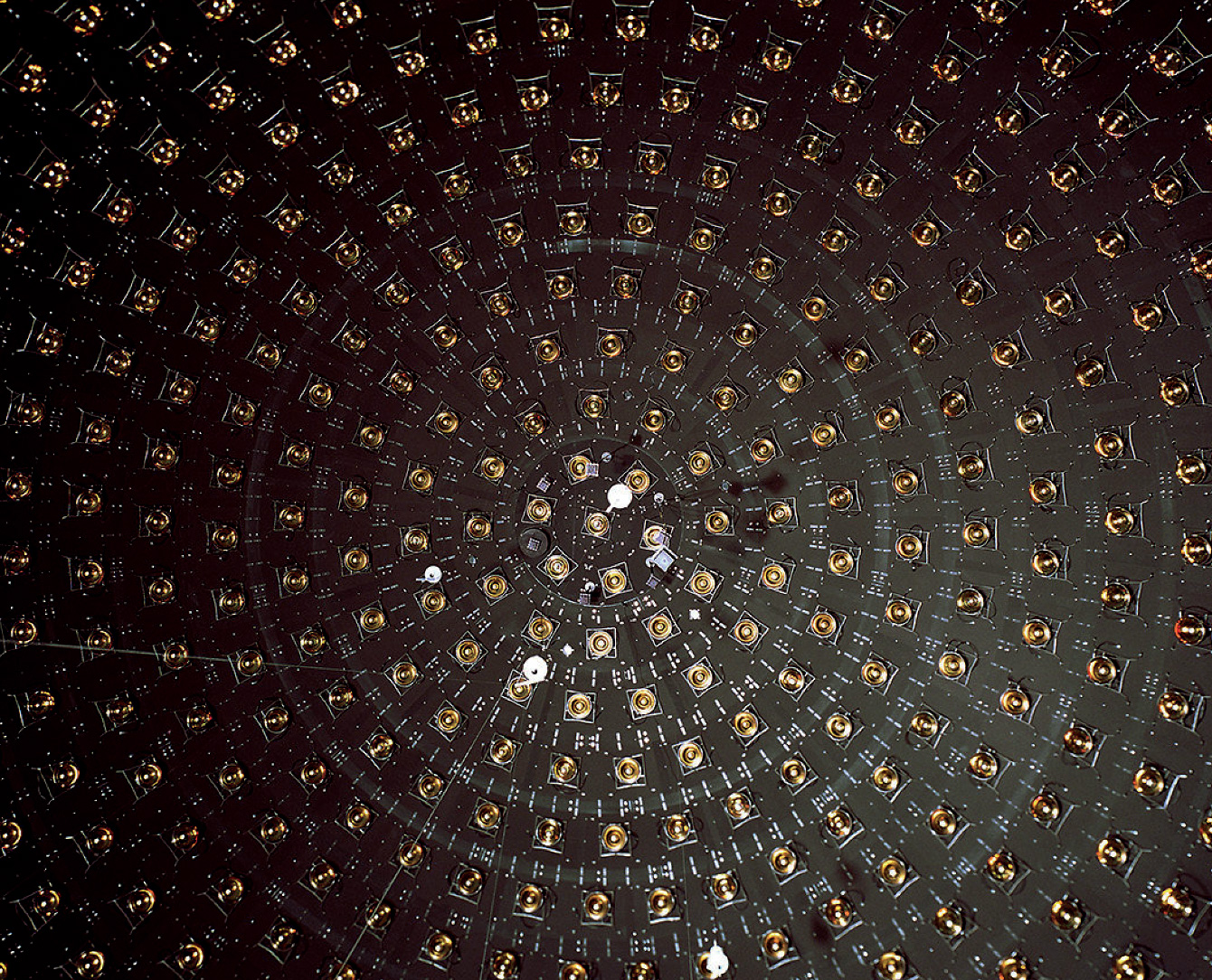
JUNO has completed most of the digging of the underground laboratory, and equipment for the production and purification of liquid scintillator is being fabricated. A total of 18,000 20-inch photomultiplier tubes and 26,000 3-inch photomultiplier tubes have been delivered, and most of them have been tested and accepted, explains Wang. The installation of the detector is scheduled to begin next year. JUNO will arguably be at the vanguard of a precision era for the physics of neutrino oscillations, equipped to measure the mass splittings and the solar mixing parameters to better than 1% precision – an improvement of about one order of magnitude over previous results, and even better than the quark sector, claims Wang, somewhat provocatively. “JUNO’s capabilities for supernova-burst neutrinos, diffused supernova neutrinos and geoneutrinos are unprecedented, and it can be upgraded to be a world-best double-beta-decay detector once the mass hierarchy is measured.”
With JUNO, Hyper-Kamiokande and DUNE now joining a growing ensemble of experiments, the unresolved leitmotifs of the three-neutrino paradigm may find resolution this decade, or soon after. But theory and experiment both hint, quite independently, that nature may have a scherzo twist in store before the grand finale.
A rich programme of short-baseline experiments promises to bolster or exclude experimental hints of a fourth sterile neutrino with a relatively large mixing with the electron neutrino that have dogged the field since the late 1990s. Four anomalies stack up as more or less consistent among themselves. The first, which emerged in the mid-1990s at Los Alamos’s Liquid Scintillator Neutrino Detector (LSND), is an excess of electron antineutrinos that is potentially consistent with oscillations involving a sterile neutrino at a mass splitting Δm2∼ 1 eV2. Two other quite disparate anomalies since then – a few-percent deficit in the expected flux from nuclear reactors, and a deficit in the number of electron neutrinos from radioactive decays in liquid-gallium solar-neutrino detectors – could be explained in the same way. The fourth anomaly, from Fermilab’s MiniBooNE experiment, which sought to replicate the LSND effect at a longer baseline and a higher energy, is the most recent: a sizeable excess of both electron neutrinos and antineutrinos, though at a lower energy than expected. It’s important to note, however, that experiments including KARMEN, MINOS+ and IceCube have reported null searches for sterile neutrinos that fit the required description. Such a particle would also stand in tension with cosmology, notes phenomenologist Silvia Pascoli of Durham University, as models predict it would make too large a contribution to hot dark matter in the universe today, unless non-standard scenarios are invoked.
Three different types of experiment covering three orders of magnitude in baseline are now seeking to settle the sterile-neutrino question in the next decade. A smattering of reactor-neutrino experiments a mere 10 metres or so from the source will directly probe the reactor anomaly at Δm2∼ 1 eV2. The data reported so far are intriguing. Korea’s NEOS experiment and Russia’s DANSS experiment report siren signals between 1 and 2 eV2, and NEUTRINO-4, also based in Russia, reports a seemingly outlandish signal, indicative of very large mixing, at 7 eV2. In parallel, J-PARC’s JSNS2 experiment is gearing up to try to reproduce the LSND effect using accelerator neutrinos at the same energy and baseline. Finally, Fermilab’s short-baseline programme will thoroughly address a notable weakness of both LSND and MiniBooNE: the lack of a near detector.
The Fermilab programme will combine three liquid-argon TPCs – a bespoke new short-baseline detector (SBND), the existing MicroBooNE detector, and the refurbished ICARUS detector – to resolve the LSND anomaly once and for all. SBND is currently under construction, MicroBooNE is operational, and ICARUS, removed from its berth at Gran Sasso and shipped to the US in 2017, has been installed at Fermilab, following work on the detector at CERN. “The short-baseline neutrino programme at Fermilab has made tremendous technical progress in the past year,” says ICARUS spokesperson and Nobel laureate Carlo Rubbia, noting that the detector will be commissioned as soon as circumstances allow, given the coronavirus pandemic. “Once both ICARUS and SBND are in operation, it will take less than three years with the nominal beam intensity to settle the question of whether neutrinos have an even more mysterious character than we thought.”
Muon neutrinos ring out with two frequencies of roughly equal amplitude, to yield almost perfect disappearance
Outside of the purview of oscillation experiments with artificially produced neutrinos, astrophysical observatories will scale a staggering energy range, from the PeV-scale neutrinos reported by IceCube at the South Pole, down, perhaps, to the few-hundred-μeV cosmic neutrino background sought by experiments such as PTOLEMY in the US. Meanwhile, the KATRIN experiment in Germany is zeroing in on the edges of beta-decay distributions to set an absolute scale for the mass of the peculiar mixture of mass eigenstates that make up an electron antineutrino (CERN Courier January/February 2020 p28). At the same time, a host of experiments are searching for neutrinoless double-beta decay – a process that can only occur if the neutrino is its own antiparticle. Discovering such a Majorana nature for the neutrino would turn the Standard Model on its head, and offer grist for the mill of theorists seeking to explain the tininess of neutrino masses, by balancing them against still-to-be-discovered heavy neutral leptons.
Indispensable input
According to Mikhail Shaposhnikov of the Swiss Federal Institute of Technology in Lausanne, current and future reactor- and accelerator-neutrino experiments will provide an indispensable input for understanding neutrino physics. And not in isolation. “To reach a complete picture, we also need to know the mechanism for neutrino-mass generation and its energy scale, and the most important question here is the scale of masses of new neutrino states: if lighter than a few GeV, these particles can be searched for at new experiments at the intensity frontier, such as SHiP, and at precision experiments looking for rare decays of mesons, such as Belle II, LHCb and NA62, while the heavier states may be accessible at ATLAS and CMS, and at future circular colliders,” explains Shaposhnikov. “These new particles can be the key in solving all the observational problems of the Standard Model, and require a consolidated effort of neutrino experiments, accelerator-based experiments and cosmological observations. Of course, it remains to be seen if this dream scenario can indeed be realised in the coming 20 years.”
• This article was updated on 6 July, to reflect results presented at Neutrino 2020
Luckily for us, there is presently almost no antimatter in the universe. This makes it possible for us – made of matter – to live without being annihilated in matter–antimatter encounters. However, cosmology tells us that just after the cosmic Big Bang, the universe contained equal amounts of matter and antimatter. Obviously, for the universe to have evolved from that early state to the present one, which contains quite unequal amounts of matter and antimatter, the two must behave differently. This implies that the symmetry CP (charge conjugation × parity) must be violated. That is, there must be physical systems whose behaviour changes if we replace every particle by its antiparticle, and interchange left and right.
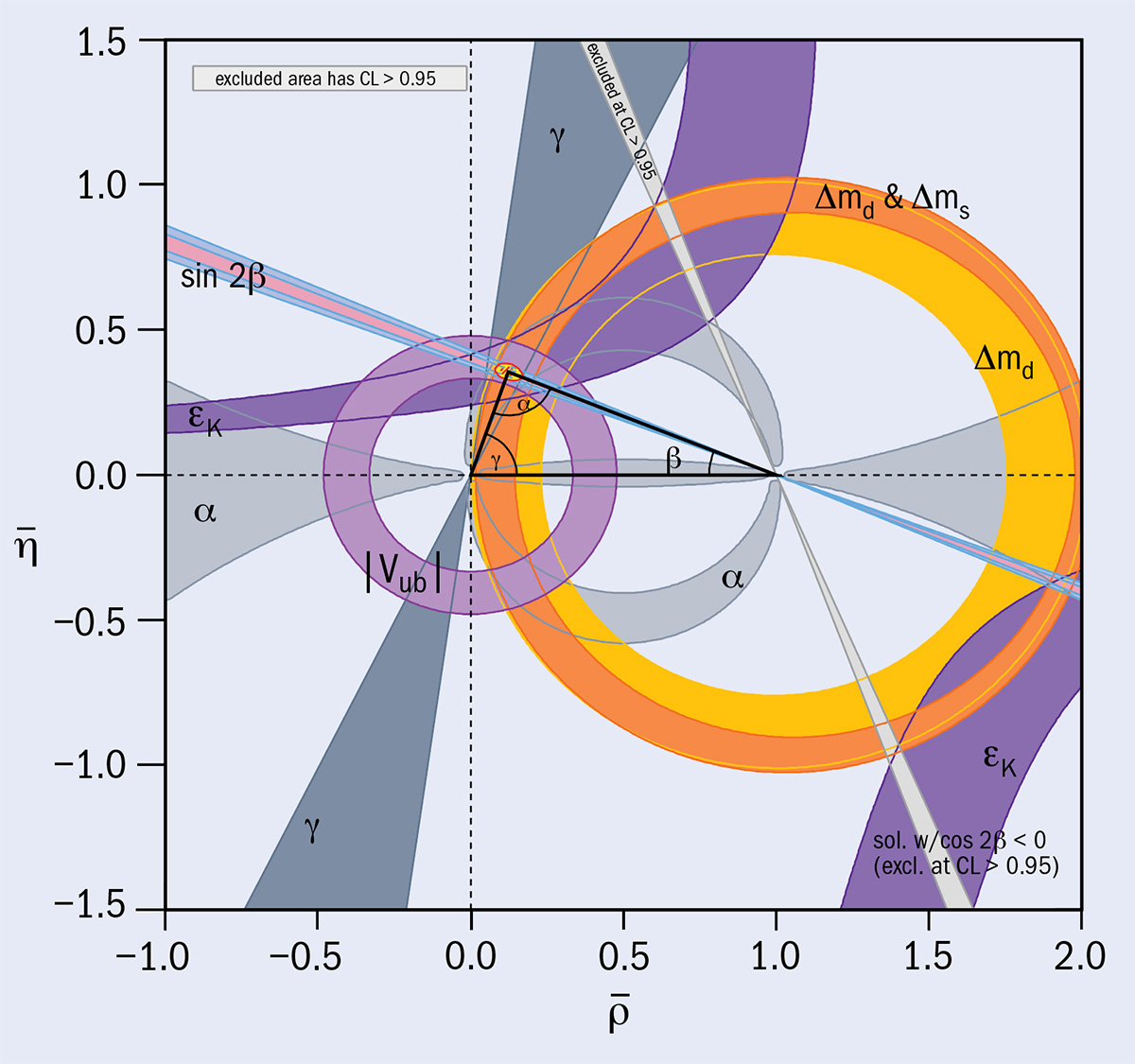
In 1964, Cronin, Fitch and colleagues discovered that CP is indeed violated, in the decays of neutral kaons to pions – a phenomenon that later became understood in terms of the behaviour of quarks. By now, we have observed quark CP violation in the strange sector, the beauty sector and most recently in the charm sector (CERN Courier May/June 2019 p7). The observations of CP violation in B (beauty) meson decays have been particularly illuminating. Everything we know about quark CP violation is consistent with the hypothesis that this violation arises from a single complex phase in the quark mixing matrix. This matrix gives the amplitude for any particular negatively-charged quark, whether down, strange or bottom, to convert via a weak interaction into any particular positively-charged quark, be it up, charm or top. Just two parameters in the quark mixing matrix, ρ and η, whose relative size determines the complex phase, account very successfully for numerous quark phenomena, including both CP-violating ones and others. This is impressively demonstrated by a plot of all the experimental constraints on these two parameters (figure 1). All the constraints intersect at a common point.
Of course, precisely which (ρ, η) point is consistent with all the data is not important. Lincoln Wolfenstein, who created the quark-mixing-matrix parametrisation that includes ρ and η, was known to say: “Look, I invented ρ and η, and I don’t care what their values are, so why should you?”
Having observed CP violation among quarks in numerous laboratory experiments of today, we might be tempted to think that we understand how CP violation in the early universe could have changed the world from one with equal quantities of matter and antimatter to one in which matter dominates very heavily over antimatter. However, scenarios that tie early-universe CP violation to that seen among the quarks today, and do not add new physics to the Standard Model of the elementary particles, yield too small a present-day matter–antimatter asymmetry. This leads one to wonder whether early-universe CP violation involving leptons, rather than quarks, might have led to the present dominance of matter over antimatter. This possibility is envisaged by leptogenesis, a scenario in which heavy neutral leptons that were their own antiparticles lived briefly in the early universe, but then underwent CP-asymmetric decays, creating a world with unequal numbers of particles and antiparticles. Such heavy neutral leptons are predicted by “see-saw” models, which explain the extreme lightness of the known neutrinos in terms of the extreme heaviness of the postulated heavy neutral leptons. Leptogenesis can successfully account for the observed size of the present matter–antimatter asymmetry.
Deniable plausibility
In the straightforward version of this picture, the heavy neutral leptons are too massive to be observable at the LHC or any foreseen collider. However, since leptogenesis requires leptonic CP violation, observing this violation in the behaviour of the currently observed leptons would make it more plausible that leptogenesis was indeed the mechanism through which the present matter–antimatter asymmetry of the universe arose. Needless to say, observing leptonic CP violation would also reveal that the breaking of CP symmetry, which before 1964 one might have imagined to be an unbroken, fundamental symmetry of nature, is not something special to the quarks, but is participated in by all the constituents of matter.
To find out if leptons violate CP, we are searching for what is traditionally described as a difference between the behaviour of neutrinos and that of antineutrinos. This description is fine if neutrinos are Dirac particles – that is, particles that are distinct from their antiparticles. However, many theorists strongly suspect that neutrinos are actually Majorana particles – that is, particles that are identical to their antiparticles. In that case, the traditional description of the search for leptonic CP violation is clearly inapplicable, since then the neutrinos and the antineutrinos are the same objects. However, the actual experimental approach that is being pursued is a perfectly valid probe of leptonic CP violation regardless of whether neutrinos are of Dirac or of Majorana character. In fact, this approach is completely insensitive to which of these two possibilities nature has chosen.
Through a glass darkly
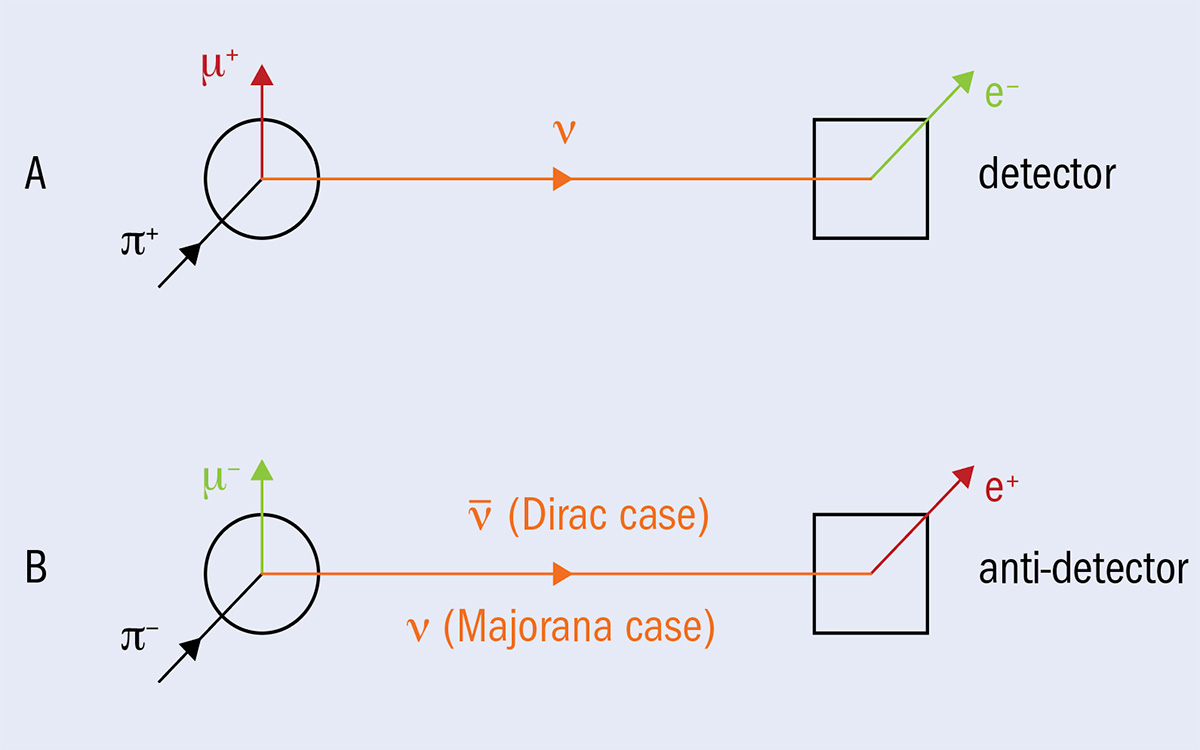
The pursuit of leptonic CP violation is based on comparing the rates for two CP mirror-image processes (figure 2). In process A, the initial state is a π+ and an undisturbed detector. The final state consists of a μ+, an e–, and a nucleus in the detector that has been struck by an intermediate-state neutrino beam particle that travelled a long distance from its source to the detector. Since the neutrino was born together with a muon, but produced an electron in the detector, and the probability for this to have happened oscillates as a function of the distance the neutrino travels divided by its energy, the process is commonly referred to as muon–neutrino to electron–neutrino oscillation.
Leptogenesis can account for the matter–antimatter asymmetry
In process B, the initial and final states are the same as in process A, but with every particle replaced by its antiparticle. In addition, owing to the character of the weak interactions, the helicity (the projection of the spin along the momentum) of every fermion is reversed, so that left and right are interchanged. Thus, regardless of whether neutrinos are identical to their antiparticles, processes A and B are CP mirror images, so if their rates are unequal, CP invariance is violated. Moreover, since the probability of a neutrino oscillation involves the weak interactions of leptons, but not those of quarks, this violation of CP invariance must come from the weak interactions of leptons.
Of course, we cannot employ an anti-detector in process B in practice. However, the experiment can legitimately use the same detector in both processes. To do that, it must take into account the difference between the cross sections for the beam particles in processes A and B to interact in this detector. Once that is done, the comparison of the rates for processes A and B remains a valid probe of CP non-invariance.
The matrix reloaded
Just as quark CP violation arises from a complex phase in the quark mixing matrix, so leptonic CP violation in neutrino oscillation can arise from a complex phase, δCP, in the leptonic mixing matrix, which is the leptonic analogue of the quark mixing matrix. However, if, as suggested by several short-baseline oscillation experiments, there exist not only the three well-established neutrinos, but also additional so-called “sterile” neutrinos that do not participate in Standard Model weak interactions, then the leptonic mixing matrix is larger than the quark one. As a result, while the quark mixing matrix is permitted to contain just one complex phase, its leptonic analogue may contain multiple complex phases that can contribute to CP violation in neutrino oscillations.
Leptonic CP violation is being sought by two current neutrino-oscillation experiments. The NOvA experiment in the US has reported results that are consistent with either the presence or absence of CP violation. The T2K experiment in Japan reports that the complete absence of CP violation is excluded at 95% confidence. Assuming that the leptonic mixing matrix is the same size as the quark one, so that it may contain only one complex phase relevant to neutrino oscillations, the T2K data show a preference for values of that phase, δCP, that correspond to near maximal CP violation. Of course, as Lincoln Wolfenstein would doubtless point out, the precise value of δCP is not important. What counts is the extremely interesting experimental finding that the behaviour of leptons may very well violate CP. In the future, the oscillation experiments Hyper-Kamiokande in Japan and DUNE in the US will probe leptonic CP violation with greater sensitivity, and should be capable of observing it even if it should prove to be fairly small (see Tuning in to neutrinos).
By searching for leptonic CP violation, we hope to find out whether the breaking of CP symmetry occurs among all the constituents of matter, including both the leptons and the quarks, or whether it is a feature that is special to the quarks. If leptonic CP violation should be definitively shown to exist, this violation might be related to the reason that the universe contains matter, but almost no antimatter, so that life is possible.
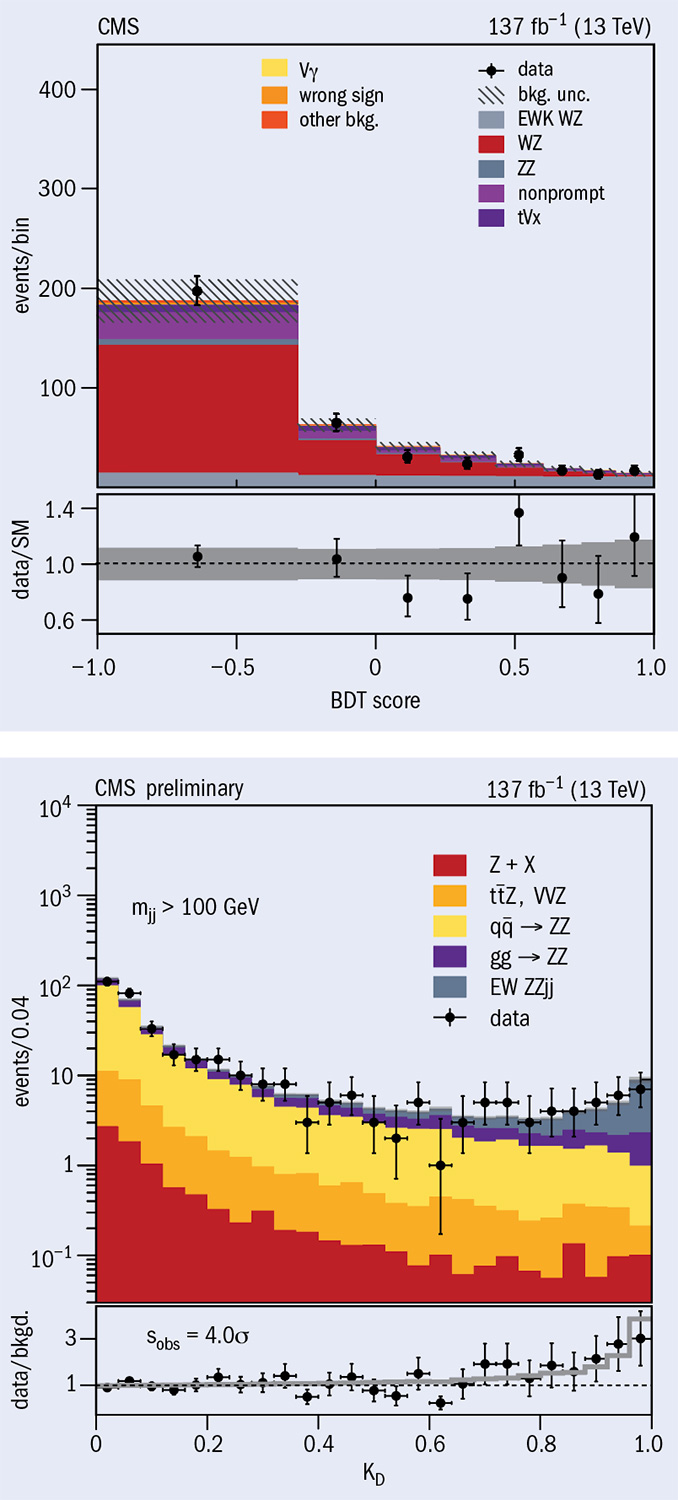
The electroweak (EW) sector of the Standard Model (SM) predicts self-interactions between W and Z gauge bosons through triple and quartic gauge couplings. Following first measurements at LEP and at the Tevatron during the 1990s, these interactions are now a core part of the LHC physics programme, as they offer key insights into EW symmetry breaking, which, in the case of the SM, causes the W and Z bosons to acquire mass as a result of the Brout–Englert–Higgs mechanism. The quartic coupling can be probed at colliders via rare processes such as tri-boson production, which the CMS collaboration observed for the first time earlier this year, and vector-boson scattering (VBS).
The scattering of longitudinally polarised W and Z bosons is a particularly interesting probe of the SM, as its tree-level amplitudes would violate unitarity at high energies without delicate cancellations from quartic gauge couplings and Higgs-boson contributions. Thus, the study of VBS processes provides key insight into the quartic gauge couplings as well as the Higgs sector. These processes offer sensitivity to enhancements caused by models of physics beyond the SM, which modify the Higgs sector with additional Higgs bosons contributing to VBS.
Vector-boson scattering is characterised by the presence of two forward jets, with a large di-jet invariant mass and a large rapidity separation. CMS previously reported the first observation of same-sign W±W± production using the data collected in 2016. The same-sign W±W± process is chosen because of the smaller background yield from other SM processes compared to the opposite-sign W±W∓ process. The collaboration has now updated this analysis and performed new studies of the EW production of two jets produced in association with WZ, and ZZ boson pairs using data collected between 2016 and 2018 at a centre-of-mass energy of 13 TeV, corresponding to 137 fb–1. Vector-boson pairs were selected by their decays to electrons and muons. The W±W± and WZ production modes were studied by simultaneously measuring their production cross sections using several kinematical observables. The measured total cross section for W±W± production of 3.98 ± 0.45 (± 0.37 stat. only) fb is the most accurate to date, with a precision of roughly 10%. No deviation from SM predictions is evident.
Though the contribution from background processes induced by the strong interaction is considerably larger in the WZ and ZZ final states, the scattering centre-of-mass energy and the polarisation of the final-state bosons can be measured as these final states can be more fully reconstructed than in W±W± production. To optimally isolate signal from background, the kinematical information of the WZ and ZZ candidate events is exploited with a boosted decision tree and matrix element likelihood techniques, respectively (see figure). The observed statistical significances for the WZ and ZZ processes are 6.8 and 4.0 standard deviations, respectively, in line with the expected SM significances of 5.3 and 3.5 standard deviations. The possible presence of anomalous quartic gauge couplings could result in an excess of events with respect to the SM predictions. Strong new constraints on the structure of quartic gauge couplings have been set within the framework of dimension-eight effective-field-theory operators.
The observation of the EW production of W±W±, WZ and ZZ boson pairs is an essential milestone towards precision tests of VBS at the LHC, and there is much more to be learned from the future LHC Run-3 data. The High-Luminosity LHC should allow for very precise investigations of VBS, including finding evidence for the scattering of longitudinally polarised W bosons.
To provide the best experiences, we use technologies like cookies to store and/or access device information. Consenting to these technologies will allow us to process data such as browsing behavior or unique IDs on this site. Not consenting or withdrawing consent, may adversely affect certain features and functions.
Functional
Always active
The technical storage or access is strictly necessary for the legitimate purpose of enabling the use of a specific service explicitly requested by the subscriber or user, or for the sole purpose of carrying out the transmission of a communication over an electronic communications network.
Preferences
The technical storage or access is necessary for the legitimate purpose of storing preferences that are not requested by the subscriber or user.
Statistics
The technical storage or access that is used exclusively for statistical purposes.The technical storage or access that is used exclusively for anonymous statistical purposes. Without a subpoena, voluntary compliance on the part of your Internet Service Provider, or additional records from a third party, information stored or retrieved for this purpose alone cannot usually be used to identify you.
Marketing
The technical storage or access is required to create user profiles to send advertising, or to track the user on a website or across several websites for similar marketing purposes.