The observation at CERN’s ISOLDE facility of a long-sought decay of the thorium-229 nucleus marks a key step towards a clock that could outperform today’s most precise atomic timekeepers. Publishing the results in Nature, an international team has used ISOLDE’s unique facilities to measure, for the first time, the radiative decay of the metastable state of thorium-229m, opening a path to direct laser-manipulation of a nuclear state to build a new generation of nuclear clocks.
Today’s best atomic clocks, based on periodic transitions between two electronic states of an atom such as caesium or aluminium held in an optical lattice, achieve a relative systematic frequency uncertainty below 1 × 10–18, meaning they won’t lose or gain a second over about 30 billion years. Nuclear clocks would exploit the periodic transition between two states in the vastly smaller atomic nucleus, which couple less strongly to electromagnetic fields and hence are less vulnerable to external perturbations. In addition to offering a more precise timepiece, nuclear clocks could test the constancy of fundamental parameters such as the fine structure or strong-coupling constants, and enable searches for ultralight dark matter (CERN Courier September/October 2022 p32).
Higher precision
In 2003 Ekkehard Peik and Christian Tamm of Physikalisch-Technische Bundesanstalt in Germany proposed a nuclear clock based on the transition between the ground state of the thorium-229 nucleus and its first, higher-energy state. The advantage of the 229mTh isomer compared to almost all other nuclear species is its unusually low excitation level (~8 eV), which in principle allows direct laser manipulation. Despite much effort, researchers have not succeeded until now in observing the radiative decay – which is the inverse process of direct laser excitation – of 229mTh to its ground state. This allows, among other things, the isomer’s energy to be determined to higher precision.
In a novel technique based on vacuum-ultraviolet spectroscopy, lead author Sandro Kraemer of KU Leuven and co-workers used ISOLDE to generate an isomeric beam with atomic mass number A = 229, following the decay chain 229Fr → 229Ra → 229Ac → 229Th/229mTh. A fraction of 229Ac decays to the metastable, excited state of 229Th, the isomer 229mTh. To achieve this, the team incorporated the produced 229Ac into six separate crystals of calcium flouride and magnesium flouride at different thicknesses. They measured the radiation emitted when the isomer relaxes to its ground state using an ultraviolet spectrometer, determining the wavelength of the observed light to be 148.7 nm. This corresponds to an energy of 8.338 ± 0.024 eV – seven times more precise than the previous best measurements.
Our study marks a crucial step in the development of lasers that would make such a clock tick
“ISOLDE is currently one of only two facilities in the world that can produce actinium-229 isotopes in sufficient amounts and purity,” says Kraemer. “By incorporating these isotopes in calcium fluoride or magnesium fluoride crystals, we produced many more isomeric thorium-229 nuclei and increased our chances of observing their radiative decay.”
The team’s novel approach of producing thorium-229 nuclei also made it possible to determine the lifetime of the isomer in the magnesium fluoride crystal, which helps to predict the precision of a thorium-229 nuclear clock based on this solid-state system. The result (16.1 ± 2.5 min) indicates that a clock precision which is competitive with that of today’s most precise atomic clocks is attainable, while also being four orders of magnitude more sensitive to a number of effects beyond the Standard Model.
“Solid-state systems such as magnesium fluoride crystals are one of two possible settings in which to build a future thorium-229 nuclear clock,” says the team’s spokesperson, Piet Van Duppen of KU Leuven. “Our study marks a crucial step in this direction, and it will ease the development of lasers with which to drive the periodic transition that would make such a clock tick.”
New physics may come at us in unexpected ways that may be completely hidden to conventional search methods. One unique example of this is the narrowly spaced, semi-periodic spectra of heavy gravitons predicted by the clockwork gravity model. Similar to models with extra dimensions, the clockwork model addresses the hierarchy problem between the weak and Planck scales, not by stabilising the weak scale (as in supersymmetry, for example), but by bringing the fundamental higher dimensional Planck scale down to accessible energies. The mass spectrum of the resulting graviton tower in the clockwork model is described by two parameters: k, a mass parameter that determines the onset of the tower, and M5, the five-dimensional reduced Planck mass that controls the overall cross-section of the tower’s spectrum.
At the LHC, these gravitons would be observed via their decay into two light Standard Model particles. However, conventional bump/tail hunts are largely insensitive to this type of signal, particularly when its cross section is small. A recent ATLAS analysis approaches the problem from a completely new angle by exploiting the underlying approximate periodicity feature of the two-particle invariant mass spectrum.
Graviton decays with dielectron or diphoton final states are an ideal testbed for this search due to the excellent energy resolution of the ATLAS detector. After convolving the mass spectrum of the graviton tower with the ATLAS detector resolution corresponding to these final states, it resembles a wave-packet (like the representation of a free particle propagating in space as a pulse of plane-wave superposition with a finite momenta range). This implies that a transformation exploiting the periodic nature of the signal may be helpful.
Figure 1 shows how a particularly faint clockwork signal would emerge in ATLAS for the diphoton final state. It is compared with the data and the background-only fit obtained from an earlier (full Run 2) ATLAS search for resonances with the same final state. As an illustration, the signal shape is given without realistic statistical fluctuations. The tiny “bumps” or the shape’s integral over the falling background cannot be detected with conventional bump/tail-hunting methods. Instead, for the first time, a continuous wavelet transformation is applied to the mass distribution. The problem is therefore transformed to the “scalogram” space, i.e. the mass versus scale (or inverse frequency) space, as shown in figure 2 (left). The large red area at high scales (low frequencies) represents the falling shape of the background, while the signal from figure 1 now appears as a clear, distinct local “blob” above mγγ = k and at low scales (high frequencies).
The strongest exclusion contours to date are placed in the clockwork parameter space
With realistic statistical fluctuations and uncertainties, these distinct “blobs” may partially wash out, as shown in figure 2 (right). To counteract this effect, the analysis uses multiple background-only and background-plus-signal scalograms to train a binary convolutional neural-network classifier. This network is very powerful in distinguishing between scalograms belonging to the two classes, but it is also model-specific. Therefore, another search for possible periodic signals is performed independently from the clockwork model hypothesis. This is done in an “anomaly detection” mode using an autoencoder neural-network. Since the autoencoder is trained on multiple background-only scalograms (unlabelled data) to learn the features of the background (unsupervised learning), it can predict the compatibility of a given scalogram with the background-only hypothesis. A statistical test based on the two networks’ scores is derived to check the data compatibility with the background-only or the background+signal hypotheses.
Applying these novel procedures to the dielectron and diphoton full Run 2 data, ATLAS sees no significant deviation from the background-only hypothesis in either the clockwork-model search or in the model-independent one. The strongest exclusion contours to date are placed in the clockwork parameter space, pushing the sensitivity to beyond 11 TeV in M5. Despite the large systematic uncertainties in the background model, these do not exhibit any periodic structure in the mass space and their impact is naturally reduced when transforming to the scalogram space. The sensitivity of this analysis is therefore mostly limited by statistics and is expected to improve with the full Run 3 dataset.
The primary goal of high-energy heavy-ion physics is the study of a new state of nuclear matter, quark–gluon plasma, a thermalised system of quarks and gluons. The study of proton–proton (pp) and proton–nucleus (pA) collisions provides the baseline for the interpretation of results from heavy-ion collisions. The study of pA collisions also helps researchers understand the effects of cold nuclear matter on the production of final-state particles.
Global observables, such as the number of produced particles (particle multiplicity) and their distribution in pseudorapidity (η), provide key information about particle-production mechanisms in these collisions. The total multiplicity is mostly determined by soft interactions, i.e. processes with small momentum transfer, which cannot be calculated using perturbative techniques and are instead modelled using non-perturbative phenomenological descriptions. For example, the distribution of the number of produced particles can be used to disentangle relative contributions to particle production from hard and soft processes using a two-component model.
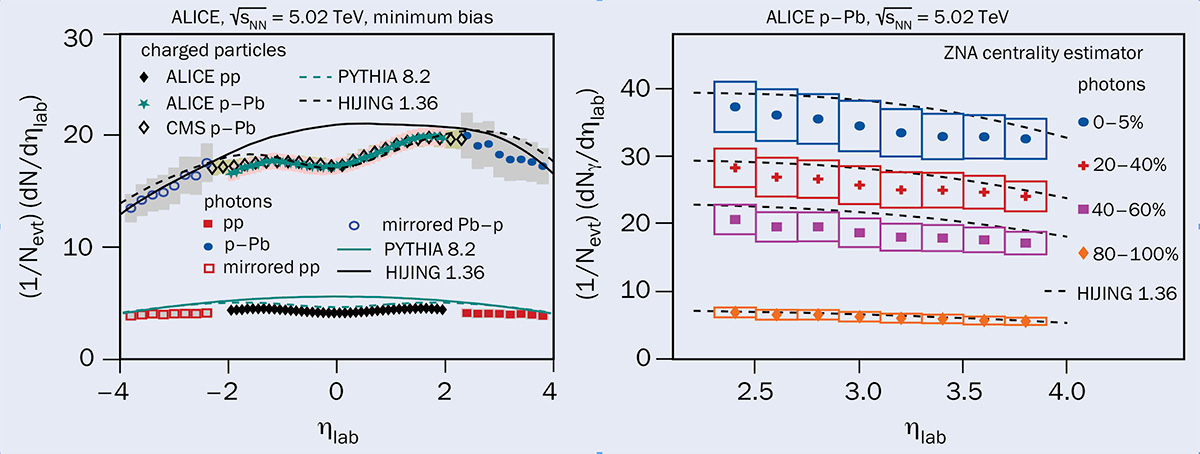
ALICE has recently completed the measurement of the multiplicity and pseudorapidity density distributions of inclusive photons at forward rapidity, spanning the range η = 2.3 to 3.9, by using the photon multiplicity detector (PMD) in pp, pPb and Pbp collisions at a centre-of-mass energy of 5.02 TeV per nucleon pair using LHC Run 1 and 2 data. Since photons mostly originate from decays of neutral pions, this result complements existing measurements of charged-particle production. A comparative study of charged particles and inclusive photons can reveal possible similarities and differences in the underlying production mechanisms for charged and neutral particles.
The PMD uses the preshower technique, where a three-radiation-length-thick lead converter is sandwiched between two planes comprising an array of 184,320 gas-filled proportional counters. Photons are distinguished from hadrons in the PMD’s preshower plane by applying suitable thresholds on the number of detector cells and the energy deposited in reconstructed clusters.
The measured distributions are corrected for instrumental effects using a Bayesian unfolding method. This is the first time that the dependence of the inclusive photon production on the number of nucleons participating in the pPb collision and its scaling behaviour has been studied at the LHC.
Figure 1 (left) compares the pseudorapidity density distribution of inclusive photons in minimum bias pp, pPb and Pbp collisions measured at forward rapidity to that of charged particles at midrapidity. The pseudorapidity distribution of inclusive photons at forward rapidity smoothly matches that of charged particles at midrapidity, indicating that the production mechanisms for charged and neutral pions are similar. Figure 1 (right) shows the pseudorapidity density distribution of inclusive photons in pPb collisions for different multiplicity classes as estimated using the energy deposited in the zero-degree calorimeter (ZNA) at beam rapidity. The multiplicity in the most central collisions reaches values twice as large as those in minimum bias events. The data and model agree within one sigma of the measurement uncertainties.
These results of inclusive photon production in pp, pPb and Pbp collisions provide valuable input for the development of theoretical models and Monte Carlo event generators, and help to establish the baseline measurements for the interpretation of PbPb collision data.
A crucial missing piece in our understanding of quantum chromodynamics (QCD) is a complete description of hadronisation in hard scattering processes with a large momentum transfer, which has now been investigated by the LHCb collaboration in proton–lead (pPb) collisions. While perturbative QCD describes reasonably well the transverse momentum (pT) dependence of heavy-quark production in proton–proton (pp) collisions, the situation is different in heavy-ion collisions due to the formation of quark–gluon plasma (QGP), which affects the behaviour of particles traversing the medium. In particular, hadronisation can be affected, modifying the relative abundance of hadrons compared to pp collisions. Several models predict an enhanced strange-quark production. Thus an abundance of strange baryons is seen as a signature of QGP formation.
The role that QGP may play in pPb collisions is currently unclear. Some models predict the formation of “QGP droplets”, which could partially induce the same behaviour, albeit less pronounced, as in PbPb collisions. In addition, in pPb interactions, “cold nuclear matter” (CNM) effects are also present that can mimic the behaviour caused by QGP but via different mechanisms. For all these reasons, a strangeness enhancement in pPb collisions would strongly indicate the formation of a deconfined medium in small systems, providing crucial information about QGP properties and formation once the CNM effects are under control.
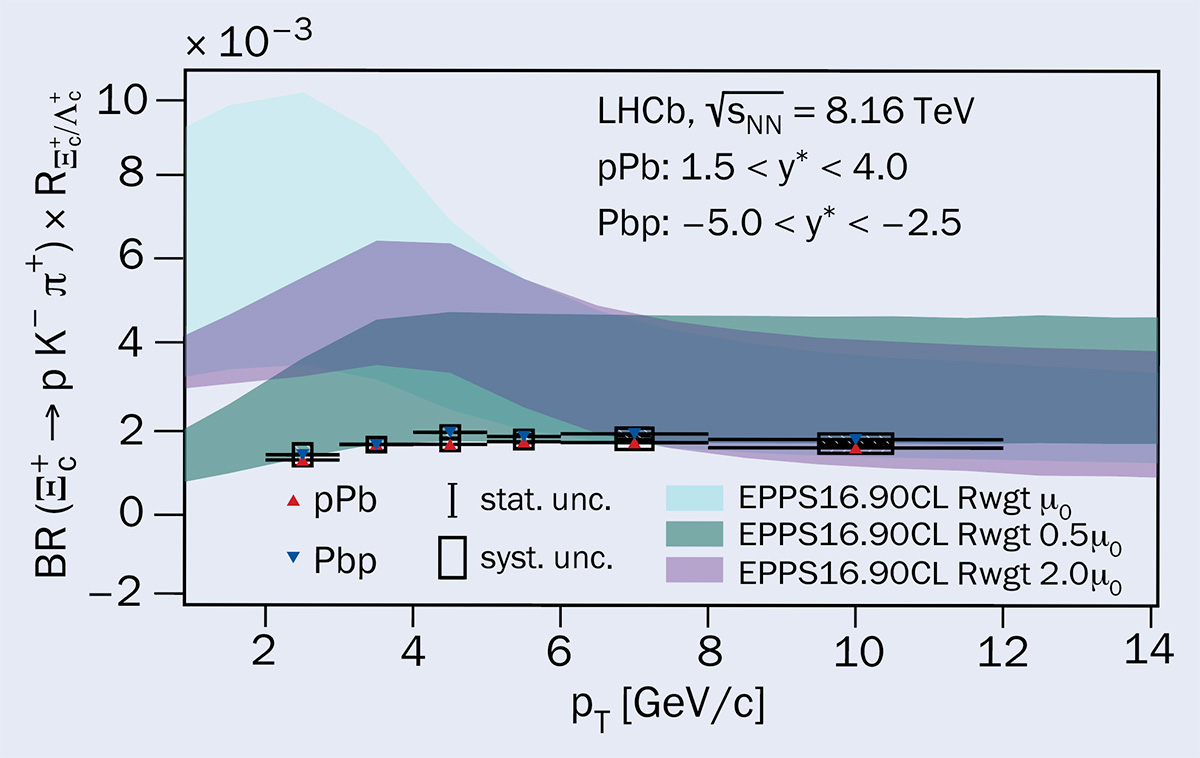
The LHCb collaboration recently analysed pPb data for QGP effects with the twofold purpose of searching for strangeness enhancement and providing a precise understanding of the CNM effects. This search was performed by measuring the production ratio of the strange baryon Ξ+c, which has never been observed in pPb collisions before, to the strangeless baryon Λ+c. Using an earlier pPb sample, LHCb has also studied the ratios of the D+s, D+ and D0 , the first being measured for the first time down to zero pT in the forward region, precisely addressing CNM effects. All measurements are performed differentially in pT and the rapidity of the produced particle, and compared to the latest theory predictions. The Ξ+c cross section has been measured for the first time in pPb collisions, giving strong indications on the factorisation scale μ0 of the theory model. This result allows to set the absolute scale of the theoretical computations in terms of strangeness production, a trend confirmed with even higher precision by comparing the measurement to the Λ+c production-cross section evaluated in the same decay mode. Moreover, the ratio is roughly constant as a function of pTand behaves in the same way at positive (pPb) and negative (Pbp) rapidities (see figure 1). The measurement is consistent with models incorporating initial-state effects due to gluon-shadowing in nuclei, suggesting that QGP formation and the resulting strangeness enhancement have little or no effect on Ξ+c production in pPb collisions.
This interpretation is confirmed by the measurement of the D+s, D+ and D0 cross sections and corresponding ratios in different rapidity regions. While the ratios show little enhancement within the statistical uncertainty, a large asymmetry is observed in the forward-backward production. This strongly indicates CNM effects and provides detailed constraints on models of nuclear parton distribution functions and hadron production in a very wide range of Bjorken-x (10–2 – 10–5). A strong suppression is observed for the D mesons, giving insight into the nature of the CNM effects involved. An explanation via additional final-state effects is challenged by the Ξ+c data that are well described by models not including them. The production ratios of Ξ+c, D+s, D+ and D0 measured as a function of pT in pPb collisions confirm these findings. All these studies will profit from the increased statistics in pPb collisions that are expected from future LHC runs.
As dark matter (DM) search experiments increasingly constrain minimal models, more complex ones have gained importance, featuring a rich “dark sector” with additional particle states and often involving forces that cannot be directly felt by Standard Model (SM) particles. Nevertheless, the SM and dark sector are typically connected by a “portal” that can be experimentally probed.
The CMS collaboration recently presented the first dedicated collider search for inelastic dark matter (IDM) using the LHC Run 2 dataset. In IDM models, a small Majorana mass component is combined with a Dirac fermion field corresponding to the DM and added to the SM Lagrangian, resulting in two new DM mass eigenstates with a predominantly off-diagonal (inelastic) coupling and a small mass splitting. In addition, a dark photon (a gauge boson similar to the ordinary photon) serves as the portal to the SM. This means that at the LHC, the lighter (χ1) and heavier (χ2) DM states are simultaneously produced via a dark photon (A′). While the lighter state is stable and escapes the detector, the heavier one can travel a macroscopic distance before decaying to the lighter one and a pair of muons, which are produced away from the collision point.
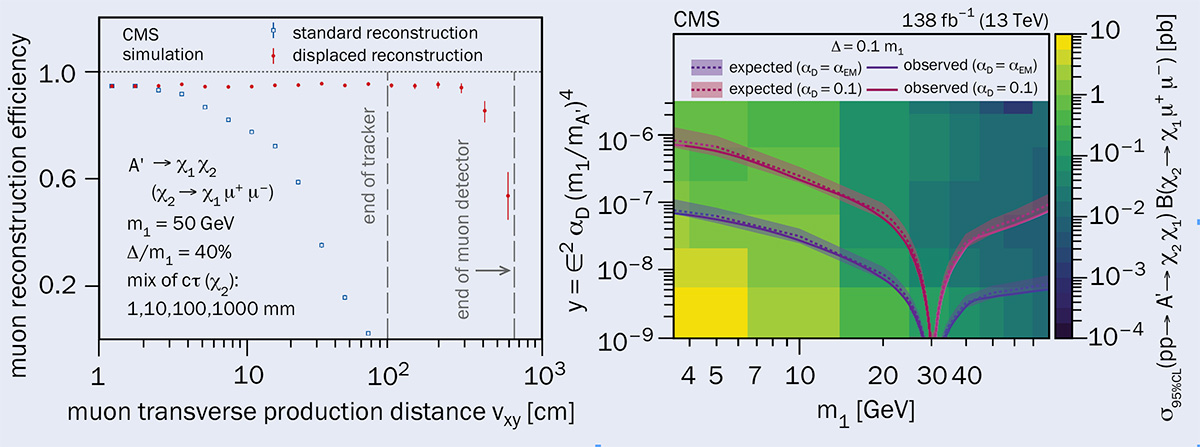
This process can be probed by exploiting a striking signature: a pair of almost collinear, low-momentum and displaced muons from the χ2 decay; significant missing transverse momentum (MET) from the χ1; and an initial-state radiation jet that can be used for trigger purposes. The MET-dimuon system recoils against the high-momentum jet, so that the muons and MET are also almost collinear. This unique topology presents challenges, including the reconstruction of the displaced muons. This problem was addressed by using a dedicated reconstruction algorithm, which remains efficient even for muons produced several metres away from the collision point (figure 1, left).
The first dedicated collider search for IDM using the full dataset collected during LHC Run 2
After applying event-selection criteria targeting the expected IDM signal, the number of events is compared to the data-driven background prediction: no excess is observed. Upper limits are set on the product of the pp → A′ →χ2χ1 production cross-section and the branching fraction of the χ2→χ1 μ+μ– decay; they are shown in figure 1 (right) for a scenario with 10% mass splitting between the χ1 and χ2 states. The y variable is roughly proportional to the interaction strength between the SM and the DM sector. Values of y > 10–7 to10–9 are excluded for masses between 3 and 80 GeV, when assuming that the fine structure constant has the same value in the dark sector and in the SM.
CMS physicists are looking forward to probing more complex and well-motivated DM models with novel and creative uses of the existing detector.
The exact origin of the high-energy cosmic rays that bombard Earth remains one of the most important open questions in astrophysics. Since their discovery more than a century ago, a multitude of potential sources, both galactic and extra-galactic, have been proposed. Examples of proposed galactic sources, which are theorised to be responsible for cosmic rays with energies below the PeV range, are supernova remnants and pulsars, while blazars and gamma-ray bursts are two of many potential sources theorised to be responsible for the cosmic-ray flux at higher energies.
When identifying the origin of astrophysical photons, one can use their direction. However, for cosmic rays this is not as straightforward due to the impact of galactic and extra-galactic magnetic fields on their direction. To identify the origin of cosmic rays, researchers therefore almost fully rely on information embedded in their energy spectra. When assuming just acceleration within shock regions of extreme astrophysical objects, the galactic cosmic-ray spectrum should follow a simple, single power law with an index between –2.6 and –2.7. However, thanks to measurements by a range of dedicated instruments including AMS, ATIC, CALET, CREAM and HAWC, we know the spectrum to be more complex. Furthermore, different types of cosmic rays, such as protons, and the nuclei of helium or oxygen, have all been shown to exhibit different spectral features with breaks at different energies.
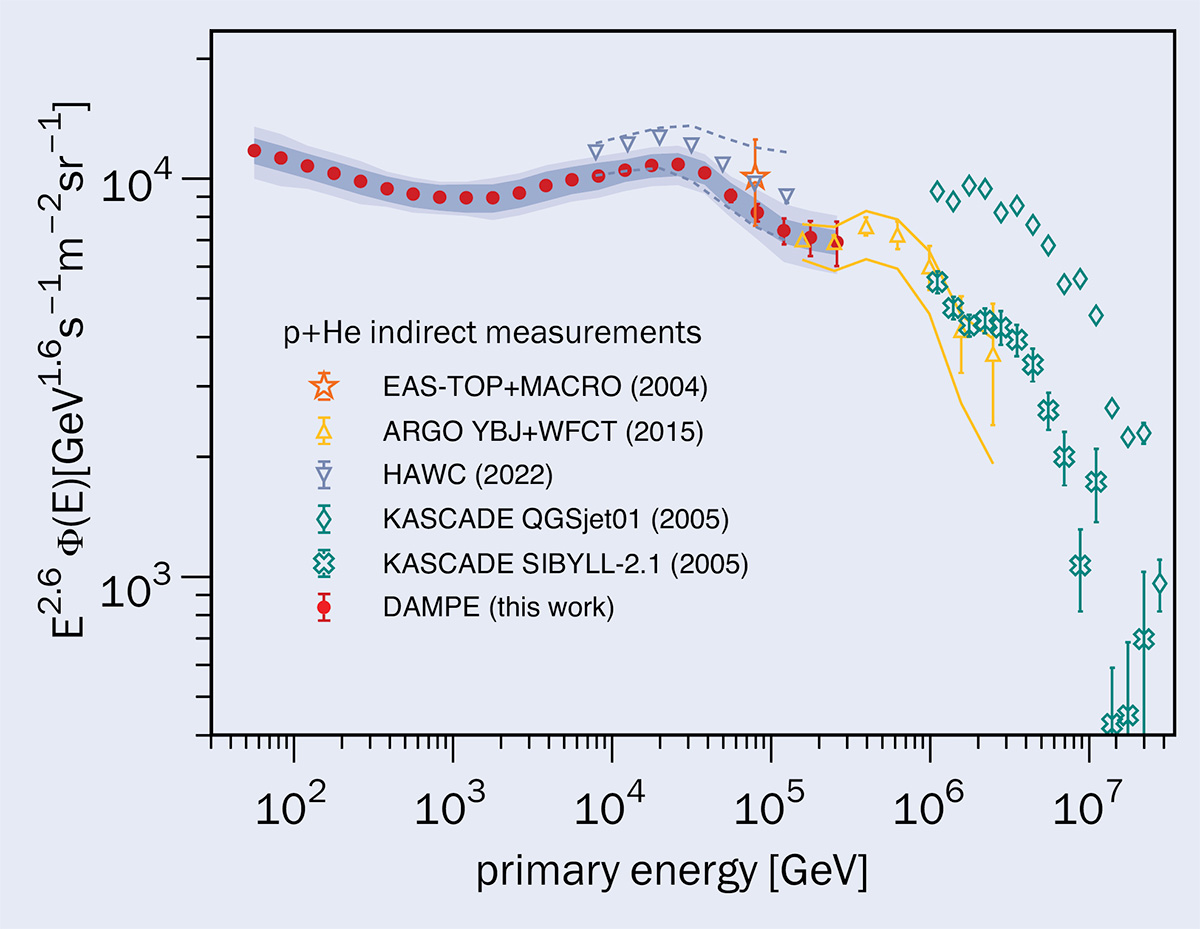
New measurements by the space-based Chinese–European Dark Matter Particle Explorer (DAMPE) provide detailed insights into the various spectral breaks in the combined proton and helium spectra. Clear hints of spectral breaks were already shown previously by various balloon and space-based experiments at low energies (below about 1 TeV), and by ground-based air-shower detectors at high energies (> TeV). However, in the region where space-based measurements start to suffer from a lack of statistics, ground-based instruments suffer from a low sensitivity, resulting in relatively large uncertainties. Furthermore, the completely different way in which space- and ground-based instruments measure the energy (directly in the former, and via air-shower reconstruction in the latter) made it important to make measurements that clearly connect the two. DAMPE has now produced detailed spectra in the 46 GeV to 316 TeV energy range, thereby filling most of the gap. The results confirm both a spectral hardening around 100 GeV and a subsequent spectral softening around 10 TeV, which connects well with a second spectral bump previously observed by ARGO-YBJ+WFCT at an energy of several hundred TeV (see figure).
The complex spectral features of high-energy cosmic rays can be explained in various ways. One possibility is through the presence of different types of cosmic-ray sources in our galaxy; one population produces cosmic rays with energies up to PeV, while a second only produces cosmic rays with energies up to tens of TeV, for example. A second possibility is that the spectral features are a result of a nearby single source from which we observe the cosmic rays directly before they become diffused in the galactic magnetic field. Examples of such a nearby source could be the Geminga pulsar, or the young supernova remnant Vela.
In the near future, novel data and analysis methods will likely allow researchers to distinguish between these two theories. One important source of this data is the LHAASO experiment in China, which is currently taking detailed measurements of cosmic rays in the 100 TeV to EeV range. Furthermore, thanks to ever-increasing statistics, the anisotropy of the arrival direction of the cosmic rays will also become a method to compare different models, in particular to identify nearby sources. The important link between direct and indirect measurements presented in this work thereby paves the way to connecting the large amounts of upcoming data to the theories on the origins of cosmic rays.
The discovery of the Higgs boson in 2012 unleashed a detailed programme of measurements by ATLAS and CMS which have confirmed that its couplings are consistent with those predicted by the Standard Model (SM). However, several Higgs-boson decay channels have such small predicted branching fractions that they have not yet been observed. Involving higher order loops, these channels also provide indirect probes of possible physics beyond the SM. ATLAS and CMS have now teamed up to report the first evidence of the decay H → Zγ, presenting the combined result at the Large Hadron Collider Physics conference in Belgrade in May.
The SM predicts that approximately 0.15% of Higgs bosons produced at the LHC will decay in this way, but some theories beyond the SM predict a different decay rate. Examples include models where the Higgs boson is a neutral scalar of different origin, or a composite state. Different branching fractions are also expected for models with additional colourless charged scalars, leptons or vector bosons that couple to the Higgs boson, due to their contributions via loop corrections.
“Each particle has a special relationship with the Higgs boson, making the search for rare Higgs decays a high priority,” says ATLAS physics coordinator Pamela Ferrari. “Through a meticulous combination of the individual results of ATLAS and CMS, we have made a step forward towards unravelling yet another riddle of the Higgs boson.”
We have made a step forward towards unravelling yet another riddle of the Higgs boson
Previously, ATLAS and CMS independently conducted extensive searches for H → Zγ. Both used the decay of a Z boson into pairs of electrons or muons, which occur in about 6.6% of cases, to identify H → Zγ events. In these searches, the collision events associated with this decay would be identified as a narrow peak over a smooth background of events.
In the new study, ATLAS and CMS combined data that was collected during the second run of the LHC in 2015–2018 to significantly increase the statistical precision and reach of their searches. This collaborative effort resulted in the first evidence of the Higgs boson decay into a Z boson and a photon, with a statistical significance of 3.4σ. The measured signal rate relative to the SM prediction was found to be 2.2 ± 0.7, in agreement with the theoretical expectation from the SM.
“The existence of new particles could have very significant effects on rare Higgs decay modes,” says CMS physics coordinator Florencia Canelli. “This study is a powerful test of the Standard Model. With the ongoing third run of the LHC and the future High-Luminosity LHC, we will be able to improve the precision of this test and probe ever rarer Higgs decays.”
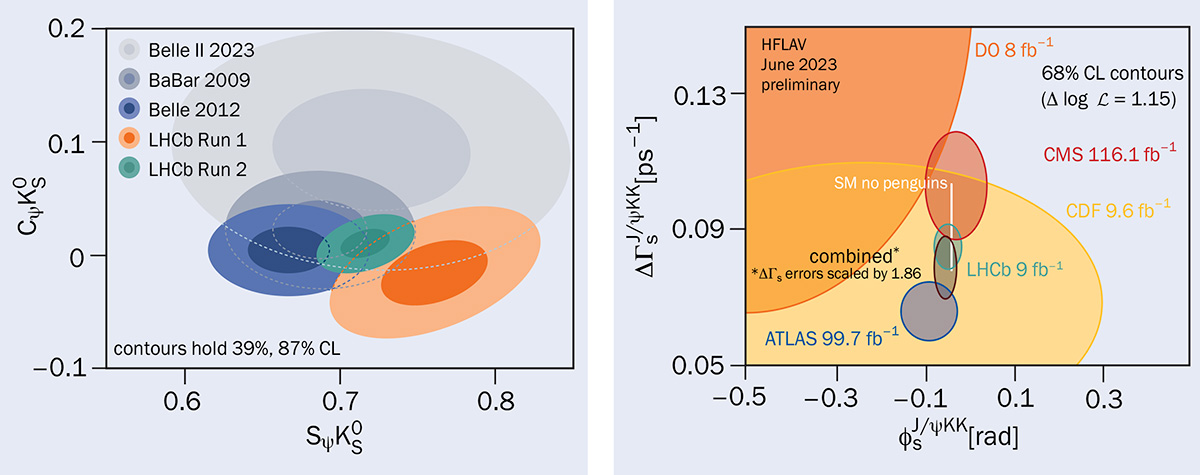
At a CERN seminar on 13 June, the LHCb collaboration presented the world’s most precise measurements of two key parameters relating to CP violation. Based on the full LHCb dataset collected during LHC Runs 1 and 2, the first concerns the observable sin2β while the second concerns the CP-violating phase φs – both of which are highly sensitive to potential new-physics contributions.
CP violation was first observed in 1964 in kaon mixing, and confirmed among B mesons in 2001 by the e+e– B-factory experiments BaBar and Belle. The latter enabled the first measurements of sin2β and were a vital confirmation of the Standard Model (SM). In the SM, CP violation arises due to a complex phase in the Cabibbo–Kobayashi–Maskawa mixing matrix, which, being unitary, defines a triangle in the complex plane: one side is defined to have unit length, while the other two sides and three angles must be inferred via measurements of certain hadron decays. If the measurements do not provide a consistent description of the triangle, it would hint that something is amiss in the SM.
The measurement of sin2β, which determines the angle β in the unitarity triangle, is more difficult at a hadron collider than it is at an e+e– collider. However, the large data samples available at the LHC and the optimised design of the LHCb experiment have enabled a measurement that is twice as precise as the previous best result from Belle. The LHCb team used decays of B0 mesons to J/ψ K0S, which can proceed either directly or by first oscillating into their antimatter partners. The interference between the amplitudes for the two decay paths results in a time-dependent asymmetry between the decay-time distributions of the B0 and B0. The amplitude of the oscillation, and thus the magnitude of CP violation present, is a measurement of sin2β for which LHCb finds a value of 0.716 ± 0.013 ± 0.008, in agreement with predictions.
Based on an analysis of B0S→ J/ψ K+K– decays, LHCb also presented the world’s best measurement of the CP-violating phase φs, which plays a similar role in B0S meson decays as sin2β does in B0 decays. As for B0 mesons, a B0S may decay directly or oscillate into a B0S and then decay. CP violation causes these decays to proceed at slightly different rates, manifesting itself as a non-zero value of φs due to the interference between mixing and decay. The predicted value of φs is about –0.037 rad, but new-physics effects, even if also small, could change its value significantly.
A detailed study of the angular distribution of B0S decay products using the Run 1 and 2 data samples enabled LHCb to measure this decay-time-dependent CP asymmetry φs = -0.039 ± 0.022 ± 0.006 rad. Representing the most precise single measurement to date, it is consistent with previous measurements and with the SM expectation. The precision measurement of φs is one of LHCb’s most important goals, said co-presenter Vukan Jevtic (TU Dortmund): “Together with sin2β, the new LHCb result marks an important advance in the quest to understand the nature and origin of CP violation.”
With both results currently limited by statistics, the collaboration is looking forward to data from the current and future LHC runs. “In Run 3 LHCb will collect a larger data sample taking advantage of the new upgraded LHCb detector,” concluded co-presenter Peilian Li (CERN). “This will allow even higher precision and therefore the possibility to detect, through these key quantities, the manifestation of new-physics effects.”
The neutrino had barely been known for two years when CERN’s illustrious neutrino programme got under way. As early as 1958, the 600 MeV Synchrocyclotron enabled the first observation of the decay of a charged pion into an electron and a neutrino – a key piece in the puzzle of weak interactions. Dedicated neutrino-beam experiments began a couple of years later when the Proton Synchrotron (PS) entered operation, rivalled by activities at Brookhaven’s higher-energy Alternating Gradient Synchrotron in the US. Producing the neutrino beam was relatively straightforward: make a proton beam from the PS hit an internal target to produce pions and kaons, let them fly some distance during which they can produce neutrinos when they decay, then use an iron shielding to filter the remaining hadrons, such that only neutrinos and muons remain. Ensuring that a new generation of particle detectors would enable the study of neutrino-beam interactions proved a tougher challenge.
CERN began with two small, 1 m-long heavy-liquid bubble chambers that used proton beams which struck an internal target inside the PS, hoping to see at least one neutrino event per day. It was nowhere near that. Unfortunately the target configuration had made the beams about 10 times less intense than expected, and in 1961 CERN’s nascent neutrino programme came to a halt. “It was a big disappointment,” recalls Don Cundy, who was a young scientist at CERN at the time. “Then, several months later, Brookhaven did the same experiment but this time they put the target in the right place, and they discovered that there were two neutrinos – the muon neutrino (νµ) and the electron neutrino (νe) – a great discovery for which Lederman, Schwartz and Steinberger received the Nobel prize some 25 years later.”
Despite this setback, CERN Director-General Victor Weisskopf, along with his Director of Research Gilberto Bernardini and the CERN team, decided to embark on an even more ambitious setup. Employing Simon van der Meer’s recently proposed “magnetic horn” – a high-current, pulsed focusing device placed around the target – and placing the target in an external beam pipe increased the neutrino flux by about two orders of magnitude. In 1963 this opened a new series of neutrino experiments at CERN. They began with a heavy-liquid bubble chamber containing around 500 kg of freon and a spark-chamber detector weighing several tonnes, for which first results were presented at a conference in Siena that year. The bubble-chamber results were particularly impressive, recalls Cundy: “Even though the number of events was of the order of a few hundred, you could do a lot of physics: measure the elastic form factor of the nucleon, single pion production, the total cross section, search for intermediate weak bosons and give limits on neutral-current processes.” It was at that conference that André Lagarrigue of Orsay urged that bubble chambers were the way forward for neutrino physics, and proposed to build the biggest chamber possible: Gargamelle, named after a giantess from a fictional renaissance story.
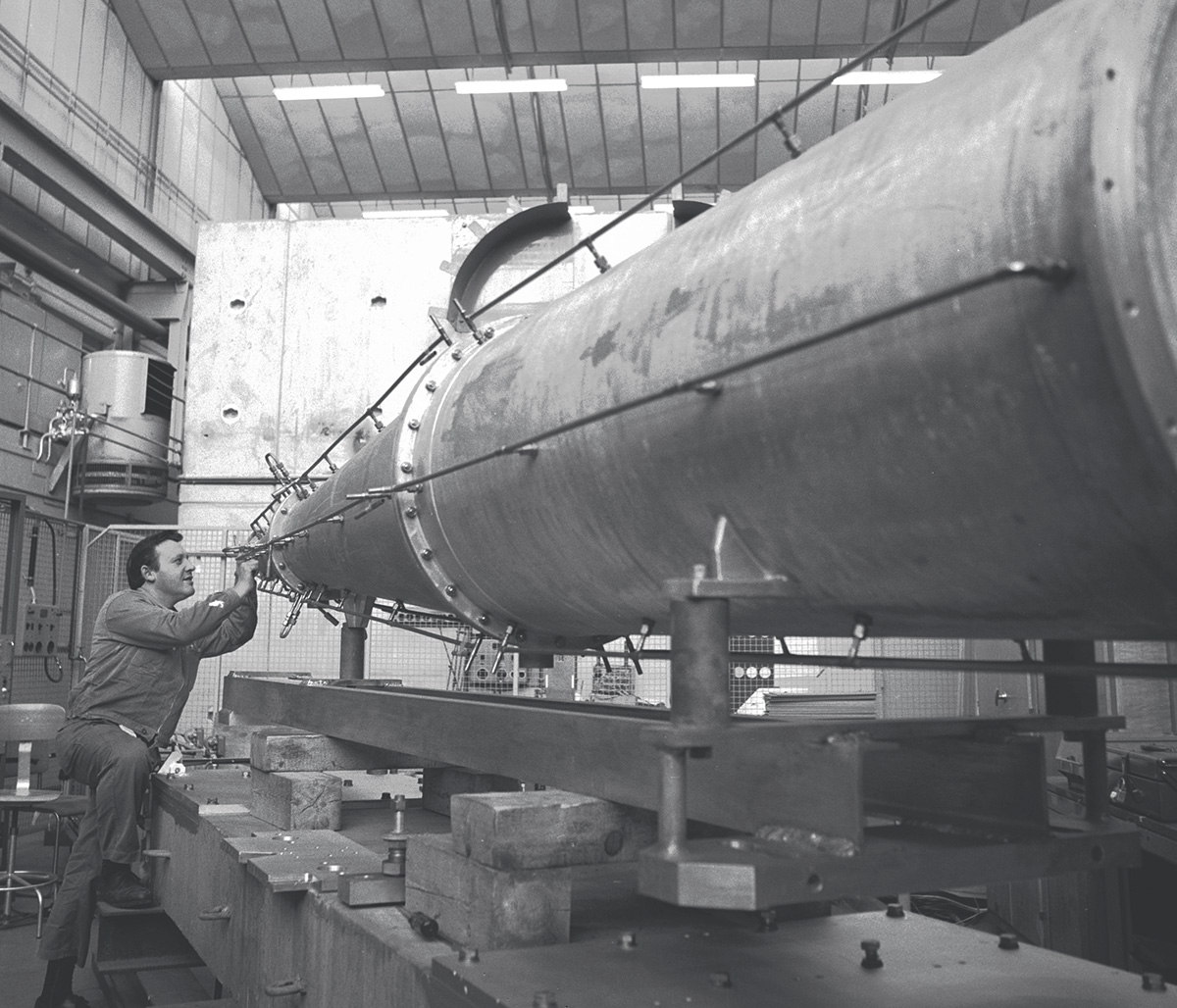
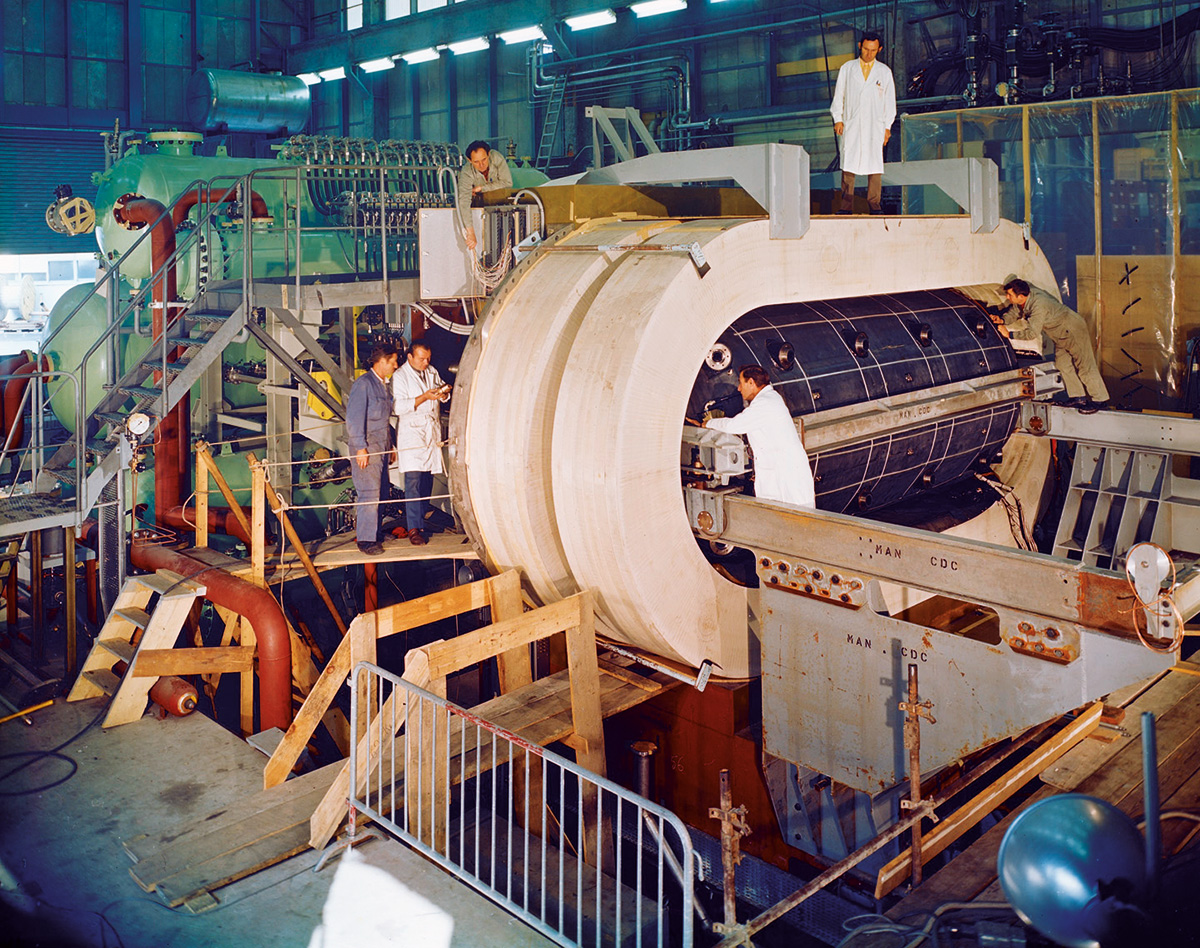
Construction in France of the much larger Gargamelle chamber, 4.8 m long and containing 18 tonnes of freon, was quick, and by the end of 1970 the detector was receiving a beam of muon neutrinos from the PS. The Gargamelle collaboration consisted of researchers from seven European institutes: Aachen, Brussels, CERN, École Polytechnique Paris, Milan, LAL Orsay and University College London. In 1969 the collaboration had made a list of physics priorities. Following the results of CERN’s Heavy Liquid Bubble Chamber, which set new limits on neutrino-electron scattering and single-pion neutral-current (NC) processes, the search for actual NC events made it onto the list. However, it only placed eighth out of 10 science goals. That is quite understandable, comments Cundy: “People thought that the most sensitive way to look for NCs was the decay of a K0 meson into two muons or two electrons but that had a very low branching ratio, so if NCs existed it would be at a very small level. The first thing on the list for Gargamelle was in fact looking at the structure of the nucleon, to measure the total cross section and to investigate the quark model.”
Setting priorities
After the discovery of the neutrino in 1956 by Reines and Cowan (CERN Courier July/August 2016 p17), the weak interaction became a focus of nuclear research. The unification of the electromagnetic and weak interactions by Salam, Glashow and Weinberg a decade later motivated experiments to look for the electroweak carriers: the W boson, which mediates charged-current interactions, and the Z boson associated with neutral currents. While the former were known to exist by means of β decay, the latter were barely thought of. Neutral currents started to become interesting in 1971, after Martinus Veltman and Gerard ’t Hooft proved the renormalisability of the electroweak theory.
More than 60 years after first putting the neutrino to work, CERN’s neutrino programme continues to evolve
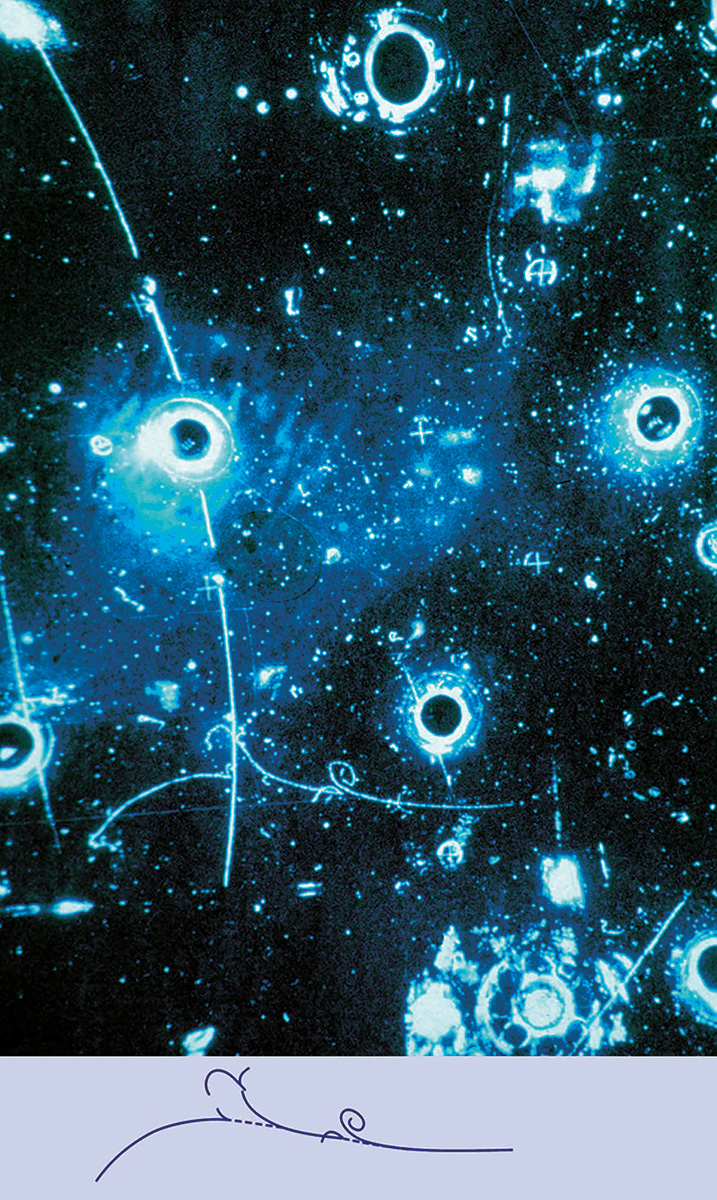
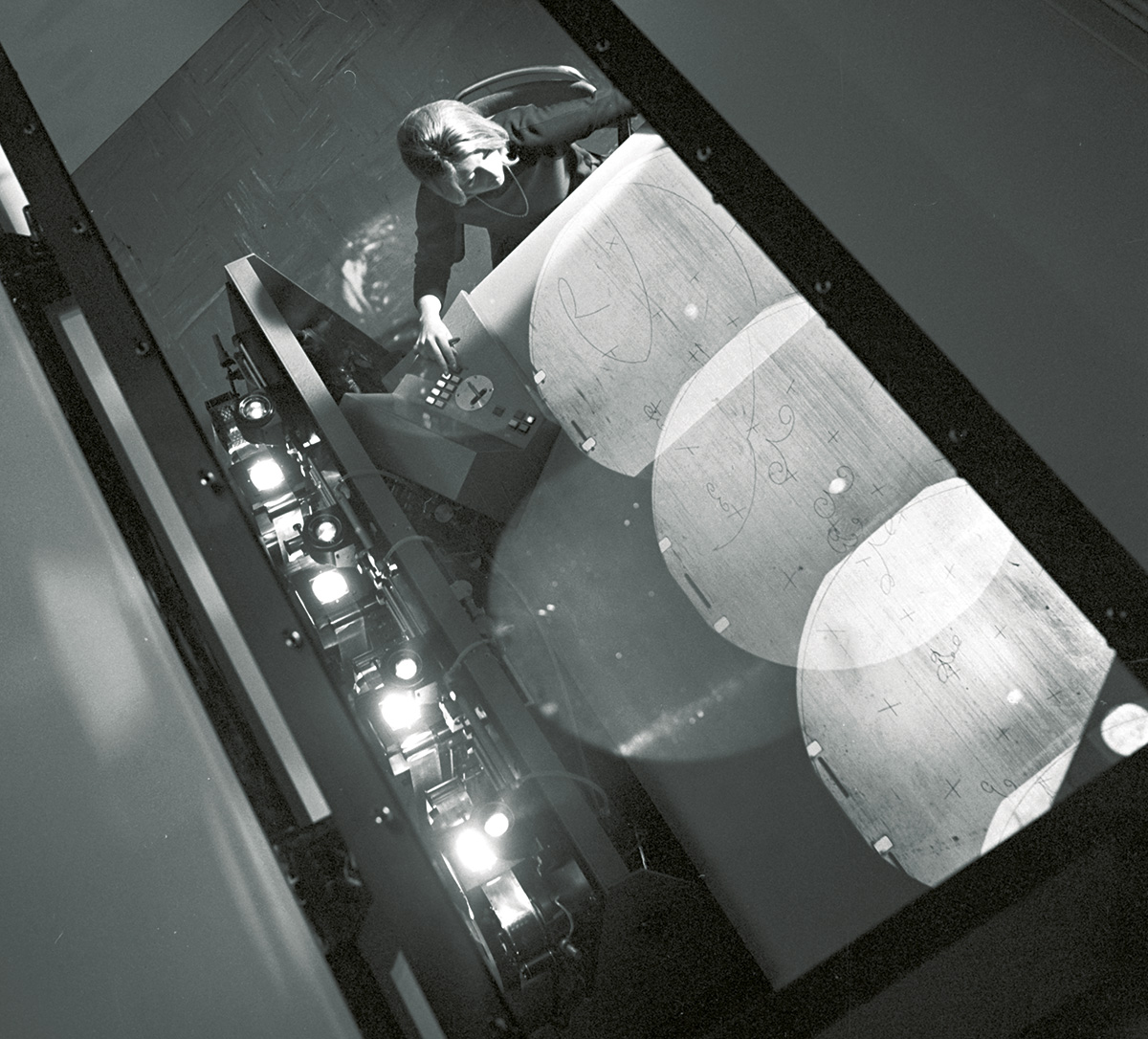
By that time, Gargamelle was running at full speed. Analysing the photographs that were taken every time the PS was pulsed to look for interesting tracks were CERN personnel (at the time often referred to as “scanning girls”) who essentially performed the role of a modern level-1 trigger. Interactions were divided into different classes depending on the number of particles involved (muons, hadrons, electron–positron pairs, even one or more isolated protons as well as isolated electrons and positrons). The leptonic NC process (νµ + e–→νµ + e–) would give an event that consisted of a single energetic electron. Since the background was very low, it would be the smoking gun for NCs. However, the cross-section was also very low, with only one to nine events expected from the electroweak calculations. The energetic hadronic NC event (νµ + N →νµ + X, with the respective process involving antiparticles if the reaction was triggered by an antineutrino beam) would consist only of several hadrons, in fact just like events produced by incoming high-energy neutrons.
“When the first leptonic event was found in December 1972 we were convinced that NCs existed,” says Gargamelle member Donatella Cavalli from the University of Milan. “It was just one event but with very low background, so a lot of effort was put into the search for hadronic NC events and in the full understanding of the background. I was the youngest in my group and I remember spending the evenings with my colleagues scanning the films on special projectors, which allowed us to observe the eight views of the chamber. I proudly remember my travels to Paris, London and Brussels, taking the photographs of the candidate events found in Milan to be checked with colleagues from other groups.”
At a CERN seminar on 19 July 1973, Paul Musset, who was one of the principal investigators, presented Gargamelle’s evidence for NCs based on both the leptonic and hadronic analyses. Results from the former had been published in a short paper received by Physics Letters two weeks earlier, while the paper on the hadronic events, which reported on the actual observation and hence confirmation of neutral currents, was received on 23 July. In August 1973 Gerald Myatt ofUniversity College London, now at the University of Oxford, presented the results at the Electron-Photon conference. The papers were published in the same issue of the journal on 3 September. Yet many physicists doubted them. “It was generally believed that Gargamelle made a mistake,” says Myatt. “There was only one event, a tiny track really, and very low background. Still, it was not seen as conclusive evidence.” Among the critical voices were T D Lee, who was utterly unimpressed, and Jack Steinberger, who went as far as to bet half his wine cellar that the Gargamelle result would be wrong.
The difficulty was to demonstrate that the hadronic NC signal was not due to background from neutral hadrons. “A lot of work and many different checks were done, from calculations to a full Monte Carlo simulation to a comparison between spatial distributions of charged- and neutral-current events,” explains Cavalli. “We were really happy when we published the first results from hadronic and leptonic NCs after all background checks, because we were confident in our results.” Initially the Gargamelle results were confirmed by the independent HPWF (Harvard–Pennsylvania–Wisconsin–Fermilab) experiment at Fermilab. Unfortunately, a problem with the HPWF setup led to their paper being rewritten, and a new analysis presented in November 1973 showed no sign of NCs. It was not until the following year that the modified HPWF apparatus and other experiments confirmed Gargamelle’s findings.
Additionally, the collaboration managed to tick off number two on its list of physics priorities: deep-inelastic scattering and scaling. Confirming earlier results from SLAC which showed that the proton is made of point-like constituents, Gargamelle data were crucial in proving that these constituents (quarks) have charges of +2/3 and –1/3. For neutral currents, the icing on the cake came 10 years after Gargamelle’s discovery with the direct discovery of the Z (and W) bosons at the SppS collider in 1983. The next milestone for CERN in understanding weak interactions came in 1990 with the precise measurement of the decay width of the Z boson at LEP, which showed that there are three and no more light neutrinos.
Legacy of a giantess
In 1977 Gargamelle was moved from the PS to the newly installed Super Proton Synchrotron (SPS). The following year, however, metal fatigue caused the chamber to crack and the experiment was decommissioned. Some of the collaboration members – including Cundy and Myatt – went to work on the nearby Big European Bubble Chamber. Also hooked up to the SPS for neutrino studies at that time were CDHS (CERN–Dortmund–Heidelberg–Saclay, officially denoted WA1) led by Steinberger, and Klaus Winter’s CHARM experiment. Operating for eight years, these large detectors collected millions of events that enabled precision studies on the structure of the charged and neutral currents as well as the structure of nucleons and the first evidence for QCD via scaling violations.
The third type
The completion of the CHARM programme in 1991 marked the halt of neutrino operations at CERN for the first time in almost 30 years. But not for long. Experimental activities restarted with the search for neutrino oscillations, driven by the idea that neutrinos were an important component of dark matter in the universe. Consequently, two similarly styled short-baseline neutrino-beam experiments – CHORUS and NOMAD – were built. These next-generation detectors, which took data from 1994 to 1998 and from 1995 to 1998, respectively, joined others around the world to look for interactions of the third neutrino type, the ντ, and to search for neutrino oscillations, i.e. the change in neutrino flavour as they propagate, which was proposed in the 1950s and confirmed in 1998 by the SNO and Super-Kamiokande experiments in Canada and Japan. In 2000 the DONUT experiment at Fermilab reported the first direct evidence for ντ interactions.
CERN’s neutrino programme entered a hiatus until July 2006, when the SPS began firing an intense beam of muon neutrinos 732 km through Earth to two huge detectors – ICARUS and OPERA – located underground at Gran Sasso National Laboratory in Italy. Designed to make precision measurements of neutrino oscillations, the CERN Neutrinos to Gran Sasso (CNGS) programme observed the oscillation of muon neutrinos into tau neutrinos and was completed in 2012.
As the CERN neutrino-beam programme was wound down, a brand-new initiative to support fundamental neutrino research began. “The initial idea for a ‘neutrino platform’ at CERN was to do a short-baseline neutrino experiment involving ICARUS to check the LSND anomaly, and another to test prototypes for “LBNO”, which would have been a European long-baseline neutrino oscillation experiment sending beams from CERN to Phyäsalmi in Finland to investigate the oscillation,” says Dario Autiero, who has been involved in CERN’s neutrino programme since the beginning of the 1980s. “The former was later decided to take place at Fermilab, while for the latter the European and US visions for long-baseline experiments found a consensus for what is now DUNE (the Deep Underground Neutrino Experiment) in the US.”
A unique facility
Officially launched in 2013 in scope of the update to the European strategy for particle physics, the CERN Neutrino Platform serves as a unique R&D facility for next-generation long-baseline neutrino experiments. Its most prominent project is the design, construction and testing of prototype detectors for DUNE, which will see a neutrino beam from Fermilab sent 1300 km to the SURF laboratory in Dakota. One of the Neutrino Platform’s early successes was the refurbishment of the ICARUS detector, which is now taking data at Fermilab’s short-baseline neutrino programme. The platform is also developing key technologies for the near detector for the Tokai-to-Kamioka (T2K) neutrino facility in Japan (see p10), and has a dedicated theory working group aimed at strengthening the connections between CERN and the worldwide neutrino community. Independently, the NA61 experiment at the SPS is contributing to a better understanding of neutrino–nucleon cross sections for DUNE and T2K data.
More than 60 years after first putting the neutrino to work, CERN’s neutrino programme continues to evolve. In April 2023 a new experiment at the LHC called FASER made the first observation of neutrinos produced at a collider. Together with another new experiment, SND@LHC, FASER will enable the study of neutrinos in a new energy range and compare the production rate of all three types of neutrinos to further test the Standard Model.
As for Gargamelle, today it lies next to BEBC and other retired colleagues in the garden of Square van Hove behind CERN’s main entrance. Not many can still retell the story of the discovery of neutral currents, but those who can share the story with delight “It was very tiny that first track from the electron, one in hundreds of thousands of pictures,” says Myatt. “Yet it justified André Lagarrigue’s vision of the large heavy-liquid bubble chamber as an ideal detector of neutrinos, combining large mass with a very finely detailed picture of the interaction. There can be no doubt that it was these features that enabled Gargamelle to make one of the most significant discoveries in the history of CERN.”
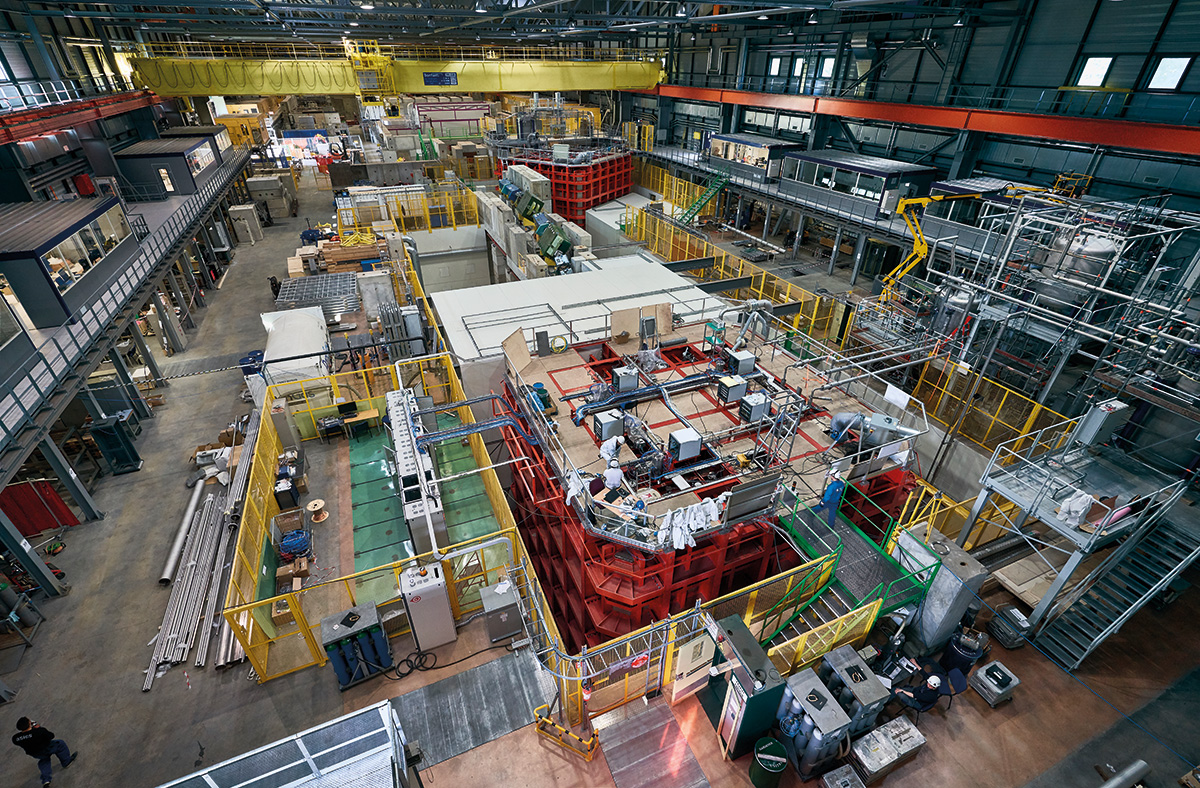
The European Spallation Source (ESS) is a European project with 13 members states and two host states. In this talk, Mats Lindroos will give examples of the science that will be done at ESS both in applied physics and fundamental physics. He will speak about the in-kind model, which made it possible to build this facility on a greenfield site in a country without any previous experience of much of the required technology.
Also reviewed will be the status of the project with beam on target planned for 2025 and the start of the full user programme in 2027.
Mats Lindroos has a PhD in subatomic physics from Chalmers University of technology in Gothenburg, Sweden, and since 2014, is adjunct professor at Lund’s university. He worked at CERN from 1993–2009 starting as a research fellow at the ISOLDE facility and from 1995 as a staff member in the CERN accelerator sector. He has among other tasks been responsible for PS Booster operation and technical coordination of the CERN ISOLDE facility. He has also been project leader of several CERN projects and had leading roles in several EC-supported design studies for future nuclear physics and neutrino facilities. Mats co-authored a book in 2009 on a future neutrino beam concept, beta-beams. Since 2009 he has been head of the accelerator division and sub-project leader at the European Spallation Source ERIC (ESS) in Lund.
To provide the best experiences, we use technologies like cookies to store and/or access device information. Consenting to these technologies will allow us to process data such as browsing behavior or unique IDs on this site. Not consenting or withdrawing consent, may adversely affect certain features and functions.
Functional
Always active
The technical storage or access is strictly necessary for the legitimate purpose of enabling the use of a specific service explicitly requested by the subscriber or user, or for the sole purpose of carrying out the transmission of a communication over an electronic communications network.
Preferences
The technical storage or access is necessary for the legitimate purpose of storing preferences that are not requested by the subscriber or user.
Statistics
The technical storage or access that is used exclusively for statistical purposes.The technical storage or access that is used exclusively for anonymous statistical purposes. Without a subpoena, voluntary compliance on the part of your Internet Service Provider, or additional records from a third party, information stored or retrieved for this purpose alone cannot usually be used to identify you.
Marketing
The technical storage or access is required to create user profiles to send advertising, or to track the user on a website or across several websites for similar marketing purposes.





 Mats Lindroos has a PhD in subatomic physics from Chalmers University of technology in Gothenburg, Sweden, and since 2014, is adjunct professor at Lund’s university. He worked at CERN from 1993–2009 starting as a research fellow at the ISOLDE facility and from 1995 as a staff member in the CERN accelerator sector. He has among other tasks been responsible for PS Booster operation and technical coordination of the CERN ISOLDE facility. He has also been project leader of several CERN projects and had leading roles in several EC-supported design studies for future nuclear physics and neutrino facilities. Mats co-authored a book in 2009 on a future neutrino beam concept, beta-beams. Since 2009 he has been head of the accelerator division and sub-project leader at the European Spallation Source ERIC (ESS) in Lund.