Comsol -leaderboard other pages

Topics

Boosting physics with precision and intensity

The Physics Beyond Colliders (PBC) initiative has diversified the landscape of experiments at CERN by supporting smaller experiments and showcasing their capabilities. Its fifth annual workshop convened around 175 physicists from 25 to 27 March to provide updates on the ongoing projects and to explore new proposals to tackle the open questions of the Standard Model and beyond.

This year, the PBC initiative has significantly strengthened CERN’s dark-sector searches, explained Mike Lamont and Joachim Mnich, directors for accelerators and technology, and research and computing, respectively. In particular, the newly approved SHiP proton beam-dump experiment (see SHiP to chart hidden sector) will complement the searches for light dark-sector particles that are presently conducted with NA64’s versatile setup, which is suitable for electron, positron, muon and hadron beams.

First-phase success

The FASER and SND experiments, now taking data in the LHC tunnel, are two of the successes of the PBC initiative’s first phase. Both search for new physics and study high-energy neutrinos along the LHC collision axis. FASER’s successor, FASER2, promises a 10,000-fold increase in sensitivity to beyond-the-Standard Model physics, said Jonathan Feng (UC Irvine). With the potential to detect thousands of TeV-scale neutrinos a day, it could also measure parton distribution functions and thereby enhance the physics reach of the high-luminosity LHC (HL-LHC). FASER2 may form part of the proposed Forward Physics Facility, set to be located 620 m away, along a tangent from the HL-LHC’s interaction point 1. A report on the facility’s technical infrastructure is scheduled for mid-2024, with a letter of intent foreseen in early 2025. By contrast, the CODEX-b and ANUBIS experiments are being designed to search for feebly interacting particles transverse to LHCb and ATLAS, respectively. In all these endeavours, the Feebly Interacting Particle Physics Centre will act as a hub for exchanges between experiment and theory.

Francesco Terranova (Milano-Bicocca) and Marc Andre Jebramcik (CERN) explained how ENUBET and NuTAG have been combined to optimise a “tagged” neutrino beam for cross-section measurements, where the neutrino flavour is known by studying the decay process of its parent hadron. In the realm of quantum chromodynamics, SPS experiments with lead ions (the new NA60+ experiment) and light ions (NA61/SHINE) are aiming to decode the phases of nuclear matter in the non-perturbative regime. Meanwhile, AMBER is proposing to determine the charge radii of kaons and pions, and to perform meson spectroscopy, in particularwith kaons.

The LHCspin collaboration presented a plan to open a new frontier of spin physics at the LHC building upon the successful operation of the SMOG2 gas cell that is upstream of the LHCb detector. Studying collective phenomena at the LHC in this way could probe the structure of the nucleon in a so-far little-explored kinematic domain and make use of new probes such as charm mesons, said Pasquale Di Nezza (INFN Frascati).

Measuring moments

The TWOCRYST collaboration aims to demonstrate the feasibility and the performance of a possible fixed-target experiment in the LHC to measure the electric and magnetic dipole moments (EDMs and MDMs) of charmed baryons, offering a complementary probe of searches for CP violation in the Standard Model. The technique would use two bent crystals: the first to deflect protons from the beam halo onto a target, with the resulting charm baryons then deflected by the second (precession) crystal onto a detector such as LHCb, while at the same time causing their spins to precess in the strong electric and magnetic fields of the deformed crystal lattice, explained Pascal Hermes (CERN).

New ideas ranged from the measurement of molecular electric dipole moments at ISOLDE to measuring the gravitational field of the LHC beam

Several projects to detect axion-like particles were discussed, including a dedicated superconducting cavity for heterodyne detection being jointly developed by PBC and CERN’s Quantum Technology Initiative. Atom interferometry is another subject of common interest, with PBC demonstrating the technical feasibility of installing an atom interferometer with a baseline of 100 m in one of the LHC’s access shafts. Other new ideas ranged from the measurement of molecular EDMs at ISOLDE to measuring the gravitational field of the LHC beam.

With the continued determination to fully exploit the scientific potential of the CERN accelerator complex and infrastructure for projects that are complementary to high-energy-frontier colliders testified by many fruitful discussions, the annual meeting concluded as a resounding success. The PBC community ended the workshop by thanking co-founder Claude Vallée (CPPM Marseille), who retired as a PBC convener after almost a decade of integral work, and welcomed Gunar Schnell (Ikerbasque and UPV/EHU Bilbao), who will take over as convener.

Ultra-peripheral conference debuts in Mexico

Ultra-peripheral collisions (UPCs) involving heavy ions and protons represent the energy frontier for photon-induced reactions. These high-energy photons can be used to study unique features of quarks and gluons inside nuclei, and can probe electromagnetic and electroweak interactions without the usual backgrounds associated with quantum-chromodynamic processes. The first edition of the international workshop on this subject took place from 10 to 15 December 2023 in Playa del Carmen, Mexico, bringing together about 90 participants, more than a third of whom were early-career researchers. This is the first time that the international UPC community has gathered together, establishing a new international conference series on this active and expanding area of research.

The conference highlighted the impressive progress and diversity of UPC physics, which goes far beyond the initial studies of exclusive pro­-cesses. UPC23 covered the latest results from experiments at RHIC and the LHC, and prospects for the future Electron-Ion Collider (EIC) at Brookhaven National Laboratory. Discussions delved into the intricacies of inelastic photo-nuclear events, including the exciting programme of open charm that is yet to be explored, and examined how UPCs serve as a novel lens for investigating the quark–gluon plasma and other final-state nuclear effects. Lots of attention was devoted to the physics of low-x parton densities – a fundamental aspect of protons and nuclei that photons can probe in a unique way.

Enriched understanding

Among the conference’s theoretical highlights, Farid Salazar (UCLA) showed how vector–meson photoproduction could be a powerful method to detect gluon saturation across different collision systems, from proton–nucleus to electron–nucleus to UPCs. Zaki Panjsheeri (Virginia) put forth innovative ideas to study double-parton correlations, linking UPC vector–meson studies to generalised parton distributions, enhancing our understanding of the proton’s structure. Ashik Ikbal (Kent State), meanwhile, introduced exciting proposals to investigate quantum entanglement through exclusive J/ψ photoproduction at RHIC.

The conference also provided a platform for discussing the active exploration of light-by-light scattering and two-photon processes for probing fundamental physics and searches for axion-like particles, and for putting constraints on the anomalous magnetic moment of the tau lepton (see CMS closes in on tau g–2).

Energy exploration

Physicists at the LHC have effectively repurposed the world’s most powerful particle accelerator into a high-energy photon collider. This innovative approach, traditionally the domain of electron beams in colliders like LEP and HERA, and anticipated at the EIC, allows the LHC to explore photon-induced interactions at energies never before achieved. David Grund (Czech Technical University in Prague), Georgios Krintiras (Kansas) and Cesar Luiz Da Silva (Los Alamos) shared the latest LHC findings on the energy dependence of UPC J/ψ events. These results are crucial for understanding the onset of gluon saturation – a state where gluons become so dense reaching saturation, the dynamical equilibrium where the emission and recombination occurs. However, the data also align with the nuclear phenomenon known as gluon shadowing, which arises from multiple-scattering processes. David Tlusty (Creighton) presented the latest findings from the STAR Collaboration, which has recently expanded its UPC programme, complementing the energy exploration at the LHC. Klaudia Maj (AGH University of Krakow) presented the latest results on two-photon interactions and photonuclear jets from the ATLAS collaboration, including measurements that may be probing the quark-gluon plasma. 

Delegates discussed the future opportunities for UPC physics with the large integrated luminosity expected for Runs 3 and 4 at the LHC

Carlos Bertulani (Texas A&M) paid tribute to Gerhard Baur, who passed away on June 16 last year. Bertulani and Baur co-authored “Electromagnetic processes in relativistic heavy ion collisions” – a seminal paper with more than 1000 citations. Bertulani invited delegates to consider the untapped potential of UPCs in the study of anti-atoms and exotic atoms.

Delegates also discussed the future opportunities for UPC physics with the large integrated luminosity expected for Run 3 and Run 4 at the LHC, with the planned detector upgrades for Run 4 such as FoCal, the recent upgrades by STAR, the sPHENIX programme and at the EIC. Delegates are expecting event selection and instrumentation close to the beam line, for example using “zero degree” calorimeters, to offer the greatest experimental opportunities in the coming years.

The next edition of the UPC conference will take place in Saariselka, Finland in June 2025.

Slim, charming protons on the menu in Mainz

The triennial international conference on meson–nucleon physics and the structure of the nucleon (MENU) attracted more than 140 participants to the historic centre of Mainz from 16 to 20 October 2023.

Among MENU 2023’s highlights on nucleon structure, a preliminary analysis by the NNPDF collaboration suggests that the proton contains more charm than anticharm, with Niccolò Laurenti (Università degli Studi di Milano) showing evidence of a non-vanishing intrinsic valence charm contribution to the proton’s wavefunction. Meanwhile, Michael Kohl (Hampton University) concluded that the proton–radius puzzle is still not resolved. To make progress, form-factor measurements in electron scattering must be scrutinised, and the use of atomic spectroscopy data clarified, he said.

Hadron physics

A large part of this year’s conference was dedicated to hadron spectroscopy, with updates from Belle II, BESIII, GlueX, Jefferson Lab, JPAC, KLOE/KLOE-2 and LHCb, as well as theoretical overviews covering everything from lattice quantum chromodynamics to effective-field theories. Special emphasis was also given to future directions in hadron physics at future facilities such as FAIR, the Electron-Ion Collider and the local Mainz Energy-Recovering Superconducting Accelerator (MESA) facility – a future low-energy but high-intensity electron accelerator that will make it possible to carry out experiments in nuclear astrophysics, dark-sector searches and tests of the SM. Among upgrade plans at Jefferson Lab, Eric Voutier (Paris-Saclay) presented a future experimental programme with positron beams at CEBAF, the institute’s Continuous Electron Beam Accelerator Facility. The upgrade will allow for a rich physics programme covering two-photon exchange, generalised polarisabilities, generalised parton distribution functions and direct dark-matter searches.

Highlights on nucleon structure include a preliminary analysis suggesting that the proton contains more charm than anticharm

Hadron physics is also closely related to searches for new physics, as precision observables of the Standard Model are in many cases limited by the non-perturbative regime of quantum chromodynamics. A prime example is the physics of the anomalous magnetic moment of the muon, for which a puzzling discrepancy between data-driven dispersive and lattice–quantum chromodynamics calculations of hadronic contributions to the Standard Model prediction persists (CERN Courier May/June 2021 p25). The upcoming collaboration meeting of the Muon g-2 Theory Initiative in September 2024 at KEK will provide important new insights from lattice QCD and e+e experiments. It remains to be seen whether the eventual theoretical consensus will confirm a significant deviation from the experimental value, which is currently being updated by Fermilab’s Muon g-2 experiment using their last three years of data.

BESIII passes milestone at the charm threshold

The BESIII collaboration has marked a significant milestone: the completion of its 15-year campaign to collect 20 fb–1 of e+e collision data at the ψ(3770) resonance. The sample, collected in two main running periods, 2010–2011 and 2022–2024, is more than 20 times larger than the world’s previous charm-threshold data set collected by the CLEO-c experiment in the US.

BESIII is an experiment situated on the BEPCII storage ring at IHEP in Beijing. It involves more than 600 physicists drawn not only from China but also other nations, including Germany, Italy, Poland, the Netherlands, Sweden and the UK from the CERN member states. The detector has collected data at a range of running points with centre-of-mass energies from 1.8 to 4.95 GeV, most of which are inaccessible to other operating colliders. This energy regime allows researchers to make largely unique studies of physics above and below the charm threshold, and has led to important discoveries and measurements in light-meson spectroscopy, non-perturbative QCD, and charm and tau physics.

The ψ(3770), discovered at SLAC in 1977, is the lightest charmonium state above the open-charm threshold. Charmonium consists of a bound charm quark and anti-charm quark, whereas open-charm states such as D0 and D+ mesons are systems in which the charm quark co-exists with a different anti-quark. The ψ(3770) can decay into D and anti-D mesons, whereas charmonium states below threshold, such as the J/ψ, are too light to do so, and must instead decay through annihilation of the charm and anticharm quarks.

The sample is more than 20 times larger than the worlds previous charm-threshold data set

Open-charm mesons are also produced in copious quantities at the LHC and at Belle II. However, in ψ(3770) decays at BESIII they are produced in pairs, with no accompanying particles. This makes the BESIII sample a uniquely clean laboratory in which to study the properties of D mesons. If one meson is reconstructed, or tagged, in a known charm decay, the other meson in the event can be analysed in an unbiased manner. When reconstructed in a decay of interest, the unbiased sample of mesons can be used to measure absolute branching fractions and the relative phases between any intermediate resonances in the D decay.

“Both sets of information are not only interesting in themselves, but also vital for studies with charm and beauty mesons at LHCb and Belle II,” explains Guy Wilkinson of the University of Oxford. “For example, measurements of phase information performed by BESIII with the first tranche of ψ(3770) data have been essential input in the world-leading determination of the CP-violating angle γ of the unitarity triangle by LHCb in events where a beauty meson decays into a D meson and an accompanying kaon.” Exploitation of the full 20 fb–1 sample will be essential in helping LHCb and Belle II realise their full potential in CP-violation measurements with larger data sets in the future, he adds. “Hence BESIII is very complementary to the higher energy experiments, demonstrating the strong synergies that exist between particle-physics facilities worldwide.”

This summer, BEPCII will undergo an upgrade that will increase its luminosity. Over the rest of the decade more data will be taken above and below the charm threshold. In the longer term, there are plans, elsewhere in China, for a Super Tau Charm Facility – an accelerator that would build on the BEPCII and BESIII programme with datasets that are two orders of magnitude larger.

First DESI results shine a light on Hubble tension

The expansion of the universe has been a well-established fact of physics for almost a century. By the turn of the millennium the rate of this expansion, referred to as the Hubble constant (H0), had converged to a value of around 70 km s–1 Mpc–1. However, more recent measurements have given rise to a tension: whereas those derived from the cosmic microwave background (CMB) cluster around a value of 67 km s–1 Mpc–1, direct measurements using a local distance-ladder (such as those based on Cepheids) mostly prefer larger values around 73 km s–1 Mpc–1. This disagreement between early- and late-universe measurements, respectively, stands at the 4–5σ level, thereby calling for novel measurements.

One such source of new information are large galaxy surveys, such as the one currently being performed by the Dark Energy Spectroscopic Instrument (DESI). This Arizona-based instrument uses 5000 individual robots that optimise the focal plane of the detector to allow it to measure 5000 galaxies at the same time. The goal of the survey is to provide a detailed 3D map, which can be used to study the evolution of the universe by focussing on the distance between galaxies. During its first year of observation, the results of which have now been released, DESI has provided a catalogue of millions of objects.

Primordial imprints

Small fluctuations in the density of the early universe resulted not only in signatures in the CMB, as measured for example by the Planck probe, but also left imprints in the distribution of baryonic matter. Each over-dense region is thought to contain dark matter, baryonic matter and photons. The gravitational force from dark matter on the baryons is countered by radiation pressure from the photons. From the small over-densities, baryons are dragged along by photon pressure until these two types of particles decoupled during the recombination era. The original location of the over-density is surrounded by a sphere of baryonic matter, which typically is at a distance referred to as the sound horizon. The sound horizon at the moment of decoupling, denoted rd, leaves an imprint that has since evolved to produce the density fluctuations in the universe that seeded large-scale structures.

Constraints on the Hubble constant assuming the flat ΛCDM model

This imprint, and how it has evolved over the last 13 billion years, depends on a number of parameters in the standard ΛCDM model of cosmology. Measuring the baryon distribution therefore allows many of the ΛCDM parameters to be constrained. Since the DESI data measure the combination of H0 and rd, a direct measurement of H0 is not possible. However, by using additional data for the sound horizon, taken from CMB measurements and Big Bang nucleosynthesis theory, the team finds values of H0 that cluster around 67.5 km s–1 Mpc–1 (see “Hubble tension” figure). This is consistent with early-universe measurements and differs by more than 3σ from late-universe measurements.

Although these new results do not directly resolve the Hubble tension, they do hint at one potential solution: the need to revise the ΛCDM model. The measurements also allow constraints to be placed on the acceleration of the universe, which depends on the dark-energy equation of state, w. While this is naturally assumed to be constant at w = –1, the DESI first-year results better match a time-evolving equation of state. Although highly dependent on the analysis, the DESI data so far provide results that differ from ΛCDM predictions by more than 2.5σ. The data from the remaining four years of the survey are therefore highly anticipated as these will show whether a change to the standard cosmological model is required.

7th Workshop for Energy for Sustainable Science at Research Infrastructures

Event description

In the current decade, after contrasted indications of dwindling and instable energy resources, energy cost rises and severe evidences of climate change, the sustainability of technical infrastructures has been confirmed as an unavoidable demand. New medium and large dimension research infrastructures are forced to face this challenging scenario.

Extreme performance operation and cutting-edge technologies often lead to high power consumption. The development of next generation research and technological infrastructures and the upgrade of existing ones demand new concepts in terms of sustainability, affecting both to new technological concepts and reconsidering the operation of the facilities.

Besides, the clear increase of carbon-free, renewable energy sources, energy-efficient systems, more advanced energy storage integration and smart grids can reduce strain on the energy supply. But this cannot be an excuse for delaying the transition to sustainable infrastructures. In this regard, collaboration among scientists, engineers, environmental experts and scientific policy makers is crucial for devising long-term strategies for sustainable research infrastructure.

Sustainable development and operation of research infrastructures does not limit to energy efficiency considerations; it also encompasses circular economy concepts and a proper life cycle of materials and components, concluding with a responsible management of wastes. Embracing transformative changes towards sustainability means progress and innovation. Research facilities must take a leading position in environmental consciousness and the pursuit of efficient energy solutions, inspiring other sectors.

Renewable energy sources offer hope for a greener future, including solar, wind, and geothermal technologies. Energy-efficient systems and smart grids can mitigate power demand and reduce strain on traditional energy grids. Integrating energy storage and management systems is essential for a stable power supply.

The main goal of this event is to identify the challenges, technical and strategical, to develop and implement sustainable solutions at research infrastructures. This includes sharing experiences on new energy-efficient technologies, energy management at research infrastructures, review how the energy sustainability is faced on the current research projects, analyze life cycle, and discuss about future aims and trends, among other topics. Specific interest will be paid to involve pre-doctoral students into the workshop discussions, to promote the involvement of the young research staff on the event topics.

To stimulate exchanges and foster contacts and cooperation among the participants, the format of the event has been selected to be in-presence, although speakers from non European institutions will be exceptionally allowed to participate on-line.

CIEMAT, in collaboration with CERN (the European Organization for Nuclear Research), the ESRF (European Synchrotron Radiation Facility), DESY (Deutsches Elektronen-Synchrotron), PSI (the Paul Scherrer Institut), ESS (The European Spallation Source) and ERF (The European Association of National Research Facilities) will host the Seventh Workshop on Energy for Sustainable Science at Research Infrastructures Facilities in Madrid on 25-27 November 2024, as a continuation of a series of events hosted by ESS (2011), CERN (2013), DESY (2015), ELI-NP (2017), PSI (2019) and ESRF (2022).

New pentaquark searches in beauty decays

LHCb figure 1

Pentaquarks, bound states of five quarks predicted in the first formulation of the quark model in 1964, have had a troubled history. Following disputed claims of the discovery of light-flavour species over 20 years ago, pentaquarks with hidden charm are now well-established members of the hadronic spectrum. The breakthrough was achieved by the LHCb experiment in 2015 with the observation of Pc+ states in the J/ψ p system.

The Pc+ quark content (uudcc) implies that decays to two open-charm hadrons, such as Λc+ D0 or Λc+ D*0, are possible. The rates of such decays are important for understanding more about the nature of the Pc+ states, as different models predict rates that differ by orders of magnitude. Distinguishing between the proposed mechanisms by which pentaquarks, and excited hadrons in general, are produced and bound allows a better understanding of the dynamics of the strong interaction in the non-perturbative regime.

A new analysis by LHCb of the open-charm hadrons in Λb decays was presented at the International Conference on Meson-Nucleon Physics and the Structure of the Nucleon, held in Mainz in October. It concerns the first observation and measurement of the branching fractions of Λb0→ Λc+ D(*)0 K and Λb0→ Λc+ Ds* decays using proton–proton collision data collected during LHC Run 2.

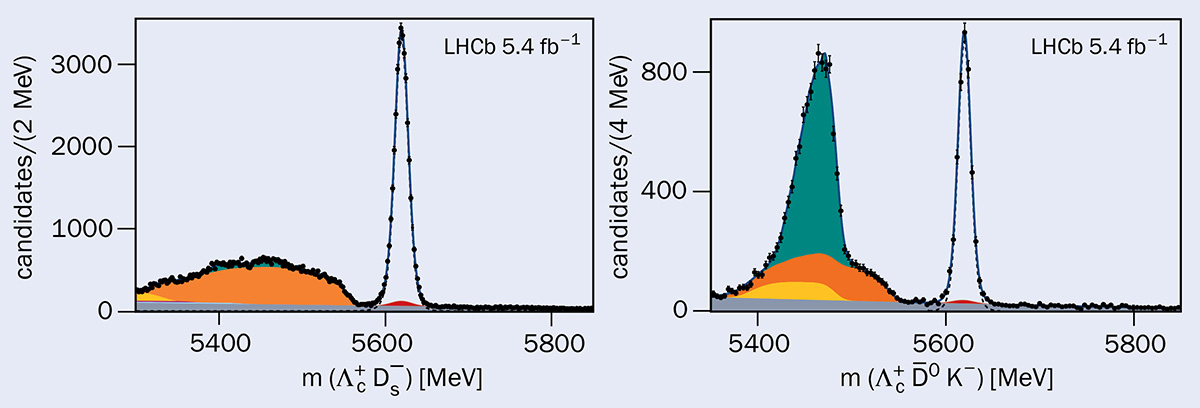
All branching fractions are measured relative to the known Λb0→ Λc+ Ds decay mode, which is reconstructed with the same set of six final-state hadrons: p K π+ K+ π K. Many systematic uncertainties in the measured ratios therefore cancel out, making the precision on the relative branching fraction of Λb0→ Λc+ D0 K statistically limited. For Λb0→ Λc+ D0* K and Λb0→ Λc+ D* the resulting branching fractions are systematically limited. This is because either a photon or neutral pion is not reconstructed, so their shape in the invariant mass spectrum of the reconstructed particles is more difficult to describe and more affected by the backgrounds (see figure 1, where the components with a missing photon for which a branching fraction is calculated are shown in orange and those with a missing neutral pion in green).

The partially reconstructed Λb0→ Λc+ Ds* decay cannot be used directly to search for pentaquarks, but it is an important input to model calculations. In addition, as a two-body decay, it is a powerful test of factorisation assumptions in heavy-quark effective theory.

In the Λb0→ Λc+ D(*)0  K decay, the production process of the Pc+ pentaquarks is the same as in the discovery channel, Λb0→ J/ψ p K. A comparison between the measured branching fractions and observed signal yields can thus be used to estimate the expected sensitivity for observing Pc+ signals in the open-charm channels. In particular, the rate of a Λb0 decay to Λc+ D0 K is about six times greater than to J/ψ p K; however, more than 60 times as much data would be needed to match the currently available Λb0→ J/ψ p K signal yield.

A factor of about 24 in this calculation comes from the branching fractions ratio of J/ψ and open-charm hadrons, given their reconstructed decay modes. The rest is from reconstruction and selection inefficiencies, which favour the four-prong μ+μ p K over the fully hadronic six-body final state. With the upgraded Run 3 detector and now triggerless detector readout, a large part of the inefficiency for fully hadronic final states is recoverable, making pentaquark searches in double open-charm final states more favourable compared to the situation in Run 2.

Tango for two: LHCb and theory

The 13th annual “Implications of LHCb measurements and future prospects” workshop, held at CERN on 25–27 October 2023, drew substantial interest with 231 participants. This collaborative event between LHCb and the theoretical community showcased the mutual enthusiasm for LHCb’s physics advances. The workshop featured five streams highlighting the latest experimental and theoretical developments in mixing and CP violation, heavy ions and fixed-target results, flavour-changing charged currents, QCD spectroscopy and exotics, and flavour-changing neutral currents.

The opening talk by Monica Pepe Altarelli underscored LHCb’s diverse physics programme, solidifying its role as a highly versatile forward detector. While celebrating successes, her talk candidly addressed setbacks, notably the new results in tests of lepton-flavour universality. LHCb detector and computing upgrades for Run 3 include a fully software-based trigger using graphics processing units. The collaboration is also working towards an Upgrade II programme for Long Shutdown 4 (2033–2034) that would position LHCb as a potentially unique global flavour facility.

On mixing and CP violation, the October workshop unveiled intriguing insights in both the beauty and charm sectors. In the beauty sector, notable highlights encompass measurements of the mixing parameter ΔΓs and of CP-violating phases such as ϕs,d, ϕssss and γ. CP asymmetries were further scrutinised in B  DD decays, accounting for SU(3) breaking and re-scattering effects. In the charm sector, the estimated CP asymmetries considering final-state interactions were found to be small compared to the experimental values related to D0 ππ+ and D0 KK+ decays. Novel measurements of CP violation in three-body charm hadron decays were also presented.

Unique capabilities

On the theoretical front, discussions delved into the current status of bottom-baryon lifetimes. Recent lattice predictions on the εK parameter were also showcased, offering refined constraints on the unitarity triangle. The LHCb experiment’s unique capabilities were discussed in the heavy ions and fixed-target session. Operating in fixed-target mode, LHCb collected data pertaining to proton–ion and lead–ion interactions during LHC Run 2 using the SMOG system. Key highlights included measurements impacting theoretical models of charm hadronisation, global analyses of nuclear parton density functions, and the identification of helium nuclei and deuterons. The first Run 3 data with the SMOG2 upgrade showed promising results in proton–argon and proton–hydrogen collisions, opening a path to measurements with implications for heavy-ion physics and astrophysics.

The session on flavour-changing charged currents unveiled a recent measurement concerning the longitudinal polarisation of D* mesons in B0 D*τντ decays, aligning with Standard Model (SM) expectations. Discussions delved into lepton-flavour-universality tests that showed a 3.3σ tension with predictions in the combined R(D(*)) measurement. Noteworthy were new lattice-QCD predictions for charged current decays, especially R(D(*)), showcasing disparities in the SM prediction across different lattice groups. Updates on the CKM matrix elements |Vub| and |Vcb| lead to a reduced tension between inclusive and exclusive determinations. The session also discussed the impact of high-energy constraints of Wilson coefficients on charged-current decays and Bayesian inference of form-factor parameters, regulated by unitarity and analyticity. The QCD spectroscopy and exotics session also featured important findings, including the discovery of novel baryon states, notably Ξb(6087)0 and Ξb(6095)0. Pentaquark exploration involved diverse charm–hadron combinations, alongside precision measurements of the Ω0c mass and first observations of b-hadron decays with potential exotic-state contributions. Charmonia-associated production provided fresh insights for testing QCD predictions, and an approach based on effective field theory (EFT) interpreting pentaquarks as hadronic molecules was presented. A new model-independent Born–Oppenheimer EFT framework for the interpretation of doubly heavy tetraquarks, utilising lattice QCD predictions, was introduced. Scrutinising charm–tetraquark decays and the interpretation of newly discovered hadron states at the LHC were also discussed.

During the flavour-changing neutral-current session a new analysis of B0 K*0μ+μ decays was presented, showing consistency with SM expectations. Stringent limits on branching fractions of rare charm decays and precise differential branching fraction measurements of b-baryon decays were also highlighted. Challenges in SM predictions for b  sℓℓ and rare charm decays were discussed, underscoring the imperative for a deeper comprehension of underlying hadronic processes, particularly leveraging LHCb data. Global analyses of b  dℓℓ and b  sℓℓ decays were presented, alongside future prospects for these decays in Run 3 and beyond. The session also explored strategies to enhance sensitivity to new physics in B± π±μ+μ decays.

The keynote talk, delivered by Svjetlana Fajfer, offered a comprehensive summary and highlighted existing anomalies that demand further consideration. Tackling these challenges necessitates precise measurements at both low and high energies, with the collaborative efforts of LHCb, Belle II, CMS and ATLAS. Additionally, advancements in lattice QCD and other novel theoretical approaches are needed for precise theoretical predictions in tandem with experimental efforts.

Balancing matter and antimatter in Pb–Pb collisions

ALICE figure 1

When lead ions collide head-on at the LHC they deposit most of their kinetic energy in the collision zone, forming new matter at extremely high temperatures and energy densities. The hot and dense zone quickly expands and cools down, leading to the production of approximately equal numbers of particles and antiparticles at mid-rapidity. However, in reality the balance between matter and antimatter can be slightly distorted.

The collision starts with matter only, i.e. protons and neutrons from the incoming beam. During the collision process, incoming lead nuclei interact while penetrating each other, and most of their quantum numbers are carried away by particles travelling close to the beam direction. Due to strong interactions among the quarks and gluons, quantum numbers of the colliding ions are transported to mid-rapidity rather than to the ions themselves. This leads to an imbalance of baryons originating from the initial state, which has more baryons than antibaryons.

This matter–antimatter imbalance can be quantified by determining two global system properties: the chemical potentials associated with the electric charge and baryon number (denoted μQ and μB, respectively). In a thermodynamic description, the chemical potentials determine the net electric-charge and baryon-number densities of the system. Thus, μB measures the imbalance between matter and antimatter, with a vanishing value indicating a perfect balance.

In a new, high-precision measurement, the ALICE collaboration reports the most precise characterisation so far of the imbalance between matter and antimatter in collisions between lead nuclei at a centre-of-mass energy per nucleon pair of 5.02 TeV. The study was carried out by measuring the antiparticle-to-particle yield ratios of light-flavour hadrons, which make up the bulk of particles produced in heavy-ion collisions. The measurement using the ALICE central barrel detectors included identified charged pions, protons and multi- strange Ω baryons, in addition to light nuclei, 3He, triton and the hypertriton (a bound state of a proton, a neutron and a Λ-baryon). The larger baryon content of these light nuclei makes them more sensitive to baryon-asymmetry effects.

The medium created in lead–lead collisions at the LHC is nearly electrically neutral and baryon-number-free at mid-rapidity

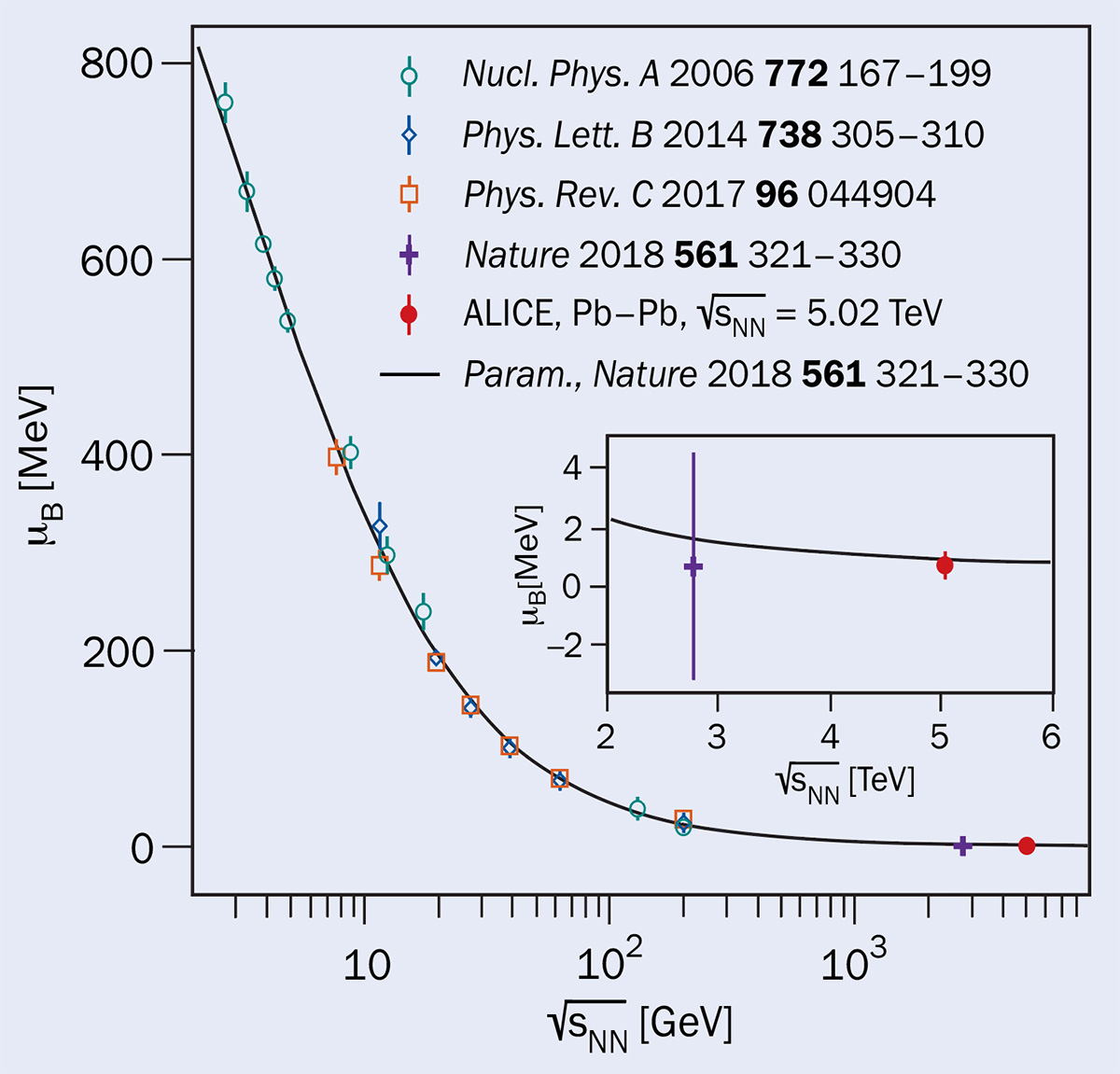
The analysis reveals that in head-on lead–ion collisions, for every 1000 produced protons, approximately 986 ± 6 antiprotons are produced. The chemical potentials extracted from the experimental data are μQ = -0.18 ± 0.90 MeV and μB = 0.71 ± 0.45 MeV. These values are compatible with zero, showing that the medium created in lead–lead collisions at the LHC is nearly electrically neutral and baryon-number-free at mid-rapidity. This observation holds for the full centrality range, from collisions where the incoming ions peripherally interact with each other up to the most violent head-on processes, indicating that quantum-number transport at the LHC is independent of the size of the system formed.

The values of μB are shown in figure 1 as a function of the centre-of-mass energy of the colliding nuclei, along with lower-energy measurements at other facilities. The recent ALICE result is indicated by the red solid circle, along with a phenom­enological parametrisation of μB. The decreasing trend of μB observed as a function of increasing collision energy indicates that different net-baryon-number density conditions can be explored by varying the beam energy, reaching almost vanishing net-baryon content at the LHC. The inset gives the μB values extracted at two LHC energies. It shows that the new ALICE result is almost one order of magnitude more precise than the previous estimate (violet), thanks to a more refined study of systematic uncertainties.

The present study with improved precision characterises the vanishing baryon-asymmetry at the LHC, posing stringent limits to models describing baryon-number transport effects. Using the data samples collected in LHC Run 3, these studies will be extended to the strangeness sectors, enabling a full characterisation of quantum-number transport at the LHC.

Iodine vapours impact climate modelling

FLOTUS quartz flow-tube system

Climate models are missing an important source of aerosol particles in polar and marine regions, according to new results from the CLOUD experiment at CERN. Atmospheric aerosol particles exert a strong net cooling effect on the climate by making clouds brighter and more extensive, thereby reflecting more sunlight back out to space. However, how aerosol particles form in the atmosphere remains poorly understood, especially in polar and marine regions.

The CLOUD experiment, located in CERN’s East Area, maintains ultra-low contaminant levels and precisely controls all experimental parameters affecting aerosol formation growth under realistic atmospheric conditions. During the past 15 years, the collaboration has uncovered new processes through which aerosol particles form from mixtures of vapours and grow to sizes where they can seed cloud droplets. A beam from the Proton Synchrotron simulates, in the CLOUD chamber, the ionisation from galactic cosmic rays at any altitude in the troposphere.

Globally, the main vapour driving particle formation is thought to be sulphuric acid, stabilised by ammonia. However, ammonia is frequently lacking in polar and marine regions, and models generally underpredict the observed particle-formation rates. The latest CLOUD study challenges this view, by showing that iodine oxoacids can replace the role of ammonia and act synergistically with sulphuric acid to greatly enhance particle-formation rates.

“Our results show that climate models need to include iodine oxoacids along with sulphuric acid and other vapours,” says CLOUD spokesperson Jasper Kirkby. “This is particularly important in polar regions, which are highly sensitive to small changes in aerosol particles and clouds. Here, increased aerosol and clouds actually have a warming effect by absorbing infrared radiation otherwise lost to space, and then re-radiating it back down to the surface.”

The new findings build on earlier CLOUD studies which showed that iodine oxoacids rapidly form particles even in the complete absence of sulphuric acid. At iodine oxoacid concentrations that are typical of marine and polar regions (between 0.1 and 5 relative to those of sulphuric acid), the CLOUD data show that the formation rates of sulphuric acid particles are between 10 and 10,000 times faster than previous estimates.

“Global marine iodine emissions have tripled in the past 70 years due to thinning sea ice and rising ozone concentrations, and this trend is likely to continue,” adds Kirkby. “The resultant increase of marine aerosol particles and clouds, suggested by our findings, will have created a positive feedback that accelerates the loss of sea ice in polar regions, while simultaneously introducing a cooling effect at lower latitudes. The next generation of climate models will need to take iodine vapours and their synergy with sulphuric acid into account.”

bright-rec iop pub iop-science physcis connect