Comsol -leaderboard other pages

Topics

Exploiting the synergy between great and small

There are a number of astrophysical phenomena, notably in connection with cosmology and ultrahigh-energy cosmic rays, that open a new window onto particle physics and lead to a better microscopic understanding of matter, space and time. On the other hand, particle physics is often exploited to great depths for an ultimate understanding of astrophysical phenomena, in particular the structure and evolution of the universe. These frontier-physics issues attracted a record number of 188 participants to Hamburg for the latest annual DESY Theory Workshop, held on 28 September – 1 October 2004 and organized by Georg Raffelt.
CCEexp1_04-05

The workshop started with the traditional day of introductory lectures aimed at young physicists, which covered the main topics of the later plenary sessions. Most of the participants jumped at this opportunity. At the end of the day, they had learned much about Big Bang cosmology, including the thermal history of the universe; about the evolution of small fluctuations in the early universe, and their imprints on the cosmic microwave background (CMB) radiation and the large-scale distribution of matter; and about how these initial fluctuations may emerge during an inflationary era of the universe. They were also up to date in ultrahigh-energy cosmic-ray physics. Thus the ground was laid for the workshop proper.

Highlighting the dark

In recent years, significant advances have been made in observational cosmology, as several plenary talks emphasized. Observations of large-scale gravity, deep-field galaxy counts and Type Ia supernovae favour a universe that is currently about 70% dark energy – accounting for the observed accelerating expansion of the universe – and about 30% dark matter. The position of the first Doppler peak in recent measurements of the CMB radiation, by for example the Wilkinson Microwave Anisotropy Probe (WMAP) satellite, strongly suggests that the universe is spatially flat. These values for the cosmological parameters, together with today’s Hubble expansion rate, are collectively known as the “concordance” model of cosmology, for they fit a wide assortment of cosmological data. Indeed, we have entered the era of precision cosmology, with the precision set to continue increasing in the coming decade as a result of further observational efforts. It is now the turn of theoretical particle physicists to explain these cosmological findings, in particular why the dominant contribution to the energy density of the present universe is dark and what it is made of microscopically.

Dark matter

Successful Big Bang nucleosynthesis requires that about 5% of the energy content of the universe is in the form of ordinary baryonic matter. But what about the remaining non-baryonic dark matter?
CCEexp2_04-05

This 25% cannot be accounted for in the Standard Model of particle physics: the only Standard Model candidates for dark matter, the light neutrinos, were relativistic at the time of recombination and therefore cannot explain structure formation on small galactic scales. Studies of the formation of structure – as observed today by the Sloan Digital Sky Survey, for example – from primordial density perturbations measured in the CMB radiation yield an upper bound of about 2% on the energy fraction in massive neutrinos. This translates into an upper bound of around 1 eV for the sum of the neutrino masses. Observations, by means of the forthcoming Planck satellite, of distortions in the temperature and polarization of the CMB will improve the sensitivity in the sum of neutrino masses by an order of magnitude to 0.1 eV. This is comparable to the sensitivity of the future Karlsruhe Tritium Neutrino Experiment (KATRIN), which measures the neutrino mass via the tritium beta-decay endpoint spectrum, and of the planned second-generation experiments on neutrinoless double beta-decay.

In theories beyond the Standard Model, there is no lack of candidates for the dominant component of dark matter. Notable viable candidates are the lightest supersymmetric partners of the known elementary particles, which arise in supersymmetric extensions of the Standard Model: the neutralinos, which are spin-½ partners of the photon, the Z-boson and the neutral Higgs boson, and the gravitinos, which are spin-½ partners of the graviton. Showing that one of these particles accounts for the bulk of dark matter would not only answer a key question in cosmology, but would also shed new light on the fundamental forces and particles of nature.
CCEexp3_04-05

While ongoing astronomical observations will measure the quantity and location of dark matter to greater accuracy, the ultimate determination of its nature will almost certainly rely on the direct detection of dark-matter particles through their interactions in detectors on Earth. Second-generation experiments such as the Cryogenic Dark Matter Search II (CDMS II) and the Cryogenic Rare Event Search with Superconducting Thermometers II (CRESST II), which are currently being assembled, will provide a serious probe of the neutralino as a dark-matter candidate.

Complementary, but indirect, information can be obtained from searches for neutrinos and gamma rays from neutralino-antineutralino annihilation, coming from the direction of particularly dense regions of dark matter, for example in the central regions of our galaxy, the Sun or the Earth. Ultimately, however, the proof of the existence of dark matter and the determination of its particle nature will have to come from searches at accelerators, notably CERN’s Large Hadron Collider (LHC). Even the gravitino, which is quite resistant to detection in direct and indirect dark-matter searches because it interacts only very feebly through the gravitational force, can be probed at the LHC.

Dark energy

In contrast with dark matter, dark energy has so far no explanation in particle physics. Apart from the observed accelerated expansion, the fact that we seem to be living at a special time in cosmic history, when dark energy appears only recently to have begun to dominate dark and other forms of matter, is also puzzling. Explanations put forth for dark energy range from the energy of the quantum vacuum to the influence of unseen space dimensions. Popular explanations invoke an evolving scalar field, often called “quintessence”, with an energy density varying in time in such a way that it is relevant today. Such an evolution may also be linked to a time variation of fundamental constants – a hot topic in view of recent indications of shifts in the frequencies of atomic transitions in quasar absorption systems, which hint that the electromagnetic fine-structure constant was smaller 7-11 billion years ago than it is today.

Depending on the nature of dark energy, the universe could continue to accelerate, begin to slow down or even recollapse. If this cosmic speed-up continues, the sky will become essentially devoid of visible galaxies in only 150 billion years. Until we understand dark energy, we cannot comprehend the destiny of the universe. Determining its nature may well lead to important progress in our understanding of space, time and matter.

The first order of business is to establish further evidence for dark energy and to discern its properties. The gravitational effects of dark energy are determined by its equation of state, i.e. the ratio of its pressure to its energy density. The more negative its pressure, the more repulsive the gravity of the dark energy. The dark energy influences the expansion rate of the universe, which in turn governs the rate at which structure grows, and the correlation between redshift and distance. Over the next two decades, high-redshift supernovae, counts of galaxy clusters, weak-gravitational lensing and the microwave background will all provide complementary information about the existence and properties of dark energy.

Inflationary ideas

The inflationary paradigm that the very early universe underwent a huge and rapid expansion is a bold attempt to extend the Big Bang model back to the first moments of the universe. It uses some of the most fundamental ideas in particle physics, in particular the notion of a vacuum energy, to answer many of the basic questions of cosmology, such as “Why is the observed universe spatially flat?” and “What is the origin of the tiny fluctuations seen in the CMB?”.

The exact cause of inflation is still unknown. Thermalization at the end of the inflationary epoch leads to a loss of details about the initial conditions. There is, however, a notable exception: inflation leaves a telltale signature of gravitational waves, which can be used to test the theory and distinguish between different models of inflation. The strength of the gravitational-wave signal is a direct indicator of what caused inflation. Direct detection of the gravitational radiation from inflation might be possible in the future with very-long-baseline, space-based, laser-interferometer gravitational-wave detectors. A promising shorter-term approach is to search for the signature of these gravitational waves in the polarized radiation from the CMB.

Matter Matters

The ordinary baryonic matter of which we are made is the tiny residue of the annihilation of matter and antimatter that emerged from the earliest universe in not-quite-equal amounts. This tiny imbalance may arise dynamically from a symmetric initial state if baryon number is not conserved in interactions that violate the conservation of C (C = charge conjugation) and the combination CP (P = parity), which produce more baryons than antibaryons in an expanding universe.

There are a few dozen viable scenarios for baryogenesis, all of which invoke more or less physics beyond the Standard Model. A particularly attractive scenario is leptogenesis, according to which neutrinos play a central role in the origin of baryon asymmetry. Leptogenesis predicts that the out-of-equilibrium, lepton-number violating decays of heavy Majorana neutrinos, with an exchange responsible for the smallness of the masses of the known light neutrinos, generate a lepton asymmetry in the early universe that is transferred into a baryon asymmetry by means of non-perturbative electroweak baryon- and lepton-number violating processes. Leptogenesis works nicely within the currently allowed window for the masses of the known light neutrinos.

Heavenly accelerators

The Earth’s atmosphere is continuously bombarded by cosmic particles. Ground-based observatories have measured them in the form of extensive air showers with energies up to 3 x 1020 eV, corresponding to centre-of-mass energies of 750 TeV, far beyond the reach of any accelerator here on Earth. We do not yet know the sources of these particles and thus cannot understand how they are produced.

Astrophysical candidates for high-energy sources include active galaxies and gamma-ray bursts. Alternatively, a completely new constituent of the universe could be involved, such as a topological defect or a long-lived superheavy dark-matter particle, both associated with the physics of grand unification. Only by observing many more of these particles, including the associated gamma rays, neutrinos and perhaps gravitational waves, will we be able to distinguish these possibilities.

Identifying the sources of ultrahigh-energy cosmic rays requires several kinds of large-scale experiments, such as the Pierre Auger Observatory, currently under construction, to collect large enough data samples and determine the particle directions and energies precisely. Dedicated neutrino telescopes of cubic-kilometre size in deep water or ice, such as IceCube at the South Pole, can be used to search for cosmic sources of high-energy neutrinos. An extension of their sensitivity to the ultrahigh-energy regime above 1017 eV will offer possibilities to infer information about physics in neutrino-nucleon scattering beyond the reach of the LHC.
Balloon experiment searches for antiparticles above the Antarctic

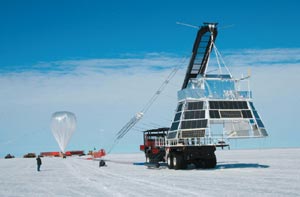
The Balloon-borne Experiment with Superconducting Spectrometer (BESS) launched a cosmic-ray spectrometer from Antarctica on 13 December. BESS, a collaboration between the US and Japan, has been studying cosmic rays since 1993 with balloon flights over northern Canada, but this was its first flight in Antarctica with a completely new instrument.

CCEnew3_03-05

The 2 t detector was carried by a 1,000,000 m3 balloon from Williams Field near the US McMurdo Station. It flew to altitudes of 37-39 km for a period of 8 days and 17 hours. Flight operations were carried out by the National Scientific Balloon Facility (NSBF) as part of the United States Antarctic Program, supported by NASA and by the National Science Foundation (NSF).

With this new detector the BESS group is continuing the systematic study of low-energy antiprotons in cosmic radiation. These rare particles are a unique probe for understanding elementary particle phenomena in the early universe.

Most cosmic-ray antiprotons are produced in collisions of primary cosmic-ray nuclei with the interstellar gas. However, if an excess of low-energy antiprotons beyond those expected from standard processes is observed, measurements from BESS may provide evidence for the primary origin of some cosmic-ray antiprotons through processes such as the evaporation of primordial black holes or the decay of possible forms of dark matter.

BESS has detected more than 2000 low-energy antiprotons in eight flights from northern Canada over the past 11 years. Most of the antiprotons measured by BESS are clearly secondary products of primary cosmic rays. However, the data obtained during the last solar minimum in the sunspot cycle (which occurred in 1996) suggest a spectrum flatter than expected in the low-energy region, and hence the exciting possibility of novel origins for cosmic antiprotons.

BESS also searches for antihelium in the cosmic radiation, the detection of which would have profound significance for both cosmology and particle physics. Unlike antiprotons, antihelium has a vanishingly small probability of creation by cosmic rays. Furthermore, our current understanding is that the universe is baryon-asymmetric, with an overwhelming dominance of matter over antimatter, and that antimatter stars or galaxies do not exist. The discovery of a single antihelium event would change this view.

The analysis of the BESS data has found no evidence for antihelium while recording more than 7 million helium nuclei, establishing the most stringent upper limit to the existence of antihelium and supporting baryon asymmetry.

In 2001 the BESS group started a project to improve the statistics and to lower the energy threshold of the detector. They developed a new instrument with a much thinner superconducting solenoid magnet and detector system and without an outer pressure vessel. The cryogen lifetime of the new magnet has also been greatly improved, and at polar latitudes a solar-power system increases flight times by more than an order of magnitude compared with typical one-day flights in Canada.

During the 2004 BESS-Polar flight, the data from some 900 million cosmic rays, totalling about 2 Tb, was recorded on an array of on-board hard disks. Following the flight around Antarctica, BESS-Polar descended by parachute to a landing site on the Ross Ice Shelf approximately 900 km from its launch point. A recovery crew was flown to the area, and in a series of flights from the remote Siple Dome Camp to the landing location the data disks and the remainder of the instrument and payload were recovered successfully.

• BESS is a collaboration between KEK, the NASA Goddard Space Flight Center, the University of Tokyo, Kobe University, the Institute of Space and Astronautical Science of JAXA, and the University of Maryland.

CAST sheds some light on axions

The CERN Axion Solar Telescope (CAST) collaboration has released the first results from its search for the solar axion, a viable candidate for a dark-matter particle. The result from CAST’s first year of operation, submitted to Physical Review Letters, does not show evidence for the axion but it narrows down the hunt for this elusive particle.

CCEnew4_03-05

Axions were theorized more than 25 years ago to explain the absence of charge-parity (CP) symmetry violation in the strong interaction. These neutral, very light particles (in the mass range 10–5 – 10 eV/c2) interact so weakly with ordinary matter that they could have survived until now from their birth at the very beginning of the universe, so could contribute to dark matter. However, axions could also be created today, for example near the strong electric field inside the hot plasma core of the Sun, where thermal X-rays could be efficiently converted into axions. These axions would stream out freely and arrive on Earth in quantities larger than solar neutrinos.

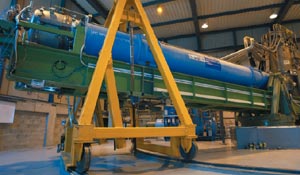
CAST, currently the world’s only working “axion helioscope”, is a prototype superconducting magnet for the Large Hadron Collider that has been refurbished and fitted with X-ray detectors, plus a focusing mirror system for X-rays that was recovered from the German space programme. The 9 T field in the magnet can convert solar axions passing through CAST into X-rays, with the highest efficiency for such a detector to date.

The first results from CAST show that the axion-photon coupling constant is gaγγ< 1.16 x 10–10 GeV–1 for axion masses below 0.02 eV (Zioutas et al. 2004). This new limit is five times smaller than the previous best laboratory measurements, from the Tokyo axion helioscope experiment (Moriyama et al. 1998). However, CAST’s new result is comparable, in the mass range studied, to the best limit derived from stellar energy-loss arguments. It also excludes an important part of the parameter space that is not excluded by solar-age considerations, which allow an axion-photon coupling somewhat larger than the Tokyo limit.

So far CAST has covered the low end of the axion rest-mass range, ma< 0.02 eV/c2. The group is currently remodelling the telescope; filling the two tubes of the magnet with helium gas will keep the X-rays and axions in phase over the magnet’s entire length of 9.26 m. This will allow a search for axions of higher mass, covering more of the range expected from theory and not excluded by astrophysical and cosmological observations.

AD stores record number of antiprotons

A new technique for cooling antiprotons has been tested at CERN’s Antiproton Decelerator (AD), yielding 50 times more trapped antiprotons per cycle than ever before. Storing and cooling large samples of antiprotons is an important step towards achieving the physics goals of the experiments at the AD, which require the synthesis of exotic atoms such as antihydrogen (pbar e+) and protonium (p pbar).

CCEnew5_03-05

Atoms, including exotic ones like these, can be efficiently synthesized only at chemical-energy scales (a few electron-volts or lower). This is many orders of magnitude below the energy scales needed for the production of antiprotons using an accelerator (a few giga-electron-volts). The AD reduces this gap by decelerating the 3 GeV antiprotons generated when the proton beam from the Proton Synchrotron hits an iridium target down to an energy of 5.3 MeV. This is still too high, however, for electromagnetic traps that can only capture antiprotons at the 10 keV range. Until now, thin “degrader” foils were used to slow antiprotons further, but the efficiency of such a system is low as many antiprotons stop and annihilate within the foils. Indeed, out of the 3 x 107 antiprotons ejected every 2 min in a 90 ns pulse (or “shot”) of the AD, only about 25,000 were retained.

Now a team from the Atomic Spectroscopy And Collisions Using Slow Antiprotons (ASACUSA) experiment and CERN have replaced these foils by a radio-frequency quadrupole decelerator (RFQD). This 4 m-long device can decelerate antiprotons to 10-120 keV. In the tests, the antiprotons passed from the RFQD into a standard multi-ring trap (MRT), as was the case with the earlier work with degrader foils. The trap is filled with an electron gas that helps to cool the antiprotons through thermal exchange, as the electron gas dissipates energy through the emission of synchrotron radiation.

During the tests, around 1.2 x 106 antiprotons per AD shot were stored in the MRT for 10 min or more. This is 50 times higher than the previous best values obtained with degrader foils and corresponds to an antiproton trapping efficiency of about 4%.

ATRAP tests new way to make antihydrogen

cernalb34_10-04

One goal of future studies with antihydrogen will be to compare its spectroscopy with hydrogen’s. This will require the antihydrogen atoms to be trapped long enough for precise measurements to be made, which in turn will need very low antihydrogen temperatures, well below 0.5 K. The ATRAP collaboration at the AD has been experimenting with a new way of producing antihydrogen that might result in suitably low temperatures.

Until now, antihydrogen production has been achieved by bringing cooled antiprotons and positrons together in a nested Penning trap structure. The new method consists of exciting caesium atoms from an oven with two lasers, and then introducing the caesium into a positron trap. Excited positronium, a bound state of an electron and a positron, is then formed when a positron collides with a caesium atom and captures an electron. These positronium atoms carry virtually all the 10 meV or so binding energy of the caesium atoms. Finally, a fraction of the excited positronium atoms collide with trapped antiprotons to produce excited antihydrogen atoms with a probability that is expected to be much higher than for ground-state positronium.

The velocity distribution of the resulting excited antihydrogen is expected to be the same as that of the trapped antiprotons from which the antihydrogen forms, which can be made arbitrarily low in principle. Verifying this by directly measuring the antihydrogen velocity has not yet been possible, but if the low antihydrogen energy is confirmed, and if the highly excited states can be de-excited, this technique could become the method of choice for producing cold antihydrogen for precise spectroscopic analysis.

Further reading

C H Storry et al. 2004 Phys. Rev. Lett. 93 263401.

Spin time in Italy

Spin is a key element in particle and nuclear physics, and has always played a paramount role in the study of fundamental symmetries, static-particle properties and the structure of fundamental interactions. Moreover, during the past 15 years, spin physics has enjoyed a true renaissance, with many enthusiastic young people – both theoreticians and experimentalists – entering the field, attracted by new ideas and experimental opportunities.

CCEspi1_03-05

Last year, around 300 physicists attended the 16th International Spin Physics Symposium, SPIN 2004, which was held on 10-16 October in Trieste, Italy. The event was organized by the Trieste section of the Istituto Nazionale di Fisica Nucleare (INFN) and was hosted by the Abdus Salam International Centre for Theoretical Physics (ICTP) on the beautiful Miramare campus. The symposium also benefited from the support and infrastructure of the nearby International School for Advanced Studies (SISSA).

Participation at SPIN 2004 was highly diverse, with 29 different countries represented. A unique feature was the large contingent from developing countries, made possible thanks to logistic support from the ICTP and sponsorship from the International Union of Pure and Applied Physics. Additional support from the Central European Initiative allowed significant participation from the initiative’s 17 member countries. The symposium was also sponsored by the International Spin Physics Committee, the town of Trieste, the Friuli-Venezia Giulia region and a few other local institutions.

SPIN 2004 was structured with plenary and parallel sessions, but no poster session. Instead, more than 160 presentations were accommodated in short communications in the parallel sessions, allowing everybody, in particular the young participants, the opportunity to stand up and present their work. The 20 plenary talks, half of which were given by excellent young physicists, were followed by interesting discussions. In addition, four rapporteurs were asked to give plenary talks to summarize the contributions of corresponding parallel sessions. The plenary sessions included short reports on the specialized workshops supported by the International Committee that had taken place during the previous two years: “SPIN 2003” in Dubna, “Polarized Sources and Targets” in Novosibirsk, “Symmetries and Spin” in Prague, “Polarized Solid Target Materials and Targets” in Bad Honnef, and “Polarized Electron Sources and Polarimeters (PESP 2004)” in Mainz. Following tradition, this last workshop took place the week before SPIN 2004.

It is impossible to summarize in a few pages the large amount of information presented in Trieste. In the following, we give some highlights that are bound to reflect our personal bias. However, all the talks have immediately been put on the web and are accessible to everybody until the time when proceedings become available.

CCEspi2_03-05

Two of the parallel sessions were dedicated to technical developments in the fields of polarized sources, polarized targets, polarized beams and polarimetry – the essential tools of spin physics. In the session on “Polarized Sources, Targets, and Polarimetry”, summarized in the last plenary session by Thomas Wise from Wisconsin, contributions described all of the ongoing activities in the field: polarized electron sources; various aspects of thermal velocity atomic H and D sources, used either as jets or to feed storage cells; new ion sources; polarimetry for a 3He gas target; and solid targets.

Further impressive work was presented in the session on “Acceleration, Storage and Polarimetry of Polarized Beams”. In this plenary talk, William McKay from Brookhaven illustrated the enormous progress made there with the Relativistic Heavy-Ion Collider (RHIC). Thanks to the insertion of a partial Siberian snake in the Alternating Gradient Synchrotron, polarization at extraction is now 50% and can be preserved during acceleration in RHIC at 40% (compared with 27% last year). After changing the betatron-tune working point, average luminosity is now 4 x 1030 cm-2 s-1 at &radics; = 200 GeV. The presentations in this parallel session spelled out the activity at various existing accelerators (AGS, RHIC, COSY, Nuclotron and BATES), as well as the plans for future facilities (JPARC, FAIR, eRHIC), all of which were skilfully summarized by Andreas Lehrach of Jülich. Importantly, a polarized-hydrogen jet target has been installed at Brookhaven and, during the course of 2004, was successfully used to calibrate the polarization of the RHIC proton beam.

CCEspi3_03-05

Spin physics began in 1921 with the pioneering work of Otto Stern, who discovered the spin of the electron and showed that it has a gyromagnetic ratio, ge, of about 2. Since then, the study of dipole moments of elementary particles has provided a wealth of information about subatomic physics, and the measurement of the electron and muon anomaly a = (g-2)/2 has reached impressive sensitivities. Lee Roberts of Boston described Brookhaven’s g-2 experiment, which yields a final result of aμ = 11 659 208(6) x 10-10(&plusmn0.5 ppm). This is 2.7 standard deviations from the Standard Model value and is a possible indication for new physics.

In an equally impressive talk, Klaus Jungmann of KVI Goningen reviewed current searches for permanent electric dipole moments, which could also provide an excellent sign of new physics. In this context, Emlyn Hughes of Caltech reported on the past, present and future measurements of parity violation in electron scattering as a means of making precision measurements of the weak mixing angle, θW, far from the Z mass, and possibly detecting signals of new physics. Preliminary results from the full data sample of the E158 experiment at SLAC were given out to attendees for the first time as sin2θW = 0.2330 ±0.0011 (stat) ±0.0010 (syst), a result that pushes any new four-fermion interaction to a scale of ΛLL~10 TeV (95% confidence level). In addition to these three plenary talks, contributions were presented in the parallel sessions on “Spin and Fundamental Symmetries” and “Spin Beyond the Standard Model”. These spanned topics from “Graviton Exchange Effects at High-Energy Colliders” to “New Approaches to Unify Spin and Charge”, which were well summarized by Oleg Teryaev from Dubna at the end of the symposium.

The quantum chromodynamics (QCD) spin structure of the nucleon was a central issue at the symposium. Plenary talks and parallel sessions covered the present understanding, experimental status, recent developments and future perspectives of the field. In the opening talk of the symposium, Andreas Metz of Bochum gave a comprehensive review of the present knowledge of quark and gluon helicity distributions, generalized parton distributions (GPDs), single-spin asymmetries and transverse-spin effects. In his plenary talk, Vincenzo Barone of Piemonte Orientale discussed transversity and stressed the differences between transversity and helicity distributions, the difficulties related to the measurement of transversity and the importance of intrinsic quark momentum-dependent distributions.

There was a wealth of new results from the major experiments presented in the plenary talks of Delia Hasch from Frascati (talking on HERMES at DESY), Andrea Bressan from Trieste (COMPASS at CERN), Naohito Saito from Kyoto (experiments at RHIC) and Michel Garcon from SPhN-Saclay (experiments at the Jefferson Laboratory), and also in many other parallel sessions, of which we cite only a few.

There is now high-precision data on the structure function g1 at small x for the deuteron (from COMPASS) and at large x for the proton and neutron (from CLAS at the Jefferson Laboratory). The first measurements of the Sivers and Collins asymmetries have been made on transversely polarized protons, by HERMES, and on deuterons, by COMPASS. Both HERMES and experiments at the Jefferson Laboratory have results (and projections) for deeply virtual Compton-scattering measurements. There are measurements of the gluon polarization ΔG/G from high pT hadron pairs(COMPASS) and ALL for π0 production (the PHOENIX experiment at RHIC). Experiments at RHIC have also made measurements of the cross-section for prompt photon and π0 production, as well as precision measurements of AN for proton-proton and proton-carbon elastic-scattering in the Coulomb-nuclear interference region. In a nutshell, the latest results indicate that ΔG/G seems to be small, hinting at a larger angular momentum contribution to the nucleon helicity; transversity signals definitely seem to be there. Needless to say, it was not an easy job for Gerhard Mallot of CERN to summarize in his rapporteur talk 16 hours of parallel sessions with highly compressed contributions.

The bridge to hadronic physics was represented by the session on “Soft Spin Physics with Photons and Leptons”. Plenary talks here were dedicated to the Gerasimov-Drell-Hearn (GDH) sum rule, to nucleon form factors and to other activity at Jefferson Laboratory in “soft physics”. As Hans Arends of Mainz explained, with the recent data from the MAMI machine at Mainz and ELSA in Bonn, the GDH sum-rule is now verified at the 10% level for the proton, while the situation for the neutron is not clear and more theoretical work is needed.

The hot issue of the discrepancy between results of GEp/GMp with the Rosenbluth techniques and with polarization transfer was discussed by Kees de Jager of Jefferson Laboratory. This now seems to be understood, thanks to recent advances in the calculations of the two-photon exchange contributions. The subjects of the third plenary talk of this session, by Raffaella de Vita of Genoa, were the high-precision measurements of g1 and g2 at low Q2, and the study of polarization observables in exclusive and semi-inclusive meson production.

The SPIN 2004 symposium also covered most recent developments in spin physics at intermediate energies and in nuclear physics. Jean-Marc Richard of ISN Grenoble gave a particularly lively talk in which he revisited hadron spectroscopy, summarizing and discussing the dramatic revival of the field that has occurred over the past few months. Barbara von Przewoski of Indiana reviewed the nucleon-nucleon scattering experiments in hadron storage rings with a polarized beam and a polarized internal target at the Indiana Cooler and at COSY in Jülich, and described their impact on phase-shift analysis, meson-exchange models, chiral-perturbation theory and the role of the three-nucleon forces (3NF).

Many other data from ITEP, Protvino and other laboratories were discussed in the parallel session on “Spin in Soft Hadronic Reactions”. Kichiji Hatanaka of Osaka reported on the high-precision systematic work that is ongoing at lower energies to establish the theory of the modification of the NN interaction in a medium and, in general, to find evidence for the 3NF in nuclear matter. He also reviewed the contributions presented in the parallel session dedicated to “Spin Physics in Nuclear Interactions”.

The symposium could not end without looking to the future. In the last plenary session, Abhay Deshpande of Stony Brook illustrated the physics potential and the machine concept of the eRHIC project at Brookhaven – an electron-proton/nuclei collider that could be operational 10 years from now – as well as the alternative ELIC project at Jefferson Laboratory. Frank Rathmann of Jülich described the polarized antiproton facility at GSI, focusing particularly on the new ideas of measuring transversity in polarized antiproton-proton Drell-Yan processes. With a completely different scenario, and on a much longer timescale, Stefano Forte of Milan communicated to the audience his enthusiasm for the huge physics potential of a future neutrino factory.

During the symposium, tributes were paid to two distinguished members of the International Committee who have passed away since SPIN 2002: Vernon Hughes and Lev Soloviev. Both Myriam Hughes and Tatiana Solovieva attended the symposium and accepted the friendship and gratitude of many of their husbands’ colleagues.

• The 17th International Spin Physics Symposium will be held in Kyoto in September 2006.

News from the frontline in the hunt for exotic nuclei

Nuclei, from the lightest to the super-heavyweights, were the subject of EXON 2004, the International Symposium on Exotic Nuclei held on 5-12 July 2004 in Peterhof, the former royal estate outside St Petersburg, Russia. The participants’ main goals were to discuss the latest results and to develop the programme for further joint research in this area of nuclear physics.

CCEexo1_03-05

Co-organized by the four scientific centres where exotic nuclei are studied – the Flerov Laboratory of Nuclear Reactions (FLNR) at the Joint Institute for Nuclear Research (Russia), RIKEN (Japan), GANIL (France) and GSI (Germany) – the symposium attracted 220 scientists from 23 countries. Eighty-six talks and more than 40 posters covered topics divided as follows: the synthesis of neutron-rich nuclei of light elements and the study of their properties; the synthesis of superheavy elements and the study of their properties; rare processes and decays; beams of radioactive nuclei (production and research programme); and experimental set-ups and future projects.

The first session covered the current experimental and theoretical situation in the investigation of the properties of neutron-rich nuclei. Here talks discussed the problems connected with precision measurements of nuclear masses in the vicinity of the neutron drip-line. The advent of relatively intense beams of exotic nuclei is now allowing the study of their interactions with other nuclei, and the first results of such investigations were presented in several talks. In the course of these studies of exotic nuclei new effects have been discovered, namely the appearance of new magic numbers (N = 16, N = 26), the co-existence in the same nucleus of two types of deformation, and an unusual order in nucleon shell filling. These effects were also the subject of a number of theoretical talks.

The latest achievements in the synthesis of superheavy elements were presented by various speakers, and other talks provided theoretical interpretations of the results obtained. Further scientific centres have now joined Dubna in implementing a programme for the production of superheavy elements, in particular at GANIL in France. Investigations of the structure of transfermium elements (Z > 100) have also become an active area. This field of research involves such high-efficiency equipment as the gamma detectors EXOGAM, EUROBALL, AGATA and others. There were several reports on the results of such investigations, as well as a presentation on the possibility of investigating the characteristics of transuranium nuclei using laser spectroscopy.

The search for exotic states of nuclear matter – multi-neutron systems – has had some interesting results. Talks covered experimental attempts to observe such states, as well as peculiarities in the structure of light exotic nuclei.

One day of the symposium was devoted to large active accelerator complexes and new projects. The results and achievements were highlighted in a number of talks, covering for example the ALTO project at IPN Orsay, the KEK-JAERI joint radioactive nuclear-beam project (RNB), the Radioisotope Beam Factory at RIKEN (RIBF), the K = 130 cyclotron in Jyväskylä, TITAN at TRIUMF, and the first radioactive beams in Brazil. The new projects for accelerator complexes were presented on the last day of the symposium, covering NUSTAR at GSI, SPIRAL-2 at GANIL, radioisotope-beam-based research at RIKEN, and the FLNR cyclotrons at JINR.

Some interesting effects have been recently noticed in the characteristics of nuclear-reaction products and the decays of exotic nuclei while investigating fine structure. Multi-cluster decay has been discovered in the ternary fission of nuclei, and while some talks focused on that problem, others were devoted to the peculiarities of fine-structure effects in the decay of exotic nuclei.

The study of chemical properties of superheavy elements was the subject of a special session. Radiochemical groups from Germany, France and JINR have carried out a number of experiments using fast, selective methods. These include joint experiments on the chemical identification of superheavy elements and the study of their chemical properties, and several talks reported on the results.

One of the themes that aroused a great deal of interest among the participants was public relations. The talks “Russian-German Co-operation at GSI, an Example of Success and Friendship”, “Public Awareness of Nuclear Science in Europe” and “JINR: International Scientific Centre Bringing Nations Together” focused on this topic.

A round-table discussion summed up the work of the symposium. Participants agreed that wider collaboration should be established to open up new avenues of enquiry in the synthesis of superheavy elements and the study of their properties, and in investigations with beams of radioactive nuclei, and to develop new projects. They also want theoretical support for the investigations to be increased and for more young scientists to be attracted into the work.

EXON 2004 also offered an interesting cultural programme. There was the opportunity to see the cultural and historic attractions of St Petersburg and its vicinity, cruising on board a ship across Lake Ladoga to stop and admire the Island of Valaam. The next symposium will be held in Russia in two years’ time.

Particles meet cosmology and strings in Boston

PASCOS 2004 is the latest in the symposium series that brings together disciplines from the frontier areas of modern physics.

The Tenth International Symposium on Particles, Strings and Cosmology took place at Northeastern University, Boston, on 16-22 August 2004. Two days of the symposium, 18-19 August, were devoted to the Pran Nath Fest in celebration of the 65th birthday of Matthews University Distinguished Professor Pran Nath. The PASCOS symposium is the largest interdisciplinary gathering on the interface of the three disciplines of cosmology, particle physics and string theory, which have become increasingly entwined in recent years.

CCEpar1_03-05

Topics at PASCOS 2004 included the large-scale structure of the universe, cosmic strings, inflationary models, unification scenarios based on supersymmetry and extra dimensions, M-theory and brane models, and string cosmology. Experimental talks discussed data from the Wilkinson Microwave Anisotropy Probe (WMAP), neutrino physics, the direct and the indirect detection of dark matter, B-physics and data from the CDF and D0 detectors at Fermilab’s Tevatron.

Cosmology and quantum gravity

The issue of dark matter in the universe and prospects for the future were reviewed by Joseph Silk of Oxford and Margaret Geller of the Harvard-Smithsonian Center for Astrophysics. Geller observed that, while the cosmic microwave background combined with large redshift surveys suggests that the critical matter density of the universe is Ωm ~ 0.3, direct dynamical measurements combined with the estimates of the luminosity density indicate Ωm = 0.1-0.2. She suggested that the apparent discrepancy may result from variations in the dark-matter fraction with mass and scale. She also suggested that gravitational lensing maps combined with large redshift surveys promise to measure the dark-matter distribution in the universe. The microwave background can also provide clues to inflation in the early universe. Eva Silverstein from SLAC discussed a new mechanism for inflation that results from a strong back-reaction on rolling scalar-field dynamics near regions with extra-light states. She claimed that this leads to a distinctive non-Gaussian signature in the cosmic microwave background, which can distinguish this mechanism from traditional slow-roll inflation.

CCEpar2_03-05

Cosmology and particle physics connected again in a talk at the Nath Fest by Steven Weinberg of the University of Texas, Austin. He spoke on the analogy between perturbations to the Friedmann-Robertson-Walker cosmology and the Goldstone bosons of particle physics in his talk “Goldstone Bosons Through the Ages”. Ali Chamseddine of the Center for Advanced Mathematical Sciences, American University of Beirut, showed that consistency problems on the action for massive coloured gravitons can be resolved by employing spontaneous symmetry-breaking to give masses to gravitons.

In his talk on quantum gravity, Lee Smolin of Perimeter Institute described rigorous results and the possibility of testing them experimentally. He discussed possible violations of the Greisen-Kuzmin-
Zatsepin bound on the upper energies of cosmic rays, which may be observed by the Pierre Auger Observatory, and possible variations of the speed of light with energy, which would be observable by the GLAST gamma-ray observatory. Dark energy in the universe formed part of the talk by Gregory Tarlé of Michigan reviewing the SNAP (Supernova Acceleration Probe) satellite observatory.

Supersymmetry and strings

Strings featured at the symposium on both the cosmic and the fundamental particle scales. In a talk on cosmic strings, Alexander Vilenkin of Tufts presented their current status in view of recent developments in string cosmology. At the opposite end of the scale, other speakers discussed string- and brane-based models in particle physics. Mary K Gaillard of the University of California, Berkeley, presented results from studies of effective Lagrangian theories that arise from compactification of the weakly coupled heterotic string. Models based on D-branes and their implications were discussed by Mirjam Cvetic of Pennsylvania, while Richard Arnowitt from Texas A&M examined the gravitational forces felt by point particles on two 3-branes (the Planck brane and the tera-electron-volt brane) bounding a 5D anti de Sitter (AdS) space with S1/Z2 symmetry.

CCEpar3_03-05

Nima Arkani-Hamed of Harvard and Michael Dine of the University of California, Santa Cruz, discussed string-based landscape scenarios from two different perspectives: whether the landscape does or does not predict low-energy supersymmetry. Arkani-Hamed argued for a high scale for supersymmetry or split supersymmetry while Dine said that, under rather mild assumptions, the landscape seems to favour a low and possibly even a very low scale for supersymmetry breaking. In considering the possibility for inflation in string theory, Boris Kors from MIT discussed a Stückelberg extension of both the Standard Model and the Minimal Supersymmetric Standard Model, recently introduced in collaboration with Pran Nath. In this extension, the vector bosons become massive without spontaneous symmetry-breaking, via condensation of Higgs scalar fields. Furthermore, such an extension implies the existence of a sharp Z boson and may lead to a new lightest supersymmetric particle composed mainly of Stückelberg fermions. In this case, the signals of supersymmetry will change in a significant way and the Stückelberg fermion may become the new candidate for dark matter.

Experiment and phenomenology

A number of talks dealt with supersymmetry phenomenology, specifically with regard to searches for supersymmetry at particle colliders and in dark matter. Howard Baer of Florida State described the possibilities for direct and indirect detection of supersymmetric dark matter, as well as searches at colliders, within the minimal supergravity grand unification (mSUGRA) paradigm. Searches at colliders were also discussed by Xerxes Tata of Hawaii, this time in the light of data from WMAP and other experimental constraints on weakly interacting massive particles (WIMPs). On the experimental side, Rupak Mahapatra of the University of California, Santa Barbara, reported on the world’s lowest exclusion limits on the coherent WIMP-nucleon scalar cross-section for WIMP masses above 13 GeV/c2 based on data from the Cryogenic Dark-Matter Search experiment at the Soudan Underground Laboratory. These results rule out a significant part of the parameter space of supersymmetric models.

David Cline of UCLA presented the current ZEPLIN II programme for the direct detection of dark matter as a prototype of large liquid- xenon detectors. He then described ZEPLIN IV and other 1 t liquid xenon detectors, and discussed the limiting backgrounds for such detectors in exploring the full range of the SUSY parameter space. Stefano Lacaprara of INFN, Padua, looked at the prospects for dark-matter searches at the Large Hadron Collider, and Rita Bernabei from INFN Rome reviewed the observation of dark-matter signals using the low-background NaI(Tl) detector of the DAMA dark-matter project in the Gran Sasso Laboratory.

Neutrinos and other particles

Several speakers at the symposium emphasized the promising future for neutrino physics and astrophysics. Vernon Barger from Wisconsin gave an in-depth presentation about the status and future prospects of precision neutrino physics. Haim Goldberg of Northeastern discussed galactic and extra-galactic neutrino sources, and Sandip Pakvasa from Hawaii showed how high-energy astrophysical neutrinos can provide information about neutrino lifetimes and mass hierarchies. Tom Weiler of Vanderbilt reviewed the particle physics and astrophysics information encoded in the energy spectrum, arrival directions and the flavour content of such cosmic neutrinos.

The detection of high-energy neutrinos was discussed by Stefan Schlenstedt of DESY-Zeuthen, who gave an update on the AMANDA experiment at the South Pole and the construction of the IceCube experiment for the observation of high-energy neutrinos. Luis Anchordoqui of Northeastern University gave an overview of the current status of the Pierre Auger Observatory being built to detect the highest-energy cosmic rays.

At lower energies, there are new measurements of the solar neutrino spectrum at the Sudbury Neutrino Observatory, using salt to enhance the detection of neutral currents. These were presented by José Maneira of Queen’s University, who also described the prospects for using strings of 3He proportional counters to increase the sensitivity by a factor of two. Nikolai Tolich from Stanford presented the improved measurement from KamLAND of Δm2 versus sin22θ for neutrino oscillations, while Ion Stancu of Alabama covered the status of the MiniBooNE neutrino oscillation experiment. Hans Volker Klapdor-Kleingrothaus of MPI-Heidelberg discussed the evidence for neutrinoless double-beta-decay using data from the Heidelberg-Moscow experiment, which shows a signal at the 4.2 σ level, and discussed its consequences for particle physics.

Other aspects of particle physics were not neglected. Shiro Suzuki from Saga University presented new results from the Belle experiment at KEK on the measurement of time-dependent charge-parity (CP) violation in b→s penguin processes. These yield in an average value 2.4 σ away from the Standard Model value.

Continuing with B-physics, Stefano Passaggio of INFN Genova reported the direct observation of CP violation at BaBar in B→K+π at a confidence level of 4.2 σ. Results from DESY’s HERA collider and prospects for HERA II were reviewed by Chiara Genta of INFN Florence, while electroweak results from LEP2, the upgraded Large Electron Positron collider at CERN, were summarized by Roberto Chierici of CERN. Markus Schumacher from Bonn presented results of searches for new physics by the LEP experiments. Recent results from the D0 experiment at Fermilab were presented by Pushpalatha Bhat from Fermilab and Nick Hadley of Maryland. Those from CDF were presented by Un-ki Yang of Chicago and Dmitri Tsybychev from SUNY, Stonybrook. Ernst Sichtermann of Lawrence Berkeley National Laboratory gave the latest status of the muon g-2 experiment at Brookhaven, and William Marciano of Brookhaven reviewed the theoretical implications of the g-2 results.

Other talks dealt with a range of interdisciplinary topics. In his status report on using lattice quantum chromodynamics (QCD) in the calculation of light quark masses and the CP-violation parameter BK, Rajan Gupta of Los Alamos was able to weave in some early history of the lattice gauge calculations from his time at Northeastern University in the early 1980s. Roman Jackiw of MIT discussed the consequences of a vanishing Cotton tensor, which ensures that the 3D gravitational Chern-Simons term is stationary. He showed that this condition leads to kink solutions and that the effective theory is a new type of dilaton gravity.

• PASCOS 2005 will be held in the 1600-year-old ancient Korean town of Gyeong-Ju.

HESS provides new view of gamma-ray sky

CCEhes1_01-05

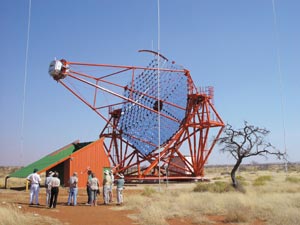
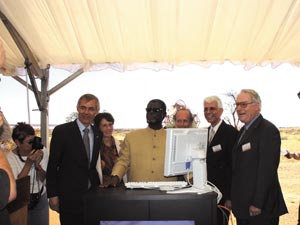
On 28 September 2004 the four telescopes representing the first phase of the High Energy Stereoscopic System (HESS) were inaugurated by the Namibian Prime Minister Theo-Ben Gurirab. The event represented the culmination of a five-year construction and commissioning effort, carried out by physicists and technicians from 19 institutes in Germany, France, the UK, Ireland, the Czech Republic, Armenia, South Africa and Namibia.

The HESS telescopes measure cosmic gamma rays in the energy range above 100 GeV with unprecedented sensitivity and resolution. They achieve this by detecting the Cherenkov light that is emitted when a high-energy gamma ray is absorbed in our atmosphere, resulting in a cascade of electrons and positrons rushing through the air at speeds close to that of light. Viewed in its Cherenkov light, the cascade resembles the trail of a shooting star, pointing back to the origin of the primary gamma ray (figure 1a). However, the light is very faint – about 10 photons per square metre at a gamma-ray energy of 100 GeV – and the duration of the light flash is only a few nanoseconds. Large mirrors, fast photon detectors and short signal-integration times are required to collect enough light from the shower, with minimal contamination from night-sky background light.

The telescopes in the HESS array provide up to four different views of the same shower, which enable the direction of the gamma ray to be reconstructed to better than 0.1°, and its impact point can be located with a precision of 10-20 m. Knowing the distance from the telescope to the shower axis, the intensity of the Cherenkov image is converted into an energy estimate for the gamma ray, with a precision of about 15%. The requirement that multiple telescopes register a shower in coincidence virtually eliminates one major source of background – penetrating muons that hit the ground close to a telescope, resulting in Cherenkov rings like those seen in ring-imaging Cherenkov counters in particle-physics experiments (figure 1b).

The HESS telescopes are located in the scenic Khomas highland region of Namibia, within 20 km of the tropic of Capricorn, in an area cherished by professional and amateur astronomers for its clear and dark skies. Equally important, the southern location provides optimum views towards the central part of our galaxy, a region that hosts a variety of objects suspected to serve as cosmic particle accelerators. These include supernova remnants, pulsars, star associations with strong stellar winds, and of course the supermassive black hole at the very centre of our galaxy.

Indeed, one of the main goals of the HESS experiment is to identify positively sources of cosmic rays in the galaxy, ending a search that has been going on for almost 100 years, since the discovery in 1912 of cosmic rays by Victor Hess. Locating the origin of the abundant cosmic rays is so difficult because they are deflected in the interstellar magnetic fields; their arrival directions are uniformly distributed and give no clues concerning their origin. Real images of cosmic accelerators can be taken using very-high-energy (VHE) gamma rays, which are produced when the accelerated protons or electrons interact in or near their source with ambient material or – in the case of electrons – scatter off starlight or the cosmic microwave background radiation.

CCEhes2_01-05

Just as the HESS collaboration encompasses particle physicists and astrophysicists, the HESS Cherenkov telescopes combine technologies from different fields. The design of the telescope structures and of the telescope mirrors – each segmented into 382 mirror facets with a combined area of 107 m2 – builds upon the experience collected in the design of low-cost solar concentrators. The mirrors are aluminized ground glass, manufactured like mirrors of astronomical telescopes, but with reduced requirements for optical quality. The focal-plane instrumentation – the “camera”, supported at 15 m focal length by a quadrupod attached to the telescope dish – contains 960 Photonis photomultiplier tubes (PMTs). PMT signals are sampled at a rate of 1 GHz by the analogue memory of the ASIC (application-specific integrated circuit) originally developed for the ANTARES neutrino detector. When an air shower is detected by several telescopes in coincidence, the signals are digitized, preprocessed and transmitted to a central computer cluster for recording. A novel feature of the HESS cameras is that the entire electronics is contained in the 1.5 x 1.5 x 1.5 m3 camera body, connected only by a few optical fibres.

While the last of the four HESS telescopes was completed in December 2003, data collection began in summer 2002 with the first telescope alone, and later with two and three telescopes. Even with a single telescope, HESS was the most sensitive instrument in the southern hemisphere. With four telescopes, gamma-ray sources with a flux below 1% of the flux from the Crab Nebula – which is often used as a standard candle of VHE gamma-ray astronomy – are routinely detected. For comparison, when the Whipple instrument discovered the Crab Nebula as the first tera-electron-volt gamma-ray source in 1989, a significant detection required about 50 hours of observation time; the HESS telescopes will detect such a source within 30 s!

It was no surprise therefore that the first HESS data taken during the construction and commissioning phase have already provided exciting results, many of which were presented at the International Symposium on High Energy Gamma-Ray Astronomy in Heidelberg, in July 2004. The active galaxy PKS 2155-304, detected previously only by the Durham Cherenkov telescope with a significance of about 6.8σ, exhibits a signal with more than 100σ, allowing for the first time an in-depth study of the emission and propagation of tera-electron-volt gamma rays for such a distant active galactic nucleus, at a redshift of z ≈ 0.12.

CCEhes3_01-05

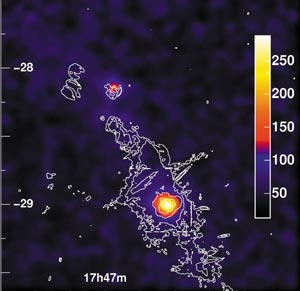
In HESS data taken towards the centre of our galaxy, a strong gamma-ray source stands out, coincident with Sagittarius A*, the supermassive black hole at the galactic core (Aharonian et al. 2004b). HESS can locate the source of the VHE radiation to within 30 arcseconds from the Galactic Centre, an order-of-magnitude improvement in precision compared with other instruments. The Galactic Centre has long been predicted as a source of VHE gamma rays generated in the accumulation and annihilation of dark-matter particles, for example the lightest stable supersymmetric particles. The characteristics of the gamma-ray signal detected by HESS are indeed consistent with the expected features for dark-matter annihilation, but would require very heavy (> 10 TeV) dark-matter particles and a large annihilation rate or enhanced density of the dark matter at the Galactic Centre. More conventional explanations include particle acceleration in the 10,000-year-old supernova remnant Sagittarius A East, which is still consistent with the HESS error circle for the source location. Future data should pin down the source location even better. Another key question is whether the gamma-ray flux is constant, or whether it varies, pointing to an origin near the Schwarzschild radius of the central black hole.

CCEhes4_01-05

For the first time, a tera-electron-volt instrument is sensitive enough that several sources appear in the field of view. The field of the Galactic Centre shows, in addition to the strong source close to Sagittarius A*, a second source, which appears to be associated with the pulsar nebula inside the supernova remnant G0.9+0.1. Similarly, observations targeted at the pulsar PSR B1259-63 have revealed – besides a gamma-ray signal from the pulsar – evidence of a second source about 0.6° north of the pulsar. This source HESS J1303-631 could not so far be associated with a counterpart in other wavelength regimes and may represent a type of cosmic accelerator hitherto unknown.

CCEhes5_01-05

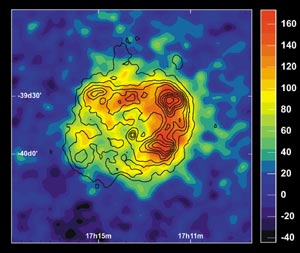
The most exciting of the first results from HESS is the image of the supernova RX J1713.7-3946, which shows a ring of twice the size of the Moon glowing in tera-electron-volt gamma rays (figure 3). Gamma-ray emission from this remnant was detected before with the CANGAROO instrument, but only HESS, with its high sensitivity and angular resolution, could actually resolve the supernova shell as the source of the radiation. This image provides the unequivocal proof that supernova shocks can accelerate particles to multi-tera-electron-volt energies. The measured energy spectrum of gamma rays extends to beyond 10 TeV and exhibits a power-law energy dependence with a spectral index of 2.2±0.2, consistent with predictions of theories for the shock acceleration of cosmic rays (Aharonian et al. 2004b).

To demonstrate fully that the gamma rays result from interactions of accelerated cosmic-ray protons – as opposed to processes involving high-energy electrons (of which the signature is evident in the strong synchrotron X-ray emission of the supernova shell) – will require more detailed studies of the morphology and wide-band spectra of the remnant.

These first results from HESS illustrate the power of the new generation of Cherenkov instruments, which include CANGAROO III, MAGIC and VERITAS. Tera-electron-volt gamma-ray astronomy has finally entered a stage where sources are no longer featureless points in the sky. Instruments have achieved the sensitivity to reach beyond the few exceptionally strong sources, and provide images of a new tera-electron-volt sky.

• For more information see www.mpi-hd.mpg.de/HESS.

Further reading

F Aharonian et al. 2004a Astron. Astrophys. 425 L13.
F A Aharonian et al. 2004b Nature 432 75.
T N LaRosa et al. 2000 AJ 119 207.

Author:
Werner Hofmann, MPI für Kernphysik, Heidelberg.

Neutrino physics gains new levels of popularity

The 21st International Conference on Neutrino Physics and Astrophysics was held on 14-19 June in the splendid Marguerite de Navarre auditorium at the Collège de France, in the heart of Paris. Organized by the CEA, the CNRS, the Collège de France and the University of Paris7-Denis Diderot, its aim was to review the latest developments in this rapidly evolving branch of physics. It attracted 520 participants – a record turnout for this series of meetings, and a clear sign of the renewed interest in neutrinos within the particle-physics community. All the advances made in neutrino physics were reviewed over the course of six days, and the most significant new results are summarized here.

CCEneu1_01-05

Solar neutrinos formed the topic of the first session, beginning with a presentation of the latest measurements from the Sudbury Neutrino Observatory in Canada. This was followed by a report from Giorgio Gratta of Stanford on the results from the KamLAND experiment in Japan, which has provided new and definitive proof of neutrino oscillation in the energy range of a few million electron-volts.

Here, the neutrinos are not of extraterrestrial origin – instead they come from an artificial source, namely nuclear reactors. The detector, which has been built on the site of the old Kamiokande experiment, uses 1 kt of liquid scintillator as the target and seeks to observe the neutrino interactions of nearby reactors – mainly those at installations in Japan, but also some in South Korea. The average distance between the sources and the detector is 180 km, which has proven sufficient to confirm the deficit observed by the experiments designed to measure solar neutrinos.

After two years of taking data, KamLAND has reported 258 events, compared with an expected 365. Furthermore, the study of the energy distribution of these events indicates a spectral distortion in the low-energy range. This is a crucial result, because in addition to confirming oscillation, it allows a much more precise measurement than that made possible by solar neutrinos of the essential oscillation parameter Δm2, the difference in the mass-squared of the two oscillating neutrinos. The result can be expressed as Δm2 = 8.2 + 0.6 – 0.5 10-5 eV2. In a simple mass-hierarchy scenario, this determines the mass of the second neutrino νμ at 9 meV, which is about 100,000 million times lighter than the proton.

CCEneu2_01-05

The results from KamLAND also open up a new line of research, namely the study of geoneutrinos, which was presented by Gianni Fiorentini of Ferrara and INFN. The Earth emits a tiny heat flux, and what scientists want to know is whether it comes exclusively from radioactivity. The uranium, thorium and potassium content could be determined by studying the neutrinos emitted, but the energy of these neutrinos is even lower than that of neutrinos from nuclear power plants, and KamLAND is close to the observation limits.

With neutrinos it is also possible to spy on what is going on inside nuclear reactors, and on the various fission products that produce neutrinos with different spectra, as John Learned from Hawaii described. The International Atomic Energy Agency, the watchdog organization for the non-proliferation of nuclear weapons, is beginning to be interested in this means of control.

Oscillation experiments

Following the presentations on low-energy neutrinos, it was the turn of atmospheric neutrinos and the results obtained with the new Super-Kamiokande detector. Edward Kearns from Boston presented the expected distribution of νμ interactions as a function of the L/E parameter, the ratio between the length of flight and the energy of the neutrinos detected, which agrees very well with the oscillation hypothesis. These results have been supported by those from the K2K experiment, in which neutrinos produced at the KEK laboratory are observed in the Super-Kamiokande detector 250 km away.

CCEneu3_01-05

Overall, analyses from all the oscillation experiments are placing increasingly severe constraints on Δm2 and on the mixing angles of the leptonic, or MNSP (Maki-Nakagawa-Sakata-Pontecorvo), mixing matrix. Srubabati Goswami of Allahabad summarized the state of progress. The third angle θ13 is the least well known; we have only one limit, from the experiment at the Chooz reactor in France. The determination of this angle, together with CP violation in the field of neutrinos, is crucial, and various projects at different reactors were discussed. Intense activity surrounds the preparation of the longer-term future; pending the construction of neutrino factories, super beams and radioactive beams are under consideration, particularly at CERN.

Direct measurements of neutrino masses, limits on the magnetic moment, and searches for double beta-decay (with or without neutrinos) were also presented, in particular the first results from the Neutrino Ettore Majorana Observatory (NEMO3) experiment in Fréjus Underground Laboratory, France, and the Cuoricino project in the Gran Sasso Laboratory, Italy. The presentations on this subject covered evidence, indications and enigma. The latter category includes a signal for neutrinoless double-beta decay that comes from an analysis of the Heidelberg-Moscow germanium experiment, which will probably be the subject of discussion for several years to come. The field of unresolved enigma also includes the result from the Liquid Scintillator Neutrino Detector (LSND) at Los Alamos, which should soon be clarified by the MiniBoone experiment at Fermilab.

The last part of the conference covered neutrino astrophysics. The neutrino sky map is still very incomplete; only the Sun and the brief signal from supernova SN1987A in February 1987 have been observed. Other sources are at work in the vast expanse of the sky, but their detection requires instruments 10,000 times larger than those that exist at present. Current projects, which tend towards a detector of 1 km3, were reviewed. In parallel with neutrinos, attention at the conference focused on research into astroparticles – high-energy photons, charged cosmic rays and gravitational waves. Michel Davier of Orsay demonstrated the potential richness of the “multi-messenger” approach for the future.

There is a fine line between astrophysics and cosmology, especially since constraints on neutrino mass are starting to emerge from experiments on the study of cosmic background radiation and
in-depth explorations of the universe. The constantly evolving results of this discipline were presented, and research into dark matter – both direct (new results from the Cryogenic Dark Matter Search, CDMS) and indirect – was discussed, along with dark energy.

Theory was not forgotten, and there was discussion of recent progress on neutrino mass models, tests of the various CP, T and CPT symmetries, flavour violations, and the implications of neutrinoless double-beta decay. The previous week, a two-day satellite conference involving almost 100 physicists had been held to commemorate the 25th anniversary of the discovery of the “seesaw mechanism”, currently the most promising explanation for the smallness of neutrino masses.

Remote visitors

Thanks to a successful webcast, some 800 Web users interested in neutrinos were able to follow the conference remotely, and anyone wishing to hear the presentations again will be able to do so during the next few months by logging onto the conference website at http://neutrino2004.in2p3.fr, where copies of the speakers’ transparencies are also available. The event was also a media success, thanks to a press conference organized the previous week involving around 15 journalists representing the main French newspapers and radio stations.

Neutrino physics has undergone dynamic changes in recent years. New ideas have been put forward in both the theoretical and the experimental fields, which should help this branch of physics to continue making major advances for many more years to come. The next step will be discussed during June 2006 in Santa Fe, at the next conference to be held in this series.

bright-rec iop pub iop-science physcis connect