“Table-top” experiments can still probe physics complementary to particle searches at high-energy accelerators. A beta-neutrino correlation experiment using TRIUMF’s Neutral Atom Trap (TRINAT) has now set the best limits on general scalar interactions contributing to nuclear beta decay.
TRINAT uses the radiation pressure of laser light to capture radioactive atoms in a 1 mm-sized cloud. Laser light of a frequency slightly below an atomic resonance is shone from all sides of the trap. Atoms moving away from the trap then “see” along their direction of motion light that is blueshifted closer to the resonance, while away from their direction of motion they see light redshifted further away from resonance. The net effect is of radiation pressure opposite to the direction of motion, as the atom absorbs more light that is closer to its resonance.
The trapped atomic nuclei undergo beta decay, which produces three decay products: a positron (β+), a neutrino (ν) and the recoiling daughter nucleus. The daughter nucleus has a kinetic energy of 0-430 eV; while it would stop in 1 nm of material, it can escape the trap. By measuring the momentum of the nucleus in coincidence with that of the β+, the TRINAT team can deduce the momentum of the neutrino more accurately than in previous experiments (which did not measure the recoil energy).
These techniques have been pioneered at TRIUMF using potassium isotopes with 1 s half-lives produced at the Isotope Separation and Acceleration (ISAC) facility with the main TRIUMF cyclotron – this “table-top” experiment admittedly is driven by the world’s largest cyclotron. Results are also becoming available from other experiments based on neutral-atom traps at Berkeley and Los Alamos.
In the Standard Model the weak interaction is mediated by spin-1 vector bosons, the W+, W– and Z. Measurements of the β-ν angular distribution in the decay of 38Km → 38Ar + β + ν where both parent and daughter have no nuclear spin allow the search for contributions from hypothetical spin-0 scalar bosons. The TRINAT result for the β-ν correlation parameter a is 0.9981 ± 0.0030 ± 0.0037, consistent with the Standard Model value a =1.
The previous best result, by a Seattle-Notre Dame collaboration using beta-delayed proton emission of 32Ar produced at the ISOLDE facility at CERN, is in the process of being re-evaluated after new measurements of the mass of parent and daughter. Such results constrain the existence of spin-0 bosons with mass:coupling ratios as great as four times the W+ mass, and are complementary to other measurements.
TRINAT can determine detector response functions in situ from the data itself. This is routinely done in high-energy experiments but never before for low-energy beta decay. The experiment has also used the equivalent of the missing-mass construction in high-energy physics to constrain the admixture of possible sterile neutrinos of million-electron-volt mass with the electron-neutrino.
TRINAT is also investigating other physics topics. These include measuring the neutrino asymmetry from polarized nuclei to search for evidence of non-Standard Model right-handed neutrinos (using a complementary measurement to the purely leptonic muon-decay studied at TRIUMF and PSI); measuring the spin asymmetry of the daughter nuclei in pure Gamow-Teller decays; and testing hints of a nonzero tensor interaction reported in π→νeγ by the PIBETA collaboration at PSI.
The town of Ericeira on the Atlantic coast faces Cabo da Roca, the western limit of the European continent. It proved an inspiring setting for Hard Probes 2004, the first International Conference on Hard and Electromagnetic Probes of High Energy Nuclear Collisions.
The conference grew out of a series of Hard Probe Café meetings, the first of which was held in 1994 at CERN. The idea then was to form a collaboration of theorists and experimentalists interested in the interface between hard perturbative quantum chromodynamics (QCD) and relativistic heavy-ion physics. CERN’s Super Proton Synchrotron (SPS), with a beam energy of up to 200 GeV/nucleon, was the highest-energy heavy-ion facility at the time and hard processes were rare. But it was becoming clear that the use of penetrating hard probes – for example, high-mass lepton pairs and high-momentum photons – held promise for understanding the strongly interacting hot medium formed in heavy-ion collisions.
Subsequent experimental results from the SPS, and the commissioning of the Relativistic Heavy Ion Collider (RHIC) at the Brookhaven National Laboratory, put hard processes in the focus of physicists’ attention. After meetings in Europe and the US, when the first published proceedings helped in planning experiments at RHIC and the Large Hadron Collider (LHC) at CERN, the Hard Probe Café could no longer accommodate all the enthusiasts. So Hard Probes 2004 was born, organized by Carlos Lourenço, Helmut Satz, João Seixas and Jorge Dias de Deus, and held on 3-10 November 2004 in the beautiful resort of Ericeira. The 120 or so participants did not have much free time to enjoy the sea breeze; the programme was intense as well as interesting, and local maritime advice underlined the importance of keeping the aim in mind (figure 1).
After a first day of lectures that were more pedagogically oriented, Krishna Rajagopal of MIT opened the conference by surveying what is known about the QCD phase diagram and its new states of matter, from quark-gluon plasma (QGP) to colour superconductors. Jochen Bartels of DESY recalled the parton formulation of high-energy interactions, addressing parton evolution and saturation. These aspects have led to major progress in the understanding of the initial conditions in heavy-ion collisions, forming a new approach to the physics of high-energy hadron and nuclear collisions: the colour glass condensate, reviewed by Edmond Iancu of Saclay and Raju Venugopalan of Brookhaven. Related percolation studies were presented by Carlos Pajares of Santiago de Compostela. It is becoming evident that QCD at high parton density can provide a common framework for describing different high-energy interactions, from deep inelastic scattering to relativistic nuclear collisions.
Probes with charm
One of the main topics discussed at the Hard Probe Café was the fate of heavy quarkonia – bound states of heavy quarks and anti-quarks – in hot quark-gluon matter. Around 20 years ago, Tetsuo Matsui and Helmut Satz predicted that at sufficiently high temperatures Debye screening in the quark-gluon plasma would lead to the dissociation of quarkonia. At the conference, Frithjof Karsch of Bielefeld surveyed the status of theoretical quarkonium studies; our understanding of the topic has progressed significantly following recent lattice QCD calculations, which were discussed by Tetsuo Hatsuda of Tsukuba, Peter Petreczky of Brookhaven and others.
The different binding energies and bound-state radii of the various quarkonia lead to different dissociation temperatures; while the higher excited charmonium states melt near the deconfinement point, the J/ψ (the cbarc ground state) can survive up to higher temperatures. Such behaviour had been previously obtained from potential model studies, and had shown that the in-medium dissociation pattern of quarkonia constitutes a very effective tool for the study of quark-gluon plasma. It can now provide a direct way to relate QCD calculations to data collected from heavy-ion collisions.
The use of heavy quarks for the diagnostics of QCD matter depends of course on reliable computations of their yields in perturbative QCD; the status of these calculations was reviewed by Stefano Frixione of Genova and Ramona Vogt of Lawrence Berkeley National Laboratory (LBNL). The increase of heavy-quark production at high energies could in fact even lead to enhanced quarkonium yields, as Ralf Rapp of Texas A&M and Bob Thews of Arizona showed for different recombination and coalescence models. A further issue to be resolved is the possibility of initial state quarkonium dissociation by parton percolation, which was reviewed by Marzia Nardi of Torino.
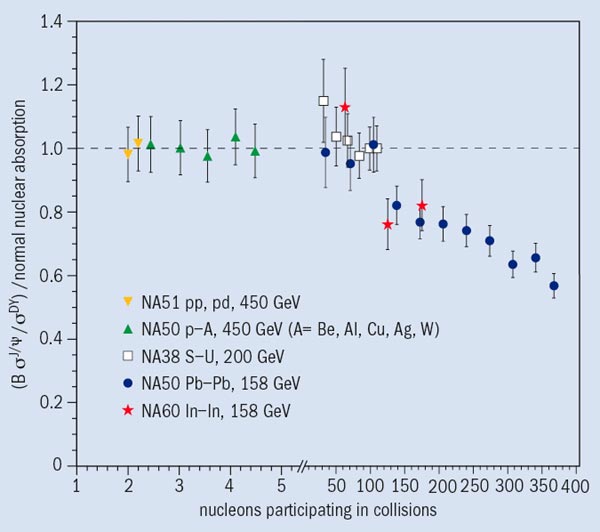
The suppression of charmonium production in nuclear collisions was indeed observed at the SPS (figure 2). Louis Kluberg of CERN and Laboratoire Leprince-Ringuet reviewed the 20 year evolution and the final results of the pioneering NA38 and NA50 experiments. Further studies are being pursued at CERN by NA60, with improved detector capabilities, and at RHIC by PHENIX, where the much lower integrated luminosities, so far, limit the usefulness of the higher collider energies. The HERA-B collaboration presented recent results on χc production in proton-nucleus collisions at HERA, while Mike Leitch of Los Alamos reviewed several issues in quarkonium production. It is particularly puzzling that the ground state resonances J/ψ and Υ show complete absence of polarization, contrary to the expectations of non-relativistic QCD, while the excited states Υ(2S) and Υ(3S) show maximum transverse polarization.
The meeting also discussed measurements of heavy-flavour production. The STAR collaboration reported on open-charm measurements made by reconstructing the D° → K–π+ hadronic decay in d-Au collisions at RHIC. The reconstruction of such hadronic decay modes is difficult to perform in heavy-ion collisions, owing to the high particle multiplicities. The single-electron transverse momentum spectrum provides an alternative, albeit indirect, measurement of charm production at RHIC energies. The charm production cross-sections currently derived from the PHENIX and STAR data differ by a factor of two. Effects that might cause this discrepancy are being investigated and improved results should be available soon.
Another promising direction is the use of electromagnetic probes – leptons and photons; their production has for a long time been considered one of the basic pieces of evidence for the formation of a quark-gluon plasma. There is great interest in these probes because they escape from the medium almost without any interactions, and thus carry valuable information about the early stages in the evolution of dense matter. Moreover, their emission rates can be calculated in lattice QCD as well as in perturbation theory, as discussed by Jean-Paul Blaizot of Saclay, Charles Gale of McGill and others. Rolf Baier of Bielefeld showed that parton-saturation effects also play a crucial role here.
New experimental information on dilepton production was presented by the NA60 experiment at CERN, which took proton-nucleus and In-In data in 2002 and 2003, respectively, with better statistics and mass resolution than previous measurements. Such “second-generation” data should answer some of the questions raised by results previously obtained by CERES at the SPS and lower-energy experiments (such as DLS at LBNL’s BEVALAC and KEK’s E235), reviewed by Itzhak Tserruya of the Weizmann Institute. Currently, PHENIX at RHIC cannot explore the physics of the low-mass dilepton continuum, given the overwhelming combinatorial background levels. This should be solved by a “hadron blind detector”, based on a proximity focus Cherenkov detector, soon to be added to PHENIX.
Jets are another classic hard probe. Colliding beams of protons or heavy nuclei produce jets when partons from the incoming projectiles undergo hard scattering off each other and emerge from the reaction at large angles. In the early 1980s, James Bjorken proposed that jets would interact with the material generated by high-energy nuclear collisions in a way analogous to the more familiar interaction of charged particles in detector material. He suggested that this interaction would lead to energy loss in a quark-gluon plasma (jet quenching). Further theoretical analysis showed that gluon bremsstrahlung is an efficient way of dissipating jet energy to the medium, generating large and potentially observable differences between hot and cold strongly interacting matter.
Jets and RHIC
Jets are the hard probe par excellence at RHIC, where the collision energy is high enough to produce them in vast numbers. The first runs with gold beams at RHIC did indeed reveal strong modifications to jet structure, agreeing with the predictions of jet quenching in matter many times denser than cold nuclear matter. Heavy-ion physicists are now looking more deeply into jet-related measurements and interesting nuclear effects continue to emerge. The diversity and quality of the high-momentum-transfer data from the four RHIC experiments justified eight detailed talks. Data were presented from pp, d-Au and Au-Au collisions at the top RHIC centre-of-mass energy of 200 GeV, together with Au-Au measurements at 62.4 GeV, chosen to match the energy of CERN’s Intersecting Storage Rings (for which extensive pp collision data are available for comparison).
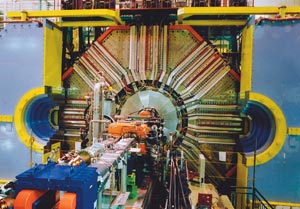
One of the key pieces of evidence for jet quenching is the strong suppression of high-momentum inclusive pion and charged particle production in the most central nuclear collisions, seen by all RHIC experiments and now provided by PHENIX for transverse momenta up to 14 GeV/c. It is crucial to crosscheck such measurements and theoretical calculations in simpler systems. Inclusive particle spectra at high transverse momentum in pp collisions are described well by perturbative QCD calculations, so that the reference spectra for measuring nuclear effects are well understood. Jets and hard photons at high momentum are generated by similar mechanisms, but direct photons should not lose energy in the nuclear medium, since they have no colour charge. Klaus Reygers of Münster showed that, at RHIC, direct photons are indeed produced at the rate expected from QCD calculations, while high-momentum pions are suppressed by a factor of five (figure 3).
On the theory side, Xin-Nian Wang of LBNL and Urs Wiedemann of CERN discussed partonic energy loss in matter, and showed that perturbative QCD calculations incorporating medium-induced bremsstrahlung can describe the main jet-related measurements. A key test is the variation of energy loss with collision energies. Jet quenching generates strong effects at the top RHIC energy of 200 GeV, but does it diminish at lower collision energy? Recently analysed Au-Au data from RHIC at 62.4 GeV found a hadron suppression similar to that at 200 GeV. Model calculations of jet quenching had predicted this, as the result of smaller overall energy loss convoluted with a softer underlying initial partonic spectrum.
It is therefore natural to look at the extensive data amassed by the fixed-target experiments at the SPS, with centre-of-mass energies of 17-20 GeV. Though jet production at SPS energies is rare, high-statistics data sets can probe the lower reaches of the hard-scattering regime. Until recently it was thought that in Pb-Pb collisions at the SPS, production of hadrons with high transfer momentum was enhanced, not suppressed. David D’Enterria of Columbia has re-examined the pp reference data used to measure the hadron production at the SPS, and concludes that its uncertainties were previously underestimated and that signs of jet quenching may indeed also be present at the SPS. This has spurred the SPS heavy-ion collaborations to re-analyse their old data, with more news to be expected by the summer of 2005.
Future prospects
Most of the Au-Au data from RHIC presented at the conference are from the 2002 run, with an integrated luminosity of 250 μb-1. The RHIC collaborations are still analysing the 2004 data set, with a much higher integrated luminosity (3.7 nb-1), and new results on jet physics and other rare probes are expected within a few months.
John Harris of Yale discussed the long-term future of RHIC, including upgrades to the major detectors and the addition of electron cooling to the accelerator which will increase its luminosity for Au-Au by a factor of 10 (RHIC~II). The theoretical interest in low x forward physics was emphasized by Al Mueller of Columbia; this topic should also be high on RHIC’s agenda, as noted by Les Bland of Brookhaven. In 2008, the high-energy frontier in heavy-ion collisions will move to the LHC; Bolek Wyslouch of MIT, Andreas Morsch of CERN and Philippe Crochet of Clermont-Ferrand previewed the possibilities this will open up.
Further heavy-ion runs at the SPS could occur in parallel with operation of the LHC, as advocated by Hans Specht of Heidelberg, to profit from what seems to be an ideal collision energy for the studies of the transition to the QGP phase, associated with the high luminosities offered by fixed target running. High-precision data from such runs could be available several years before the start of GSI’s Facility for Antiproton and Ion Research (FAIR), where heavy-ion collisions will be studied at up to 35 GeV/nucleon (data sets have been taken at the SPS at 20-200 GeV/nucleon).
The wealth of information presented at the meeting was summarized in three talks: on quarkonia and heavy flavours, by Enrico Scomparin of Torino; on jets and high-transverse-momentum physics, by Peter Jacobs of LBNL; and on electromagnetic probes, by Axel Drees of Stony Brook. Dmitri Kharzeev of Brookhaven summarized the theory presentations at the meeting, inspired by the venue’s history. When the Pope divided the unknown world between Portugal and Spain in the 1494 treaty of Tordesillas, he drew a line in what he thought was an empty ocean; 10 years later, South America had been discovered and was being explored. Similarly, the boundaries of 10 years ago, between the old hadronic and the new partonic worlds in the phase diagram of strongly interacting matter, are now more complex and less sharp, thanks to impressive recent progress.
The focused programme, good attendance, spectacular location and extracurricular activities (including a concert of 18th-century popular music in the majestic Convento de Mafra) made this a memorable and successful meeting – one in a new conference series. The second will be held in the spring of 2006 in the San Francisco Bay Area, convened by physicists from Berkeley and Brookhaven. A third is already on the horizon, as Santiago de Compostela in northern Spain would like to welcome a pilgrimage of hard probe physicists.
Arguably the most fascinating question in modern cosmology is why the universe is expanding at an accelerating rate. An original solution to this puzzle has been put forward by four theoretical physicists: Edward Kolb of Fermilab, Sabino Matarrese of the University of Padova, Alessio Notari of the University of Montreal, and Antonio Riotto of the Italian National Institute for Research in Nuclear and Subnuclear Physics (INFN)/Padova. Their study has been submitted to the journal Physical Review Letters.
In 1998, observations of distant supernovae provided detailed information about the expansion rate of the universe, demonstrating that it is accelerating. This can be interpreted as evidence of “dark energy”, a new component of the universe, representing some 70% of its total mass. (Of the rest, about 25% appears to be another mysterious component, dark matter, while only about 5% consists of the ordinary “baryonic” matter.) Other explanations include a modification of gravity at large distances and more exotic ideas, such as the presence of a dynamic scalar field referred to as “quintessence”.
Although the hypothesis of dark energy is fascinating and more appealing than the other explanations, it faces a serious problem. Attempts to calculate the amount of dark energy give answers much larger than its measured magnitude: more than 100 orders of magnitude larger, in fact.
Kolb and colleagues offer an alternative explanation, which they say is rather conservative. They propose no new ingredient for the universe; instead, their explanation is firmly rooted in inflation, an essential concept of modern cosmology, according to which the universe experienced an incredibly rapid expansion at a very early stage.
The new explanation, which the researchers refer to as the Super-Hubble Cold Dark Matter (SHCDM) model, considers what would happen if there were cosmological perturbations with very long wavelengths (“super-Hubble”) larger than the size of the observable universe. They show that a local observer would infer an expansion history of the universe that would depend on the time evolution of the perturbations, which in certain cases would lead to the observation of accelerated expansion. The origin of the long-wavelength perturbations is inflation, as, effectively, the visible universe is only a tiny part of the pre-inflation-era universe. The accelerating universe is therefore simply an impression due to our inability to see the full picture.
Of course, observation is the ultimate arbiter between theories. The SHCDM model predicts a different relationship between luminosity-distance and redshift than the dark-energy models do. While the two models are indistinguishable within current experimental precision, more precise cosmological observations in the future should be able to distinguish between them.
The record performance of the KEK B-factory is currently supplying Belle with about 1 million B Bbar meson pairs per day. While data analyses on charge-parity (CP) violation and searches for new physics beyond the Standard Model continue, the vast amounts of accumulated data have helped another important aspect of Belle’s physics programme: the discovery of new particle states in the charm sector.
Recent additions to Belle’s new particle list are the Y(3940) and the strange charmed baryon Σc(2800), to be added to the ηc(2S), the D0*(2308), the D1(2427) and the X(3872) already discovered. This brings Belle’s total of new particles discovered to six.
Now it seems, however, that Belle’s new-particle tally may be seven. Last summer the collaboration reported strong evidence for a mass peak in the spectrum of particles recoiling against a J/Ψ in electron-positron collisions with a similar mass to the Y(3940). Although the mass of this new peak is the same as that of the Y(3940) within errors (measurement errors are about 10 MeV for both observations), the Belle team is not yet convinced that these two states are the same and, for the time being at least, are referring to the new object as the X(3940).
The X(3940) mainly decays into D plus anti-D* mesons, as expected for charmonium states with this mass. The Y(3940), on the other hand, does not seem to follow this pattern and its preference to decay into an w and a J/Ψ is difficult to understand in the context of heavy quark potential models, which have explained the charmonium spectrum up to now. The Y(3940) may not therefore be an ordinary quark-antiquark meson, but rather a “hybrid state” – a meson comprising a charmed quark, an anti-charmed quark and a gluon.
Belle’s particle hunters have their work cut out as they try to pin down the identity of the new particles they have already observed, while more data – and opportunities for more discoveries – pour in faster and faster.
Normal muon decay (μ+ → e+ νe νμbar) is an ideal process to investigate the electroweak interaction in the Standard Model. The reaction involves only leptons, obviating the need for uncertain strong-interaction corrections, thus making it a clean probe of the theory’s purely left-handed (V-A) structure. A high-precision determination of the parameters describing the muon-decay spectral shape explores physics possibilities beyond the Standard Model, for example involving right-handed interactions. The world’s most precise determination of these parameters has been the goal of the TRIUMF Weak Interaction Symmetry Test (TWIST) experiment. The collaboration has recently completed its first phase by directly measuring the muon-decay parameters ρ and δ, improving the Particle Data Group (PDG) values by factors of 2.5 and 2.9 respectively.
The distribution in energy and angle of positrons from polarized muon decay is described by the four “Michel parameters”. The spectrum’s isotropic part has a momentum dependence determined by ρ plus an additional small term that is proportional to a second parameter, η. The asymmetry is proportional to a third parameter ξ multiplied by the muon polarization, Ρμ, while a fourth parameter, δ, determines its momentum dependence. Within the Standard Model, these parameters are predicted to be ρ = ¾, δ= ¾,ξ = 1 and η = 0.
TWIST uses beams of positive muons as they can be produced with high polarization. The high-intensity TRIUMF proton beam produces π+, some of which decay at rest at the surface of a production target to create a highly polarized “surface” muon beam with momentum 29.6 MeV/c, which is subsequently transported into a 2 T superconducting solenoid.
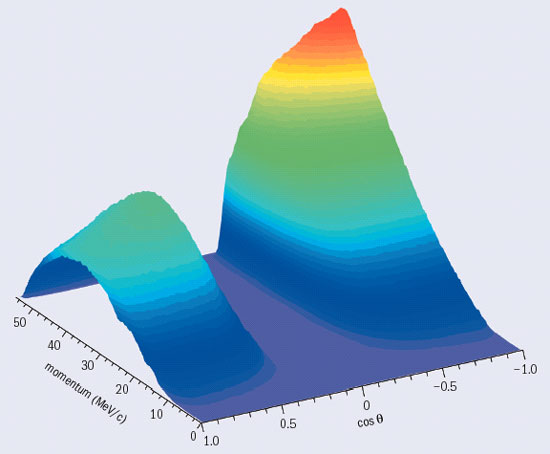
Most of the muon beam stops in a thin target, located at the centre of a symmetric array of 56 low-mass, high-precision planar drift-chambers. Limitations on final errors are dominated by systematic effects since the statistical precision is very high. The measured momentum and angular distribution of the decay positrons are shown in the figure. The drop in acceptance near | cos (θ) | = 0 is because of the poor reconstruction efficiency in that region. To extract the muon-decay parameters, a 2D fit is made to a fiducial region where the detector acceptance is uniform, using a blind-analysis technique. The results are based on 6 x 10⁹ muon decays, spread over 16 data sets. Four sets were analysed for both ρ and δ. A fifth set of low-polarized muons from pion decays in flight was also analysed for ρ. The remaining data sets, combined with further Monte Carlo simulations, were used to estimate the sensitivities to various systematic effects.
TWIST’s new measurement of ρ = 0.75080 ± 0.00032(stat.) ± 0.00097(syst.) ± 0.00023 (last uncertainty due to the current PDG error in η) sets an upper limit on the mixing angle of a possible heavier right-handed partner to the W boson, |ζ| <0.03 at 90% confidence level (c.l.). Combining ρ with the new measurement of δ = 0.74964 ± 0.00066(stat.) ± 0.00112(syst.), and the PDG value of Ρμξδ/ρ, an indirect limit is set on Ρμξ: 0.996 <Ρμξ< 1.004 with 90% c.l. The lower limit slightly improves the limit on the mass of the possible right-handed boson, WR ≥ 420 GeV/c2. Finally, an upper limit is found for the muon right-handed coupling probability, QμR< 0.00184 at 90% c.l.
Muon decay, combined with measurements from experiments at higher energies and in nuclear beta decay, helps our understanding of the asymmetry in the weak interaction’s handedness. In the future phases of the experiment, TWIST aims to produce a direct measurement of Ρμξ with a precision of a few parts in 104 and to increase its sensitivity to ρ and δ by approximately another factor of five.
The US Department of Energy’s Thomas Jefferson National Accelerator Facility (JLab) is well known for its Continuous Electron Beam Accelerator Facility (CEBAF), where experiments with a 6 GeV electron beam probe nuclear structure. Now it turns out the same beam may also be helpful for neutrino research. Physicists from several neutrino projects around the world recently visited JLab to take electron-scattering data on carbon, hydrogen, deuterium and iron targets.
Precise knowledge of neutrino beams and neutrino interactions with atomic nuclei helps neutrino researchers analyse the results of their experiments. They gather this by participating in nuclear and high-energy physics experiments, a practice known as “neutrino engineering”. Examples are the HARP experiment at CERN, which measures pion-production cross-sections of protons on nuclear targets, and experiment E04-001 at JLab, which measures electron-nucleus cross-sections.
Electrons at CEBAF energies interact with nuclei predominantly via the electromagnetic force, while neutrinos interact via the weak force. However, precise information about the electron interaction provides information about the neutrino interaction, since the two forces are actually different aspects of the electroweak force. Electrons probe the vector structure of the nucleon, whereas neutrinos probe both the vector and axial-vector structure. So both probes are needed to understand the full electroweak structure of the nucleon and the nucleus.
The nuclear targets studied in the JLab experiment are the same as, or closely resemble, the production targets and detectors commonly used in neutrino experiments. Thus electron-scattering studies with nucleons and nuclei at low momentum-transfer-squared Q2, such as the data taken at JLab in the Q2 range of 0.01-2 (GeV/c)2, can provide information about how neutrinos interact in neutrino experiments. For example, since experiments such as K2K (KEK to Kamioka) in Japan and MiniBooNE at Fermilab use 1 GeV neutrino beams to study neutrino oscillations, electroweak analysis of 1 GeV electron-scattering data from E04-001 can be used as a first step to provide constraints on neutrino cross-sections needed in the study of neutrino oscillations.
In the long term, JLab and JLab’s own researchers are collaborating in a future experiment, MINERvA (Main Injector Experiment v-A), which is dedicated to measuring neutrino cross-sections in Fermilab’s NuMI (Neutrinos at the Main Injector) beam line. Combining the high-precision electron cross-section data from E04-001 with precise data on neutrino cross-sections from MINERvA should allow the axial structure of the nucleon to be extracted.
The first detailed image of the central part of our galaxy at very-high-energy gamma rays shows several sources. Surprisingly, some of them do not have a known counterpart at radio, optical or X-ray wavelengths, so their nature is a complete mystery.
Gamma rays at tera-electron-volt energies are detected using the Earth’s atmosphere as a detector. The passage of such a photon through the upper atmosphere triggers a shower of relativistic electrons and positrons moving faster than the speed of light in the air, thus emitting Cherenkov radiation. This faint bluish light-flash can be detected at night by dedicated ground-based telescopes.
Currently, the most sensitive Cherenkov telescope array is the European-African High Energy Stereoscopic System (HESS) located in the Namibian desert. It consists of four mirror telescopes 13 m in diameter placed at the corners of a square of side 120 m. Its image resolution of a few arc-minutes has enabled for the first time a map to be made at tera-electron-volt energies of the central part of our galaxy, the Milky Way.
The image published in the journal Science by Felix Aharonian and an international team of scientists reveals eight new sources of very-high-energy gamma rays in the central 60° of the disc of our galaxy. This essentially doubles the number of sources known at these energies. Three of the newly discovered sources could be associated with supernova remnants, two with giga-electron-volt gamma-ray sources discovered by the Energetic Gamma-Ray Experiment Telescope (EGRET) aboard the Compton Gamma-Ray Observatory, and in three cases an association with pulsar-powered nebulae such as the Crab Nebula is not excluded.
However, at least two of the sources discovered by HESS are not at a position where there is a possible counterpart. These could be members of a new class of “dark” particle accelerators.
Cosmic particle accelerators are believed to accelerate charged particles in strong shockwaves such as those produced when the gas expelled from a supernova hits the ambient interstellar medium. High-energy gamma rays are secondary products, which have probably been boosted to tera-electron-volt energies by ultra-relativistic electrons through the inverse Compton process. Gamma rays are easier to detect because they travel in straight lines from their source – unlike charged particles, which are deflected by magnetic fields in the galaxy. The discovery of new sources in the HESS survey of the galaxy therefore helps to solve the long-standing question of the origin of cosmic rays.
The IceCube observatory is being built to detect extraterrestrial neutrinos with energies above 100 GeV. Neutrinos are attractive for high-energy astronomy because they are not absorbed in dense sources like other probe particles, and they travel in straight lines from their source. Protons or nuclear cosmic rays are also bent by interstellar magnetic fields, and while photons fly straight, at energies above 10 TeV, their interactions (by e+e– pair creation) with interstellar background photons limit their range.
The interaction cross-sections of neutrinos are tiny, so a huge detector is required. Calculations of neutrino production in many different types of sources show that a 1 km3 (1 Gt) detector is required to observe astrophysical signals. IceCube will observe neutrinos that interact in Antarctic ice at the South Pole, producing muons, electrons or tau particles. These leptons interact with the ice (and the tau also decays), producing additional charged particles. High-energy (peta-electron-volts) muons travel many kilometres in the ice, and IceCube will observe muons that traverse the detector. The charged particles emit optical Cherenkov radiation, which can travel hundreds of metres before being detected by IceCube’s digital optical modules (DOMs). The type of neutrino, its direction and its energy can then be reconstructed by measuring the intensity and arrival time of the light at many DOMs.
Work at the South Pole
The South Pole might seem like an unusual place to build a huge detector, but the Antarctic ice is very clear and very stable. Deep below the surface, the light-absorption length can exceed 250 m. Compared with seawater, which is another active medium, the ice has much lower levels of background radiation and a longer attenuation length, but more light is scattered.
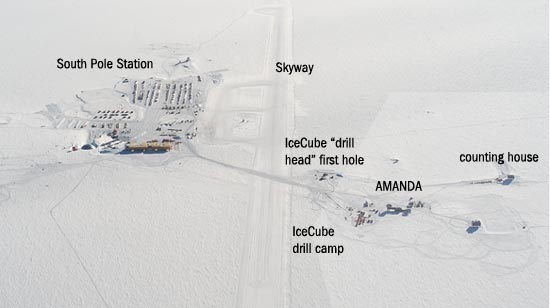
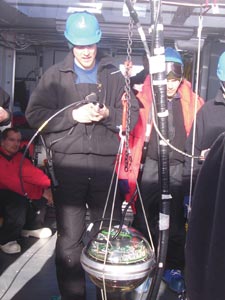
Using the US South Pole station as a base for operations, deployment of the IceCube detector in the ice began on 15 January, when the first hole was started. A jet of water heated to 90 °C was used to melt the hole. The drill pumped 750 l/min of water from a 5 MW heater to reach a drilling speed of slightly over 1 m/min. Drilling this first hole, 2450 m deep and 60 cm in diameter, took about 52 h. Once the drilling was complete, a string of 60 DOMs was lowered into the hole, which took another 20 h. The DOMs are attached to the string every 17 m, between depths of 1450 and 2450 m. The water that remained in the hole took about two weeks to freeze.
The South Pole is very different from an accelerator laboratory, and logistics is a key issue for IceCube. Environmental conditions are rough, and manpower and working time are limited, so everything must be carefully engineered and tested before being shipped to the Pole. Everything must be flown in from the Antarctic coast on LC-130 turboprop aeroplanes equipped with skis. The drilling rig alone filled 30 flights, about an eighth of the annual capacity; fuel for the drill required another 25 flights. Many of the components were transported in pieces to the Pole. The reassembly time limited this inaugural drilling campaign to about 10 days.
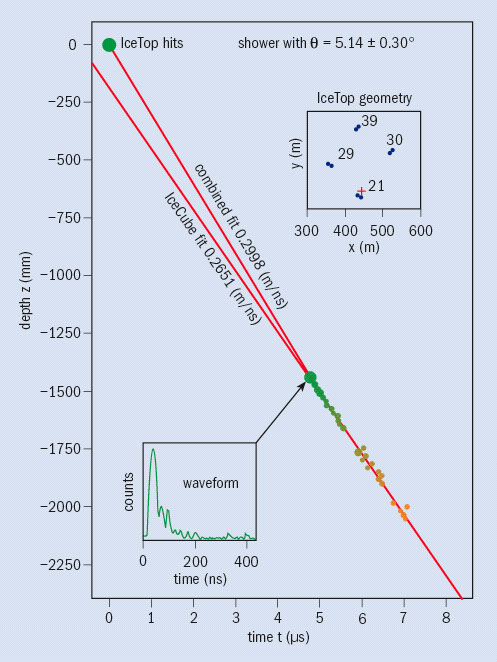
The image below shows an early result of this hard work, a cosmic-ray muon in IceCube, in coincidence with an air shower observed by eight surface tanks that form part of the IceTop array above IceCube. These data were taken less than two weeks after deployment, showing that everything works “right out of the box”. At the time, many of the DOMs were not yet turned on. More recent tests have verified that all 60 DOMs are working.
This success owed much to the Antarctic Muon and Neutrino Detector Array (AMANDA), which preceded IceCube and had more than 650 modules. The AMANDA optical modules contained only a photomultiplier tube (PMT) and analogue signals were transmitted to the surface on the power cable; later versions used fibre-optic cables to transmit analogue signals. These schemes worked in AMANDA, which observed several thousand atmospheric neutrinos, but the approach required manpower-intensive calibrations and could not be scaled up for the much larger IceCube. The solution was “String 18”, a string of DOMs that, in addition to the AMANDA fibre readout, included electronics for locally digitizing the signals, and sending digital signals to the surface. The digital readout worked, and the DOM approach was adopted by IceCube. This advance was a key to reaching the 1 km3 scale.
Each DOM functions independently. Data collection starts when a photon is detected. The PMT output is collected with a custom waveform-digitizer chip, which samples the signal 128 times at 300 megasamples per second. Three parallel 10 bit digitizers combine to provide a dynamic range of 16 bits. Late-arriving light is recorded with a 40 MHz, 10 bit analogue-to-digital converter, which stores 256 samples (6.4 μs). These waveforms enable IceCube to reconstruct the arrival time of most detected photons. A large field-programmable gate array with an embedded processor controls the system, compresses the data and forms it into packets.
The entire DOM uses only 5 W of power. Adjacent DOMs communicate via local-coincidence cables, allowing for possible coincidence triggers. Data are transmitted to the surface over the DOM power cables, and at the surface trigger conditions for the strings and array-wide are applied. The data are stored locally and selected samples transmitted to the Northern Hemisphere via satellite link.
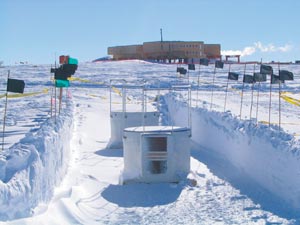
A surface cosmic-ray air-shower detector array, IceTop, forms part of IceCube. IceTop will eventually consist of 160 ice-filled tanks 2 m in diameter, distributed over 1 km2. The tanks are similar to the water tanks used in other air-shower arrays – such as at Haverah Park in the UK, the Milagro Gamma Ray Observatory in the US and the Pierre Auger Observatory in Argentina. Each tank contains two DOMs frozen in the ice. DOMs in each pair of tanks are connected via local coincidence signals, providing a simple local trigger. Part of IceTop was the first piece of IceCube to be deployed, with eight tanks installed in December 2004.
IceTop will serve several functions: tagging IceCube events that are accompanied by cosmic-ray air showers; studying the cosmic-ray composition up to around 1018 eV (correlating IceTop showers with IceCube muons); and as a calibration source to tag directionally the cosmic-ray muons that reach IceCube.
One big problem in large arrays is measuring the relative timing between separated detector elements. IceCube solved this with “RapCal”, a timing calibration whereby signals are sent down the cables from the surface then retransmitted to the surface. Accuracy is maintained by using identical electronics at the two ends of the cables. In IceCube, laboratory measurements and early data show that the local DOM clocks are kept calibrated to about 2 ns.
The environment at the South Pole motivated extensive reliability engineering and pre-deployment testing. The extended temperature range – down to -55 °C – was a challenge for the selection of parts and for design verification. Indeed, IceTop may reach temperatures below -55 °C, beyond the design range of any electronic components. Reliability estimates were also challenging. Conventional models predict that the failure rate halves for each 10 °C drop in temperature; according to these models, IceCube will last forever.
The physics of IceCube
IceCube will study many physics topics, but the major objective is high-energy neutrino astronomy. Any source that accelerates protons or heavier ions (cosmic rays) also produces neutrinos. The accelerated particles will collide with other nuclei, producing hadronic showers. Pions and kaons in the shower will decay, emitting neutrinos. Cosmic rays have been observed with energies up to 3 x 10²⁰ eV and the neutrino spectrum should extend to a few per cent of this energy. The neutrino flux is model-dependent, but most calculations predict that a 1 km3 detector should see at least a handful of events each year.
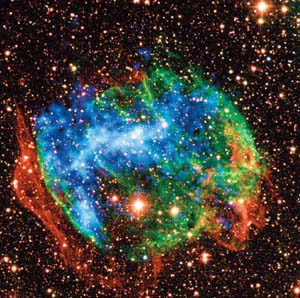
There are several likely astrophysical sources of neutrinos. These include active galactic nuclei (AGNs), gamma-ray bursters (GRBs) and supernova remnants. AGNs are galaxies with massive black holes at their centres, which can power a jet of relativistic particles. Calculations based on the observed flux of photons at energies of tera-electron-volts show that IceCube should observe neutrinos from AGNs. GRBs are mysterious objects that produce bursts of high-energy gamma rays. They are associated with objects in galaxies, including hypernovae (very large supernovae) and colliding neutron stars. Some calculations suggest that IceCube should see a handful of neutrinos from a single GRB, which would be a striking result. Supernova remnants such as the Crab Nebula are the likely source of most cosmic rays of moderate energy in our galaxy. If this is correct, they must also produce neutrinos.
Neutrinos also probe cosmic rays more directly. Ultra-high-energy (above 5 x 10¹⁹ eV) protons interact with relic microwave photons from the big bang. These protons are excited into Δ resonances, which decay to lower-energy nucleons and pions. Subsequent pion and neutron decays then produce neutrinos. The proton energy-loss limits the range of very energetic protons; this is known as the Greisen-Kuzmin-Zatsepin cutoff. Photo-dissociation plays a similar role for heavier ions, limiting their range and producing neutrinos. By measuring the ultra-high-energy neutrino spectrum, IceCube will probe the cosmic-ray composition and possible evolution (with redshift) of energetic cosmic-ray sources.
Besides being two orders of magnitude larger, IceCube has several advantages over experiments such as AMANDA and the array in Lake Baikal. IceCube is optimized for higher-energy neutrinos (especially above 1 TeV), where the atmospheric neutrino background is lower. The high detector granularity will allow IceCube to study electron-neutrinos and tau-neutrinos as well as muon-neutrinos. The electron-neutrinos produce blob-like electromagnetic showers, which contrast strongly with long muon tracks; the latter can extend for many kilometres. Above 1015 eV, tau-neutrinos are identifiable through their distinctive “double-bang” signature – an initial shower from the tau-neutrino interaction and the single track of a tau particle, which eventually decays, producing a second shower.
IceCube will study many other physics topics. Over a decade, it will observe about 1 million atmospheric neutrinos, enough to search for deviations from the standard three-flavour scenario for neutrino oscillations. The IceCube collaboration will also look for violations of the Lorentz and equivalence principles, and will search for neutrinos produced by the annihilation of weakly interacting massive particles that have been gravitationally captured by the Earth or the Sun. Because of the very low dark-noise rates (about 800 Hz per DOM), IceCube can detect bursts of low-energy neutrinos from collapsing supernovae. The detector will also contribute to glaciology, studying the dust layers that record the Earth’s weather over the past 200,000 years.
• The IceCube collaboration consists of more than 150 scientists, engineers and computer scientists from the US, Belgium, Germany, Japan, the Netherlands, New Zealand, Sweden and the UK. IceCube is funded by a $242 million Major Research Equipment Grant from the US National Science Foundation, plus approximately $30 million from European funding agencies.
Further reading
J Ahrens et al. 2004 Astropart. Phys.20 507.
E Andres et al. 2001 Nature410 6827.
See also www.icecube.wisc.edu.
Now in its 19th year, the Rencontres de Physique de la Vallée d’Aoste is known for being a vibrant winter conference, where presentations of new results and in-depth discussions are interlaced with time for skiing. Taking place in La Thuile, a village on the Italian side of Mont Blanc, it consistently attracts a balanced mix of young researchers and seasoned regulars from both theoretical and experimental high-energy physics. The 2005 meeting, which took place from 27 February to 5 March, was no exception.
As well as the standard sessions on particle physics, cosmology and astrophysics typical for such a conference, the organizers always try to include a round-table session on a topical subject, as well as a session on a wider-interest topic that tackles the impact of science on society. This year, the first of these sessions was Physics and the Feasibility of High-Intensity, Medium-Energy Accelerators, and the second was The Energy Problem.
Dark energy, WIMPs and cannon balls
An increasing number of experiments are trying to answer questions in high-energy physics by taking to the skies, making the distinction between particle physics and astronomy more fuzzy. The first session of the conference presented an impressive array of experiments and results, ranging from gravitational-wave detection to gamma-ray astronomy. The team working on the Laser Interferometer Gravitational-Wave Observatory (LIGO), with two fully functioning antennas 3000 km apart, now understands the systematics and has begun the fourth period of data-taking with improved sensitivity.
In gamma-ray astronomy, ground-based detectors – which detect the Cherenkov light emitted when gamma-ray-induced particle showers traverse the atmosphere – are constantly improving. The High Energy Stereoscopic System (HESS) in Namibia became fully operational in 2004 with a threshold of 100 GeV, while new detectors with thresholds as low as 20 GeV are in the pipeline. Satellite-based gamma-ray detectors have also provided some excitement, with the Energetic Gamma Ray Experiment Telescope (EGRET) observing an excess of diffuse gamma rays above 1 GeV, uniformly distributed over all directions in the sky.
This excess could be interpreted as due to the annihilation of neutralinos. The neutralino is the supersymmetric candidate of choice as a weakly interacting massive particle (WIMP) – a popular option for the dark matter of the universe. This prompted Dmitri Kajakov of the Institute for Theoretical and Experimental Physics (ITEP), Moscow, to state that “dark matter is the supersymmetric partner of the cosmic microwave background”, since neutralinos can be thought of as spin-½ photons.
The Gamma-Ray Large Area Space Telescope (GLAST) satellite, launching in 2007, will offer an important improvement in gamma-ray astronomy, with sensitivity to 10,000 gamma-ray sources compared with EGRET’s 200.
The DAMA/NaI collaboration raised some eyebrows. It reported an annual modulation of 6.3σ significance in data observed over seven years in its nuclear-recoil experiment at the Gran Sasso National Laboratory, which stopped taking data in 2002. This modulation could be interpreted as due to a WIMP component in the galactic halo, which is seen from Earth as a “wind” with different speeds, depending on the annual cycle. The collaboration’s study of possible backgrounds has not identified any process that could mimic such a signal, but other experiments have not observed a similar effect. The new set-up, DAMA/LIBRA, which is more than twice as big and started taking data in 2003, might shed some light.
Another way of looking for WIMPs is through their annihilations that produce antimatter. Antimatter in the universe is not produced in large quantities in standard processes, therefore any excess of antimatter seen would be exciting news for WIMP searchers. The Payload for Antimatter Matter Exploration and Light-Nuclei Astrophysics (PAMELA) satellite due to be launched later this year will provide valuable data on antiproton and positron spectra.
Alvaro De Rújula of CERN, using traditional (and increasingly rare) coloured transparencies written by hand, gave an account of his theory of gamma-ray bursts (GRBs), which has now developed into a theory of cosmic rays. Central to the theory are the cosmic “cannon balls”, objects ejected from supernovae with a density of one particle per cubic centimetre, and with a mass similar to that of the planet Mercury but a radius similar to that of the orbit of Mars. These cannon balls, moving through the interstellar medium at high speeds (with initial γ factors of the order of 1000), not only explain GRBs and their afterglows in a simple way, but also explain all features of cosmic-ray spectra and composition, at least semi-quantitatively, without the need to resort to fanciful new physics. What the theory does not attempt to explain, however, is how cannon balls are accelerated in the first place.
Dark energy was reviewed by Antonio Masiero of the University of Padova. Masiero pointed out that theories that do not associate dark energy with the cosmological constant do exist. One can assume, for instance, that general relativity does not hold over very long distances, or that there is some dynamical explanation, like an evolving scalar field that has not yet reached its state of minimum energy (known as a quintessence scalar field), or even that dark energy is tracking neutrinos. With the latter assumption, he came to the interesting conclusion that the mass of the neutrinos depends on their density, and therefore that neutrino mass changes with time. The cosmological constant or vacuum-energy approach, however, offers the less exotic explanation of dark energy.
Finally, Andreas Eckart of the University of Cologne reviewed our knowledge of black holes, with emphasis on the massive black hole at the centre of our own galaxy, Sagittarius A*. He played an impressive time sequence of observations taken over 10 years of the vicinity of this black hole, showing star orbits curving around it.
The golden age of neutrino experiments
The neutrino session began with Guido Altarelli of CERN, who reviewed the subject in some depth. Although impressive progress has been made during the past decade, there are unmeasured parameters that the new generation of experiments must address. The Antarctic Muon and Neutrino Detector Array (AMANDA), which uses the clean ice of the South Pole for neutrino detection, reported no signal from its search for neutrino point-sources in the sky, but the collaboration is already excited about its sequel, IceCube.
The Sudbury Neutrino Observatory (SNO) collaboration has added salt to its apparatus, to increase the detection efficiency by nearly a factor of three compared with the earlier runs. Analysis yields slightly smaller errors on Δm13 than K2K (KEK to Kamiokande), the long-baseline experiment in Japan, which reported on the end of data-taking. K2K is now handing over to the Main Injector Neutrino Oscillation Search (MINOS) in the US, which had recorded the first events in its near detector just in time for the conference. MINOS is similar in conception to K2K, but has a magnetic field in its fiducial volume – the first time in such an underground detector – and it will need three years of data-taking to provide competitive results.
The director of the Gran Sasso National Laboratory, Eugenio Coccia, gave a status report of the activities of the laboratory, which is undergoing an important safety and infrastructure upgrade following a chemical leak. The laboratory is the host of a multitude of experiments on neutrino and dark-matter physics. These include the Imaging Cosmic And Rare Underground Signals (ICARUS) and Oscillation Project With Emulsion Tracking Apparatus (OPERA) experiments for the future CERN Neutrinos to Gran Sasso (CNGS) project and Borexino, which is the only experiment other than KamLAND in Japan that can measure low-energy solar neutrinos. The laboratory also houses neutrinoless double-beta-decay experiments.
Strong, weak and electroweak matters
In the session on quantum chromodynamics, Michael Danilov of ITEP had the unenviable task of reviewing the numerous experiments that have looked for pentaquarks. In recent years, there have been 17 reports of a pentaquark signal and 17 null results. Danilov justified his sceptical approach by pointing out various problems with the observed signals. The small width of the Θ+ is very unusual for strong decays. Moreover, this state has not been seen at the Large Electron Positron (LEP) collider, although this fact can be circumvented by assuming that the production cross-section falls with energy. However, the Belle experiment at KEK does not see the signal either, weakening the cross-section argument. The Θc is seen by the H1 experiment at HERA, but not by ZEUS or by the Collision Detector at Fermilab (CDF). Finally, many experiments have not seen the Ξ— signal. Although Danilov thinks that the statistical significance of the reported signals has been overestimated, it is still too large to be a statistical fluctuation. The question will only be settled by high-statistics experiments coming soon.
Amarjit Soni of Brookhaven summarized our knowledge of charge-parity (CP) violation by emphasizing the success of the B-factories, the fact that the Cabibbo-Kobayashi-Maskawa paradigm is confirmed, and that we now know how to determine the unitarity triangle angles α and γ, as well as the previously known angle β.
The electroweak session began with a report on new results from LEP, with LEP showing no signs that it has said its final word yet. The running of αQED has been the subject of a new analysis of Bhabha events at LEP. The results from the OPAL experiment, recently submitted for publication, give the strongest direct evidence for the running of αQED ever achieved in a single experiment, with a significance above 5σ. Regarding the W mass, the combined data error for LEP now stands at 42 MeV, whereas at the Tevatron, Run II is being analysed and the error from CDF from 200 fb-1 of data (a third of the collected data) is already less than their published result for Run I. The Tevatron collaborations expect to achieve a 30-40 MeV error on the W mass with 2 fb-1 of data. The search is on for the Higgs particle at Fermilab with a new evaluation of the Tevatron’s reach. For a low-mass Standard Model Higgs, the integrated luminosity needed for discovery (5σ) is 8 fb-1; evidence (3σ) needs 3 fb-1, while exclusion up to 130 GeV needs 4 fb-1.
From high intensity to future physics
The round-table discussion on physics and the feasibility of high-intensity, medium-energy accelerators was chaired by Giorgio Chiarelli of the University of Pisa, and after a short introduction he asked the panel members for their views. Pantaleo Raimondi of Frascati gave an overview of B and f factories and Gino Isidori, also of Frascati, pointed to a series of interesting measurements that can be performed by a possible upgrade to the Double Annular Ring For Nice Experiments (DAFNE) set-up at Frascati, where the time schedule would be a key point.
Francesco Forti of Pisa discussed the possibility of a “super B-factory”. He noted that by 2009, 1 ab-1-worth of B-physics data will be available around the world, and to have a real impact any new machine would need to provide integrated luminosities of the order of 50 ab-1. Roland Garoby of CERN talked about a future high-intensity proton beam at CERN, where the need for a powerful proton driver, a necessary building block of future projects, has been identified. Finally, Franco Cervelli of Pisa reviewed the high-intensity frontier, including prospects for the physics of quantum chromodynamics, kaons, the muon dipole-moment and neutrinos. A lively debate followed.
In the interesting science and society session on alternative energy sources, Durante Borda of the Instituto Superior Tecnico of Lisbon gave a detailed account of ITER, the prototype nuclear-fusion reactor that is expected to be the first of its kind to generate more energy than it consumes. ITER is designed to fuse deuterium (obtained from water) with tritium obtained in situ from lithium bombarded with neutrons, thereby creating helium and releasing heat (in the form of neutrons) captured through heat exchangers. It is hoped that this ambitious project, with its many engineering challenges, will pave the way for commercial fusion-power plants.
This talk was followed by presentations on geothermal, solar, hydroelectric and wind energy, covering a wide spectrum of renewable energy resources. It was clear from the presentations that the problem of future energy production is complicated, and a clear winner has yet to emerge from these alternative energy sources.
In the session on physics beyond the Standard Model, Andrea Romanino of CERN did not make many friends among the community working towards the Large Hadron Collider (LHC) at CERN. He stated that “split supersymmetry” – a variation of supersymmetry (SUSY) that ignores the naturalness criterion – pushes the SUSY scale (and any SUSY particles) beyond reach of the LHC, although within reach of a future multi-tera-electron-volt collider.
Fabiola Gianotti of CERN appeared undeterred. She closed the session and the conference by giving a taste of the first data-taking period of the LHC to come. She reminded the audience that for Standard Model processes at least, one typical day at the LHC (at a luminosity of 1033) is equivalent to 10 years at previous machines.
• The conference series is organized by Giorgio Bellettini and Giorgio Chiarelli of the University of Pisa and Mario Greco of the University of Rome.
The Main Injector Neutrino Oscillation Search (MINOS) experiment was officially inaugurated in a ceremony at Fermilab on 4 March. MINOS is the latest weapon in the arsenal of neutrino-oscillation searches. Its main goal is to measure the largest difference in mass-squared between different neutrino species (Δm223) with an accuracy of 10% – more than a factor of two better than it is known today.
MINOS takes over from the KEK to Kamioka (K2K) experiment in Japan, which has finished taking data with a similar set-up. The unique feature of MINOS, however, is its 1.5 T magnetic field. This enables the experiment to distinguish positively and negatively charged tracks and hence discriminate between neutrinos and antineutrinos.
MINOS uses a neutrino beam produced by Fermilab’s Neutrinos at the Main Injector (NuMI) facility, where 120 GeV protons from the Main Injector hit a graphite target, producing hadrons including pions. A “horn” focusing system selects positive pions, which then decay in a 700 m-long decay pipe. After passing through a beam absorber, the beam comprises mostly muon neutrinos. An important advantage of the system is that the energy of the neutrinos can be tuned by moving the horn focusing system.
The neutrino beam is aimed at the MINOS “far” detector, located in the Soudan Underground Laboratory in northeastern Minnesota, some 730 km away from Fermilab. The laboratory is 700 m underground in an old iron mine. To reduce errors by measuring directly the beam composition and neutrino energy spectrum, a “near” detector is also incorporated in the experiment 1 km from the target. It is essentially a miniature of the 6000 t far detector.
An important milestone was reached on 4 December 2004, when the first beam reached the target hall. The horns were powered in January and the near detector has already recorded its first events.
• MINOS is a collaboration of 200 scientists, engineers, technical specialists and students from 32 institutions in Brazil, France, Greece, Russia, the UK and the US.
To provide the best experiences, we use technologies like cookies to store and/or access device information. Consenting to these technologies will allow us to process data such as browsing behavior or unique IDs on this site. Not consenting or withdrawing consent, may adversely affect certain features and functions.
Functional
Always active
The technical storage or access is strictly necessary for the legitimate purpose of enabling the use of a specific service explicitly requested by the subscriber or user, or for the sole purpose of carrying out the transmission of a communication over an electronic communications network.
Preferences
The technical storage or access is necessary for the legitimate purpose of storing preferences that are not requested by the subscriber or user.
Statistics
The technical storage or access that is used exclusively for statistical purposes.The technical storage or access that is used exclusively for anonymous statistical purposes. Without a subpoena, voluntary compliance on the part of your Internet Service Provider, or additional records from a third party, information stored or retrieved for this purpose alone cannot usually be used to identify you.
Marketing
The technical storage or access is required to create user profiles to send advertising, or to track the user on a website or across several websites for similar marketing purposes.