The Japanese-European ASACUSA team at CERN has measured the antiproton-to-electron-mass ratio to record-breaking accuracy. The answer is 1836.153674, with an error margin of 5 in the last decimal place, which is equivalent to measuring the distance between Paris and London to within 1 mm. The corresponding ratio for the proton is 1836.15367261, so the new result shows that the mass of the antiproton is the same as that of the proton to nine significant figures (Hori 2006). This precision has been achieved using the “frequency comb” technique, development of which earned John Hall and Theodor Hänsch, the Nobel prize in 2005.
In the ASACUSA experiment, samples of antiprotonic helium – an atom with an antiproton and an electron orbiting a normal helium nucleus – were produced using CERN’s Antiproton Decelerator facility, and irradiated with a tunable laser beam, the frequency of which could be measured very precisely with the Hall-Hänsch frequency-comb technique. The laser beam could be tuned to one of several characteristic frequencies of the antiprotonic atoms, each frequency corresponding to an atomic transition of the antiproton. Since these frequencies were determined by the properties of the antiproton, the ratio of the antiproton mass to the electron mass could then be calculated from the measured values.
The results can also be combined with an earlier high-precision measurement of the antiproton’s cyclotron frequency (which determines the curvature of its path in a magnetic field). This shows that there is no difference in the proton and antiproton charges either, apart from the sign. Still more precise experiments are planned with the optical comb, and may soon give an even smaller margin of error for the antiproton than the best one obtained for the proton itself (currently about five times smaller). Surprisingly, the antiproton may soon be known better than the proton.
One of the biggest mysteries of science is the nature of dark matter, which first became apparent as astronomer Fritz Zwicky’s “dunkle Materie” in 1933. The two leading particle candidates for this “missing matter” are weakly interacting massive particles (WIMPs) and axions – hypothesized uncharged particles that have a very small but unknown mass, which barely interact with other particles. To bring together the widespread axion community, the Integrated Large Infrastructure for Astroparticle Science (ILIAS), the CERN Axion Solar Telescope (CAST) collaboration and CERN have organized a series of training workshops on current axion research, including open discussions between theorists and experimentalists. The first two of these were held at CERN in November and at the University of Patras in Greece, in May. This article highlights the presentations at both meetings.
The idea of the axion has been around for some 30 years, proposed as a solution to the strong charge-parity (CP) problem in quantum chromodynamics (QCD), the theory of strong interactions. According to the basic field equations of QCD, strong interactions should violate CP symmetry, rather as weak interactions do. However, strong interactions show no sign of CP violation. In 1977, Roberto Peccei and Helen Quinn suggested that to restore CP conservation in strong interactions, a new symmetry must be present, compensating the original CP-violating term in QCD almost exactly – to at least one part in 1010. The breakdown of this gives rise to the so-called axion field proposed by Steven Weinberg and Frank Wilczek, and the associated pseudo-scalar particle – the axion. Appropriately, Peccei, from the University of California Los Angeles, gave the first lecture of the workshop series and described the theoretical raison d’être of the Peccei-Quinn symmetry.
Evidence for strong CP violation should in particular appear in an electron dipole moment (EDM) for the neutron, but this has not yet been detected. Instead, we know from a high-precision measurement using polarized ultracold neutrons at the Institut Laue Langevin (ILL) in Grenoble that the neutron EDM is at least some 10 orders of magnitude below expectation. Peter Geltenbort of ILL presented the recently announced limit of 3 × 10-26 e cm. This is part of a series of experiments started by Nobel laureates Norman Ramsey and Edward Purcell in the 1950s, which continues today with the ambitious goal of reaching 10-28 e cm by the end of the decade. Other proposed neutron EDM experiments include those at the Paul Scherrer Institut and at the Spallation Neutron Source in Oak Ridge with goals of 10-27 e cm and 10-28 e cm, respectively. A new technique with the deuteron may provide the route for the next sensitivity scale, reaching 10-29 e cm, as Yannis Semertzidis of Brookhaven explained.
CP violation seems to be necessary to explain the survival of matter at the expense of antimatter after the Big Bang. Thus the creation of relic axions shortly after the dawn of time could have been enormous, perhaps amounting to some six times more in mass than ordinary matter. In addition to the scenario of relic axions, Georg Raffelt, an axion pioneer from the Max Planck Institute, introduced the connections between astrophysics and axions, with the stars as axion sources as his central topic. The effect of such an energy-loss channel on stellar physics provides constraints on the interaction strength of axions with ordinary particles. The Sun, our best known star, should be a strong axion source in the sky, allowing a direct search for these almost-invisible particles.
This is precisely the objective of the CAST helioscope at CERN, which searches for solar axions using a recycled LHC test dipole magnet pointing at the Sun for some three hours a day. The signal of solar axions will be an excess of X-rays detected during solar tracking. While the relic axions are expected to move slowly at about 300 km/s, those escaping from the solar core must be super relativistic, despite their assumed kinetic energy of only about 4 keV. CAST is the first helioscope ever built with an imaging X-ray optical system, whose working principle was explained by Peter Friedrich from Max-Planck-Institut für extraterrestrische Physik and Regina Soufli from Lawrence Livermore National Laboratory (LLNL) in their lectures on X-ray optics. For axion detection, the X-ray optics act as a concentrator to enhance the signal-to-noise ratio by focusing the converted solar X-rays into a small spot on a CCD chip or a micromesh gaseous structure (Micromegas), as developed by Yannis Giomataris and Georges Charpak. CAST has been taking data since the end of 2002 and has already published first results.
The possible existence of axions in the universe means that they are a candidate for (very) cold dark matter, as another axion pioneer, Pierre Sikivie, from the University of Florida explained. He also described the technique that he invented in 1983 for detecting axions. The idea is that axions in the galactic halo may be resonantly converted to microwave photons in a cavity permeated by a strong magnetic field. The expected signals are extremely weak, measured in yoctowatts, or 10-24 W. The same holds also for the solar axions inside the CAST magnet, whose energies of a few kilo-electron-volts (keV) are several orders of magnitude higher. The process depends on various parameters, such as the magnetic-field vector and size, the plasma density, the (unpredictable) axion rest mass and the photon polarization – all of which provide the multiparameter space in which axion hunters search for their quarry.
Sikivie also described the search for relic axions at LLNL, the topic of the CERN seminar at the start of the first workshop, presented by Karl van Bibber from LLNL. The Axion Dark Matter eXperiment (ADMX), which uses a microwave cavity to look for axionic dark matter as proposed by Sikivie, has been taking data for a decade. It is now undergoing an upgrade to use near-quantum-limited SQUID amplifiers. In his review, van Bibber also described CARRACK, a similar experiment in Kyoto, which uses a Rydberg-atom single-quantum detector as the back-end of the experiment.
The axion, together with the Higgs boson – another so-far undetected particle required by theory – may contribute not only to dark matter but also to dark energy, as Metin Arik from Istanbul explained. This leads to the question of why the dark-energy density is so small.
Light polarization
Giovanni Cantatore presented the Polarizzazione del Vuoto con LASer (PVLAS) experiment at the INFN Legnaro National Laboratory, which has recently caused a stir in the axion community. In a recent paper in Physical Review Letters, the PVLAS collaboration reports that a magnetic field can be used to rotate the polarization of light in a vacuum. The detected rotation is extremely small, about 0.00001°. The slight twist in the polarization, the result of photons of a given polarization disappearing from the beam, could suggest the existence of a light, new neutral boson, as the signal strength observed by PVLAS is much larger than would be expected on the basis of quantum electrodynamics alone.
The particle suggested by PVLAS is not exactly the expected axion; its coupling to two photons is so strong that experiments searching for axions, such as CAST, should have seen many of them coming from astrophysical sources. It would need peculiar properties not to conflict with the current astrophysical observations, but there is no fundamental reason barring it from having such properties. Eduard Masso from the University of Barcelona reviewed the theoretical motivation for axions and the importance of an axion-like coupling to photons, and addressed the apparent conflict between the PVLAS results and CAST and the astrophysically derived bounds.
Andreas Ringwald from DESY pointed out that the possible interpretation of the PVLAS anomaly in terms of the production of an axion-like particle has triggered a revisit of astrophysical considerations. Models exist in which the production of axion-like particles in stars is suppressed compared with the production in a vacuum. In these models, the bounds derived from the age of stars or from CAST may be relaxed by some orders of magnitude. The workshop participants agreed unanimously that the PVLAS result needs direct confirmation of the particle hypothesis with laboratory-based experiments.
Semertzidis spoke about a PVLAS-type experiment that was performed at Brookhaven more than 15 years ago, with most of the PVLAS collaborators as major players. They also observed large signals, which they attributed however to the laser light motion at the magnet frequency. He went on to suggest that laser motion at the magnet rotation frequency might also produce signals at the second harmonic that would look like axion signals. The PVLAS collaboration has spent five years looking for a systematic artifact that might explain their observations, and plans to attempt to settle the question in a new photon-regeneration experiment. Here, any particles produced from photons in a first magnet, would propagate into a second magnet blocked to photons, where they would convert back into photons.
The solar-axion energy range less than 0.5-1 KeV remains a challenging new territory
Detection of such regenerated photons would provide a very robust confirmation of the particle interpretation of the PVLAS result, and similar regeneration experiments are in preparation elsewhere. Keith Baker presented the plans by the Hampton University-
Jefferson Lab collaboration to use the world’s highest-power tunable free-electron laser (FEL), in the LIght Pseudoscalar-Scalar Particle Search (LIPSS) experiment, which will run during the coming months. As Ringwald pointed out, there are a number of experiments based either on photon polarization or on photon regeneration measurements that should soon exceed the sensitivity of PVLAS. At DESY, there is a proposal to exploit the photon beam from the Free-electron LASer in Hamburg (FLASH) for the Axion Production at the FEL (APFEL) experiment, which will take advantage of unique properties of the FLASH beam. The available photon energies (around 40 eV) are just in the range where photon regeneration is most sensitive to masses in the milli-electron-volt range. In addition, the tuning possibilities of FLASH will allow a mass determination, and the pulsed nature of the photon beam allows noise reduction by timing.
Two linked experiments to search for axions proposed by a team from CERN and several other institutes are also well advanced. These were presented by Pierre Pugnat from CERN, who explained how this approach allows for simultaneous investigations of the magneto-optical properties of the quantum vacuum and of photon regeneration. The team could start next year to check the PVLAS result. The two experiments are integrated in the same LHC superconducting dipole magnet and so can provide solid results via mutual cross-checks.
Carlo Rizzo from Université Paul Sabatier/Toulouse presented a different detection concept in the Biréfringence Magnétique du Vide experiment at the Laboratoire National des Champs Magnétiques Pulsées in Toulouse. The goal is to study quantum vacuum magnetism and the experiment will be in operation this summer to test the PVLAS result.
Frank Avignone from South Carolina reviewed possibilities that go beyond the current experimental searches for axions, such as the use of coherent Bragg-Primakoff conversion in single crystals, coherence issues in vacuum and gas-filled magnetic helioscopes, and novel proposals to detect hadronic axions with suppressed electromagnetic couplings. Emmanuel Paschos of the University of Dortmund addressed possible coherence phenomena in low-energy axion scattering and its potential use for axion detection. This could be an important application of light-sensitive detectors used in underground dark-matter experiments, where they may allow the first low-energy axion searches, as reported by Klemens Rottler from the University of Tübingen and the CRESST dark-matter experiment. After all, the solar-axion energy range less than 0.5-1 keV remains a challenging new territory.
From the Sun and beyond
The signatures of axions are not confined to the solar system, and there were a number of interesting presentations on searches for axions or axion-like particles with telescopes on the ground or in orbit. A cosmologically interesting topic concerns axion-photon conversion induced by intergalactic magnetic fields, which offers an alternative explanation for the dimming of distant supernovae, without the need for cosmic acceleration. However, the same mechanism would cause excessive spectral distortion of the cosmic microwave background (CMB). Alessandro Mirizzi of Bari concludes that owing to the spectral shape of the CMB, photon-axion oscillation can play only a relatively minor role in supernova dimming. Nevertheless, a combined analysis of all the observables affected by the photon-axion oscillations would be required to give a final verdict on this model.
In related work, Damien Hutsemékers from the University of Liège has investigated the potential for photon-axion conversion within a magnetic field over cosmological distances, as it can affect the polarization of light from distant objects such as quasars. He reported on the remarkable observation, using the ESO telescopes in Chile, of alignments of quasar polarization vectors that might be due to axion-like particles along the line of sight.
Rizzo also discussed potential axion signatures in astrophysical observations, presenting an impressive movie. He reported that axion and quantum vacuum effects have been studied in the double neutron-star system J0737-3039. Astrophysical observations of such effects will be possible in 2007 with the ESA XMM/Newton and NASA GLAST telescopes in orbit.
Coming nearer to Earth, Hooman Davoudiasl from the University of Wisconsin-Madison showed that solar axion conversion to photons in the Earth’s magnetosphere can produce an X-ray flux, with average energy about 4 keV, which is measurable on the dark side of the Earth. (The low strength of the Earth’s magnetic field is compensated for by a large magnetized volume.) The signal has distinct features: a flux of X-rays coming from the dark Earth, pointing back to the core of the Sun, with a thermal distribution characteristic of the solar core, and orbital as well as annual modulations. For axion masses less than 10-4 eV, a low-Earth-orbit X-ray telescope could probe the axion-photon coupling well below the current laboratory bounds, with a few days of data-taking. Also, the question was discussed as to whether axion-photon oscillations occur inside solar magnetic fields, sufficient to give the enhanced X-ray emission from places such as in sunspots.
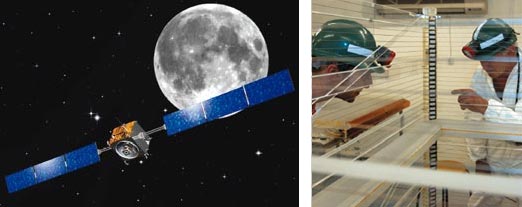
Another possibility is the detection of the radiative decay of massive axions, predicted in extra dimensional models, which change drastically their mass, lifetime and detection, as Emilian Dudas from Ecole Polytechnique argued. In this context, Juhani Huovelin from Helsinki Observatory presented space-borne X-ray observations of the Sun and the sky background with ESA’s SMART-1, the first European mission to the Moon, which began operation in 2004 and will continue data-taking until September 2006. The important instruments onboard for axion research are an X-ray camera from CCLRC Rutherford Appleton Laboratory in the UK, and the X-ray Solar Monitor (XSM) from the University of Helsinki. The XSM measures solar X-ray spectra with high time resolution in the 1-20 keV energy range.
Extensive data have already been accumulated, including a series of lengthy observations of the X-ray Sun during quiescence and flares, as well as various observations of the background sky. Preliminary analysis of the data indicates possible residual emission at several intervals in the 2-10 keV range after fitting known solar and sky-background emission components. A future more-refined analysis will show whether the residual emission is statistically significant, and possibly related to X-rays from the decay of gravitationally trapped massive axions. The NASA solar mission RHESSI has also entered this kind of research, with the aim of detecting the same sort of particles near the surface of the Sun, as we published with Luigi di Lella at CERN five years ago. SMART and RHESSI use the Moon and Sun respectively to block out the background sky, thereby creating a large fiducial volume to search for axion radiative decay. The 1 m3 DRIFT detector operating in the Boulby Mine in the UK provides a similar capability in an underground experiment, as Eirini Tziaferi and Neil Spooner from Sheffield explained.
The friendly atmosphere of the two workshops saw plenty of fruitful discussions in which new ideas could emerge. For example, Ringwald has recently suggested a laboratory photon-regeneration experiment with X-rays. It seems that the ESRF at Grenoble offers one of the best opportunities worldwide for such an experiment, with photon energies in the 3-70 keV range. Also, as Sikivie highlighted, there is strong scientific interest in building a next-generation microwave cavity embedded in a large-bore superconducting solenoid to detect galactic-halo axions. CERN, together with several collaborating institutes, for example, could build a microwave cavity of around 1 m3 integrated inside a 8-10 T magnetic field.
The workshop participants unanimously concluded with a call to CERN to become a focal point for axion physics. There will be more ideas and new results by the next workshop in June 2007 in Patras.
Muon neutrinos definitely disappear en route from Fermilab in Illinois to Soudan in Minnesota. This is the conclusion from the first results of the Main Injector Neutrino Oscillation Search (MINOS), presented at a seminar at Fermilab on 30 March, which showed that MINOS has observed the disappearance of a significant fraction of these neutrinos. The observation is consistent with the phenomenon of neutrino oscillation, in which neutrinos change from one kind to another, and corroborates earlier observations of muon-neutrino disappearance, made by the Super-Kamiokande and KEK-to-Kamioka (K2K) experiments in Japan.
The Fermilab side of the MINOS experiment comprises a beam-line in a 1220 m long tunnel pointing towards Soudan. The tunnel holds the carbon target and beam-focusing elements that generate neutrinos from protons accelerated by Fermilab’s Main Injector accelerator. A neutrino detector, the MINOS “near detector” located 100 m underground on the Fermilab site, measures the composition and intensity of the neutrino beam as it leaves the laboratory. The Soudan side of the experiment features the 6000 tonne “far” detector about 700 m underground, which measures the properties of the neutrinos after their 725 km trip to northern Minnesota.
If neutrinos did not change as they travel away from Fermilab, the MINOS detector in Soudan should have recorded 177±11 muon neutrinos. Instead, the collaboration found only 92 muon-neutrino events – a clear observation of muon-neutrino disappearance. The deficit as a function of energy is consistent with the hypothesis of neutrino oscillations, which can occur only if different neutrino types have different masses. The MINOS observations yield a value of Δm2, the square of the mass difference between two types of neutrinos, equal to 0.0031 ±0.0006 (statistical uncertainty) ±0.0001 (systematic uncertainty) eV2.
In the oscillation scenario, muon neutrinos can transform into electron neutrinos or tau neutrinos, but alternative models – such as neutrino decay and extra dimensions – are not yet excluded. The MINOS collaboration will need to record much more data to test more precisely the exact nature of the disappearance process. Over the next few years, the experiment should collect about fifteen times more data, yielding more results with higher precision.
The MINOS neutrino experiment follows on from the K2K long-baseline neutrino experiment in Japan. From 1999-2001 and 2003-2004, K2K sent neutrinos created at an accelerator at the KEK laboratory to a detector in Kamioka, a distance of about 240 km. Compared with K2K, the distance in the MINOS experiment is three times longer, and both the intensity and the energy of the MINOS neutrino beam are higher. These advantages have enabled the MINOS experiment to observe in less than a year about three times as many neutrinos as K2K did in around four years. Later this year the CERN Neutrinos to Gran Sasso project will start delivering muon neutrinos to the Gran Sasso National Laboratory in Italy.
• The MINOS experiment includes about 150 scientists, engineers, technical specialists and students from 32 institutions in six countries, including Brazil, France, Greece, Russia, the UK and the US. The US Department of Energy provides the major share of the funding, with additional funding from the US National Science Foundation and the UK’s Particle Physics and Astronomy Research Council. For more information on the experiment see www-numi.fnal.gov/.
The Belle experiment has recently revealed evidence for a rare and long-sought missing-energy decay of the B meson, B– → τ–ν. This has allowed the Belle Collaboration to measure the B-meson decay constant, fB, for the first time. The results were announced at the Flavor Physics and CP Violation conference in Vancouver, and have been submitted to Physical Review Letters (Ikado et al. 2006).
The Belle experiment is a collaborative effort of scientists from universities and laboratories in America, Asia, Australia and Europe. It operates at the KEK High Energy Physics Laboratory in Japan – home to KEKB, the world’s highest-luminosity particle accelerator, which recently achieved a peak luminosity of 1.6 × 1034 cm-2s-1.
In the decay mode B– → τ–ν, the B meson (a strongly interacting bound state of a b quark and anti-u quark) transforms into a final state containing only leptons. Previously, because this decay process had not been seen, researchers had to rely entirely on either calculations in lattice quantum chromodynamics (QCD) or models to obtain the parameter fB, which is needed to interpret many other measurements in particle physics, including the Cabibbo-Kobayashi-Maskawa unitarity triangle constraints from Bd-Bbard mixing.
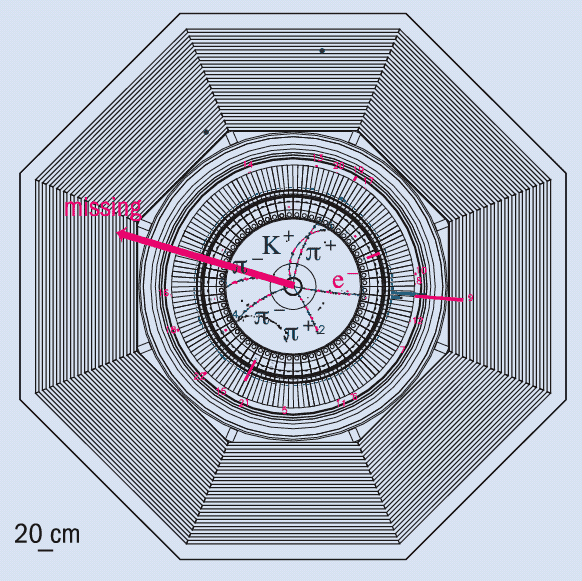
The decay mode B– → τ–ν is especially hard to find. Not only is it rare – about 1 in 10,000 charged B decays contains such an event – but tau leptons often decay to an electron or muon together with two neutrinos, which escape the detector unseen. This means that the experimental signature is simply a single charged track accompanied by missing energy, and is frequently mimicked by less-interesting background processes.
The Belle experiment operates at the U(4S) resonance where each B meson is produced accompanied by an anti-B meson partner and nothing else. The experimental breakthrough that allowed the discovery of the missing-energy decay mode involved detecting all the decay products of the B meson accompanying the sought-after decay, thereby constraining the energy and momentum of the missing or undetected particles. This technique has a very low efficiency and is only possible because of the unprecedented luminosity of the KEKB accelerator, which provided the Belle experimenters with 457 million charged B mesons to study. Even so, this was barely sufficient to discover this rare and unusual process.
Based on the events that they have found, the Belle team reports a preliminary value of fB = 176+28-23 (stat.) +20-19 (syst.) MeV, which is compatible with the most recent calculations in unquenched lattice QCD. Conversely, if fB is taken from lattice QCD, the Belle measurement of B → τν gives a tight constraint on charged Higgs masses at high tanβ in extensions of the Standard Model, where tanβ is the ratio of vacuum expectation values.
This breakthrough in the detection of a rare missing-energy decay is the first step towards the observation of exotic decays such as B → Kννbar, B → dark matter, and other possible types of unusual and new physics processes. Although the experimental technique for observing a rare missing-energy mode has now been established, two orders of magnitude more BBbar pairs are probably needed to find B → Kννbar and exploit all of the possibilities this technique has to offer. This will be possible at the proposed KEK Super B-Factory facility.
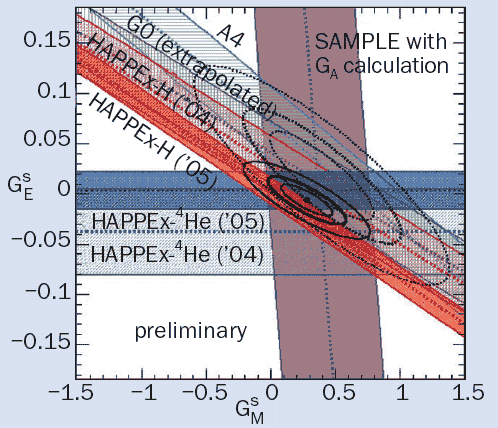
Two more rounds of data taken by the Hall A Proton Parity Experiment (HAPPEx) at the US Department of Energy’s Jefferson Lab have provided the most precise constraint yet on nucleon strangeness. The result, presented at the American Physical Society April meeting in Dallas, reveals that the strange-quark contribution to the proton’s overall charge distribution and magnetic moment is small. It amounts to no more than 1% of the proton’s charge radius and no more than 4% of its magnetic moment – and in both cases, the final value could be consistent with zero.
It may seem unusual that strange quarks should be important in determining the properties of the proton as, unlike up and down quarks, they are not thought of as permanent residents of the proton. However, the strange quark may appear as part of the proton’s quark-gluon sea, the seething mass of particles that constantly blink in and out of existence due to strong force energy.
A useful method of accessing strange quarks is through parity-violating electron scattering, in which the interference of the electromagnetic force and neutral weak force is measured by scattering a beam of polarized electrons off target particles. Since the electromagnetic force is parity-symmetric, while the weak force is not, a longitudinally polarized electron beam allows experimenters to separate the electromagnetic and weak components, and by comparing their strengths they can disentangle the contributions of the up, down and strange quarks.
The HAPPEx Collaboration measured a combination of strange-quark contributions to the charge distribution and magnetization of the proton, which are represented via GsE and GsM, the strange electric and magnetic form factors, respectively. To disentangle the two form factors, the collaboration took data on two different targets: hydrogen and helium (4He). 4He has no net spin and hence no magnetic moment, and so allowed the researchers to isolate GsE.
HAPPEx took data on both targets during 2005, using a longitudinally polarized 3 GeV electron beam from Jefferson Lab’s Continuous Electron Beam Accelerator Facility. A gallium arsenide superlattice photocathode provided an average beam polarization of 86% with rapidly flipping helicity. The beam was sent into a 20-cm long cryogenic aluminum target vessel containing either hydrogen or 4He in Jefferson Lab’s Hall A. Septum magnets then deflected elastically scattered electrons, which were at a forward angle of 6°, to the Hall A High Resolution Spectrometers (HRS), located at 12.5°.
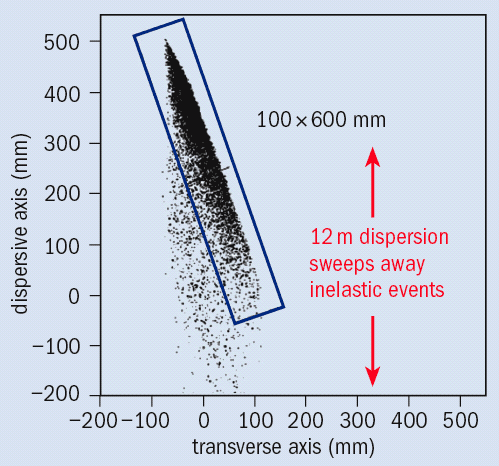
The HRS allowed a very clean separation of elastic events, with an average value of momentum-transfer squared, Q2 = 0.1 (GeV/c)2. A Cherenkov electromagnetic shower calorimeter covered the distribution of elastic events in the spectrometer focal plane. The signal was integrated over each period of constant helicity. A blinding factor was placed on the data and removed only a week before the result was presented in Dallas.
The HAPPEx results indicate small values for the strange form factorss GsM = 0.12±0.24 and GsE = -0.002±0.017. While these results are consistent with previous results from HAPPEx (Aniol et al. 2006) and world data, they reveal that the large values and possible radical Q2 dependence of the strange form factors suggested by previous data in this kinematic region, are highly unlikely. Also, while these new data are accurate enough to eliminate many models of strangeness content, they do not rule out sizable contributions at higher Q2. They are also compatible with a new analysis of world data, the result of which is in excellent agreement with modern calculations based on non-perturbative quantum chromodynamics using lattice methods and chiral extrapolation (Young et al. 2006).
During their long lifetimes stars generate their energies by nuclear fusion in their interiors, which are generally accepted to be the breeding grounds for carbon and heavier elements. The heaviest elements made this way are iron and nickel; heavier elements are thought to be built by slow and/or rapid neutron-capture reactions, the s- and r-processes. Although these mechanisms for nucleosynthesis have been known for some time, the abundances of some heavy elements have remained a mystery. Now Carla Fröhlich of the Universität Basel and Gabriel Martínez-Pinedo of the Gesellschaft für Schwerionenforschung, Darmstadt, and colleagues have proposed a novel nucleosynthesis that might solve these puzzles.
When a massive star forms a supernova, part of the matter in the stellar interior forms a neutron star, and the liberated energy, mainly in the form of neutrinos, contributes to the ejection of the stellar mantle into the interstellar medium. The temperature of the deepest ejected layers is so hot that nuclei are decomposed into free protons and neutrons. The tremendous flux of neutrinos and antineutrinos, which accompanies the birth of the neutron star, can be absorbed by the nucleons and so determines the relative abundance of protons and neutrons and hence the composition of the nuclei that form when the ejected matter reaches cooler regions.
During the later stages of the explosion the matter is expected to become rich in neutrons, so supernovae are believed to be the site of heavy-element production by the r-process. However, it has been realized very recently that during the first second of the explosion the ejected material is rich in protons.
When Fröhlich and colleagues studied the nucleosynthesis in this proton-rich environment they discovered possible solutions to two long-standing problems. First, they could reproduce the abundances of elements such as scandium, copper and zinc, for which calculations had previously fallen notoriously short. More surprisingly, they also noticed the appearance of heavier elements such as strontium, molybdenum, ruthenium and beyond (C Fröhlich et al. 2006).
This heavy-element production can be attributed to a novel nucleosynthesis process, which Fröhlich and colleagues named the νp process after the two main contributors: proton capture, which transports matter sequentially to higher charges, and (anti)neutrinos, which are captured by free protons and so change the protons to neutrons. This presence of neutrons allows the flow in element creation to circumvent long-lived nuclei such as 56Ni and 64Ge, so enabling the synthesis of heavier elements.
The νp process is a primary process, that is, it should occur in all core-collapse supernovae. As a consequence there should already be fingerprints of νp nucleosynthesis in the earliest and most primitive stars. Indeed, finding strontium in the most metal-poor, and hence oldest, star observed so far came as a big surprise last year. This might now be explained as debris from the νp process that had operated in an earlier supernova. Further observations of elemental abundances in metal-poor stars combined with progress in supernova modelling and improved knowledge of the nuclei involved – as expected from future facilities such as the Facility for Antiproton and Ion Research – will help to disentangle the importance of the νp process for the abundances of the elements in the universe.
The CDF collaboration at Fermilab has announced the precision measurement of the matter-antimatter transitions for the B0s meson, which consists of a bottom quark bound to a strange anti-quark. The announcement came less than a month after the news that the D0 collaboration had measured the first upper and lower bounds on the oscillation frequency.
In a seminar at Fermilab on 10 April, the CDF Collaboration reported on their analysis of 1 fb-1 of proton-antiproton collision data acquired by the CDF detector between February 2002 and January 2006, during Tevatron Run II. Within the 700-member CDF Collaboration – from 61 institutions and 13 countries – a team of 80 researchers from 27 institutions performed the data analysis leading to the precision measurement just one month after the data-taking was completed.
The team used semileptonic and hadronic decays of the B0s and found a signature consistent with B0s-Bbar0s oscillations, with a probability that the data could randomly fluctuate to mimic such a signature of 0.5%. Analysis yielded a preliminary result for the B0s-Bbar0s oscillation frequency, Δms, of 17.33+0.42-0.21(stat.)±0.07(sys.) ps-1 – in agreement with D0’s result of 17 < Δms Δ 21 ps-1. The CDF Collaboration also derived a value for the ratio of the related parameters of the Cabibbo-Kobayashi-Maskawa matrix, |Vtd|/|Vts| = 0.208+0.008-0.007 (stat.+sys.).
This precision measurement from CDF will immediately be interpreted within different theoretical models, in particular in the context of supersymmetry. General versions of supersymmetry predict an even faster transition rate than has been measured, so some of those theories can be ruled out based upon this result. More information will come from combining precise measurements of B0s-Bbar0s oscillations and searching for the rare decay of B0s mesons into muon pairs. Both the D0 and CDF experiments expect to achieve improved results in these areas in the near future.
Researchers at the Lawrence Livermore National Laboratory (LLNL) in California have made the most precise test so far of quantum electrodynamics (QED). In studies of highly ionized, lithium-like uranium, they have measured the two-loop Lamb shift for the first time (Beiersdorfer et al. 2005).
QED is a well-established theory that describes at the quantum level all phenomena involving the electromagnetic force. Its extremely accurate predictions have been tested by various experiments, including measurements of the tiny shift in the energy levels in hydrogen discovered by Willis Lamb in 1951, owing to the self-interaction of the electron. Tests of so-called one-loop QED (self-energy and vacuum polarization) confirmed the theoretical predictions with high precision, and theorists and experimentalists are now looking to evaluate higher-order QED processes.
Highly charged ions offer an opportunity for high-accuracy calculations of atomic properties within QED, in that they provide a strong-field environment and relatively simple spectra. These conditions allow high-precision measurements of some transitions. Moreover, measurements of lithium-like systems such as U89+ are more sensitive to higher-order QED terms than those of hydrogen-like systems.
Using the SuperEBIT high-energy electron-beam ion trap at LLNL, the researchers measured the 2s(1/2)-2p(1/2) transition in U89+ with an accuracy that is nearly an order of magnitude better than previously available. The team monitored X-ray emission from the ions with a high-purity germanium detector, and used a spectrometer specifically developed for this experiment for spectroscopy at extreme ultraviolet wavelengths.
The results allow the researchers to infer a two-loop Lamb shift in lithium-like U89+ of 0.20 eV. This is also in excellent agreement with the recent calculation of the two-loop Lamb shift for the 1s level in hydrogen-like U91+.
It is slightly more than 30 years since the discovery of the J/ψ, the first bound state of a charmed quark, c, and its antiquark cbar, near a mass of 3.1 GeV/c2. This discovery ushered in the era of heavy-flavour physics, which now includes studies of the tau lepton and its neutrino, and the b and t quarks. As the mass of the charmed quark is quite large, the velocities of the c and cbar in a bound state are small enough that many important features of these states can be described using non-relativistic potential models. Also, at typical separations of the quark and antiquark, the shape of the ccbar potential is somewhat like that of the Coulomb potential. Hence, many features of ccbar states – collectively called charmonium – are familiar from the physics of the hydrogen atom, or more precisely, from the spectroscopy and dynamics of positronium, a bound state of an electron and a positron.
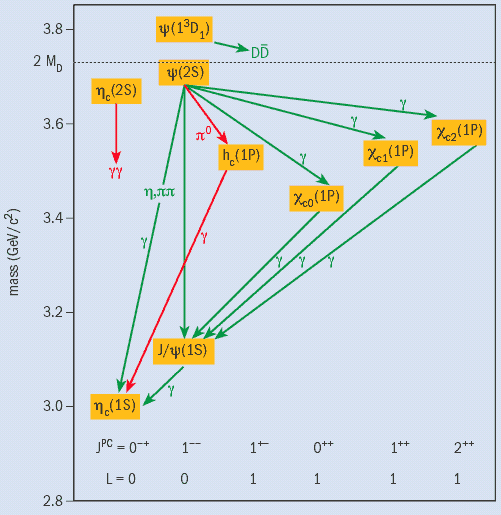
After its discovery, the J/ψ was soon identified as a 3S1 ccbar bound state, that is, a spin-triplet (S = 1) S-wave (L = 0) level with total spin J = 1. Several other ccbar levels were observed soon after, including the ψ(2S), or ψ’, an excited version of the J/ψ; several orbitally excited triplet P-wave (3PJ = 0, 1, 2) levels χcJ; a D-wave level at 3.77 GeV/c2; and a spin-singlet 1S0 level known as the ηc(1S). Figure 1 illustrates the low-mass charmonium spectrum and the principal transitions between charmonium states expected from the analogy of ccbar states with positronium states. Among the low-mass states expected, only the ηc(2S), an excited version of the ηc(1S), and the hc, a spin-singlet P-wave 1P1 level, steadfastly refused to make significant appearances, despite reported sightings that were not confirmed.
A few years ago, with the conclusion of its 20-year programme of studies of the decays and spectroscopy of the bottom quark, the CLEO Collaboration at the Cornell Laboratory for Elementary-Particle Physics turned its attention to the study of charm and charmonium. The National Science Foundation supported converting the Cornell Electron Storage Ring (CESR) to CESR-c, including installing wiggler magnets to enhance luminosity in the charm threshold region (see CERN Courier May 2003 p7). The new programme benefits enormously from the versatility of the CLEO detector, upgraded to CLEO-c (figure 2), which is unrivalled by other detectors that have operated in this energy region. This latest version of the CLEO detector features excellent charged-particle tracking, neutral-shower energy resolution, and particle identification.
The ease of studying the lower-mass charmonium states is due in part to their narrow decay widths (long lifetimes), which are much smaller than the mass differences among the states. Above the charm threshold, where production of a pair of charmed mesons, D, becomes possible – that is, above 2MD ≈ 3.73 GeV/c2 – charmonium states are much broader and they may overlap, so the spectroscopy becomes more complicated.
The charmonium spectrum provides fundamental information about the nature of the strong force holding quarks together. If current ideas about the nature of the interquark force are correct, the mass of the hc, M(hc), is expected to be near the spin-weighted average of the masses of the χcJ levels, 〈M(3PJ)〉 ≈ 3525 MeV/c2. This prediction for M(hc) is based on the expectation that the dominant spin-dependent interquark force is Coulomb-like, as predicted by quantum chromodynamics (QCD), the theory of the strong force. It is borne out by calculations in lattice gauge theory, which predict a difference of at most a few mega-electron-volts/c2 between the masses of the spin-singlet and spin-triplet P-wave states.
Charm and charmonium data taken at CLEO so far include a sample of slightly more than 3 million ψ(2S) decays, as well as continuum data below the ψ(2S), charm data just above DDbar threshold, and data at higher energies for a nascent programme of Ds investigations. The ψ(2S) data were used to search for the isospin-violating transition ψ(2S) → π0hc. A similar transition in the bbbar system (from the Υ(3S) level) was proposed some time ago as a way to search for the 1P1 state hb (Voloshin 1986). The transition was expected to occur with a branching fraction of only about 10-3, and so substantial suppression of background was required. The hc was expected to decay to the ηc and a photon of energy around 500 MeV with a branching fraction of roughly 40%, so this photon was sought in coincidence with the slow π0 (energy around 160 MeV) from the first transition.
The search for the hc using just the 160 MeV π0 and 500 MeV photon at CLEO produced good results (Rosner et al. 2005 and Rubin et al. 2005). Analyses of this inclusive signature yielded M(hc) = 3524.9±0.7±0.4 MeV/c2 and a product of branching fractions Bψ’Bh ≡ B(ψ(2S) → π0hc)B(hc → γηc) = (3.5±1.0±0.7) × 10-4, both in good agreement with expectations.
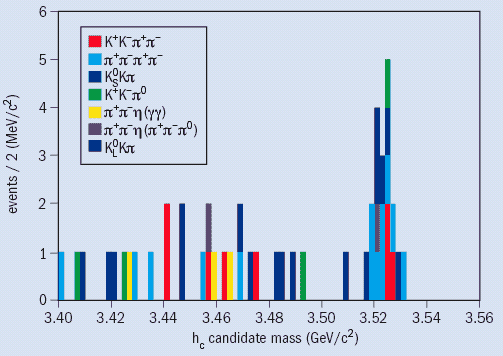
The inclusive hc signal sits on a considerable background. Further reduction of this background is possible if one reconstructs the decay of ηc into specific final states. The hc peak stands out quite distinctly under such circumstances (figure 3). This exclusive analysis yielded values of the hc mass and product branching fraction consistent with those of the inclusive measurement, but with slightly larger errors. However, as a result of the low background, the statistical significance of the exclusive measurement is higher than that of the inclusive measurement, providing a more conclusive observation of the existence of the hc. The combined inclusive and exclusive analyses yield M(hc) = 3524.4±0.6±0.4 MeV/c2 and Bψ’Bh (4.0±0.8±0.7) × 10-4, very close to theoretical expectations.
The hc thus lies at 1.0±0.6±0.4 MeV/c2 below the average 3PJ mass, supporting the QCD prediction and indicating little contribution from a long-range spin-dependent quark-confining force or coupled-channel effects, which could cause a displacement from this value. It is barely consistent with an interesting (but non-relativistic) bound that predicted the hc should lie no lower than 〈M(3PJ)〉 (Stubbe and Martin 1991).
An independent experiment at Fermilab, E835, has produced additional evidence that the hc is nearly degenerate with 〈M(3PJ)〉 (Andreotti et al. 2005). By forming hc candidates using collisions of antiprotons in the Accumulator Ring with protons in a gas-jet target, the E835 Collaboration found 13 candidates for the process pbarp →hc → γgηc → γ(γγ). Utilizing the carefully controlled energy of the antiproton, the team found M(hc) = 3525.8±0.2 0.2 MeV/c2 and a decay width Γ <1 MeV.
The CLEO Collaboration plans to collect more ψ(2S) data, enabling a better measurement of the hc mass and production rate. It is hoped that the predictions of lattice gauge theories will keep pace with these improvements.
Further discoveries
The hc is not the only new charmonium state below charmed threshold to which CLEO has contributed substantially. Several years ago, the Belle Collaboration observed a candidate for ηc(2S) in B→ K(KSKπ) (Choi et al. 2002) and e+e– → J/ψ + X (Abe et al. 2002), the mass of which was incompatible with that of the previously claimed observation. By studying its production in photon-photon collisions, the CLEO collaboration has confirmed the presence of this state (Asner et al. 2004), as has the BaBar Collaboration. The mass of the ηc(2S) is found to be only 48±5 MeV/c2 below the corresponding spin-triplet ψ(2S) state, a hyperfine splitting that is considerably less than the difference of 117 MeV/c2 seen in the 1S charmonium states, that is, between the J/ψ and the ηc(1S). This difference may well be due to the proximity of the charmed meson-pair threshold, which can lower the mass of the ψ(2S) by tens of MeV/c2.
Researchers at the CLEO Collaboration found that the product Γ(ηc(2S) → γγ)B(ηc(2S) → KSKπ) is only 0.18±0.05±0.02 times the corresponding product for ηc(1S). This could pose a problem for descriptions of charmonium if the branching ratios to KSKπ are equal. More likely, the heavier ηc(2S) has more decay modes available to it, so its branching ratio to KSKπ is likely to be less than that of the hc(1S).
Altogether it is remarkable that more than 30 years after the first discovery, charmonium continues to yield new information and new challenges to elementary-particle physics, thanks to improvements in collider luminosities and detector capabilities. Recent advancements include surprises from charmonium spectroscopy above charm threshold to which CLEO is also contributing.
With the recent discoveries of the hc and the ηc(2S), all of the expected bound states below charm threshold have now been observed. With the exception of the mass of the ηc(2S), the observed masses and branching fractions are in quantitative agreement with theoretical expectations, while the lower-than-expected ψ(2S) – ηc(2S) mass splitting stresses the importance of the nearby DDbar- threshold. The quantitative agreement between theory and experiment for the states below charm threshold provide a firm foundation for developing an understanding of the new states found above the threshold.
The D0 collaboration at Fermilab has published the first direct two-sided bound on the oscillation frequency of the B0s, the meson comprising a strange quark (s) and a bottom antiquark (Bbar). The result is consistent with what is expected from the Standard Model, within a 90% confidence level. The phenomenon in which a B0d meson (with a down quark, d, instead of the strange quark) converts into its antiparticle Bbar0d is well established, and its oscillation frequency Δmd has been measured precisely (Heavy Flavour Averaging Group 2006). The value of the corresponding measure of the oscillation frequency of a B0s meson into its antiparticle Bbar0s – Δms – was until now much more poorly known.
The D0 collaboration is an international team of 700 physicists from 90 institutions and 20 countries working at Fermilab’s Tevatron, which provides high-energy proton-antiproton collisions for two experiments, D0 and CDF. The data for the D0 result were taken from 1 fb-1 of total collision data, yielding more than a billion events (Abazov et al. 2006). The 90% confidence level means that the result does not qualify as a discovery, although it does provide a very strong indication. However, according to Rob Roser, co-spokesperson of CDF, within the next month or so the CDF collaboration should provide a result with greater precision.
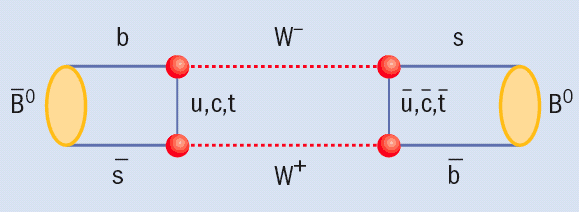
The D0 result already provides some interesting constraints on supersymmetry. “The D0 value of 17 < Δms < 21 ps-1 limits the contributions to the oscillation process that could be made by supersymmetric particles,” explains D0 co-spokesperson Terry Wyatt, from the University of Manchester. “The basic idea is that supersymmetric particles may be exchanged in the box diagrams that are responsible for B0s mixing.” Several theoretical models of supersymmetry predict a much faster oscillation of B0s, and the D0 result now disfavours these models.
To provide the best experiences, we use technologies like cookies to store and/or access device information. Consenting to these technologies will allow us to process data such as browsing behavior or unique IDs on this site. Not consenting or withdrawing consent, may adversely affect certain features and functions.
Functional
Always active
The technical storage or access is strictly necessary for the legitimate purpose of enabling the use of a specific service explicitly requested by the subscriber or user, or for the sole purpose of carrying out the transmission of a communication over an electronic communications network.
Preferences
The technical storage or access is necessary for the legitimate purpose of storing preferences that are not requested by the subscriber or user.
Statistics
The technical storage or access that is used exclusively for statistical purposes.The technical storage or access that is used exclusively for anonymous statistical purposes. Without a subpoena, voluntary compliance on the part of your Internet Service Provider, or additional records from a third party, information stored or retrieved for this purpose alone cannot usually be used to identify you.
Marketing
The technical storage or access is required to create user profiles to send advertising, or to track the user on a website or across several websites for similar marketing purposes.