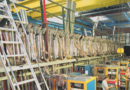
Read article 'Accident ruins major detector'
Accident ruins major detector
On 12 November, thousands of photomultipliers imploded in the huge Superkamiokande detector in Japan, which has produced important results on neutrino physics.
Thank you for registering
If you'd like to change your details at any time, please visit My account
Read article 'Accident ruins major detector'
On 12 November, thousands of photomultipliers imploded in the huge Superkamiokande detector in Japan, which has produced important results on neutrino physics.
Read article 'BES accumulates 51 million J/psi events'
While plans to update the Beijing Electron-Positron Collider (BEPC) and the Beijing Spectro-meter (BESII) experiment go ahead, the BES experiment has completed its second highly successful run at t...
Read article 'DELPHI goes home to Delphi'
Although CERN's LEP electron-positron collider finished operating in November 2000, analysis of the enormous amount of data it produced will continue for some time.
Read article 'Specialists re-evaluate transition radiation'
Transition radiation is playing an increasingly important role in the armoury of detection techniques for particle physics.
Read article 'Aging workshop provides a useful review of the long-term use of gaseous detectors'
Detectors, like people, encounter problems as they get older.
Read article 'Channelling produces new sources of positrons'
For future electron-positron linear colliders, high-intensity electron and positron beams are needed.
Read article 'Arctic Circle maintains the freshness of ancient physics'
A recent meeting underlined the continual freshness of studying the ancient history of the universe.
Read article 'Why do high-energy collisions contrive to produce so few particles most of the time?'
The collisions produced by the new generation of high-energy hadron machines - Fermilab's revamped Tevatron for protons on antiprotons, Brookhaven's RHIC for heavy ions and CERN's LHC for protons and...
Read article 'Antares detector deployment progress is on target for 2004'
The Antares undersea neutrino experiment, scheduled for deployment 2400 m down in the Mediterranean off the south coast of France, successfully laid its sea cable at the beginning of October.
Read article 'Astronomers celebrate sight of two million year old ‘baby’'
A very small, faint galaxy more than 13.4 billion light-years from Earth is creating a great deal of excitement among astronomers. This protogalaxy, which is just 500 light-years across (a two-hundred...