Read article 'WASA finds a new home at COSY'
WASA finds a new home at COSY
The Wide Angle Shower Apparatus (WASA) detector, currently at the CELSIUS facility of The Svedberg Laboratory (TSL) in Uppsala, Sweden, is to find a new home.

 Read article 'WASA finds a new home at COSY'
The Wide Angle Shower Apparatus (WASA) detector, currently at the CELSIUS facility of The Svedberg Laboratory (TSL) in Uppsala, Sweden, is to find a new home.
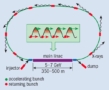 Read article 'Cornell gets funding for brighter X-rays'
The US National Science Foundation (NSF) has awarded Cornell University $18 million to begin developing a high-brilliance, high-current Energy Recovery Linac (ERL) synchrotron radiation X-ray source.
 Read article 'Radio astronomers observe a possible dark-matter galaxy'
An international team of astronomers has discovered what appears to be an invisible galaxy made almost entirely of dark matter – the first ever detected. The mystery galaxy, VIRGOHI21, lies in t...
 Read article 'CMS cavern ready for its detector'
On 1 February 2005, the cavern for the CMS detector at CERN was inaugurated in a ceremony attended by many guests, including the Spanish and Italian ambassadors to the United Nations and representativ...
 Read article 'Celebratory year lifts off in Paris'
More than 1000 people including eight Nobel laureates and close to 500 students from 70 countries took part in the Physics for Tomorrow conference in Paris on 13 January.
 Read article 'Balloon experiment searches for antiparticles above the Antarctic'
The Balloon-borne Experiment with Superconducting Spectrometer (BESS) launched a cosmic-ray spectrometer from Antarctica on 13 December.
 Read article 'CAST sheds some light on axions'
The CERN Axion Solar Telescope (CAST) collaboration has released the first results from its search for the solar axion, a viable candidate for a dark-matter particle.
Read article 'Countries sign up to XFEL agreement'
A milestone has been reached on the way towards the realization of the European X-ray Free Electron Laser facility (XFEL).
 Read article 'AD stores record number of antiprotons'
A new technique for cooling antiprotons has been tested at CERN's Antiproton Decelerator (AD), yielding 50 times more trapped antiprotons per cycle than ever before.
 Read article 'ATRAP tests new way to make antihydrogen'
The new method consists of exciting caesium atoms from an oven with two lasers, and then introducing the caesium into a positron trap.