Comsol -leaderboard other pages

Topics

BICEP crunches primordial gravitational waves 

The BICEP/Keck collaboration has published the strongest constraints to date on primordial gravitational waves, ruling out parameter space for models of inflation in the early universe (Phys. Rev. Lett. 2021 127 151301). A conjectured rapid expansion of the universe during the first fraction of a second of its existence, inflation was first proposed in the early 1980s to explain the surprising uniformity of the universe over scales which should not otherwise have been connected, and may have left an imprint in the polarisation of the cosmic-microwave background (CMB). Despite a high-profile false detection of gravitational-wave-induced “B-modes” by BICEP in 2014, which was soon explained as a mis-modelling of the galactic-dust foreground, the search for primordial gravitational waves remains one of the most promising avenues to study particle physics at extremely high energies, as inflation is thought to require a particle-physics explanation such as the scalar “inflaton” field proposed by Alan Guth.

Certain ‘standard’ types of inflation are now clearly disfavoured

Kai Schmitz

In its latest publication, the BICEP/Keck collaboration has managed to significantly improve the upper bound on the strength of gravitational waves produced during the epoch of inflation. “This is important for theorists because it further constrains the allowed range of viable models of inflation, and certain ‘standard’ types of models are now clearly disfavoured,” explains CERN theorist Kai Schmitz. “It’s also a great experimental achievement because it demonstrates that the sources of systematic uncertainties such as dust emission in our Milky Way are under good control. That’s a good sign for future observations.”

The BICEP/Keck collaboration searches for the imprint of gravitational waves in the polarisation pattern of the CMB, emitted 380,000 years after the Big Bang. Telescopes at the South Pole receive incoming CMB photons and focus them through plastic lenses onto detectors in the focal plane which are cooled to 300 mK, explains principal investigator Clem Pryke of the University of Minnesota. As the telescopes scan the sky they record the tiny changes in temperature due to  the intensity of the incoming microwaves. The detectors are arranged in pairs with each half sensitive to one of two orthogonal linear polarisation components. The telescopes take their best data during the six-month long Antarctic night, during which intrepid “winter-overs” maintain the detectors and upload data via satellite to the US for further analysis.

“The big change since 2014 was to make measurements in multiple frequency bands to allow the removal of the galactic foreground,” says Pryke. “Back then we had data only at 150 GHz and were relying on models and projections of the galactic foreground – models which turned out to be optimistic as far as the dust is concerned. Now we have super-deep maps at 95, 150 and 220 GHz allowing us to accurately remove the dust component.”

The current analysis uses data recorded by BICEP2, the Keck Array and BICEP3 up to 2018. Since then, the collaboration has installed a new more capable telescope platform called the BICEP Array designed to increase sensitivity to primordial gravitational waves by a factor of three, in collaboration with a large-aperture telescope at the South Pole called SPT3G. With 21 telescopes at the South Pole and in the Chilean Atacama desert, the proposed CMB Stage-4 project plans to improve sensitivity by a further factor of six in the 2030s.

Miguel Virasoro 1940–2021

Miguel Virasoro 1940-2021

On 23 July, the Italian–Argentinian theorist Miguel Ángel Virasoro, one of the founders of string theory and an initiator of complexity studies, passed away. His scientific contributions were outstanding and stimulated an impressive number of subsequent developments. He was an extraordinarily intelligent visionary with a great sense of humour.

Born in Buenos Aires in 1940, Virasoro enrolled in physics at the University of Buenos Aires in 1958. However, in 1966 General Juan Carlos Onganía successfully led a coup d’état in Argentina, establishing a dictatorship that would last until 1973. The faculty of science at Buenos Aires became a centre of opposition: the police broke into the university, massacring the occupants. In the following months, some 300 professors emigrated abroad.

Virasoro finished his thesis working from home; at the end of 1966, as soon as he obtained his doctorate, he moved to the Weizmann Institute, Israel, invited by a newly appointed young Argentinian professor, Hector Rubinstein. A few months earlier, Gabriele Veneziano had also arrived as a graduate student. The three of them, together with Marco Ademollo, began a long series of investigations into the physics of strong interactions that eventually led to string theory. Although the first step towards string theory was Veneziano’s “open-string” model in 1968, those preliminary results established the conceptual framework in which Veneziano’s model could be conceived. A few months later, stimulated by Veneziano’s work, Virasoro extended it to a model describing closed strings.

The Virasoro condition

In the following years, first at the University of Wisconsin, then at Berkeley, Virasoro did brilliant work on string theory. In 1969 he made the fundamental observation that string theory could only be made free of pathologies by fixing a certain parameter. This “Virasoro condition” allowed for the existence of an infinite number of symmetries generated by an infinite set of operators obeying a “Virasoro algebra” – a tool at the basis of countless subsequent studies. The Virasoro condition proved to be a killer for string theory as a description of strong interactions, but it opened the way to the 1974 Scherk–Schwarz reinterpretation of it as a quantum theory of gravity, in which one particular closed string corresponds to the graviton.

In 1973 democracy was restored in Argentina; Virasoro returned to his own country and was elected, still very young, dean of the faculty of science in Buenos Aires, a politically exposed position. In 1975 he accepted an invitation to spend a year at Princeton. During his stay in the US, however, Videla’s 1976 coup d’état brought dictatorship back to Argentina, in a more cruel form than before: many professors and students were slaughtered at the university. Virasoro was not only fired, but he was told that, had he returned to Argentina, he would be arrested or worse.

Virasoro was convinced of the role that theoretical physics could have in building the capacity of developing countries

He moved to Europe, and after a year in Paris, arrived in Italy, first in Turin and then, from 1981, at La Sapienza in Rome, where he remained for 30 years as a full professor, taking Italian citizenship. Having started to investigate the relationship between the emerging theory of quarks and gluons (QCD) and string theory, in 1983 he changed direction. He began to work with Giorgio Parisi on the statistical mechanics of complex systems, first with other Parisian physicists (Marc Mézard, Nicolas Sourlas and Gerard Toulouse) and then with Mézard alone, who had moved to Rome for two years. The group obtained important results on which the bases of the physical theory of complexity rest and also wrote a book on these results. In 1988 Virasoro became passionate about studying how, starting from neural networks, we can understand the functioning of the brain.

From 1995 to 2002 he was called to direct the International Centre for Theoretical Physics (ICTP) in Trieste. Sharing the vision of its founder Abdus Salam, Virasoro was convinced of the role that theoretical physics could have in building the capacity of developing countries. He decided to enlarge and diversify ICTP’s scientific programme. Within the condensed-matter group, he established a strong subgroup in statistical mechanics and its applications, which was the beginning of quantitative biology. He established a joint project with the Beijer Institute and the Fondazione Eni Enrico Mattei in environmental and ecological economics, and founded an ICTP group devoted to the physics of weather and climate. He also succeeded in rendering compulsory the Italian contribution to the ICTP, and securing a significant increase in the contribution in 2000.

Back in Rome, in the last years before his 2011 retirement, he worked on applications of physical theories to finance, an activity that he continued in Argentina, where he returned, at the Universidad Nacional de General Sarmiento. In 2009 he received the Enrico Fermi Prize from the Italian Physical Society and in 2020 was awarded the ICTP Dirac medal for his work on string theory.

Miguel Virasoro cherished the ability to use knowledge learned in one field to make progress on a different one, opening up new vistas. He will be sorely missed.

MicroBooNE homes in on the sterile neutrino

MicroBooNE

Excitement is building in the search for sterile neutrinos – long-predicted particles which would constitute physics beyond the Standard Model. Although impervious to the electromagnetic, weak and strong interactions, such a fourth “right-handed” neutrino flavour could reveal itself by altering the rate of standard-neutrino oscillations – tantalising hints of which were reported by Fermilab’s MiniBooNE experiment in 2007. In a preprint published last week, sibling experiment MicroBooNE strongly disfavours a mundane explanation for such hints, with further scrutiny by the collaboration expected to be announced later this month.

“If the MiniBooNE effect is indeed a sterile neutrino, this of course would be a major discovery which would revolutionise particle physics, opening up a whole new sector to explore,” says MicroBooNE co-spokesperson Justin Evans of the University of Manchester.

The story of the sterile neutrino began in the 1990s, when the ​​LSND experiment at Los Alamos reported seeing 88±23 (3.8σ) more electron antineutrinos than expected in a beam of accelerator-generated muon antineutrinos. This apparent short-baseline oscillation from muon to electron antineutrinos was incompatible with the oscillation rates established by Super-Kamiokande in 1998 and SNO in 2002, and would have to occur via an unknown intermediate neutrino flavour with a mass of about an electron-Volt. This hypothesised neutrino was dubbed sterile, as it would have to be insensitive to all interactions but gravity for it to have remained undiscovered this long.

The photon hypothesis

The plot thickened in 2007 when the MiniBooNE experiment at Fermilab tried to reproduce the LSND anomaly. The team also saw an excess of electron-like signals, though not quite at the energy corresponding to the LSND effect. The significance of the MiniBooNE anomaly grew to 4.5σ by the time the experiment finished running in November 2018. But a mundane possible explanation poured cold water on hopes for new physics: as a mineral-oil Cherenkov detector, MiniBooNE could not differentiate electrons from photons, and one particularly tricky-to-model background process might be contributing more photons than expected.

Many of us suspected that there could be something wrong with predictions for this background

Joachim Kopp

“High-energy single photons can be produced when a neutrino scatters on a nucleon via a neutral-current interaction and excites the nucleon to a Δ(1232) resonance,” explains CERN theorist Joachim Kopp. “Most of the time, the resonance decays to a pion and a nucleon, but there is a rare decay mode to a nucleon and a photon. The rate for this mode is very hard to predict, and many of us suspected that there could be something wrong with predictions for this background.”

Enter MicroBooNE, a liquid-argon time-projection-chamber sibling experiment to MiniBooNE which is capable of studying neutrino interactions in photographic detail, and differentiating the two signals. Having detected its first neutrino interactions in 2015, the MicroBooNE team has now set a limit on the neutral-current Δ→Nγ process is more than a factor of 50 better than existing constraints, explains Evans. “With this MicroBooNE result, we reject a Δ→Nγ model of the low-energy excess at 94.8% confidence, a strong indication that we must look elsewhere for the source of the excess.”

The electron hypothesis

Now that MicroBooNE has strongly disfavoured a leading-photon model for the MiniBooNE anomaly, attention shifts to the electron hypothesis – which would hint at the existence of a sterile neutrino, or something more exotic, if proven. And we don’t have long to wait. The MicroBooNE collaboration plans to release its search for an electron-like low-energy excess on 27 October, with results from three independent analyses looking at a range of inclusive and exclusive channels.

Beyond that, there is more to come, says Evans. “Our current round of results use only the first half of the total MicroBooNE data-set, and this is a programme that is only just beginning, with ICARUS and SBND within Fermilab’s short-baseline programme now coming online to turn this into a multi-baseline exploration of the richness of neutrino physics with unparalleled detail.”

The global picture is complex. In 2019, for example, the MINOS+ experiment failed to confirm the MiniBooNE signal (CERN Courier March/April 2019 p7). Were the sterile neutrino to exist, it should also have significant cosmological consequences which remain unobserved. But the anomalies are accumulating, says Kopp.

“LSND and MiniBooNE are quite consistent, and the short-baseline reactor experiments require parameters in the same region of parameter space, though these results are very much in flux and it’s not clear which ones are trustworthy, so it’s hard to make precise statements. The good news is that there’s realistic hope of resolving these puzzles over the next few years. ”

The inexplicable neutrino

Claustrophobia. South Dakota. A clattering elevator lowers a crew of hard-hat-clad physicists 1500 metres below the ground. 750,000 tonnes of rock are about to be excavated from this former gold mine at the Sanford Underground Research Facility (SURF) to accommodate the liquid-argon time projection chambers (TPCs) of the international Deep Underground Neutrino Experiment (DUNE). Towards the end of the decade, DUNE will track neutrinos that originate 1300 km away at Fermilab in Chicago, addressing leptonic CP violation as well as an ambitious research programme in astrophysics.

Having set the scene, director Geneva Guerin, co-founder of Canadian production company Cinécoop, cuts to a wide expanse: a climber scaling a rock face near the French–Swiss border. Francesca Stocker, the star of the film and then a PhD student at the University of Bern, narrates, relating the scientific method to rock climbing. Stocker and her fellow protagonists are engaging, and the film vividly captures the human spirit surrounding the birth of a modern particle-physics detector.

I don’t think it is possible to explain a neutrino for a general audience

Geneva Guerin

But the viewer is not allowed to settle for long in any one location. After zipping to CERN, and a tour through its corridors accompanied by eerie cello music, we meet Stocker in her home kitchen, explaining how she got interested in science as a child. Next, we hop to Federico Sánchez, spokesperson of the T2K experiment in Japan, explaining the basics of the Standard Model. 

Ghost Particle

T2K, and its successor Hyper-Kamiokande, DUNE’s equal in ambition and scope, both feature in the one-hour-long film. But the focus is on the development of the prototype DUNE detector modules that have been designed, built and tested at the CERN Neutrino Platform – and here the film is at its best. Guerin had full access to protoDUNE activities, allowing her to immerse the viewer with the peculiar but oddly fitting accompaniment of a solo didgeridoo inside the protoDUNE cryostat. We gatecrash celebrations when the vessel was filled with liquid argon and the first test-beam tracks were recorded. The film focuses on detailed descriptions of the workings of TPCs and other parts of the apparatus rather than accessible explanations of the neutrino’s fascinating and mysterious nature. Unformatted plots and graphics are pulled from various sources. While authentic, this gives the film an unpolished, home-made feel.

Given the density of the exposition in some parts, beyond the most enthusiastic popular-science fans, Ghost Particle seems best tailored for physics students encountering experimental neutrino physics for the first time – a point that Guerin herself made during a live Q&A following the CineGlobe screening: “I was aiming at people like me – those who love science documentaries,” she told the capacity crowd. “Originally I envisaged a three-part series over a decade or more, but I realised that I don’t think it is possible to explain a neutrino for a general audience, so maybe it’s something for educational purposes, to help future generations get introduced to this exciting programme.”

The film ends as it began, with the rickety elevator continuing its 12-minute descent into the bowels of the Earth.

Exploding myths about antimatter

Antimatter captivates the popular imagination. Beatriz Gato-Rivera, a former CERN fellow in theoretical physics and now a researcher at the Spanish National Research Council, recently published a noteworthy book on the subject, entitled Antimatter: What It Is and Why It’s Important in Physics and Everyday Life. Substantially extending her text Antimateria, from the outreach collection “Qué Sabemos De”, this work will also be of interest to experts, thanks to well documented anecdotes of historical interest.

Gato-Rivera sets out with a detailed exploration of the differences between atoms and antiatoms, as well as of matter–antimatter annihilation, motivating the reader to delve into a fairly complete introduction to particle physics: the concepts that underpin the Standard Model, and some that lie beyond. She then focuses on diverse aspects of antimatter science, beginning with the differences between antimatter, dark matter and dark energy, and the different roles they play in the universe. This touches upon the observed accelerating expansion of the universe. In particular, Gato-Rivera discusses dark-matter and dark-energy candidates, attempts to detect dark matter and its relation to the fate of the universe. She also carefully explains the distinction between primordial and secondary antimatter, and their roles in cosmology.

Antimatter by Gato-Rivera

Next up, a historical chapter reviews the major landmarks of the discovery of antimatter particles, from elementary antiparticles to anti-hadrons, and anti-nuclei to antiatoms. In particular, the ground-breaking discovery of the first antiparticle, the positron, is described in excellent detail. In a separate appendix, Gato-Rivera passionately clears up a historical controversy about its discovery. The positron was first found in cosmic rays by Carl Anderson and later artificially produced en masse in particle accelerators. Gato-Rivera then turns to a detailed historical overview of cosmic-ray research, from balloon experiments to large-scale ground-based detectors, finally culminating in modern space-based detectors on board satellites and the ISS. The next chapter covers the production of antimatter by particle collisions in accelerators at high energies, including a brief history of the facilities at CERN.

The focus is then put on one of the most interesting and important conundrums in particle physics and astrophysics: the apparent huge asymmetry between matter and antimatter in the observed universe. This touches upon the processes of the primordial creation of matter and antimatter, and on the open question of whether anti-stars, or even anti-galaxies, could exist somewhere in the universe. 

Gato-Rivera returns to Earth to discuss current experiments in particle physics such as those at CERN’s Antimatter Factory, asking whether antiatoms really have the same properties as atoms, at least as far as their excitation spectra and gravitational pull is concerned. The author doesn’t shy away from popular questions such as whether antimatter anti-gravitates and would float up away from Earth. While the answers to these questions are firmly predicted in theory, there could be surprises, like the discovery of CP violation in the 1950s, so it is important to actually test these fundamental properties.

Sceptical words dash hopes of using antimatter as an energy source

The book finishes by exploring practical uses of antimatter in everyday life, such as the use of PET scanners to detect positrons emitted from short-lived radioactive substances administered to patients. The same principle is also used in material analysis, for example to test the mechanical integrity of turbine blades. But sceptical words dash any hopes of using antimatter as an energy source: the effort of artificially producing a single gram of antimatter would be prohibitive.

Gato-Rivera’s semi-popular text is comprehensive and well structured, with a minimum of mathematical expressions and technicalities. It will be most profitable for a scientifically educated audience with an interest in particle physics, however, experienced researchers who are interested in the history of the subject will also enjoy reading it.

Breaking records at EPS-HEP

2021-EPS-HEP-Poster-WEB-final

In this year’s unusual Olympic summer, high-energy physicists pushed back the frontiers of knowledge and broke many records. The first one is surely the number of registrants to the EPS-HEP conference, hosted online from 26 to 30 July by the University of Hamburg and DESY: nearly 2000 participants scrutinised more than 600 talks and 280 posters. After 18 months of the COVID pandemic, the community showed a strong desire to meet and discuss physics with international colleagues. 

200 trillion b-quarks, 40 billion electroweak bosons, 300 million top quarks and 10 million Higgs bosons

The conference offered the opportunity to hear about analyses using the full LHC Run-2 data set, which is the richest hadron-collision data sample ever recorded. The results are breathtaking. As my CERN colleague Michelangelo Mangano explained recently to summer students, “The LHC works and is more powerful than expected, the experiments work and are more precise than expected, and the Standard Model works beautifully and is more reliable than expected.” About 3000 papers have been published by the LHC collaborations in the past decade. They have established the LHC as a truly multi-messenger endeavour, not so much because of the multitude of elementary particles produced – 200 trillion b-quarks, 40 billion electroweak bosons, 300 million top quarks and 10 million Higgs bosons – but because of the diversity of scientifically independent experiments that historically would have required different detectors and facilities, built and operated by different communities. “Data first” should always remain the leitmotif of the natural sciences. 

Paula Alvarez Cartelle (Cambridge) reminded us that the LHC has revealed new states of matter, with LHCb confirming that four or even five quarks can assemble themselves into new long-lived bound states, stabilised by the presence of two charm quarks. For theorists, these new quark-molecules provide valuable input data to tune their lattice simulations and to refine their understanding of the non-perturbative dynamics of strong interactions.

Theoretical tours de force

While Run 1 was a time for inclusive measurements, a multitude of differential measurements were performed during Run 2. Paolo Azzurri (INFN Pisa) reviewed the transverse momentum distribution of the jets produced in association with electroweak gauge bosons. These offer a way to test quantum chromodynamics and electroweak predictions at the highest achievable precision through higher-order computations, resummation and matching to parton showers. The work is fuelled by remarkable theoretical tours de force reported by Jonas Lindert (Sussex) and Lorenzo Tancredi (Oxford), which build on advanced mathematical techniques, including inspiring new mathematical developments in algebraic geometry and finite-field arithmetic. We experienced a historic moment: the LHC definitively became a precision machine, achieving measurements reaching and even surpassing LEP’s precision. This new situation also induced a shift more towards precision measurements, model-independent interpretations and Standard Model (SM) compatibility checks, and away from model-dependent searches for new physics. Effective-field-theory analyses are therefore gaining popularity, explained Veronica Sanz (Valencia and Sussex).

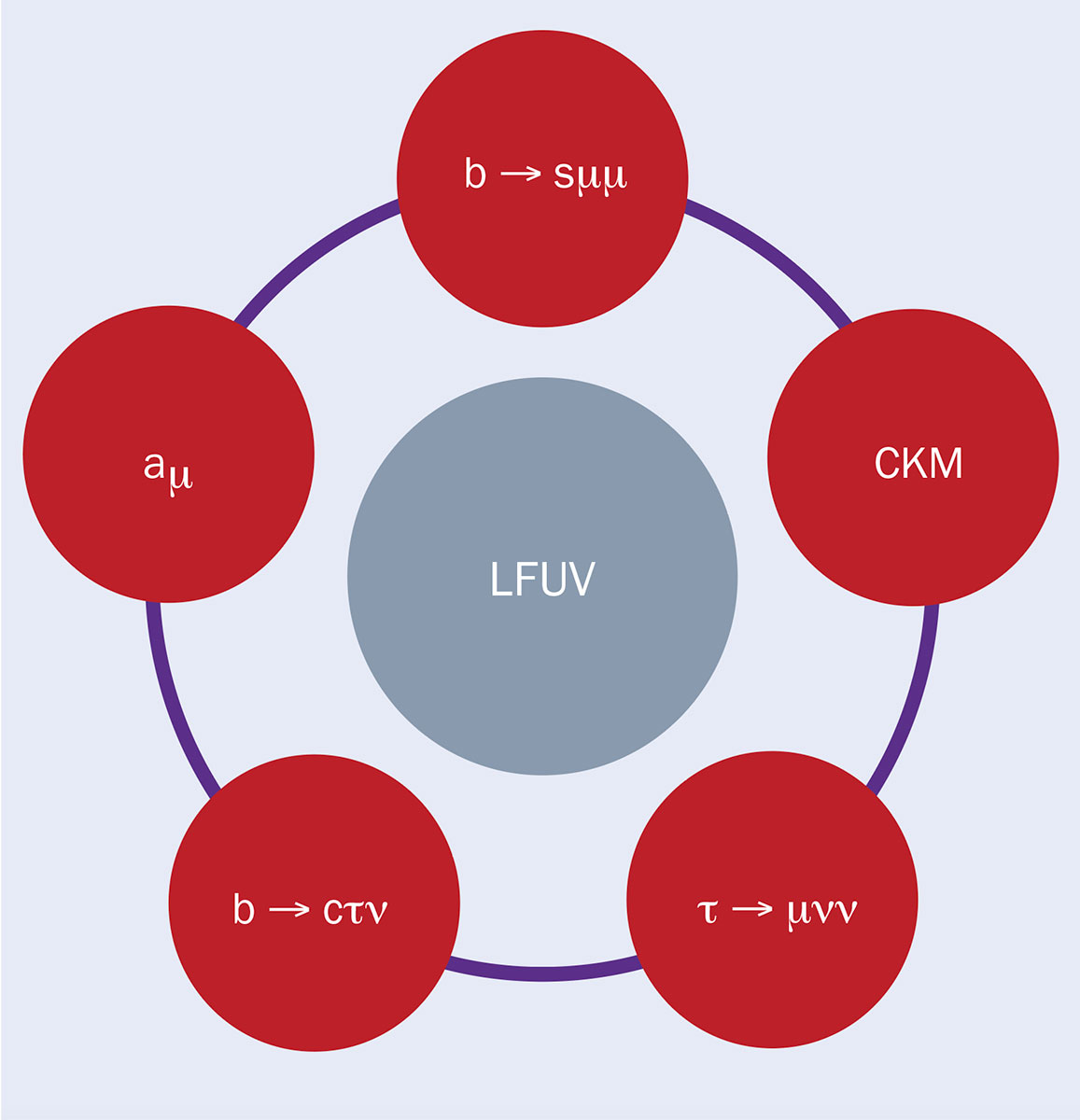
We know for certain that the SM is not the ultimate theory of nature. How and when the first cracks will be revealed is the big question that motivates future collider design studies. The enduring and compelling “B anomalies” reported by LHCb could well be the revolutionary surprise that challenges our current understanding of the structure of matter. The ratios of the decay widths of B mesons, either through charged or neutral currents, b→cℓν and b→sℓ+, could finally reveal that the electron, muon and tau lepton differ by more than just their masses.

The statistical significance of the lepton flavour anomalies is growing, reported Franz Muheim (Edinburgh and CERN), creating “cautious” excitement and stimulating the creativity of theorists like Ana Teixeira (Clermont-Ferrand), who builds new physics models with leptoquarks and heavy vectors with different couplings to the three families of leptons, to accommodate the apparent lepton-flavour-universality violations. Belle II should soon bring new additional input to the debate, said Carsten Niebuhr (DESY).

Long-awaited results

The other excitement of the year came from the long-awaited results from the muon g-2 experiment at Fermilab, presented by Alex Keshavarzi (Manchester). The spin precession frequency of a sample of 10 billion muons was measured with a precision of a few hundred parts per million, confirming the deviation from the SM prediction observed nearly 20 years ago by the E821 experiment at Brookhaven. With the current statistics, the deviation now amounts to 4.2σ. With an increase by a factor 20 of the dataset foreseen in the next run, the measurement will soon become systematics limited. Gilberto Colangelo (Bern) also discussed new and improved lattice computations of the hadronic vacuum polarisation, significantly reducing the discrepancy between the theoretical prediction and the experimental measurement. The jury is still out – and the final word might come from the g-2/EDM experiment at J-PARC.

Accelerator-based experiments might not be the place to prove the SM wrong. Astrophysical and cosmological observations have already taught us that SM matter only constitutes around 5% of the stuff that the universe is made of. The traditional idea that the gap in the energy budget of the universe is filled by new TeV-scale particles that stabilise the electroweak scale under radiative corrections is fading away. And a huge range of possible dark-matter scales opens up a rich and reinvigorated experimental programme that can profit from original techniques exploiting electron and nuclear recoils caused by the scattering of dark-matter particles. A front-runner in the new dark-matter landscape is the QCD axion originally introduced to explain why strong interactions do not distinguish matter from antimatter. Babette Döbrich (CERN) discussed the challenges inherent in capturing an axion, and described the many new experiments around the globe designed to overcome them.

Progress could also come directly from theory

Progress could also come directly from theory. Juan Maldacena (IAS Princeton) recalled the remarkable breakthroughs on the black-hole information problem. The Higgs discovery in 2012 established the non-trivial vacuum structure of space–time. We are now on our way to understanding the quantum mechanics of this space–time.

Like at the Olympics, where breaking records requires a lot of work and effort by the athletes, their teams and society, the quest to understand nature relies on the enthusiasm and the determination of physicists and their funding agencies. What we have learnt so far has allowed us to formulate precise and profound questions. We now need to create opportunities to answer them and to move ahead.

One cannot underestimate how quickly the landscape of physics can change, whether the B-anomalies will be confirmed or whether a dark-matter particle will be discovered. Let’s see what will be awaiting us at the next EPS-HEP conference in 2023 in Hamburg – in person this time!

African physicists begin strategy process

The African Strategy for Fundamental and Applied Physics

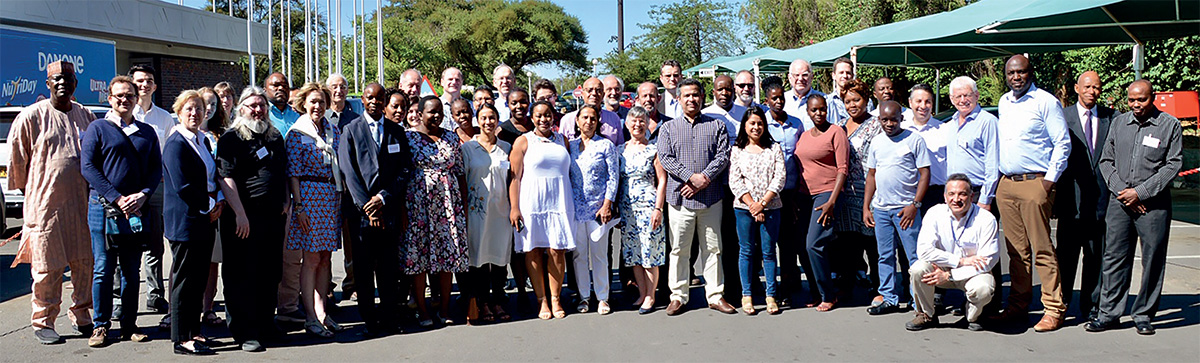
Africa’s science, innovation, education and research infrastructures have over the years been undervalued and under-resourced. This is particularly true in physics. The African Strategy for Fundamental and Applied Physics (ASFAP) initiative aims to define the education and physics priorities that can be most impactful for Africa. The first ASFAP community town hall was held from 12 to 15 July. The event was virtual, with 147 people participating, including international speakers and members of the ASFAP community. The purpose of the meeting was to initiate a broad and community-driven discussion and action programme, leading to a final strategy document in two to three years’ time.

The first day began with an overview of the ASFAP by Simon Connell (University of Johannesburg) on behalf of the steering committee and addresses by Shamila Nair-Bedouelle (UNESCO assistant director-general for natural sciences), Sarah Mbi Enow Anyang Agbor (African Union commissioner for human resources, science and technology) and Raissa Malu (member of the Democratic Republic of Congo’s Presidential Panel to the African Union). These honoured guests encouraged delegates to establish a culture of gender balance in African physics. Later, in a dedicated forum for women in physics, Iroka Chidinma Joy (chief engineer at the National Space Research and Development Agency) noted that women are drastically underrepresented in scientific fields across the continent, and pointed out a number of cultural, religious and social barriers that prevent women from pursuing higher education. Barriers can come as early as primary education: in most cases, girls are not encouraged to take leading roles in conducting science experiments in classrooms. Improved strategies should include outreach, mentorship, dedicated funding for women, the removal of age limits for women wishing to conduct scientific research or further their education, and awards and recognition for women who excel in scientific fields. 

Community-driven

Representatives of scientific organisations such as the African Physical Society, the Network of African Science Academies and the African Academy of Science all presented messages of support for ASFAP, and delegates from other regions, including Japan, China, India, Europe, the US and Latin America, all presented their regional strategies. The consensus is that strategic planning should be a bottom-up and community-driven process, even if this means it may take two to three years to produce a final report. 

The meeting was updated on the progress of a diverse and well-established range of working groups (WGs) on accelerators, astrophysics and cosmology; computing and the fourth industrial revolution (4IR); energy needs for Africa; instrumentation and detectors; light sources; materials physics; medical physics; nuclear physics; particle physics; and community engagement (CE), which comprises physics education (PE), knowledge transfer, entrepreneurship and stakeholder and governmental-agency engagement. The WGs must also maintain dynamic communications with each other as key topics often impact multiple working groups.

Marie Clémentine Nibamureke (University of Johannesburg) highlighted the importance of the CE WG’s vision “to improve science education and research in African countries in order to position Africa as a co-leader in science research globally”. Convener Jamal Mimouni (Mentouri University) stressed that for ASFAP to establish a successful CE programme, it is crucial to reflect on challenges in teaching and learning physics in Africa – and on why students may be reluctant to choose physics as their study field. Nibamureke explained that the CE WG is seeking to appoint liaison officers between all the ASFAP working groups. Sam Ramaila (University of Johannesburg), representing the PE WG, indicated four main points the group has identified as crucial for the transformation and empowering of physics practices in Africa: strengthening teacher training; developing 21st-century skills and competences; introducing the 4IR in physics teaching and learning; and attracting and retaining students in physics programmes. Ramaila identified problem-based learning, self-directed learning and technology-enhanced learning as new educational strategies that could make a difference in Africa if applied more widely. 

On the subject of youth engagement, Mounia Laassiri (Mohammed V University) led a young-person’s forum to discuss the major issues young African physicists face in their career progression: outreach, professional development and networking will be a central focus for this new forum going forwards, she explained, and the forum aims to encourage young physics researchers to take up leadership roles. So far, there are about 40 members of the young-people’s forum. Laassiri explained that the long-term vision, which goes beyond ASFAP, is to develop into an association of young physicists affiliated to the African Physical Society.

We are now soliciting inputs for the development of the African Strategy for Fundamental and Applied Physics

The ability to generate scientific innovation and technological knowledge, and translate this into new products, is vital for a society’s economic growth and development. The ASFAP is a key step towards unlocking Africa’s potential. We are now soliciting inputs for the development of the African Strategy for Fundamental and Applied Physics. Letters of interest may be submitted by individuals, research groups, professional societies, policymakers, education officials and research institutes on anything they think is an issue, needs to be improved, or is important for fundamental or applied physics education and research in Africa.

10th anniversary for HASCO school

The 10th International Summer School on Hadron Collider Physics (HASCO) took place at the University of Göttingen from 18 to 26 July. After more than a year of lockdown and social isolation, we wanted to again give our young students the opportunity to attend courses and ask questions in person, meet international students of similar age, and junior and senior scientists from the particle-physics community. The school welcomed 40 undergraduate students and lecturers virtually and 50 in person. For the latter group, a highlight was a historical walkabout to the private houses of Max Born, Werner Heisenberg, Emmy Noether, Maria Goeppert-Mayer, David Hilbert, Richard Courant, James Franck and Max Planck. Students spent a week in discussion with lecturers from the University of Göttingen, partner universities and CERN. The focus was on the fundamentals of quantum field theory and current issues in hadron-collider physics, including quantum chromodynamics and jets, statistical methods of data analysis, the top quark, supersymmetry and the Higgs boson. A special focus this year was on machine learning and artificial intelligence.

Learning to detect new top-quark interactions

Figure 1

Ever since its discovery in 1995 at the Tevatron, the top quark has been considered to be a highly effective probe of new physics. A key reason is that the last fundamental fermion predicted by the Standard Model (SM) has a remarkably high mass, just a sliver under the Higgs vacuum expectation value divided by the square root of two, implying a Yukawa coupling close to unity. This has far-reaching implications: the top quark impacts the electroweak sector significantly through loop corrections, and may couple preferentially to new massive states. But while the top quark may represent a window into new physics, we cannot know a priori whether new massive particles could ever be produced at the LHC, and direct searches have so far been inconclusive. Model-inde­pendent measurements carried out within the framework of effective field theory (EFT) are therefore becoming increasingly important as a means to make the most of the wealth of precision measurements at the LHC. This approach makes it possible to systematically correlate sparse deviations observed in different measurements, in order to pinpoint any anomalies in top-quark couplings that might arise from unknown massive particles.

The top quark impacts the electroweak sector significantly through loop corrections

A new CMS analysis searches for anomalies in top-quark interactions with the Z boson using an EFT framework. The cross-section measurements of the rare associated production of either one (tZ) or two (ttZ) top quarks with a Z boson were statistically limited until recently. These interactions are among the least constrained by the available data in the top-quark sector, despite being modified in numerous beyond-SM models, such as composite Higgs models and minimal supersymmetry. Using the full LHC Run-2 data set, this study targets high-purity final states with multiple electrons and muons. It sets some of the tightest constraints to date on five generic types of EFT interactions that could substantially modify the characteristics of associated top-Z production, while having negligible or no effect on background processes.

Machine learning

In contrast to the more usual reinterpretations of SM measurements that require assumptions on the nature of new physics, this analysis considers EFT effects on observables at the detector level and constrains them directly from the data using a strategy that combines observables specifically selected for their sensitivity to EFT. The key feature of this work is its heavy use of multivariate-analysis techniques based on machine learning, which improve its sensitivity to new interactions. First, to define regions enriched in the processes of interest, a multiclass neural network is trained to discriminate between different SM processes. Subsequently, several binary neural networks learn to separate events generated according to the SM from events that include EFT effects arising from one or more types of anomalous interactions. For the first time in an analysis using LHC data, these classifiers were trained on the full physical amplitudes, including the interference between SM and EFT components.

The binary classifiers are used to construct powerful discriminant variables out of high-dimensional input data. Their distributions are fitted to data to constrain up to five types of EFT couplings simultaneously. The widths of the corresponding confidence intervals are significantly reduced thanks to the combination of the available kinematic information that was specifically chosen to be sensitive to EFT in the top quark sector. All results are consistent with the SM, which indicates either the absence of new effects in the targeted interactions or that the mass scale of new physics is too high to be probed with the current sensitivity. This result is an important step towards the more widespread use of machine learning to target EFT effects, to efficiently explore the enormous volume of LHC data more globally and comprehensively.

Bs decays remain anomalous

Figure 1

The LHCb experiment recently presented new results on the b → sμμ decay of a Bs meson to a φ meson and a dimuon pair, reinforcing an anomaly last reported in 2015 with improved statistics and theory calculations. Such decays of b hadrons via b → s quark transitions are strongly suppressed in the Standard Model (SM) and therefore constitute sensitive probes for hypothetical new particles. In recent years, several measurements of rare semileptonic b → sℓℓ decays have shown tensions with SM predictions. Anomalies have been spotted in measurements of branching fractions, angular analyses and tests of lepton flavour universality (LFU), leading to cautious excitement that new physics might be at play.

Calculating the Standard Model prediction is more challenging than for lepton-flavour universality

At the SM@LHC conference in April, LHCb presented the most precise determination to date of the branching fraction for the decay using data collected during LHC Run 1 and Run 2 (figure 1). The branching fraction is measured as a function of the dimuon invariant mass (q2) and found to lie below the SM prediction at the level of 3.6 standard deviations in the low-q2 region. This deficit of muons is consistent with the pattern seen in LFU tests of b → sℓℓ transitions, however calculating the SM prediction for the Bs→ φμμ branching fraction is more challenging than for LFU tests as it involves the calculation of non-perturbative hadronic effects. 

Calculations based on light-cone sum rules are most precise at low q2, while lattice-QCD calculations do better at high q2. A combination is expected to give the best precision over the full q2 range. If lattice-QCD calculations are not used in the comparison, increased theory errors reduce the tension to 1.8 standard deviations in the low-q2 region. The previous 2015 measurement by LHCb, which was based exclusively on Run-1 data (grey data points), was reported at the time to be approximately three standard deviations below the best theoretical predictions that were available at the time. Since then, theo­retical calculations have generally become more precise with regard to form factors, but more conservatively evaluated with regard to non-local hadronic effects.

Figure 2

Angular information

The angular distribution of the Bs→ φμμ decay products offers complementary information. At the international FPCP conference in June, LHCb presented a measurement of the angular distribution of these decays in different q2 regions using data collected during LHC Run 1 and Run 2. Figure 2 shows the longitudinal polarisation fraction FL – one of several variables sensitive to anomalous b → sμμ couplings. The results are consistent with SM predictions at the level of two standard deviations, but may also hint at the same pattern of unexpected behaviour seen in angular analyses of other b → sμμ decays and in branching-fraction measurements.

For both analyses, LHC Run 3 will be crucial to better understanding the anomalous behaviour seen so far in Bs→ φμμ decays.

bright-rec iop pub iop-science physcis connect