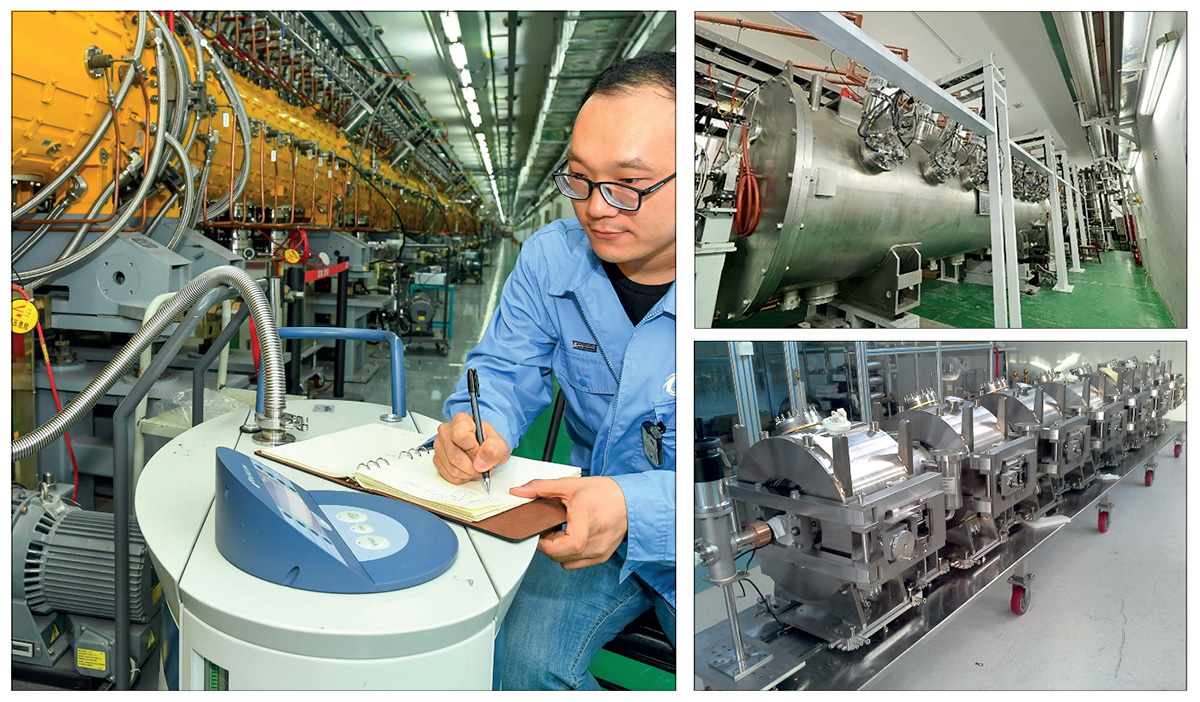
Experimentalist Volker Soergel passed away on 5 October at the age of 91. Born in Breslau in March 1931, Soergel was a brilliant experimental physicist and an outstanding leader, shaping particle physics for many years.
Receiving a doctorate from the University of Freiburg in 1956 under the tutelage of Wolfgang Gentner, Soergel remained at Freiburg until 1961, with a year at Caltech in 1957–1958. He then joined CERN as a research associate, working with Joachim Heintze on the beta decay of elementary particles, especially very rare decays of mesons and hyperons. Their results became milestones in the development of the Standard Model, resulting in the award of the German Physical Society’s highest honour in 1963.
In 1965 Soergel became a professor at the University of Heidelberg. He continued his research at CERN while taking on important roles at the university: as director of the Institute of Physics, as dean and as a member of the university’s administrative council. With vision and skill, he played a major role in shaping the university.
Important tasks outside Heidelberg followed. From 1976–1979 he chaired the DESY Scientific Council through a period that saw work begin on the electron–positron collider, PETRA. Under his leadership, the council played an important role in DESY’s transition from national to international laboratory. In 1979 and 1980 he served as research director at CERN, helping pave the way for the collider experiments of the 1980s.
From 1981–1993 Soergel headed DESY, overseeing construction of the electron–proton storage ring, HERA, together with Björn Wiik and Gustav-Adolph Voss. HERA and its experiments benefited from large international contributions, mainly in the form of components and manpower: an approach that became known as the HERA model. Soergel’s powers of persuasion, his reputation, and his negotiating skills led to support from institutes in Western Europe, Israel and Canada, as well as from Poland, Russia and China. From 1996–2000 he headed the Max Planck Institute for Physics in Munich. Under his guidance, photon science became an important pillar of DESY research, first as a by-product of accelerators used for particle physics, then, with the inauguration of HASYLAB in 1981 and the conversion of DORIS, as an established research field that continues strongly to this day.
Soergel’s time at DESY coincided with German reunification. He enabled the merger of the Institute for High Energy Physics in Zeuthen, near Berlin, with DESY and, together with Paul Söding, made Zeuthen a centre for astroparticle physics. Even before the Iron Curtain fell, Soergel personally ensured that Zeuthen scientists could work at DESY.
Volker Soergel received many honours. He was awarded the Federal Cross of Merit, 1st class, and honorary doctorates from the universities of Glasgow and Hamburg. He has left a lasting legacy. His love for physics was similar in intensity to his love for music. A gifted violin and viola player, he enjoyed making music with his wife and children, friends and colleagues. All who worked with him remain grateful for all they learned from him and will not forget his support and guidance.
Renowned high-energy theorist Nicola Najib Khuri died on 4 August 2022 in New York City. Born in 1933 in Beirut, Lebanon he was the eldest of four siblings and a precocious student. He graduated from the American University of Beirut (AUB) in 1952 at the age of 19, then travelled to the US for his graduate studies in physics. He received his MA and PhD from Princeton University and was a fellow of Princeton’s Institute for Advanced Study. While in graduate school, he met Elizabeth Tyson, the love of his life and wife of over 60 years. Upon receiving his doctorate in 1957, Nicola returned to Lebanon and joined the faculty at AUB. In 1964 he went back to the US and accepted a position at The Rockefeller University, New York, where he founded a lab and remained for the rest of his career.
Nicola was a leading authority on the use of mathematics in high-energy theoretical physics. At Rockefeller, his research focused on the mathematical description of elementary-particle collisions. Among his most notable achievements were the introduction of a new method to study the Riemann hypothesis, one of the last unsolved problems in mathematics, and the foundation of the field of potential scattering theory, which led to the development of important concepts such as Regge poles and strings.
In addition to his post at Rockefeller, he held visiting appointments and consulting roles at CERN, Stanford University, Columbia University, Lawrence Livermore National Laboratory, Brookhaven National Laboratory and Los Alamos National Laboratory. He was also a member of the panel on national security and arms control of the Carnegie Endowment for International Peace and a fellow of the American Physical Society.
Nicola and Liz, along with their two children, built a beautiful life in New York. Their homes had a revolving door for friends, family, colleagues and mentees who came from far and wide to hear Nicola’s remarkable stories, take in his sage advice, and enjoy his timeless, occasionally risqué jokes. A true cosmopolitan, he relished the vibrancy and possibility of New York. When not at home, he could be found ordering mezze for the table at one of his favourite Lebanese restaurants, exploring his interest in international politics at the Council on Foreign Relations, or making a toast at the Century Association. He retained an enduring love for, and a fundamental commitment to, Lebanon. He was a passionate supporter of his alma mater, a mentor to generations of young scientists from the Middle East, and was instrumental in establishing the university’s Center for Advanced Mathematical Sciences, among many other contributions.
There are many things we will miss about Nicola: his character; the way he commanded a room; his childlike sense of humour; the happy gleam in his eye when he told a story from his adventurous life; and his sneaky determination in old age to satisfy a lifelong appetite for good wine, good cheese and excellent chocolate over the protests of doctors, caregivers and his daughter, Suzanne. Above all, we will miss the way he treated others.
Valery Rubakov, who pioneered groundbreaking ideas and methods in many domains of particle physics and cosmology, passed away suddenly on 19 October at the age of 67.
Born in Moscow in 1955, Valery studied physics at Moscow State University from 1972–1978. He started doing research in his third year of studies, publishing his first paper at the age of 21 on the topic of quantum gravity. Valery joined the Institute for Nuclear Research (INR) of the Russian Academy of Sciences in 1978, defending his PhD on the non-perturbative aspects of gauge theories in 1981. At the age of 26, Rubakov had already made his name in global high-energy physics. He discovered that the ’t Hooft–Polyakov super-heavy magnetic monopoles that exist in grand-unified theories “catalyse” proton decay – a beautiful and subtle non-perturbative effect that provides alternative experimental signatures in the search of monopoles.
Valery was one of the first physicists to realise the importance of inflationary theory, his 1982 work with Mikhail Sazhin and Alexey Veryaskin on the primordial production of gravitational waves establishing important constraints on the energy scale of the de-Sitter stage of inflation. In 1983 Rubakov (together with Mikhail Shaposhnikov) proposed alternatives to Kaluza–Klein compactification in theories with more than four space–time dimensions – one of which is now known as the brane-world scenario, where the particles of our world live on a four-dimensional defect embedded in a higher-dimensional universe.
He produced key contributions towards the understanding of the baryon asymmetry of the universe. His paper in 1985 with Vadim Kuzmin and Shaposhnikov revealed that non-perturbative processes can drive a rapid violation of baryon- and lepton-number conservation in the early universe – the basic ingredient of thermal leptogenesis. In 1998, together with Evgeny Akhmedov and Alexey Smirnov, he suggested how to produce the baryon asymmetry by relatively light right-handed neutrinos – an alternative to so-called Fukigita–Yanagida leptogenesis, which opened a unique possibility for experimental verification.
In a series of remarkable articles from 1987–1988, Valery, together with his PhD students George Lavrelashvili and Peter Tinyakov, discussed the physical impact of topology change in quantum gravity, analysing deep conceptual issues such as quantum coherence. In 1990–1991, together with Sergei Khlebnikov and Peter Tinyakov, he attacked the challenging problem of how to compute the probability of anomalous processes with baryon number non-conservation in very high-energy collisions above tens of TeV. He returned to this problem together with Fedor Bezrukov, Dmitry Levkov and Claudio Rebbi, in 2003, demonstrating that these reactions are exponentially suppressed, thus removing hopes of experimental verification of this phenomenon.
Valery made imprints in virtually all areas of particle physics and cosmology: supersymmetry phenomenology; the strong CP-problem; dark matter and dark energy; non-commutative field theories; classical and quantum gravity; and alternatives to inflation, to name a few. His very last article, written with Christof Wetterich, was devoted to a physical concept of time for the beginning stage of the universe.
Valery was also an outstanding and passionate teacher, creating the “Rubakov School” of theoretical physics and cosmology in Moscow, and a successful scientific manager. As a research director of INR from 1987 to 1994, for example, he was responsible for the construction and operation of the Baksan neutrino observatory and the Baikal deep underwater neutrino telescope. Valery was a member of the CERN Scientific Policy Committee from 2014 to 2019 and served on the ICTP Scientific Council from 2010 to 2020. He was the recipient of numerous prizes, awards and distinctions and wrote several excellent textbooks, including Classical Theory of Gauge Fields (Princeton 2002).
Valery Rubakov was an exceptional person. He defended scientific thinking, the freedom of mind and fruitful collaboration between scientists from different countries. He will always be remembered for his kindness, sharp and inventive mind, charisma, honesty and integrity.
Sometimes, it seems, mere proximity is the engine-room of opportunity. That’s certainly the case for two of Japan’s flagship large-scale research centres – the SPring-8 (Super Photon Ring 8 GeV) synchrotron facility and SACLA (the SPring-8 Angstrom Compact free-electron LAser) – which are co-located adjacent to each other on the main campus of Harima Science Park City in Hyogo Prefecture.
It’s now two years since a joint research group from SPring-8 Center, which is managed by Japan’s premier research agency RIKEN, and the Japan Synchrotron Radiation Research Institute (JASRI), responsible for promoting the use of SPring-8, succeeded in utilising the linear accelerator of the SACLA X-ray free-electron laser (XFEL) facility as an injector for the SPring-8 storage ring.
The upsides were immediate, impressive and – crucially – sustained. For starters, the 25-year-old injector of SPring-8, which hitherto was used exclusively for beam injection, has been superseded by the SACLA linear accelerator – reducing the electricity consumption needed to support SPring-8 operation by roughly 20%. Equally significant, the quality of the electron beam injected into the storage ring has been enhanced markedly – a breakthrough that will underpin the upgrade plan of SPring-8 to a fourth-generation light source (SPring-8-II) capable of generating X-ray beams hundreds of times brighter than the current facility.
Legacy problems, creative solutions
By way of context, the previous, dedicated injector for the SPring-8 storage ring consisted of a 1 GeV linear accelerator and an 8 GeV synchrotron booster. The emittance of the resulting injection beam was about 200 nm-rad, which is far larger than the specification of the future SPring-8-II (at 10 nm-rad). There were legacy technology issues as well: both injector accelerators were more than 25 years old, while the associated (and somewhat decrepit) high-voltage power substation was itself in need of a root-and-branch overhaul.
Cue some creative thinking and the game-changing idea of deploying SACLA’s low-emittance electron beam for SPring-8 beam injection (and in parallel to its core function as a source of XFEL photon beams for front-line research). Herein an engineering win-win began to take shape: on the one hand, the opportunity to decommission (rather than renovate) the high-voltage substation; on the other, to simultaneously reduce SPring-8’s electricity consumption significantly by shutting down the old injector accelerators (which were always maintained in operational mode despite the only intermittent requirement for beam injection). Underpinning it all is the fact that the SACLA linear accelerator is always online for the XFEL research users, so no additional cost or energy consumption accrues when sending a small number of electron-beam pulses from SACLA to the SPring-8 storage ring.
In the early design phase of SACLA (around 2008), and with engineers anticipating the future possibility of beam injection to SPring-8, the nominal beam energy of SACLA was set at 8 GeV to match the SPring-8 storage ring. The direction of the SACLA electron beam was also fixed towards SPring-8 to facilitate the envisaged beam-injection
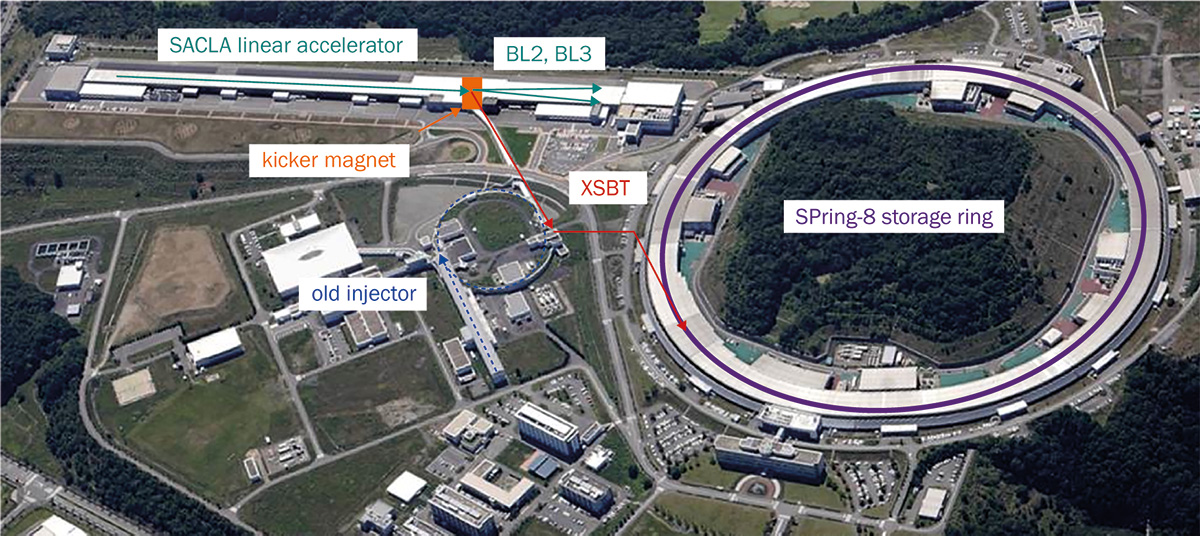
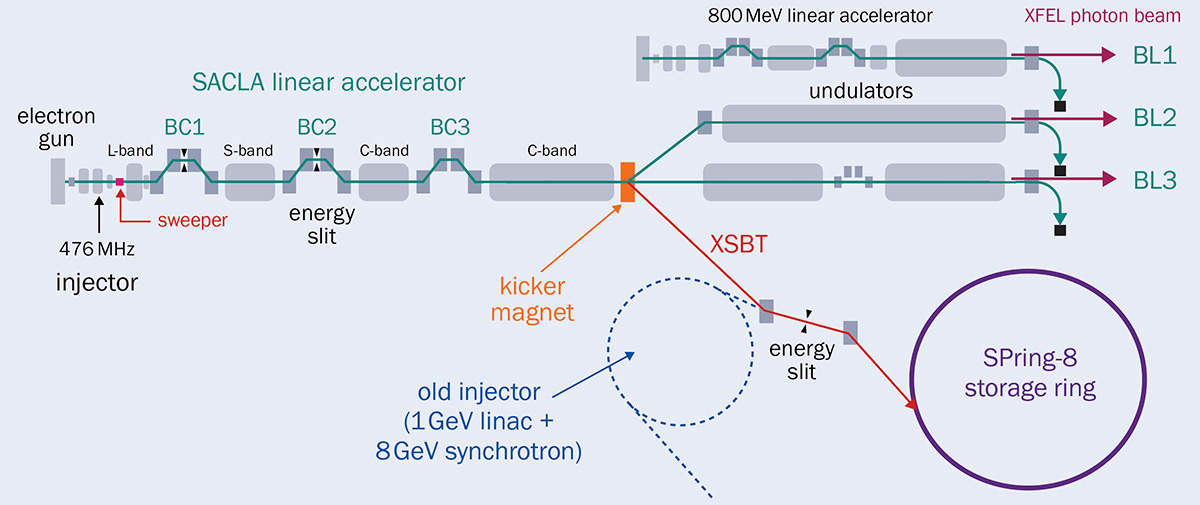
scenario. To join things up, the two accelerators are linked by a beam transport line – the XFEL to Storage ring Beam Transport (XSBT) – which was constructed at the same time as the SACLA facility (see images “Better together” and “Joined up”).
When it comes to the technical specifics, the SACLA beam repetition rate is set at 60 Hz, with the electron-beam pulses distributed on a pulse-by-pulse basis in three directions with the help of a “kicker” magnet: along two XFEL beamlines (BL2 and BL3) and down the XSBT beamline. What’s more, the electron-beam energies for XFEL user experiments are often adjusted in a range between 5 and 8 GeV depending on laser wavelengths, while the energy needs to be fixed at 8 GeV for the beam injection. It is therefore essential to control the electron-beam parameters pulse-by-pulse to allow XFEL user experiments and the SPring-8 beam injection to proceed in parallel.
Synchronisation is nothing without control
Operationally, the preparation of the SACLA beam-injection scheme took about two years in design, planning and commissioning. The first task for the project team was to synchronise the two accelerators, given that they run on different reference clock frequencies (238 MHz for SACLA; 508 MHz for SPring-8). Since the two frequencies do not have a harmonic relation, the injection timing naturally goes off with respect to the target RF bucket of SPring-8 by a maximum ±2.1 ns. A novel timing system was subsequently developed to provide the necessary synchronisation.
In top-up injection mode, which keeps a constant stored current within the storage ring, SPring-8 sends a beam request to SACLA when the stored current decreases under a certain threshold. Once SACLA receives the request, the timing system first searches out a point where the timing difference is at a minimum. By delaying the beam injection up to 197 µs, there should be a point where the timing difference becomes smaller than 105 ps. In a second step, a slight frequency modulation is applied to the SACLA 238 MHz reference clock, such that SACLA and SPring-8 are finally synchronised to within 3.8 ps (RMS).
Another significant piece of work involved retrofitting the accelerator control system. To change the accelerator parameters pulse-by-pulse, it is necessary for accelerator components to “know” the destination of the next beam pulse. That granular data (at the level of an individual pulse) is therefore sent through a “reflective memory network” to key components and subsystems – for example, RF sources and magnet power supplies – such that these devices can then operate with prestored parameters corresponding to the relevant beam destination.
Meanwhile, all diagnostic data are saved in a database with a pulse tag number so that the measured data, such as beam trajectories and charges, can be distinguished among the three beam destinations (BL2, BL3 and XSBT). It is like there are three accelerators independently running with different beam energies and parameters. In day-to-day operation, three operators adjust and tune the accelerators by looking at the monitor and control panels for the three beams versus the respective destinations. Using the pulse tag number, XFEL users are also able to see which pulses were used for the beam injection, so that these pulses can be eliminated from their experimental data.
A final core deliverable for the project team was to ensure the bulletproof reliability of SACLA – since the storage ring cannot operate without beam injection. In short, if the linear accelerator of SACLA fails to provide electron beams, close to 60 experiments on the SPring-8 beamlines are at risk of grinding to a halt. Redundancy is the key here: to promptly recover from unexpected troubles, the team installed back-up components for crucial accelerator devices, such as the electron gun, kicker magnet and RF sources.
Going live
During the early-stage evaluation of the new beam-injection scheme, two other issues came into play: electron bunch purity and magnetic hysteresis of the kicker magnet. The electron bunch purity is a ratio of electron charges contained in an electron-injected RF bucket and an empty bucket on the storage ring.
It is an important figure of merit – not least for ensuring low background noise in time-resolved experiments. A bunch purity of between 10–8 and 10–10 is typically required at SPring-8, while the electron bunch charge of SACLA is around 200 pC – i.e. even a single electron outside the beam pulse could degrade the bunch purity.
It turned out, however, that a small number of electrons were detected 18 ns after the main beam pulse during the initial experimental runs. After detailed investigation, the project team found that these electrons were slipping out from the main pulse and making a round trip between two RF cavities at the injector section of SACLA. Consequently, they were delayed by 18 ns and being injected into unexpected RF buckets on the storage ring. The solution: remove the delayed electrons using an electric sweeper and an RF knockout system – a breakthrough that, in turn, yielded the required bunch purity of 10–10.
At the far-end of SACLA’s linear accelerator, electron-beam pulses are deflected horizontally in three directions by a kicker magnet. The polarity of the kicker current is negative for BL2, zero for BL3 and positive for XSBT. As a consequence, the beam orbits of the pulses just after the beam injection (i.e. two to three times a minute) deviate from the optimum trajectory inside the XFEL undulators – seriously degrading pointing stability and laser power within the SACLA beamlines. To overcome this issue, the excitation pattern of the kicker magnet is modified slightly after the beam injection, such that the hysteresis effect is now suppressed within an angular deviation of 1 µrad (i.e. less than 10 % of the laser spot size).
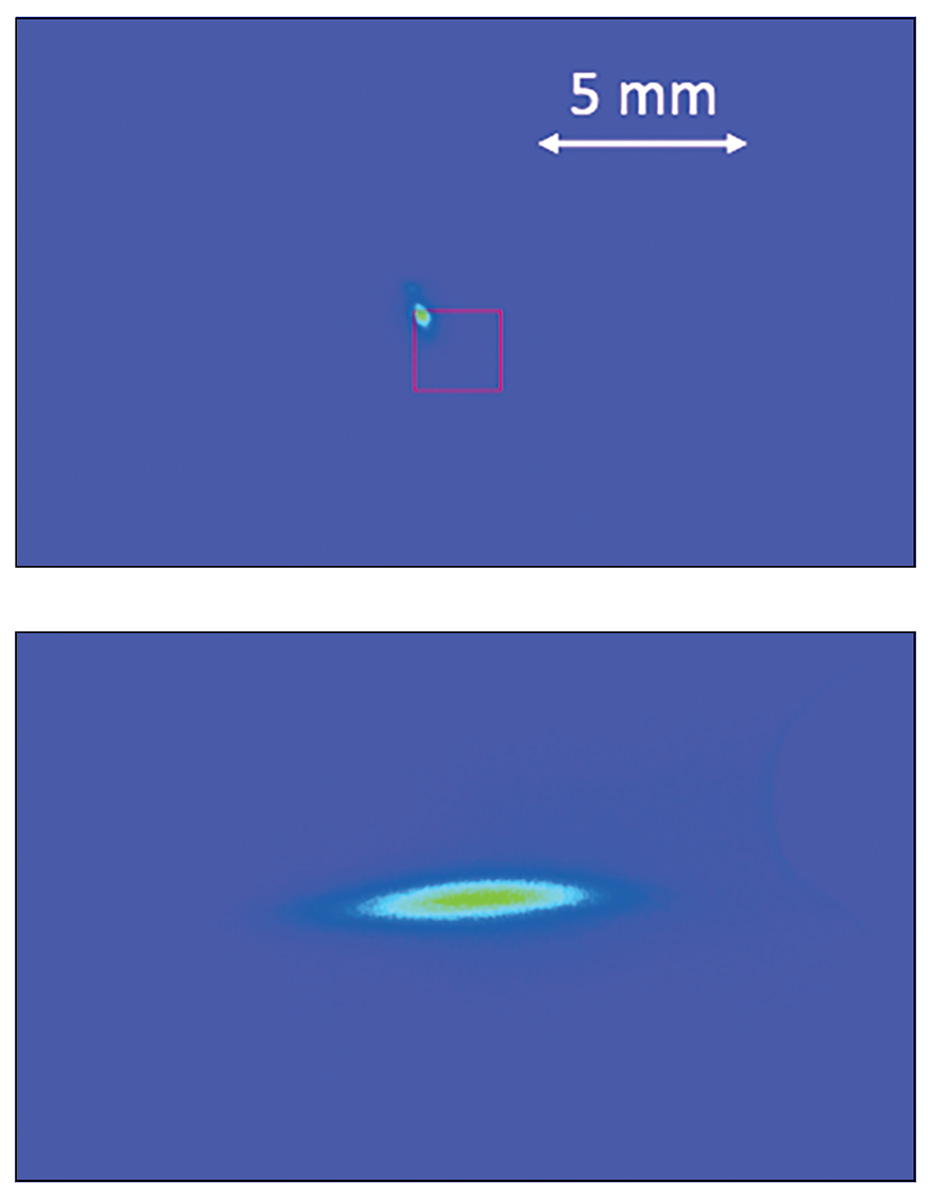
With those “issues arising” addressed successfully by the project team, it’s instructive to look at the high-level operational performance of the new beam-injection arrangement. To fill up the storage ring with a nominal stored current of 100 mA, the electron beam is injected at 10 Hz from SACLA. The process takes about 10 minutes – roughly twice as fast as the old injector. Once the storage ring is filled, top-up injection gets underway to keep the stored current at a constant level. In top-up mode, the electron beam is injected typically 2–3 times every minute. Measuring the transverse beam sizes at the injection point of SPring-8 shows that the size of the electron beam from SACLA is significantly narrower versus that from the old injector, with the beam quality represented by emittance improving from 200 nm-rad to 1 nm-rad – more than satisfying the criteria for the future SPring-8-II.
Green machines
Alongside those sustained performance improvements, there are other notable wins to report for the SACLA beam-injection arrangement. After a probation period of six months, the old SPring-8 injector and its power station were shut down in April 2021, yielding a 5 MW saving in electricity consumption and an impressive 20% reduction in the SPring-8 power bill (i.e. versus current SPring-8 plus the old injector).
Further operational efficiencies are in the works for SPring-8-II given the global surge in energy prices and the shared commitment (with SACLA) towards carbon neutrality by 2050. By using cutting-edge, short-period, in-vacuum undulator technologies in SPring-8-II, for example, the electron-beam energy will be reduced from 8 GeV to 6 GeV without changing the X-ray radiation energy range. Replacing accelerator electromagnets with permanent magnets will enable additional reductions in power consumption. The ultimate goal of SPring-8-II, and with user operation pencilled in to begin no later than 2030, is a 50% reduction in power consumption versus the current SPring-8.
The ultimate goal is a 50% reduction in power consumption for SPring-8-II versus the current SPring-8
Similarly ambitious plans are taking shape for the SACLA-II upgrade, which will take place after the completion of SPring-8-II. The end-game: a 1 kHz repetition rate using conventional (rather than superconducting RF) accelerator technologies. With traditional RF acceleration, of course, more than 99.99 % of the input power is dissipated as heat – rather than accelerating the electron beam – so the challenge for SACLA-II is to boost this extremely low conversion efficiency, thereby increasing the repetition rate without increasing the power consumption.
While none of this will be straightforward, it’s evident that the path to a “greener” and more sustainable accelerator complex is rapidly coming into view.
The estimated annual global incidence of new cancer cases was upwards of 19 million in 2020, with more than 70% of people suffering from the disease resident in low- and middle-income countries (JCO Global Oncology 2022 8 e2100358). What’s more, according to forecasts from the International Atomic Energy Agency published on World Cancer Day in February 2022, the total number of cancer deaths worldwide is forecast to rise by 60% over the next two decades – to 16 million people a year – with those same low- and middle-income countries suffering the brunt of the escalation. India finds itself in the eye of this healthcare storm, with the domestic burden of cancer cases projected at between 1.9 and 2 million in 2022 – a burden, moreover, that’s also projected to increase over time.
Fundamentally, this is a question of supply (high-quality cancer treatment) versus demand (rising cancer incidence) for India – not least when it comes to the challenges associated with rolling out accessible and affordable radiation therapy facilities at the national level. Right now, there are around 545 clinical radiotherapy units across India (180 60Co-based teletherapy systems and 365 electron linacs). Most of the e-linacs are supplied by commercial manufacturers, with 50% of these systems located in private hospitals – and therefore beyond the reach of the majority of Indian citizens.
To drive down the cost of radiotherapy treatment, while simultaneously opening up access to more cancer patients, the Society for Applied Microwave Electronics Engineering and Research (SAMEER) in Mumbai has been prioritising technology innovation in e-linacs for several decades (with financial support from the central government’s Ministry of Electronics and Information Technology, also known as MeitY).
Accessibility, affordability, availability
A case study in this regard is the medical electronics division of SAMEER, which initiated an R&D programme for a 4 MeV e-linac for cancer therapy in the late 1980s. The initial outcome: an S-band, side-coupled linac (operating at π/2 mode at 2.998 GHz) developed for electron acceleration. The SAMEER development team later integrated the linac with other core subsystems in collaboration with the Central Scientific Instruments Organisation, Chandigarh, and the Post Graduate Institute of Medical Education and Research (PGIMER), Chandigarh, with the completed linac commissioned at PGIMER in 1991.
This original machine was called Jeevan Jyoti-I. SAMEER engineers went on to build three more e-linac variations on the Jeevan Jyoti-I theme, with all units duly commissioned and operating in hospitals. Subsequently, under the Indian government’s Jai Vigyan initiative, SAMEER built six more radiotherapy units (with an increased energy of 6 MV) and installed these systems in hospitals. One more machine is being commissioned in 2022 – initially using commercial microwave sources from SAMEER (though these will eventually be replaced with a domestically developed 2.6 MW magnetron).
India’s Department of Atomic Energy (DAE) plans to exploit the country’s rich natural sources of thorium to bolster the domestic nuclear energy programme, simultaneously exploring new methods for dealing with high-level nuclear waste as well as the at-scale production of medical radioisotopes for the diagnosis and treatment of cancer.
Consider the so-called accelerator-driven subcritical reactor (ADSR), a next-generation nuclear reactor design formed by coupling a substantially subcritical nuclear reactor core (using thorium as fuel) with a high-intensity, high-energy proton accelerator. The latter generates a copious beam of spallation neutrons to sustain the fission process – activating the thorium without needing to make the reactor critical (i.e. turning off the proton beam results in immediate and safe shut-down of the reactor). Another benefit of the ADSR scheme is the relatively short half-lives of the waste products.
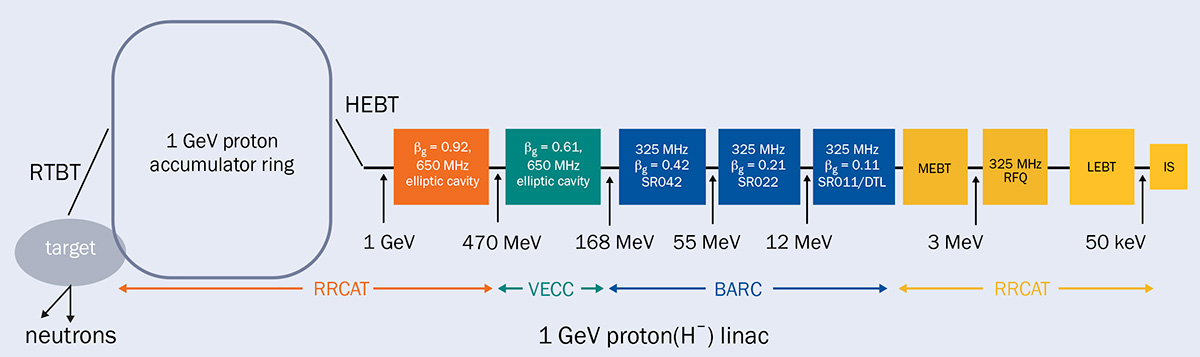
Within this context, DAE’s R&D laboratories have started work on a high-current 1 GeV proton accelerator (see “Collective endeavour” figure). In the first phase of construction of a 20 MeV normal-conducting linac at Bhabha Atomic Research Centre (BARC), scientists accelerated a 2 mA proton beam from an ion source using a four-vane RF quadrupole (generating a 3 MeV proton beam with 65% transmission). Earlier this year, the BARC team boosted the proton energy to 6.8 MeV through the first drift-tube linac (with a peak beam current of 2.5 mA and an average beam current of 1 μA with 93% transmission). At Raja Ramanna Centre for Advanced Technology (RRCAT), meanwhile, several warm-front-end ion sources and associated subsystems are under construction (including low-energy beam transport, RF quadrupoles, medium-energy beam transport and a drift-tube linac).
Operationally, collaboration is a defining theme of India’s R&D effort on proton accelerators – not least through its scientists’ direct participation in the Proton Improvement Plan II (PIP-II), an essential upgrade and ambitious reimagining of the Fermilab accelerator complex in the US. Several Indian institutions are front-and-centre in the PIP-II initiative, designing and developing room-temperature and superconducting magnets, superconducting RF cavities, cryomodules and RF amplifiers for the PIP-II project team.
BARC and the Inter-University Accelerator Centre (IUAC) in New Delhi, for example, initially supplied two single-spoke-resonator cavities for testing at Fermilab, while end-to-end infrastructure for niobium-cavity fabrication and testing has been established at RRCAT. Several niobium superconducting cavities – required in both the PIP-II project and the Indian proton accelerator programme – have since been fabricatedand tested successfully.
Innovation pathways
One thing is clear: India’s e-linac R&D effort continues to gather momentum. The next step is to enhance the technology for dual photon energies (6 and 15 MeV) from the same linac, along with multiple electron energies (from 6 to 18 MeV) for treatment. A prototype of a novel dual-energy linac has already been put through its paces, delivering beam-on-target at SAMEER. The energy is varied by introducing a plunger in the coupling cavity in the acceleration section. Industry partners are being sought as the system undergoes final quality assurance and control checks.
Parallel technology programmes – covering both e-linacs and proton cyclotrons – are also underway to support domestic production of medical radioisotopes used in the diagnosis and treatment of cancer. For example, a 30 MeV, 5–10 kW linac project (incorporating two 15 MeV sections) is being lined up for the production of 99mTc from 99Mo (the former being required in a nuclear imaging procedure called single-photon-emission computerised tomography, commonly known as SPECT). The 99Mo will be produced from 100Mo using Bremsstrahlung photons, with the latter emitted after accelerated electrons are incident on a target. Tests of the first accelerating structure (15 MeV) are in progress and the full energy of 30 MeV is expected to come online next year.
Following India’s associate membership at CERN from 2017, the country’s scientists and engineers continue to build on a rich and diverse legacy of contributions spanning core accelerator technologies and participation in front-line high-energy physics experiments. This is a legacy that extends across more than 50 years of collaboration. In the 1990s, for example, the RRCAT contributed to LEP, while the Indian High-Energy Heavy Ion Physics Team contributed to the WA93 experiment at the CERN-SPS. An international cooperation agreement between India’s Department of Atomic Energy (DAE) and CERN was signed in 1992 to deepen ties and extend the scientific and technical cooperation between India and CERN. Those developments, in turn, paved the way for the decision (in 1996) of India’s Atomic Energy Commission to take part in the construction of the LHC – specifically, to contribute to the development of the CMS and ALICE detectors. India became a CERN Observer State in 2002, and the success of the DAE–CERN partnership on the LHC led to a new cooperation on novel accelerator technologies, shaping DAE’s participation in CERN’s Linac4, SPL and CTF3 projects.
Elsewhere, the Variable Energy Cyclotron Centre (VECC) in Kolkata is leading a project to build an 18 MeV medical cyclotron – a machine that will reduce the cost of production for positron-emitting radioisotopes. In terms of operational specifics: the system will accelerate negative hydrogen ions (H–) from an external, multicusp volume ion source, while a carbon stripper foil will alter the charge state of the ions from negative to positive ahead of extraction. Progress to date is encouraging: engineering design of the main magnet is complete and a 1 mA current has been extracted from the H– ion source.
Further technology innovation is evident in the field of hadron therapy, which uses proton or ion beams to deliver precision tumour targeting with zero exit dose – a capability that clinicians estimate could improve therapeutic outcomes in 15–20% of cancer patients who receive radiotherapy. Recognising the potential here, Indian clinics have recently purchased and installed two 230 MeV proton cyclotrons, supplied by Belgian equipment maker IBA, in a pivot towards next-generation cancer treatments.
Further progress has been reported by a collaboration between SAMEER and KEK, Japan’s High-Energy Accelerator Research Organisation. Jointly, the two partners have completed conceptual design studies for a multi-ion therapy machine based on a novel digital accelerator concept. The system is basically a fast-cycling induction synchrotron with a specialised beam-handling capability. (For context, the accelerating devices of a conventional synchrotron, such as RF cavities, are replaced with induction devices in an induction synchrotron.) It is possible, for example, to inject particles at nearly 200 kV DC directly into the main ring and, as such, the induction synchrotron does not need a separate injector.
In a related initiative, the Tata Memorial Centre Mumbai, and Raja Ramanna Centre for Advanced Technology (RRCAT), Indore, have come up with a preliminary design for a 2 MeV injector and a 70–250 MeV proton synchrotron that may also be suitable for variable-energy beam delivery and other ion-beam therapies.
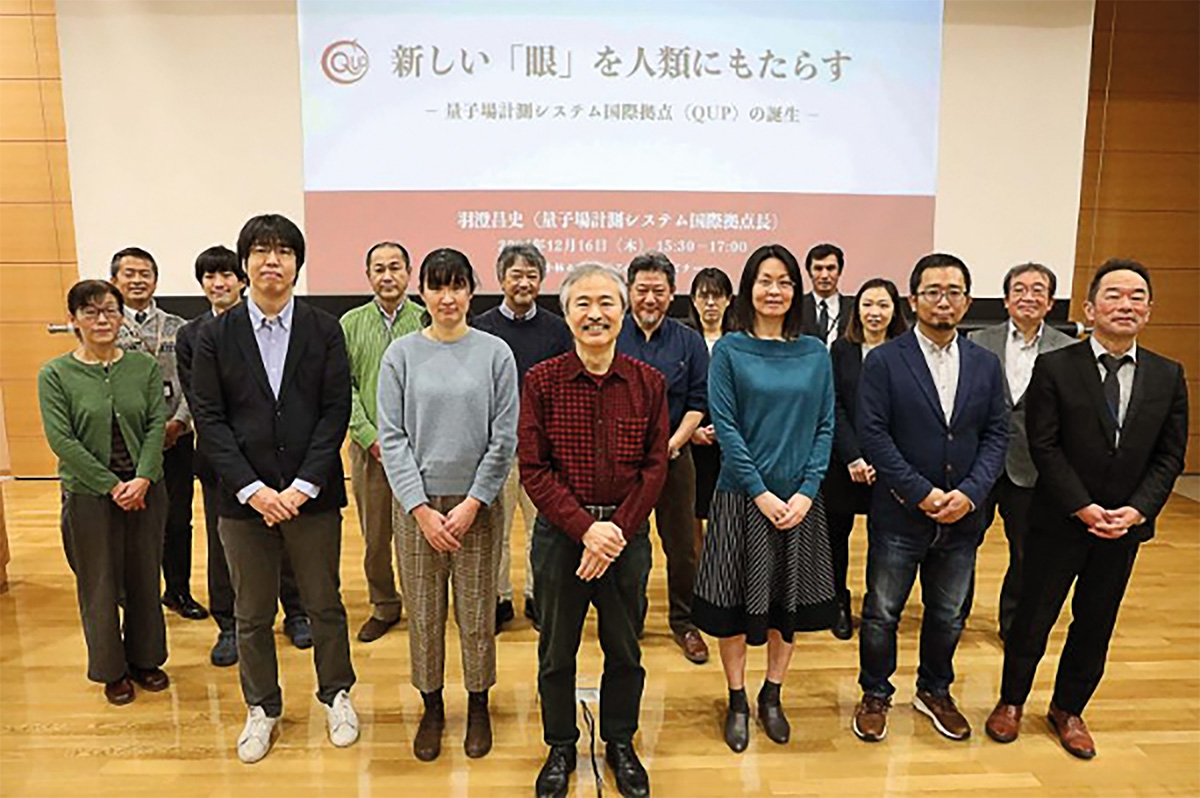
It’s 12 months since the International Center for Quantum-field Measurement Systems for Studies of the Universe and Particles (or QUP for short) was unveiled as the latest addition to the World Premier International Research Center Initiative (WPI) run by Japan’s Ministry of Education, Culture, Sports, Science and Technology (MEXT). Based in Tsukuba City, 60 km north-east of Tokyo, the new centre represents a high-profile addition to the scientific powerhouse that is KEK, Japan’s High Energy Accelerator Research Organisation.
Within KEK, QUP has since assumed its place alongside the organisation’s other flagship research laboratories – among them the Institute of Particle and Nuclear Studies (IPNS), the Accelerator Laboratory (ACCL) and the Japan Proton Accelerator Research Complex (J-PARC) – in order to ensure that the outcomes of its ambitious research endeavours dovetail with, and reinforce, KEK’s core discovery programme in elementary particle physics. Here QUP director Masashi Hazumi tells CERN Courier about the centre’s progress to date and the opportunities for talented early-career scientists prepared to take risks and look beyond the comfort zone of their core disciplinary specialisms.
How would you pitch QUP to a talented postdoc thinking about the next big career move?
QUP’s mission is to “bring new eyes to humanity” by inventing advanced measurement systems – novel electronic and quantum detectors that will unlock exciting discoveries in cosmology and particle physics. Examples include superconducting detectors to study cosmic inflation (for the LiteBIRD space mission) and low-temperature quasiparticle detection systems to search for “light dark matter”. We are also keen on applying our unique capabilities to broader academic fields and industrial and societal applications – a case in point being our close engagement with Toyota Central R&D Laboratories.
In this way, QUP will return to the essence of physics, conducting interdisciplinary research to develop new methodologies while integrating particle physics, astrophysics, condensed-matter physics, measurement science, and systems science. QUP’s inventions and innovations will exploit the most fundamental object in nature – the quantum field – and thereby open up a new era in measurement science: quantum-field measurement systemology.
What sets the QUP approach apart from other quantum measurement centres?
QUP’s strength lies in the breadth of technologies covered and the ability to transition seamlessly between studies of fundamental physics to the execution of large-scale projects on next-generation scientific instruments and quantum technologies. The aim is simple: to create a cross-disciplinary “melting pot” that encourages a fusion of ideas across diverse fields of science, technology and engineering. As such, we’re recruiting a team of “multidisciplinarians” – scientists who can apply their domain knowledge and expertise creatively and flexibly across subject boundaries.
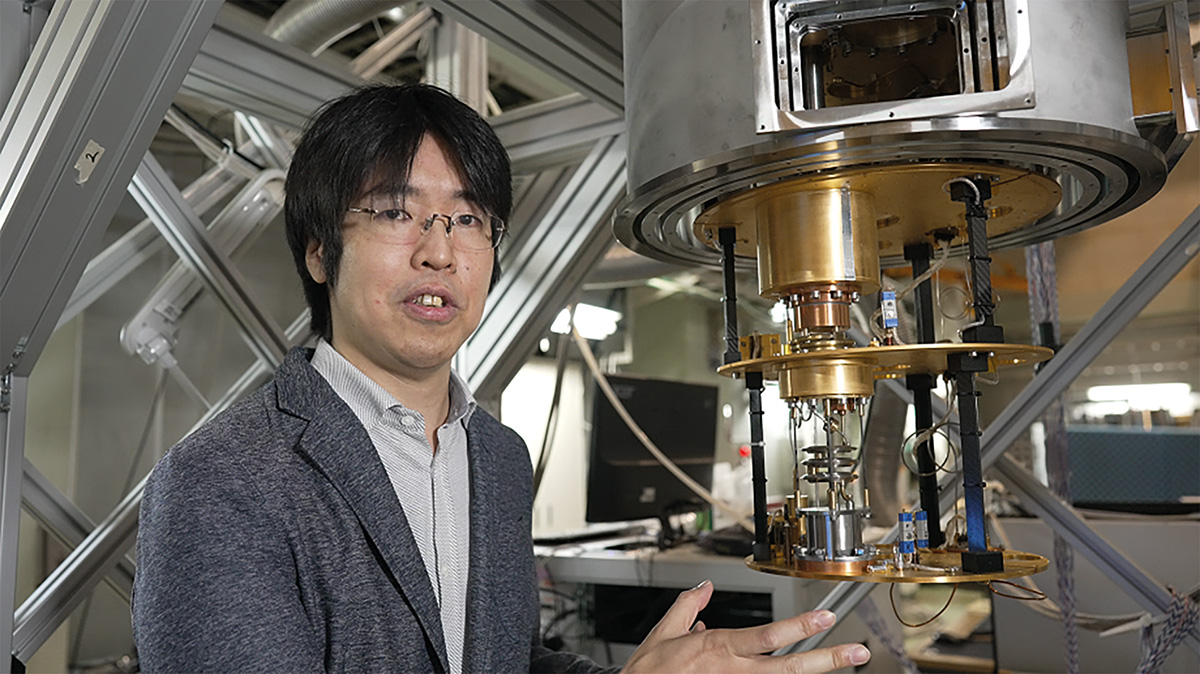
A good example is the quantum diamond sensor – an enabling technology that exploits so-called NV defects in the carbon lattice – which QUP is developing to support precise temperature measurements of instrumentation (down to the 1 mK level at room temperature) in future studies of the cosmic microwave background (CMB). Notably, that same quantum sensing technology is also attracting early-stage interest from our colleagues at Toyota, with QUP particle physicists and industrial scientists openly sharing ideas. Unanticipated connections like this can create intriguing opportunities for young scientists, opening up new research pathways and long-term career opportunities.
How important is QUP’s positioning as part of the KEK research organisation?
QUP is unique among Japan’s WPI programmes because it is the only centre focused on measurement systems, while the integration within KEK means collaboration is hard-wired into our working model. We are already establishing networks to link QUP scientists with researchers across KEK’s accelerator facilities and laboratories. An early success story is the QUP/KEK machine-learning research cluster, which is exploiting AI in a range of high-energy physics contexts and industrial applications (e.g. autonomous vehicles).
Presumably that collaborative, open mindset extends beyond KEK?
Correct. We are in the process of establishing three satellite sites for QUP – at Toyota Central R&D Laboratories in Aichi; the Japan Aerospace Exploration Agency (JAXA) Institute of Space and Astronautical Science (ISAS) in Kanagawa; and the University of California, Berkeley, in the US. These activities are already bearing fruit: Hideo Iizuka, a senior scientist at Toyota and one of our principal investigators at QUP, is developing applications of the Casimir effect (the attractive force between two surfaces in a vacuum), with a long-term goal of demonstrating a zero-friction shaft bearing for energy-efficient vehicles.
You highlighted the LiteBIRD space mission earlier. What is QUP’s role in LiteBIRD?
One of QUP’s flagship projects centres around the contribution we’re making to the JAXA LiteBIRD space mission, which will study aspects of primordial cosmology and fundamental physics. I am one of the founders of LiteBIRD, an international, large-class mission with an expected launch date in the late 2020s using JAXA’s H3 rocket. When deployed, LiteBIRD will orbit the Sun–Earth Lagrangian point L2, where it will map CMB polarisation over the entire sky for three years. The primary scientific objective is to search for the signal from cosmic inflation, either making a discovery or ruling out well-motivated inflationary models of the universe. LiteBIRD will also provide insights into the quantum nature of gravity and new physics beyond the standard models of particle physics and cosmology. The focus of QUP’s contribution is development of the superconducting detector subsystem for LiteBIRD’s low-frequency telescope.
Project Q is another of QUP’s flagship initiatives. What is it?
Project Q is still a work-in-progress. Essentially, we are putting together a framework to invent and develop a novel system for the measurement of a new quantum field. Last month, as part of the requirements-gathering exercise, QUP and the KEK Theory Center jointly organised a dedicated workshop called “Toward Project Q”. The hybrid event attracted 91 participants – a mix of QUP staff and international colleagues – who shared a range of ideas on potential lines of enquiry for Project Q, including cryogenic measurements, space missions, accelerator and non-accelerator experiments, as well as the use of novel quantum sensors. Watch this space.
What are your near-term priorities as director of QUP?
My number-one priority is to hire the best researchers and position QUP for long-term scientific success. The open nature of Project Q represents a useful conversation-starter in this regard. We have 27 scientists on the staff just now and the plan is to grow the research team to about 70 people by early 2024 – a cohort that will ultimately comprise around 15 principal investigators supported by a team of research professors and postdocs (and with WPI guidelines stating that 30% or more of the QUP team should eventually come from abroad). When it comes to recruitment, I’m looking for scientists who are enterprising, creative and not afraid to take risks – there may well be some candidates who fit the profile among the CERN Courier readership! I like that sort of spirit. If you go big, the success rate may not be high, but unexpected insights and opportunities will often emerge.
QUP in brief
QUP is the fourteenth, and latest, addition to Japan’s WPI programme, a long-running, government-backed initiative to attract the “brightest and best” scientific talent from around the world, creating a network of highly visible research centres focused on grand challenges in the physical sciences, life sciences and applied R&D. Other WPI research centres specialising in the physical sciences include: the Kavli Institute for the Physics and Mathematics of the Universe (University of Tokyo); the Advanced Institute for Materials Research (Tohoku University); and the International Center for Materials Nanoarchitectonics (part of the National Institute for Materials Science).
Right now, QUP’s research priorities cover the following themes:
Development and implementation of the superconducting detector array for the LiteBIRD CMB space mission.
The invention of methods (e.g. those using quasiparticles) for measuring novel quantum fields (e.g. axions); also the proposal and promotion of new projects based on these methods (Project Q).
The invention of a new generation of low-temperature detectors, quantum detectors and radiation-hard detectors.
Pioneering the most efficient means for large-scale projects in basic science (e.g. automated ASIC design) and modelling these approaches based on current/idealised best practice (establishing “systemology”).
Applications with industrial and societal implications (e.g. autonomous driving and smart cities).
With the worst of the supply-chain disruption from the COVID-19 pandemic receding, work is moving at pace on the preparation and systems commissioning of the Rare isotope Accelerator complex for ONline experiments (better known as RAON), the flagship heavy-ion accelerator facility that forms part of the Rare Isotope Science Project (RISP) within South Korea’s Institute for Basic Science.
RAON is big science writ large. By accessing exotic and as-yet-undiscovered radioisotopes, RAON will address a broad-scope research roadmap when it comes online for initial user experiments in two years’ time. By extension, the laboratory will generate a wealth of data to advance physicists’ fundamental understanding of the nucleus; provide novel insights about the origins of the chemical elements in the universe; and enable experiments to explore physics beyond the Standard Model. Equally significant, RAON will produce research quantities of rare isotopes to underpin diverse applied R&D efforts spanning, for example, the diagnosis and treatment of cancer, safe disposal of spent nuclear fuels, and the lossless storage of electrical energy.
It’s RAON’s combined production scheme, however, that sets it apart from other heavy-ion accelerator laboratories. Specifically, a twin-track approach that exploits – separately as well as in tandem – two methods for producing rare isotopes: isotope separation online (ISOL) and in-flight fragmentation (IF). For context, ISOL involves the acceleration of light ions (e.g. protons) and their collision with a heavy-element target (e.g. uranium), with a large abundance of rare (and high-purity) isotopes extracted following fragmentation of the target. With IF, on the other hand, accelerated heavy ions (e.g. uranium) collide with a light-element target (e.g. carbon), with strong magnets extracting rare isotopes of interest from many kinds of very fast-moving, fragmented heavy-ion beams.
RAON is, by some way, South Korea’s biggest big science endeavour to date
Myeun Kwon, director of RISP and RAON
Here Myeun Kwon, director of RISP and RAON, tells CERN Courier how the new facility is taking shape with help from a network of partnerships across the scientific community and industry.
What differentiates RAON’s scientific mission from other heavy-ion accelerator facilities?
We are developing RAON, first and foremost, to access the unexplored regions of the nuclear landscape. Upon completion, RAON will provide a first-of-its-kind production facility, combining ISOL as a first step and IF systems in a second step to produce and study the more exotic radioisotope beams – in fact, up to 80% of all the isotopes predicted to exist for elements below uranium. There are a number of studies – theoretical and experimental – which suggest that such a two-step process will expand the horizon for radioisotope production dramatically.
While other heavy-ion accelerators rely exclusively on either ISOL or IF, RAON will be the first to exploit a combined ISOLIF production scheme – while simultaneously making ISOL and IF available to users as stand-alone processes. As such, RAON is expected to increase the rate of discovery of rare isotopes, whilst producing them in larger quantities and in greater variety.
Upon completion, the RAON accelerator will generate heavy and light ion beams at a wide range of momenta – up to 200 MeV/nucleon for uranium and 600 MeV for protons (and with a beam current range from 8.3 pμA for uranium and 660 pμA for protons).
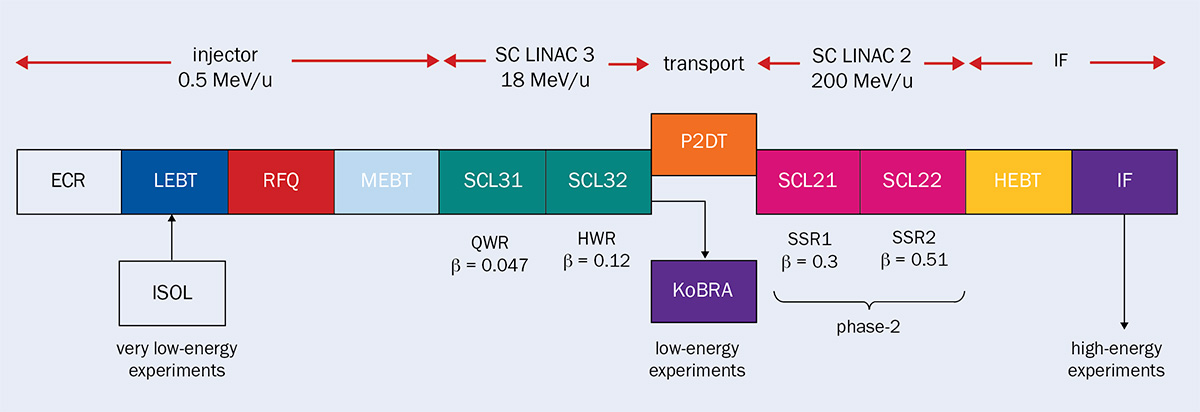
In terms of the core building blocks, RAON comprises an injector system and three discrete superconducting linac sections, the superconducting cavities of which are phased independently and operated at three different frequencies (81.25, 162.5 and 325 MHz).
The low-energy superconducting linac section (SCL3) and the high-energy superconducting linac (SCL2) are connected by a post-accelerator driver linac (P2DT), which consists of a charge-stripper, two rebunchers and a 180° bending system.
The injector system accelerates a heavy-ion beam to 500keV/nucleon and creates the desired bunch structure for injection into the SCL3 linac.
The injector comprises two electron cyclotron ion sources (ECR-IS), a low-energy beam transport section (LEBT), an RF quadrupole (RFQ) and a medium-energy beam transport system (MEBT).
The LEBT is designed to transport and match ion beams extracted from the ECR-IS to the RFQ; electrostatic quadrupoles are chosen for transport and focusing because these are more suitable for the LEBT’s low-velocity beams.
The RFQ (approx. 5 m long with a four-vane structure) is designed to accelerate ion beams from 10 keV/nucleon to 500 keV/nucleon at 81.25 MHz of the resonance frequency.
The MEBT comprises 11 room-temperature quadrupole magnets to transport and focus the ion beams, with four bunching cavities (operating at 81.25 MHz of resonance frequency) arranged to match the longitudinal beam size to SCL3.
Phase II of the accelerator roll-out (due for completion in 2025) involves the construction and commissioning of the high-energy superconducting linac (SCL2).
Completion of Phase II of RAON will see the launch of a co-located laboratory to evaluate next-generation radiotherapy modalities for the treatment of cancer – for example, the combined use of 11C particle beams for localised radiotherapy and in situ gamma-ray imaging of solid tumours (so-called theranostics).
How important are partnerships – domestic and international – for the successful delivery of the RAON initiative?
RAON is, by some way, South Korea’s biggest big science endeavour to date. Put simply, the project would not be possible without our extensive R&D partnerships, supporting us with the co-development of core enabling technologies for the accelerator facility and the experimental systems for RAON’s front-line research programme. We have a network of Korean universities and research institutes, for example, working on accelerator design and development, as well as the manufacture and testing of superconducting components and subsystems.
International collaboration is front-and-centre as well, with diverse technology contributions from the likes of TRIUMF (Canada), RIKEN and KEK (both Japan), the Institute of High Energy Physics (IHEP, China), the Institute for Nuclear Physics (INFN, Italy) and the European Spallation Source (ESS, Sweden). At a more strategic level, we rely on broad engagement and oversight from a network of scientific and engineering experts represented on our international/technical supervisory committees.
What does RAON’s engagement with industry look like?
We’re pursuing a mixed model with industry – using off-the-shelf technologies when appropriate to manage our capital outlay, but also co-developing unique breakthrough technologies that can subsequently be transferred and exploited more widely by industry. A good example of the latter is Vitzro Tech, a domestic manufacturer that we engaged on bespoke development and manufacture of a portfolio of niobium superconducting RF cavities, cryomodules and cryogenic distribution lines for key legs of the accelerator facility. Vitzro Tech’s inputs are fundamental to the project’s long-term success and the expectation is that the technologies the company developed for RAON will, in time, be offered commercially to other big science facilities – a case study in downstream innovation.
Presumably, you need to forge close links with equipment manufacturers at home and abroad?
Correct. Big science is all about collaboration, so the priority, from the off, is to have tight communication with your industry vendors. We have domestic manufacturers, for example, that have supplied us with a range of commercially available accelerator technologies – advanced magnets, vacuum systems and associated instrumentation – while international manufacturers also feature prominently in the project supply chain. The RAON cryoplant is a case in a point – a turnkey system developed specifically for RAON by our technology partner Air Liquide of France.
How has the project timeline been affected by the COVID-19 pandemic?
RAON depends on equipment deliveries from regional and international technology partners, so some supply-chain disruption was inevitable as a result of the pandemic. Notwithstanding the logistical obstacles, we have registered significant progress along many coordinates over the past three years. The construction of all buildings and supporting facilities was completed in 2021, while the low-energy linac – which includes two types of superconducting RF cavities – and its associated cryoplant, ISOL facilities (with cyclotron) and experimental systems (seven in all) are also complete.
A significant commissioning milestone was reached in October 2022 with the first argon-ion beams accelerated by the low-energy superconducting linac, with all the linac subsystems – including quarter-wave and half-wave resonator cavities – cooled down to cryogenic temperatures (see “Building blocks: the RAON accelerator facility”). The mechanical installation and commissioning of the associated cryoplant (4.2 kW cooling capacity as the equivalent heat load at 4.5 K) was completed back in August 2022, with the “cold box” connected to the main helium distribution line.
What are the next steps for RAON?
We are now in the middle of commissioning the low-energy superconducting linac and aim to complete that process early next year. We envisage a similar commissioning timeline for the ISOL facility (with 70 MeV proton cyclotron) and the low-energy experimental facilities such as KoBRA (Korea Broad acceptance Recoil Spectrometer and Apparatus). In the middle of 2023, we will combine all of these building blocks for initial radioisotope production, with preparations for the first round of user experiments (at low energies) taking another year or so through to autumn 2024. Phase two of the RAON installation involves the construction and commissioning of the high-energy superconducting linac.
The Pakistan Atomic Energy Commission (PAEC) provides a focal point for the country’s diverse scientific, technological and engineering collaborations with CERN and other leading international accelerator facilities. Zoom in a little further and one of the engine-rooms for that collaborative endeavour is very much front-and-centre: the Pakistan Institute of Nuclear Science & Technology (PINSTECH).
Headquartered in Islamabad, PINSTECH is a premier R&D institute within PAEC and, by extension, one of Pakistan’s leading research centres. The institute’s wide-ranging research programme spans, among other things, isotope production and applications, materials science, radiation protection and health physics, as well as neutron science. That R&D effort is augmented by two operational nuclear research reactors: Pakistan Research Reactor-1 is a 10 MW pool-type reactor which is used to produce radioisotopes for medical applications; Pakistan Research Reactor-2 is a smaller reactor that’s used, chiefly, for neutron activation and teaching/training activities.
Operationally, PINSTECH has facilities for the production of a range of reactor-based radioisotopes – including 99Mo, 99mTc generators, 131I, and 32P – all of which are supplied to nuclear medicine centres across the country on a rolling basis. A key element of this programme is PINSTECH’s production of freeze-dried, radiopharmaceutical in-vivo diagnostic kits for nationwide distribution.
During radioisotope production, target materials are placed into the research reactor for neutron irradiation, after which the irradiated targets are transferred into the “hot cells” of the facility for chemical separation, purification, quality control and dispatch. The Pakistan Nuclear Regulatory Authority and Drug Regulatory Authority of Pakistan regulate the end-to-end production process.
Elsewhere within PINSTECH, and with support from CERN, researchers are developing a 5 MeV electron linac for radiotherapy applications – part of a national effort to scale technical capacity and capability in medical accelerator technologies.
Radioisotope collaboration
Collaboration is hard-wired into PAEC’s operational model and, as such, underpins Pakistan’s radioisotope production programme. PAEC and the International Atomic Energy Agency (IAEA), for example, have been working together in this area for many years and have completed a number of successful technical cooperation projects (with a joint project in the healthcare sector currently under way at the national level).
CERN is another flagship R&D partner, with PINSTECH and the CERN–MEDICIS facility engaged in a cooperative effort focused on the production and study of innovative radioisotopes for medical diagnostics and treatment. Specifically, the two organisations are carrying out R&D activities on the production of novel medical (reactor- and accelerator-produced) radioisotopes such as 195mPt, 165Er, 225Ac, 155Tb, 161Tb, 177Lu – an endeavour, the two partners hope, that will ultimately extend to clinical trials. The bottom line is that Pakistan, which has high cancer mortality and morbidity within its population of 220 million, is keen to take advantage of cutting-edge radioisotope science for the at-scale diagnosis, treatment and management of cancer patients.
CERN and Pakistan: better together
The Islamic Republic of Pakistan became an Associate Member of CERN in 2015, formalising a relationship going back much further. For context, Pakistan and CERN signed a cooperation agreement in 1994, followed by the signing of several protocols. Today, Pakistan’s scientists and engineers contribute to the ALICE, CMS, ATLAS and MEDICIS experiments; that engagement has also included accelerator projects such as CLIC/CTF3 and LINAC4.
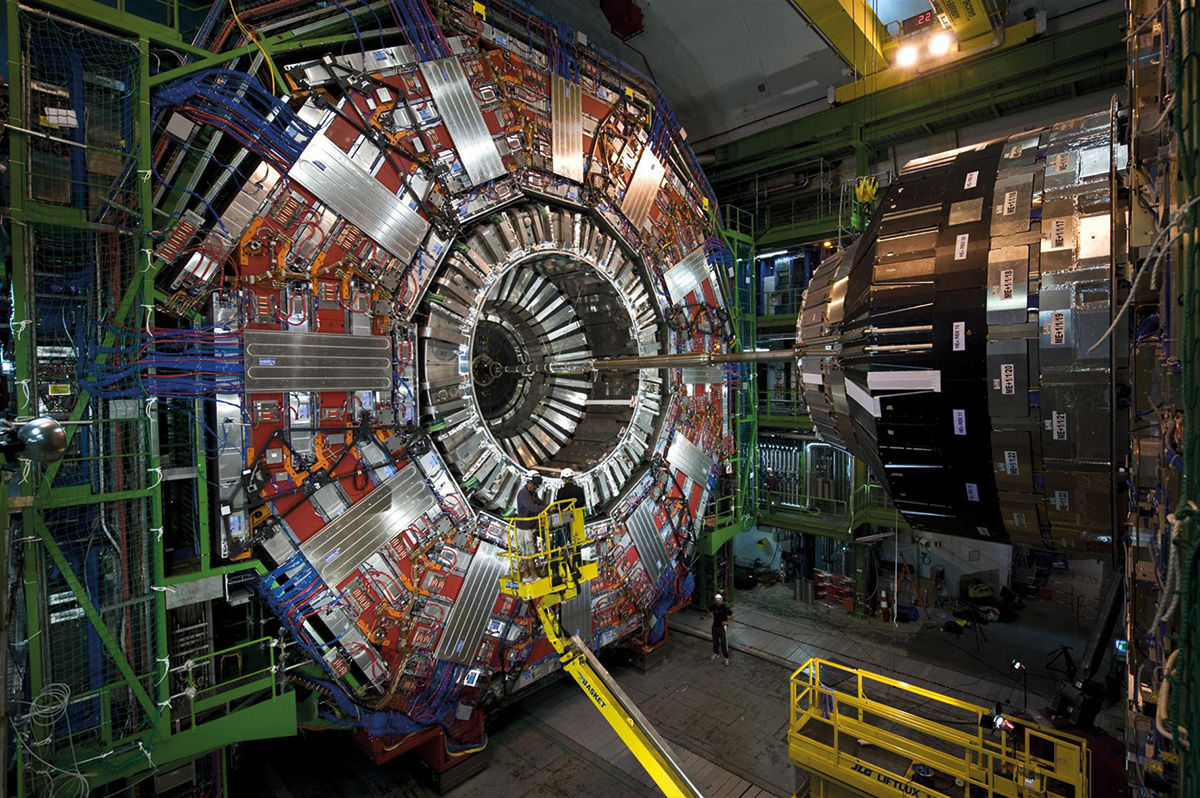
On CMS, Pakistan played an important role in the tracker alignment; built and installed 320 resistive plate chambers; and assembled and tested gas electron-multiplier detectors. Other notable contributions have included CMS and ALICE computing, the WLCG and data analysis, as well as operating one of the Tier-2 centres. Currently, Pakistan is contributing to the mechanics and electronics of the HGCAL of the CMS as well as engaging on the tracker upgrade. Teams from Pakistan also built critical parts of the experimental infrastructure, including the feet on which the whole barrel yoke stands; the outermost end-cap disks; and the removable tower supporting the forward hadron calorimeter.
In addition, Pakistan has built various mechanical components for ATLAS and for the LHC and made an important contribution to the LHC consolidation programme in 2013–2014.
Knowledge transfer
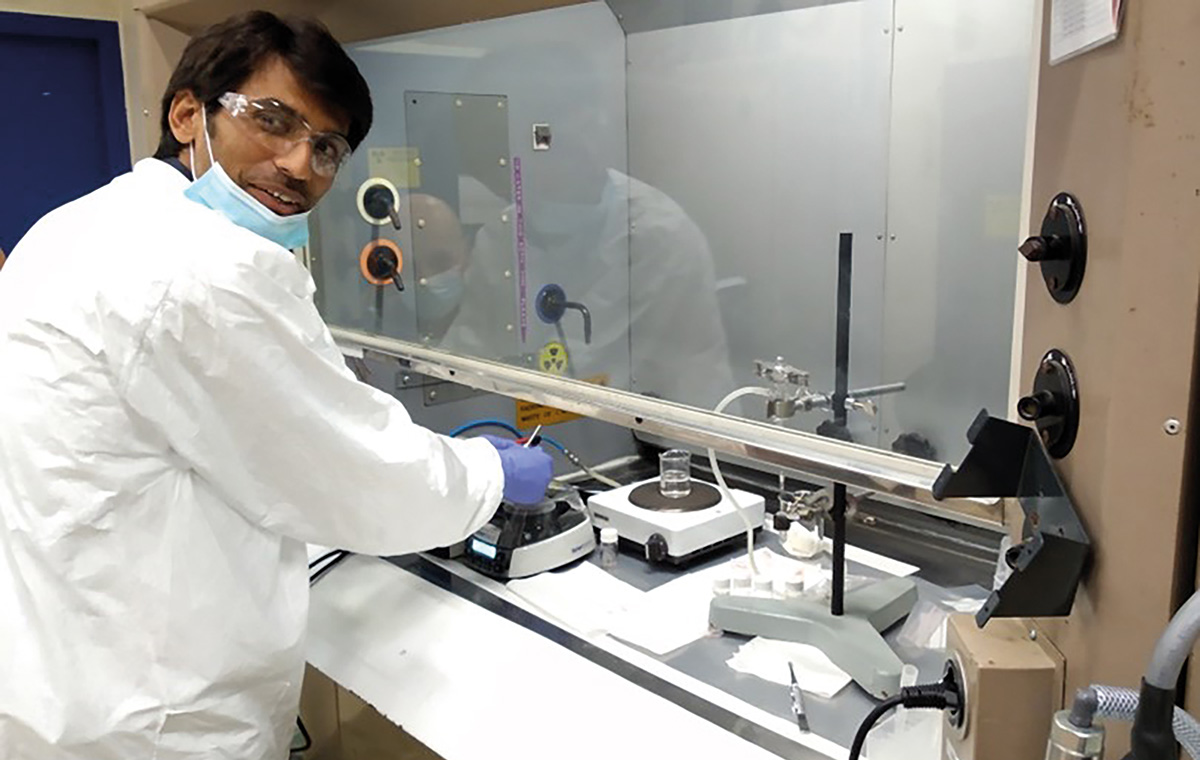
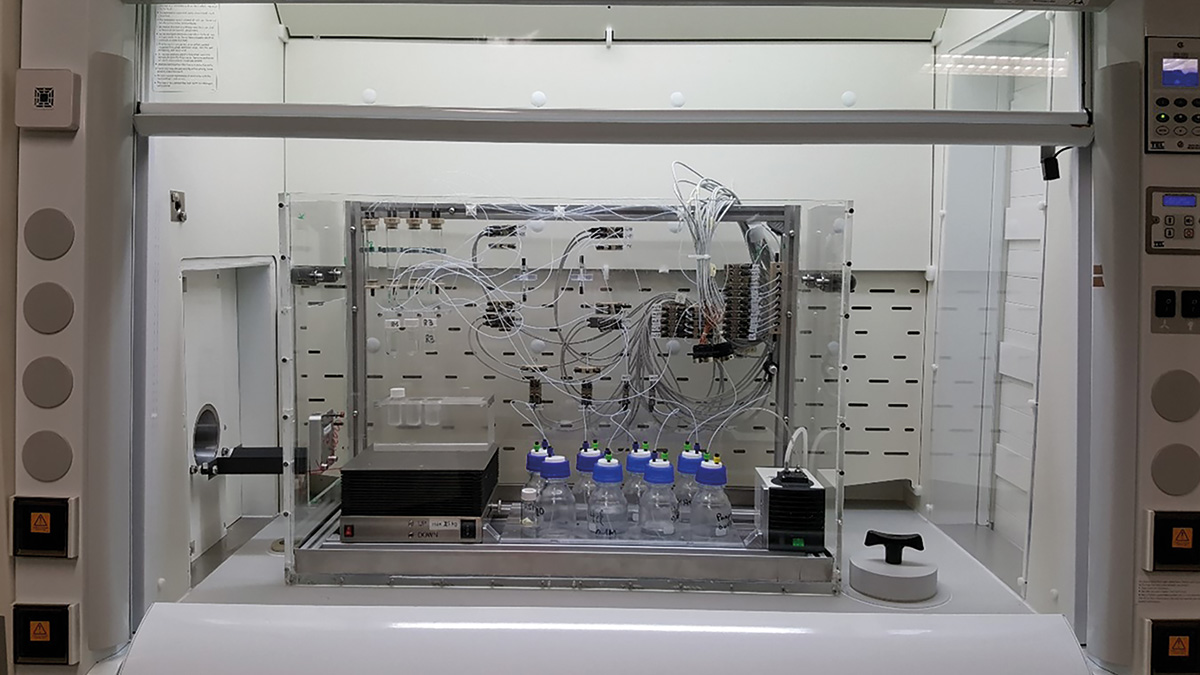
With this in mind, PINSTECH scientists and engineers have been seconded to the CERN–MEDICIS team for the development of radiochemical activities – including a major contribution to the MEDICIS radiochemistry set-up for the purification of medical radioisotopes with both therapeutic and diagnostic properties (so-called “theranostic” combinations). PINSTECH engineers have also been working on the development of salt/aluminium foils for radio-isotope collection; the management of liquid radioactive waste at MEDICIS; a very promising R&D project relating to the production of 195mPt for theranostic applications; and the development of a large-scale radiochemistry unit for handling higher levels of radioactivity.
Fundamental to the PINSTECH-MEDICIS collaboration is the regular exchange of radioisotopes between the two partners. As an example, research quantities of 225Ac were recently shipped from CERN to Pakistan and, after chemical processing at PINSTECH, transferred to the Lahore-based INMOL cancer clinic (another PAEC facility). Here the 225Ac was used in the radiolabelling of a targeted “theranostic module” (with the chemical reaction to produce the radiopharmaceutical taking about 30 mins with a yield greater than 95%).
For Pakistan, opportunity knocks, with the R&D collaboration between PINSTECH and MEDICIS key to the country’s long-term goal of strengthening the technical capability, commercial capacity and production infrastructure to secure a scalable domestic pipeline of novel and high-impact theranostic radioisotopes.
The Institute of High Energy Physics (IHEP), part of the Chinese Academy of Sciences, is in the vanguard of China’s expansive – and rapidly growing – scientific endeavours in elementary particle physics. One of the engine-rooms of that research effort is the IHEP accelerator division, the largest accelerator R&D programme in China, which has a similarly expansive remit covering the planning, design, construction and delivery of large-scale accelerator projects – on time and within budget – as well as the training and development of the next generation of accelerator scientists and engineers.
The origin story of the IHEP accelerator division can be traced back more than half a century. In 1964, Jialin Xie, the pioneer of Chinese accelerator science and technology, built the country’s first linear accelerator (a 30MeV electron linac), laying the ground for the development of future large-scale accelerator facilities in China.
Fast forward to the 1980s and IHEP’s construction of the Beijing Electron–Positron Collider (BEPC) – the foundation of the institute’s own accelerator science programme. Since then, a talented and multidisciplinary accelerator team has grown and developed alongside IHEP’s ambitious research programme in high-energy physics. Today, the IHEP accelerator team is made up of around 370 scientists and engineers, 110 postgraduate students, 26 postdocs and numerous guest scientists working across IHEP’s two campuses in Beijing and Dongguan (an industrial city close to Hong Kong).
Project management: it’s all about delivery
The IHEP accelerator team works on advanced electron and proton accelerators, with deep domain knowledge and capabilities spanning a broad base of enabling technologies, including (but not limited to) precision mechanics; magnets and power supplies; ultrahigh vacuum components and nonevaporable-getter-(NEG)-coated vacuum chambers; cryogenic systems; superconducting magnets and RF cavities; RF power equipment and accelerating structures; as well as autocontrol systems and cutting-edge instrumentation for beam diagnostics and steering.
Furthermore, that collective IHEP know-how – tying together fundamental accelerator science, technology innovation and systems engineering – has scaleddramatically over the past 20 years as the team has overseen the construction and enhancement of several large-scale accelerator initiatives, including: the upgrade of the Beijing Electron–Positron Collider (BEPCII); a high-current proton injector for the Accelerator Driven Sub-critical System (ADS); the China Spallation Neutron Source (CSNS); the High Energy Photon Source (HEPS); as well as formative design work on the proposed 100km Circular Electron–Positron Collider (CEPC). This is big science at scale – a diverse programme of accelerator R&D that required all manner of technology/engineering innovation along the way:
1. BEPCII (2004–2009)
BEPCII was a five-year effort to upgrade the original BEPC with a new injector as well as replacing its single-ring collider with a double-ring architecture. Upon completion of the upgrade, BEPCII entered operation in 2009 with an adjustable beam energy in the range 1.0–2.3 GeV and a beam current of 910 mA. Significant progress was registered in terms of the core enabling technologies for a high-beam-current, high-luminosity electron–positron collider, as well as in the design optimisation, system integration and project management. The luminosity of BEPCII reached the design goal of 1×1033 cm–2.s–1 at a beam energy of 1.89 GeV (100 times higher than that of BEPC). These successful outcomes informed and shaped subsequent IHEP accelerator projects, including the proposal for the future 100 km CEPC (see below).
2. ADS (2010–2017)
ADS is a high-power, high-intensity proton machine that has potential applications in nuclear-waste transmutation as well as thorium-based energy production. Under the auspices of the Chinese Academy of Sciences, IHEP developed the world’s first high-frequency, high-power and continuous-wave (CW) proton injector for ADS – the building blocks consisting of a CW radiofrequency quadrupole (RFQ), a superconducting linac, a beam dump and transport lines. The RFQ operates in 325 MHz CW mode, providing a 3.2 MeV acceleration capability, while the superconducting spoke cavities installed in the 2 K cryomodules have successfully accelerated the 10.6 mA proton beam to an energy of 10.67 MeV. As such, ADS is the first proton linac operating at such a high beam current (and integrated by 14 superconducting spoke cavities with a record-breaking beta value of 0.12).
3. CSNS (2011–2018)
The CSNS is located on IHEP’s Dongguan campus and consists of an accelerator, a target station and several neutron instruments. The accelerator complex itself is made up of an H– ion source (with 20 mA current), a four-vane RFQ linac (at 3 MeV), four drift-tube linac tanks (80 MeV), a rapid circling synchrotron (1.6 GeV/25 Hz) and various beam transfer lines.
CSNS construction was completed in 2018, with the beam power reaching the design value of 100 kW in February 2020. The uncontrolled beam loss rate is less than 1 W/m thanks to IHEP’s custom-designed collimation system and successful mitigation of space-charge effects. Beam availability during 2021/22 operations reached 97.1% (with 5262 hours of effective beam-time on-target).
The CSNS-II upgrade has since been approved, with construction scheduled to start in 2023. CSNS-II is designed to have a beam power of 500 kW – a capability that will be achieved by adding 20 superconducting double-spoke cavities and 24 six-cell ellipsoidal superconducting cavities to increase the linac beam energy to 300 MeV. Peak current intensity will, in turn, be scaled from 15 mA to 50 mA.
4. HEPS (2019–2025)
HEPS is a fourth-generation synchrotron radiation facility under construction in Huairou, a district in northern Beijing. HEPS consists of a 6 GeV storage ring with a circumference of about 1.3 km, a full energy booster, a 500 MeV linac, three transfer lines, multi-beamlines and corresponding experimental stations. In terms of performance, HEPS aims to have a beam current of 200 mA and a record-breaking ultralow emittance (better than 0.06 nm-rad), promising spectral brightness up to 1×10²² phs∙s-1∙mm-2∙mrad-2∙(0.1% BW)-1 in the typical hard X-ray regime.
The storage ring consists of 48 hybrid seven-bend acrhomats, with alternating high- and low-beta straight sections to accommodate various types of insertion devices. An innovative and high-energy, accumulation-aided on-axis swap-out scheme is adopted for injection from the booster to the storage ring. In addition, the ultralow-emittance design imposes very-high-precision requirements on all equipment as well as beam diagnostics and controls (with temperature fluctuation in the tunnel also kept within 0.1°C).
Worth adding that HEPS will function as a “green accelerator”, with a 10MW solar power generator (the largest solar power station in Beijing) on the roof of the storage ring serving as a test-case for future machines.
The HEPS ground-breaking ceremony took place in 2019, with the linac and booster installation now nearing completion. Installation of the storage ring will be completed in 2023, with the first synchrotron X-rays expected in 2024.
The CEPC blueprint: theory meets technology
A legacy of successful project delivery and technology innovation on these accelerator initiatives means IHEP physicists are looking ahead to a bright future. Soon after the discovery of the Higgs boson at CERN a decade ago, IHEP scientists unveiled a grand plan to build the CEPC – which will function as a “Higgs factory” – followed by construction of a Super Proton–Proton Collider (SppC) to be housed in the same tunnel. The scope and ambition of these combined facilities would, were they to be realised, unquestionably position IHEP at the cutting-edge of particle physics and accelerator science for decades to come.
At the same time, fleshing out the design, technology and engineering requirements for a next-generation accelerator complex like the CEPC is, by necessity, a collective endeavour, involving a network of collaborations with scientists and engineers at large-scale research facilities around the world. In terms of high-level design specifications, the circumference of the collider is optimised to be 100 km (based on the construction cost, operational performance and upgrade considerations for the SppC). Meanwhile, the lattice of the CEPC collider ring, as well as the interaction region, are specified so as to achieve high luminosities switchable among various energies corresponding to the Z, W and the Higgs bosons. A number of thorny challenges have already been overcome during the design phase, including beam–beam effects, strong collective instabilities, and radiation background and dose shielding.
As with all big science initiatives, innovation and cost reduction are ever-present priorities. With this in mind, a number of new technologies are under study – for example, an electron-beam-driven plasma acceleration scheme for the linac injector, as well as the iron-based superconducting coils for the SppC. IHEP is also devoting its efforts to designing the CEPC as a dual-use machine – i.e. a Higgs factory on the one hand, as well as a high-flux, high-energy gamma-ray (up to 100 MeV) synchrotron light source with a multidisciplinary research programme of its own.
CEPC is, by necessity, a collective endeavour, involving a network of collaborations with scientists and engineers at large-scale research facilities around the world
Over the past decade, IHEP and its collaborators have been working on an extensive programme of technology R&D projects as part of the validation and iteration for the CEPC and SppC design studies. Significant progress can be seen along a number of coordinates, including: electropolishing and mid-temperature processing to yield state-of-the-art performance in the 1.3 GHz nine-cell and 650MHz single-cell superconducting RF cavities; all design specifications met in prototypes of unprecedented low-field dipole and dual-aperture magnets; and prototype energy-efficient klystrons demonstrated an efficiency of 70.5% (closing in on the ultimate target value of 80%). Equally important in this regard is the fact that around 40% of the CEPC hardware requirement will exploit existing platform technologies that are already established at facilities like HEPS, CSNS and BEPCII.
Collaborate and accelerate
One thing is clear: cross-disciplinary and cross-border collaboration are going to be key to translating the technical vision underpinning the CEPC (and the SppC) into scientific reality. In this regard, IHEP is well placed, having a successful track-record of domestic collaboration with accelerator facilities across the country. IHEP scientists and engineers, for example, helped to build the Shanghai Light Source, and collaborated with the Institute of Modern Physics in Lanzhou to build ADS. Cooperation is underway now with the Shanghai Free Electron Laser Facility (to develop and produce superconducting RF cavities) as well as the Dalian Light Source (to build a complete superconducting accelerator module, including cavities and other components).
It goes without saying that international collaboration is also hard-wired into IHEP’s operational model, with long-term R&D partnerships established in the US (e.g. Brookhaven National Laboratory and SLAC), Europe (CERN and DESY) and Japan (KEK) – and with many of these partners very much to the fore during the construction of BEPC/BEPCII, CSNS, ADS and HEPS. It works both ways, of course, with IHEP recently contributing to CERN’s High Luminosity-LHC upgrade with the provision of 13 units of superconducting corrector magnets.
As for the future CEPC, the technology R&D effort is being led by IHEP with extensive support from domestic research institutes – including Peking University, Tsinghua University and Shanghai Jiao Tong University – and with additional inputs provided by an Institution Board of 32 universities and research centres. Meanwhile, the CEPC international network comprises an International Advisory Committee (IAC), International Accelerator Review Committee (IARC) and the International Detector R&D Review Committee (IDRDC). The global nature of the collaboration is evident in the CEPC Conceptual Design Report – which has some 1143 authors from 221 research institutes (including 144 overseas institutions across 24 countries) – while the CEPC study group has also signed more than 20 memoranda of understanding with research facilities and universities around the world.
Wide-scale engagement is everything just now. As such, the CEPC accelerator team has been a participant in the commissioning of KEK’s SuperKEKB electron–positron
collider in Tsukuba, Japan, and has worked with the Future Circular Collider (FCC) team at CERN on fundamental studies of beam–beam interactions and related aspects of beam physics. There’s also been extensive outreach to industry via the CEPC Industry Promotion Consortium (CIPC). Established in 2017, the CIPC now has more than 70 industrial companies participating within China.
For IHEP’s accelerator division, and its domestic and international partners, a new world of scientific opportunity is rapidly taking shape.
Collaboration, connection and collective conversation proved to be the defining themes for the biannual Asia-Europe-Pacific School of High-Energy Physics (AEPSHEP) – a two-week, residential “intensive” that took place in PyeongChang, South Korea, back in October for an international cohort of 96 postgraduate physics students and junior postdocs. Delayed by two years owing to the COVID-19 pandemic, AEPSHEP 2022 (the fifth instalment of the school) covered the latest advances in elementary particle physics from an experimental and phenomenological perspective, with the focus of the teaching programme, for the most part, on accelerator-based research programmes in Asia and Europe, as well as other related fields such as astroparticle physics and cosmological aspects of high-energy physics.
One thing is certain: AEPSHEP is not for the faint-hearted or the semi-committed. With 15 guest lecturers and six expert facilitators, the 12 days (and 13 nights) of the school are an exercise in total immersion, covering an expansive canvas at the frontiers of high-energy physics. The hot-house academic programme comprised 32 plenary lectures (each at 90 mins); nine afternoon breakout sessions for parallel discussion groups (each at 90 mins); an evening poster session (that lasted until almost midnight); and another evening session for student project presentations. Teaching also continued during the two weekends of the school, including a keynote video lecture by Takaaki Kajita (co-recipient of the 2015 Nobel Prize in Physics for the discovery of neutrino oscillations) and an online Q&A session with Fabiola Gianotti, director-general of CERN.
Learning together, working together
So how was it for you? Four PhD students talk to CERN Courier about the joys of in-person (rather than virtual) learning, networking and collaboration
at AEPSHEP 2022 in South Korea.
Vismaya V S, IIT Hyderabad, India. Home country: India. Area of research: Belle II experiment (Tsukuba, Japan)
“AEPSHEP 2022 proved to be a fantastic learning and development opportunity, allowing me to familiarise myself with the diverse experiments and research being carried out across the field of high-energy physics – and well beyond the immediate area of interest for my PhD studies. We also had the opportunity to interact with leading experts in this area, which in and of itself is motivating. The highlight of each day was the discussion group session, which helped all of us to understand core topics in greater detail and to overcome our public speaking anxieties and uncertainties. We were encouraged to pursue a career in high-energy physics by the coordinators, students and lecturers alike and will carry this knowledge with us for the remainder of our voyage.”
Aashwin Basnet, Ohio State University, US. Home country: Nepal. Area of research: CMS experiment
“AEPSHEP 2022 has been one of the highlights of my PhD experience, primarily because it’s the biggest in-person scientific event that I have attended post-COVID. One of the strongest aspects of the school was the perfect blend of lectures on conventional particle-physics topics – QCD, neutrinos, electroweak theory and the like – along with several higher-level workshops/talks focusing on the current status and future prospects for experiments in high-energy physics. It goes without saying that I learned a lot of new physics – not just from the lecturers and the discussion leaders, but also from my fellow students. I am certain that this will open up new avenues for potential research collaborations in the future. On top of all that, the opportunity to visit new places and immerse myself in the local culture of South Korea was outright refreshing.”
Juhee Song, Hanyang University, Seoul. Home country: South Korea. Area of research: CMS experiment
“As one of the local students participating in AEPSHEP 2022, the lecture programme opened my eyes to a much a broader view of the high-energy physics community. The discussion groups were especially useful, giving students a chance to ask questions and explore topics from the main lecture programme in more detail, and I also enjoyed the interactive aspects of the poster session and group project work. What I liked most, though, was meeting many new friends and potential future colleagues. My graduate studies started at the beginning of the pandemic, which has made it difficult to forge new relationships within the research community. After attending this school, many of us plan to stay in touch and are already looking forward to meeting up again at future conferences and workshops. I’m sure that AEPSHEP will be a turning point for my career because I’m super-motivated to study more.”
Henrikas Svidras, DESY, Germany. Home country: Lithuania. Area of research: Belle II experiment
“Owing to the pandemic restrictions of the past three years, AEPSHEP provided one of the few opportunities for me as a PhD student to socialise at a professional and personal level with colleagues from many different experiments – and multiple continents. The two weeks of lectures, discussion groups and social events created a real sense of kinship among students. We were able to laugh about the things we disliked, while appreciating the things we all enjoyed. I believe that the ability to reassess topics that many of us last studied in our undergraduate courses helped us to see how much we have learned through our subsequent research work. As I work towards finishing up my PhD thesis, I am very happy to have been able to attend AEPSHEP 2022.”
Building connections
Although mask-wearing indoors was mandatory owing to local COVID restrictions, “it was evident from very early on that the AEPSHEP 2022 students were eager, post-lockdown, to embrace the opportunity for face-to-face learning and interaction with their peers and their lecturers,” explains Martijn Mulders, head of the AEPSHEP international organising committee (and a CERN research physicist working on the CMS experiment). “The afternoon breakout groups, in particular, were a great way for students to really get to know each other,” he continues, “while also affording the opportunity to ask questions of the facilitators and explore the core lecture content in real depth.”
For Mulders, the strength of AEPSHEP lies in its self-organised, community-driven working model. As such, operational responsibilities are carved up between an international advisory board, an international organising committee and a local organising committee (co-chaired in this instance by TaeJeong Kim, a particle physicist at Hanyang University in Seoul and current spokesperson for all Korean research groups working on the CMS experiment). “AEPSHEP is a case study in international and inter-laboratory collaboration,” notes Mulders. “In addition to the major contribution from South Korea, as host country, there was international sponsorship from the likes of CERN, KEK (Japan), DESY (Germany), as well as CEA and IN2P3 in France.”
That emphasis on international partnership is reinforced by the diversity of attendees at this year’s AEPSHEP, with 29 different nationalities represented across the student group (and 37 of them women). “The impact of AEPSHEP on students’ professional development is far-reaching,” claims Mulders. “The school brings together physicists from many countries who would not ordinarily get to collaborate with each other, while students from developing countries gain access to a unique and fast-track learning opportunity with the help of AEPSHEP travel grants and sponsorship.”
Local knowledge
Those views are echoed by TaeJeong Kim and the AEPSHEP local organising committee, who worked closely with Mulders and his international colleagues to co-develop the lecture programme and schedule of guest lecturers. “The international nature of AEPSHEP – at all levels of the planning and delivery – reflects the inherently global nature of the high-energy physics community,” Kim explains. “In this way, the school helps early-career researchers to experience and understand different cultures, while giving them the skills and confidence to work with people from a wide range of backgrounds.”
Notwithstanding those longer-term outcomes, the local organising committee is also front-and-centre regarding the day-to-day coordination and smooth running of the event – a not inconsiderable undertaking given the two-week teaching programme. “Attention to detail is everything – transport, accommodation, special dietary requirements and helping students and lecturers alike with the language barrier,” explains Kim. The choice of venue was also key, with the Alpensia mountain resort (which hosted the 2018 Winter Olympics) providing an optimum environment for learning and student interaction.
“Alpensia is isolated, but not too isolated,” notes Kim. “It’s important to get the balance right with the venue, allowing students the opportunity to experience Korean culture up close while also ensuring there are not too many distractions.” With this in mind, the local organising committee opened up space in the AEPSHEP schedule for two excursions: an afternoon trip to the nearby Woljeonsa Temple complex, including a contemporary autumn festival; also a full-day excursion to visit the Demilitarised Zone at the border with North Korea, followed by a few hours in the beach town of Gangneung.
AEPSHEP, in many ways, provides a launchpad for early-career scientists intent on a future in high-energy physics. “The networking and learning opportunities for students attending the school are fundamental to the event’s sustained success,” argues Kim. “AEPSHEP creates connections and lifelong friendships between attendees, while simultaneously scaling the talent pipeline for the international high-energy physics community.”
AEPSHEP is a case study in international and inter-laboratory collaboration
The next iteration of AEPSHEP will be held in 2024, with Mulders anticipating plenty of interest when the open call for proposals is issued to candidate countries in the Asia-Pacific region. “An important aspect of AEPSHEP is capacity-building in the host country,” he concludes. “With backing from the likes of CERN and KEK, the school attracts significant visibility and recognition for high-energy physics at the domestic level – raising awareness with politicians, funding agencies, national media and the scientific community.”
To provide the best experiences, we use technologies like cookies to store and/or access device information. Consenting to these technologies will allow us to process data such as browsing behavior or unique IDs on this site. Not consenting or withdrawing consent, may adversely affect certain features and functions.
Functional
Always active
The technical storage or access is strictly necessary for the legitimate purpose of enabling the use of a specific service explicitly requested by the subscriber or user, or for the sole purpose of carrying out the transmission of a communication over an electronic communications network.
Preferences
The technical storage or access is necessary for the legitimate purpose of storing preferences that are not requested by the subscriber or user.
Statistics
The technical storage or access that is used exclusively for statistical purposes.The technical storage or access that is used exclusively for anonymous statistical purposes. Without a subpoena, voluntary compliance on the part of your Internet Service Provider, or additional records from a third party, information stored or retrieved for this purpose alone cannot usually be used to identify you.
Marketing
The technical storage or access is required to create user profiles to send advertising, or to track the user on a website or across several websites for similar marketing purposes.