
Comsol -leaderboard other pages

Topics

The HERMES gas target: 10 years on

Over the past decade, the HERMES experiment at HERA, DESY, has successfully explored the spin structure of the nucleon. Unlike the H1 and ZEUS experiments, which detect collisions between electron and protons travelling in opposite directions in beams stored in HERA, HERMES has scattered HERA’s 27.5 GeV polarized electron beam off polarized nucleons at rest in a sophisticated target cell of polarized hydrogen or deuterium gas. This target, which has run throughout the decade, has been a key to the experiment’s success.

CCEthe1_04-06

To achieve its goals, the design of the target had to overcome three major challenges. These were to develop a gas target of high polarization with unequalled areal density; to measure its electron and nuclear polarization online to a precision of 3%; and to operate a target over long periods in the environment of a high-energy storage ring, without affecting the operation of the collider experiments too much.

Meeting the challenges

The first challenge dates back to the design achieved while preparing a proposal for the FILTEX experiment, which was submitted to CERN in 1985. The idea was that antiprotons circulating in the Low Energy Antiproton Ring at CERN were to be polarized by spin-dependent attenuation of the beam, a process known as spin-filtering. To achieve a reasonable build-up time of around 10 hours, this required a hydrogen filter target with high polarization, P ∼ 1, and an areal density, t = 1014 atoms/cm2. These figures represent a benchmark that still holds today. For a deep inelastic scattering (DIS) experiment in a high-energy electron ring, luminosity in the order of 1031/cm2 is needed; for a 30 mA electron current, this requires target figures comparable to those in the FILTEX proposal. However, the densities of gas-jet targets available in the 1980s were a few 1011/cm2, and the most dense thermal atomic-beam target recently developed has been for the Relativistic Heavy Ion Collider at Brookhaven with a density of (1.3±0.2) × 1012/cm2.

The areal density of a polarized jet can be boosted by a factor of around 100 by using a storage cell or vessel, as Willy Haeberli of the University of Wisconsin proposed in 1965. Figure 1 illustrates this principle. Polarized atoms enter the T-shaped storage cell ballistically, without hitting the walls, via a narrow feed tube. On their way out, they perform many collisions with the walls (∼300) resulting in an increase of the gas density.

CCEthe2_04-06

In the 1980s and early 1990s, high-intensity atomic-beam sources and radiation-resistant coatings for the cell walls were developed, and the first test of a high-density storage-cell target in a storage ring was performed in 1992 in the Heidelberg Heavy-Ion Test Storage Ring. This had a target density t = (0.96±0.04) × 1014 atoms/cm2 and a measured polarization P = 0.46±0.01 in a low magnetic field, which was expected to double in a strong guide field (Zapfe et al. 1996).

During the same period, the use of a polarized storage cell target for DIS experiments was being discussed. A first letter of intent to DESY dates back to 1988 and in 1990 the HERMES collaboration submitted a proposal for the study of the nucleon’s spin structure. After the successful target tests and encouraging results on the electron polarization, HERMES was approved in 1992 and constructed during the following two years. For the commissioning run in 1995, an optically pumped 3He target was operated to study the neutron-spin structure (de Schepper et al. 1998). Then in 1996, the hydrogen target set-up was installed. The elliptical, 40 cm long storage cell operating at 100 K was protected by a narrow tungsten collimator – the “bottleneck” of the HERA electron ring.

The challenge of a precise polarization measurement independent of the stored beam was met by using a polarimeter that measured the complete substate population of a sample beam extracted from the centre of the cell. This made possible the precise online determination of the target parameters, i.e. the polarization of protons and electrons, Pz and Pe, respectively, and the fraction of molecules, which for a high-quality surface was at most a few percent. One of the potentially harmful effects is RF depolarization caused by harmonics of the HERA bunch frequency of 10.4 MHz, so a strong guide field was carefully chosen to avoid resonances. With all these precautions, stable operation with longitudinally polarized hydrogen was obtained, leading to high-quality data on the proton-spin structure.

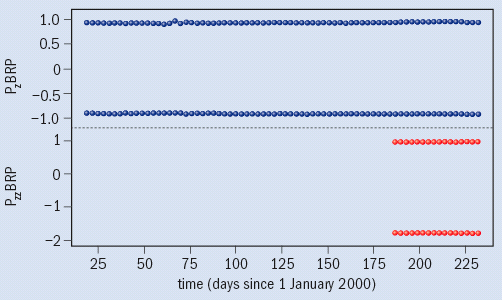
In 1998, the target was converted to one of longitudinally polarized deuterium with nuclear spin one. This allowed not only vector polarization Pz but also second-rank tensor polarization Pzz to be produced. The latter is related to the structure function b1 of the deuteron, which HERMES measured for the first time. Owing to the low magnetic moment of the deuteron, decoupling of nuclear and electron spin at the guide field of 0.33 T was nearly complete, resulting in close to ideal performance, i.e. no detectable depolarization by the cell walls. In addition, recombination to molecules was also negligible. The experiment collected a large data sample of high-quality deuterium data, in particular during the successful run in 2000. The extremely stable target performance during this run is shown in figure 2.
CCEthe3_04-06

For the next phase, from 2001 to 2005, a transversely polarized hydrogen target was required to study transversity, the last missing leading-twist structure function of the nucleon. For this purpose, a dipole magnet with a large gap and high uniformity was developed with a field limited to 300 mT. This resulted in acceptable synchrotron radiation power levels and high target polarization.

All the running with the polarized target at HERMES was performed in parallel with the operation of the collider detectors H1 and ZEUS. The areal density achieved with the storage-cell target was only about an eighth of the density allowed before it would adversely affect the stored electron beam. There were also special studies using unpolarized gas such as H2, D2, He, N2, Ne, Ar, Kr and Xe in the target cell. In this case the density was chosen according to the maximum allowed reduction of the electron-beam lifetime, yielding higher statistics relative to running with the polarized target. In additional special end-of-fill runs, when the collider experiments were switched off, the remaining beam of 12-15 mA was consumed within about an hour at extra-high densities, yielding high statistics data samples with little extra time.

End of an era

In the course of running the HERMES experiment, the physics interest has moved from semi-inclusive to exclusive measurements, such as deeply virtual Compton scattering). Clean exclusive measurements require the detection of recoil particles, e.g. the proton. However, a recoil detector turned out to be incompatible with the polarized storage cell. Therefore, the HERMES collaboration decided to run during the final phase from 2006 to 2007 with a recoil detector in addition to the standard forward spectrometer and an unpolarized high-density, very compact storage-cell target. On 13 November 2005 polarized running ended and the target was removed. Commissioning of the recoil detector to replace the target set-up began in February 2006.

The removal of the target marks the end of a very fruitful era extending over 20 years. Groups from Beijing, Erlangen, Ferrara, Heidelberg, Liverpool, Marburg, Munich, Wisconsin, Yerevan and elsewhere have contributed to the target’s outstanding performance and stability. In this way, the original idea for FILTEX, which led to the HERMES target, has enabled 20 years later a wealth of new results on nucleon-spin structure. Fortunately, after ten years of operation in HERA, there is a good chance that the present target may serve future experiments. The project for the Facility for Antiproton and Ion Research (FAIR) at GSI, Darmstadt, with its planned antiproton source, has again stimulated interest in using spin filtering to produce polarized stored beams of antiprotons, this time for measurements by the Polarized Antiproton Experiments (PAX) at the facility’s High Energy Storage Ring. Tests with protons and antiprotons in preparation for PAX are foreseen at Forschungszentrum Jülich and CERN. The HERMES target may thus play a key role in paving the way for a new experiment at FAIR, aimed at studying hadron structure in the interaction of polarized protons with polarized antiprotons.

• The contribution of numerous students, postdocs, senior scientists and technicians to the unprecedented performance of the HERMES target is gratefully acknowledged. Special thanks are owed to my colleagues G Court, P Dalpiaz-Ferretti, D Fick, G Graw, W Haeberli, B Povh, and K Rith; to P Lenisa, the target coordinator from 2000 to 2005; to the funding agencies, in particular the Bundesministerium für Bildung und Forschung in Germany and INFN in Italy; and to the HERMES and DESY management.

The operation and performance of the hydrogen and deuterium target over the full running period are summarized in a paper (Airapetian et al. 2005) in which many additional references can be found.

Nucleon form factors stride into the future

Form factors are the most fundamental dynamical quantities for describing the inner properties of a composite particle. The nucleon form factors provide detailed information about the spatial distribution of charges and currents in the nucleon.

CCEnuc1_04-06

They are directly accessible from experiment by differential cross-section and polarization observables and from theory by all nucleon models as they enter explicitly in the expression of the hadronic current. On 12-14 October 2005 the first workshop specifically dedicated to a global view on electromagnetic hadron form factors in both space-like and time-like regions was held at the INFN-Laboratori Nazionali di Frascati (LNF). The N’05 Workshop on Nucleon Form factors attracted 85 participants from 18 countries. Forty-five talks, followed by animated discussions during breaks and dinners covered the most recent findings, ideas and suggestions for future developments in experiments and theory.

After the opening welcome from Mario Calvetti, director of the LNF, Antonino Zichichi of Bologna and CERN presented a vivid historical introduction to the topic of electromagnetic form factors. He recalled his first measurements at CERN in 1963, and underlined the role played by Frascati in the field, in particular for time-like neutron form factors, where the only existing data were collected by the FENICE collaboration at the end of 1980s. He also discussed the role that Frascati could and should play in the future.

The experimental evidence, that form factors are twice as large in the time-like region as in the space-like region and that time-like neutron form factors are much larger than time-like proton form factors, could be owing to a possible NBar resonance below threshold. Discovering and studying the properties of this resonance through dedicated and precise measurements in the threshold region would be an important step in understanding nucleon structure and nucleon spectroscopy. In Zichichi’s opinion, this is one of the 10 most compelling problems in high-energy physics, which he listed in his impressive review. Dan Olof Riska of Helsinki underlined the importance of precise data on all hadron form factors – transition, axial, and strange. He drew particular attention to the role of two-photon exchange in solving the discrepancy among electric proton form-factor data, and the importance of the pion cloud in the nucleon structure.

The first session following the overview was dedicated to the current status of the research programmes at Jefferson Lab, the Bates Linear Accelerator at the Massachusetts Institute of Technology and at the Mainz Microtron. Presentations paid special attention to the discrepancies among the recent precise measurements of the electric proton form factor at large values of momentum-transfer squared, Q2, whether measured through the recoil proton-polarization method or via the unpolarized differential cross-section in elastic electron-
proton scattering. Polarization measurements have been implemented only recently, after the advent of high-luminosity polarized-electron beams and the development of hadron polarimeters and polarized targets. The surprising feature revealed by the polarization experiments, which are far more sensitive to the small electric contribution, is that the electric and magnetic distributions inside the proton are different, contrary to what was previously assumed and suggested by results from experiments based on the unpolarized method.

CCEnuc2_04-06

The search for a solution to this problem focuses on radiative corrections, particularly on the possibility of a mechanism where momentum is not transferred by only one photon, as generally assumed, but equally shared by two photons. This would change the angular dependence of the cross-section, and, at least qualitatively, provide a better agreement between the two sets of data. The presence of such a mechanism would make life much more complicated in all electron-induced reactions, and would call for a revision of many other sets of data. Two-photon exchange induces complex amplitudes, which should be mostly imaginary. A non-zero, but small imaginary part has been found in very precise measurements on parity violating terms, as Frank Maas of Mainz described, but no experimental evidence confirms the presence of the two-photon mechanism (real part) in the present data. Therefore, theoretical and experimental efforts continue and the question remains open. Such a mechanism should be more evident in the time-like region, where form factors are complex, and could be an interesting topic for the future at Frascati, with the DAFNE storage ring upgraded in energy.

Into the time-like region

The experimental situation in the time-like region was clearly described by Diego Bettoni of Ferrara, who pointed out that until now no separation of the electric and magnetic form factors has been possible, owing to the lack of statistics. He also drew attention to the importance of a precise measurement of the neutron form factors as well as of the relative phase of form factors and the role of the possible narrow resonance below threshold. Note that the Rosenbluth separation technique in the space-like region implies measurements at fixed Q2, which requires changing both the energy of the electron beam and the scattering angle of the emitted electron, whereas, in the time-like region, it requires a precise angular distribution of the emitted nucleon (or antinucleon) while keeping the beam conditions unchanged.

Form factors have been recently accessed from initial state radiation at the BaBar experiment at SLAC. The results, presented by Vladimir Druzhinin and Evgeni Solodov of Novosibirsk, are impressive and raise new questions about the ratio of the electric and magnetic form factors, GE/GM, near threshold. Contrary to measurements at CERN’s Low Energy Antiproton Ring, the new results show that GE/GM increases quickly and also reveal unexpected evidence for a step-like behaviour of the proton time-like form factor, at threshold, around 2.2 GeV and around 2.9 GeV.

Stanislav Dubnicka of Bratislava presented model-independent properties of polarization observables in the time-like region. The extension of this formalism has recently been derived for scattering and annihilation channels in the presence of two-photon exchange and was presented for proton-antiproton annihilation into two leptons by Gennady Gakh of Kharkov.

The strange and axial nucleon form factors are strongly related to the electromagnetic form factors, and their extraction from experimental observables is largely influenced by our knowledge of these quantities, thanks to the impressive precision that experiments have achieved. The first data from the G0 experiment at Jefferson Lab were presented during a review of current experiments on parity violation by Serge Kox of Grenoble. The precision of the measurement of the asymmetry in electron-proton unpolarized scattering – around 10-6 (parts per million) – is impressive, and the combined result is surprising, as it suggests a large and positive strange-proton form factor.

Theory and outlook

The session devoted to theory covered various nucleon models. Mauro Giannini of Genova and Gottfried Holzwarth of Siegen, for example, underlined the role of relativistic corrections in the constituent quark model, and in the soliton model, respectively. A global description of the four nucleon form factors in the space-like and time-like regions can be obtained by vector-dominance models and also through dispersion relations, which can be analytically continued to the time-like region. Simone Pacetti of Frascati presented an original approach based on an extrapolation from the time-like region of dispersion-relation requirements. This showed that BaBar data would constrain a zero of GE/GM in the space-like region.

Form factors are intimately related to other quantities describing the nucleon. For example, they provide a boundary for generalized parton distributions (GPDs), which are supposed to give a global, 3D picture of the nucleon. The connections with this important subject were discussed in a dedicated session. Recent results on real, virtual and deeply virtual Compton scattering (DVCS) show in particular that single-spin observables are very promising for selecting DVCS and describing the nucleon from GPDs. Nucleon polarizabilities, interpreted in the context of dispersion relations, also show evidence for a pion cloud. Peter Kroll of Wuppertal presented a first attempt to extract the GPDs from form-factor data from Jefferson Lab. A correlation with time-odd GPDs and a test of time-reversal invariance in electromagnetic interactions would be possible with a future energy upgrade of the DAFNE linac.

Looking to the future, plans for the Facility for Antiproton and Ion Research at GSI will allow precision form-factor measurements and access their phase, in particular in the region of large momentum- transfer. The PANDA experiment will allow proton time-like form factors to be measured individually and PAX will focus on polarized measurements. At the Budker Institute for Nuclear Physics in Novosibirsk, a measurement is planned at the existing linac of the two-photon contributions in electron/positron-proton scattering. An exploration of the proton form factor very near threshold is also foreseen at the new electron-positron collider, VEPP-2000. The meeting also heard about the future programme for BESIII, together with first results in the threshold region from the Bejing Electron-Positron Collider.

The project for a complete measurement of the nucleon form factors in the time-like region at Frascati with the upgraded DAFNE storage-ring, which has already triggered a great deal of interest within the community, was presented by Marco Mirazita of Frascati. An upgrade in luminosity and energy of the machine would provide a unique tool for measuring individual nucleon form factors, in particular for the neutron. The additional possibility of measuring the polarization of the outgoing nucleon would provide the first determination of the relative phase of the form factors, in addition to their moduli.

Stan Brodsky of SLAC concluded the meeting with a talk in which he stressed the importance of the high-momentum behaviour of form factors as a fundamental test of scaling in perturbative quantum chromodynamics (QCD), helicity structure and asymptotic freedom. He also showed the potentiality of a formalism based on duality between string theory in anti-de Sitter space and conformal field theory, which should provide a direct connection between QCD and nucleon amplitudes.

• N’05 was financially supported by Istituto Nazionale di Fisica Nucleare, the Hadron Physics Integrated Infrastructure Initiative and the US Department of Energy’s Jefferson Lab. For the full programme and the complete list of speakers see www.lnf.infn.it/conference/nucleon05.

What is the Electron?

by Volodimir Simulik (ed.), Apeiron. Paperback ISBN 0973291125, $25.

13339813

This collection brings together works by a number of authors, with the main purpose of presenting original papers containing new ideas about the electron. It thus provides different points of view on the electron, both within the framework of quantum theory and from competing approaches. Original modern models and hypotheses, based on new principles, are well represented. More than 10 different models of the electron are presented, and more than 20 models discussed briefly.

Accelerator Physics 2nd edition

by S Y Lee, World Scientific. Hardback ISBN 981256182X, £51 ($84). Paperback ISBN 9812562001, £27 ($44).

51DMR7KRTSL

Intended for use as a graduate or senior undergraduate text in accelerator physics and science, this book can also be used as preparatory material for graduate accelerator-physics students. The text covers historical accelerator development, transverse betatron motion, synchrotron motion, an introduction to linear accelerators, and synchrotron radiation phenomena in low emittance electron-storage rings, and introductions to special topics such as the free-electron laser and the beam-beam interaction. Each section is followed by exercises to reinforce the concept discussed and to solve a realistic accelerator design problem.

Fisica, Tecnologia, Economia (Physics, Technology, Economy)

by Elisabetta Durante (ed.), the Istituto Nazionale di Fisica Nucleare (INFN). Available from Presidenza INFN, Piazza dei Caprettari, 70 – 00186 Roma.

CCEboo2_04-06

This booklet is a collection of articles published in one of Italy’s most important newspapers, Il Sole 24 Ore @lfa, to celebrate the World Year of Physics in 2005. The authors are researchers and professors from INFN, the body that funds a major part of particle-physics research in Italy. Throughout the book, it is interesting to see the effort made to show how many important applications of particle physics there are in everyday life, and the strong links that exist between the complicated machines that serve this kind of research and the technological objects that we use every day.

The language is simple, the articles are short and, in my opinion, accessible to the lay public. For example, natural radioactivity is mentioned alongside archaeological lead in order to explain the basic functioning of the Cuoricino experiment in the Gran Sasso Laboratory. Each article about current theory and experiments is followed by a spotlight on the application that has resulted from the research.

Two sentences in the book are particularly striking: the first sentence of all, which states “Physics has already understood all the easy things,” and the last one, which reads “Young researchers who have experienced laboratories such as CERN are the best example of an effective technology transfer.” I am not sure about what can be defined as “easy to understand” in physics but I do agree with the importance of sharing knowledge and how much this is done in international laboratories such as CERN.

Drawing Theories Apart: the Dispersion of Feynman Diagrams in Postwar Physics

by David Kaiser, University of Chicago Press. Hardback ISBN 0226422666, ($80). Paperback ISBN 0226422674, ($30).

31PZQCqGHKL._SX331_BO1,204,203,200_

With the use of rich archival materials, interviews, and more than 500 scientific articles from the period, the author uses Feynman diagrams as a means to explore the development of American postwar physics. By focusing on the ways that young physicists learned new calculational skills, the story is framed around the crafting and stabilizing of the basic tools in the physicist’s kit, thus offering the first book to follow the diagrams once they left Feynman’s hands and entered the physics vernacular.

Secrets of the Old One: Einstein, 1905

by Jeremy Bernstein, Springer Science. Hardback ISBN 0387260056, €19.95 ($25).

Henri Poincaré and Relativity Theory by A A Logunov, Nauka. Hardback ISBN 5020339644.

CCEboo1_04-06

Bernstein’s book is wonderful and, as far as I can judge as a professional physicist, very pedagogical for non-specialists. My only complaint is the title, which I came to understand only on page 163. For me, the “Old One” was Albert Einstein himself and the “secrets” were about his love affairs, including the one with the Russian girl who tried to extract atomic secrets from him (Einstein knew nothing). However, Bernstein gives only a relatively brief account of Einstein’s life; on this subject there are many other more complete books available. What the author does instead is to delve into the past, as far as antiquity if necessary, and give the background to the three fundamental papers Einstein published in 1905 – special relativity, Brownian motion and the photoelectric effect – and, in fact, beyond, since general relativity is also mentioned.

In the course of the book Bernstein gives a wonderful lecture on the history of physics and chemistry, with colourful details about the main contributors: Epicurus, Lucretius, Galileo, Kepler, Newton, Bernoulli (one of them), Dalton, Avogadro, Maxwell, Smoluchowski, Perrin, Michelson, Lorentz, Poincaré and so on.

This brings me to Logunov’s book about Henri Poincaré and relativity. The author claims that the role of Poincaré in the advent of relativity was much more important than is generally believed. This does not contradict Bernstein; he is also full of admiration for Poincaré in general and for his contribution to the genesis of relativity theory in particular. Max Born once said, “The theory of relativity resulted from the joint efforts of a group of great researchers: Lorentz, Poincaré, Einstein, and Minkowski.”

Einstein never mentioned the contribution of Poincaré, which was slightly anterior and when, says Bernstein, Abraham Pais lent the text of Poincaré to Einstein, the latter returned it later without a word. Somehow it looks as though Einstein had decided to ignore Poincaré, which is difficult to understand when you see them both less than a metre apart at the 1911 Solvay Congress. However it is unclear whether Poincaré made the “big jump”, while Einstein certainly did. In a text quoted by Logunov, Poincaré says “If we are to accept the relativity principle…”, that is, there is an “if”. It should be said, however, that according to Bernstein, Poincaré also ignored the work of Einstein, although he did write a letter of recommendation for Einstein to obtain a position at the Federal Institute of Technology in Zurich in 1909. In this letter Poincaré does not mention the word “relativity” once.

The question will remain forever open. Can we blame Einstein for ignoring Poincaré? No more than we can blame Bach for copying Vivaldi’s concerto for four violins to transform it into the concerto for four pianos.

Where I cannot follow Logunov is the part in which he claims that Einstein’s theory of general relativity is useless and wrong. Logunov presents explanations of the twin paradox and the Sagnac effect using only Poincaré’s relativistic mechanics, but he does not seem to realize that we now have extremely refined tests of general relativity, and that the global positioning system could not work without relativistic corrections.

To conclude, I would say that, since the paternity of the Brownian motion theory is also controversial (what was the role of Marian Smoluchowski?), and since the importance of the 1917 paper on induced radiation was only realized later with the invention of the laser, I believe that the Swedish Academy, contrary to what I thought when I was young, was very wise in awarding Einstein’s Nobel prize “for services in theoretical physics, and especially for his discovery of the law of photoelectric effect”. For this Einstein had no competitor. Ironically this work led to quantum mechanics, with which Einstein was so unhappy: “the Old One [God] does not play dice”.

Selected Papers (1945-1980) With Commentary, 2005 edition

by Chen Ning Yang, World Scientific. Hardback ISBN 9812563679, £29 ($48).

media_10280740

First published more than 20 years ago, this collection of Chen Ning Yang’s personally selected papers has been reprinted with the edition of two further articles published in 2003 and 2005. Supplemented with Yang’s insightful commentaries, the book provides a valuable window on research in physics from the end of the Second World War to the beginning of the 1980s. It includes the seminal work with T D Lee on the non-conservation of parity and the work with R L Mills that led to modern gauge theories.

Progress in String Theory: TASI 2003 Lecture Notes

by Juan M Maldacena (ed.), World Scientific. Hardback ISBN 9812564063, £62 ($108).

41moAhmHQtL

Intended mainly for advanced graduate students in theoretical physics, this comprehensive volume covers recent advances in string theory and field theory dualities. It is based on the annual lectures given at the School of the Theoretical Advanced Study Institute (2003), a traditional event that brings together graduate students in high-energy physics for an intensive course given by leaders in their fields.

Theory of Neural Information Processing Systems

by A C C Coolen, R Kühn and P Sollich, Oxford University Press. Hardback ISBN 0198530234, £75 ($154.40). Paperback ISBN 0198530242, £30 ($64.50).

51ZDT7ZBQJL._SX344_BO1,204,203,200_

Presenting an explicit, coherent and up-to-date account of the modern theory of neural information-processing systems, this book has been developed for graduate students from any quantitative discipline, including physics and computer science. It has been class-tested by the authors over eight years and includes exercises, notes on historical background and further reading. Appendices provide further background, including probability theory, linear algebra and stochastic processes.

bright-rec iop pub iop-science physcis connect