by Edward V Shuryak, World Scientific. Hardback ISBN 9812385738 £75 ($101). Paperback ISBN 9812385746 £43 ($58).
This book is invaluable for particle and nuclear physicists and comprises extensive lecture notes on non-perturbative quantum chromodynamics. The original edition from 1988 had a review style. In this edition the outline remains, but the text has been rewritten and extended. As well as incorporating new developments, this edition has benefited from several graduate courses taught by the author at Stony Brook during the past decade. The text now includes exercises and about 1000 references to major works, arranged by subject.
by Alessandro Fabbri and José Navarro-Salas, Imperial College Press. Hardback ISBN 1860945279 £34 ($55).
This book gives a detailed and pedagogical presentation of the Hawking effect and its physical implications, and then discusses the backreaction problem, especially in relation to exactly solvable semiclassical models that analytically describe black-hole evaporation. The book aims to link the general relativistic viewpoint on black-hole evaporation and the new CFT-type approaches. The discussion on backreaction effects is valuable for graduate students and researchers in gravitation, high-energy physics and astrophysics.
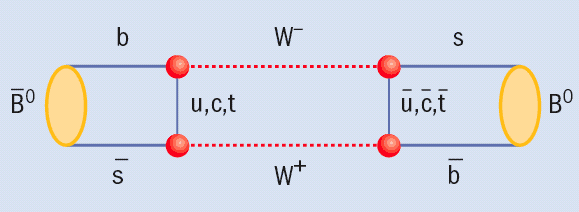
The D0 collaboration at Fermilab has published the first direct two-sided bound on the oscillation frequency of the B0s, the meson comprising a strange quark (s) and a bottom antiquark (Bbar). The result is consistent with what is expected from the Standard Model, within a 90% confidence level. The phenomenon in which a B0d meson (with a down quark, d, instead of the strange quark) converts into its antiparticle Bbar0d is well established, and its oscillation frequency Δmd has been measured precisely (Heavy Flavour Averaging Group 2006). The value of the corresponding measure of the oscillation frequency of a B0s meson into its antiparticle Bbar0s – Δms – was until now much more poorly known.
The D0 collaboration is an international team of 700 physicists from 90 institutions and 20 countries working at Fermilab’s Tevatron, which provides high-energy proton-antiproton collisions for two experiments, D0 and CDF. The data for the D0 result were taken from 1 fb-1 of total collision data, yielding more than a billion events (Abazov et al. 2006). The 90% confidence level means that the result does not qualify as a discovery, although it does provide a very strong indication. However, according to Rob Roser, co-spokesperson of CDF, within the next month or so the CDF collaboration should provide a result with greater precision.
The D0 result already provides some interesting constraints on supersymmetry. “The D0 value of 17 < Δms < 21 ps-1 limits the contributions to the oscillation process that could be made by supersymmetric particles,” explains D0 co-spokesperson Terry Wyatt, from the University of Manchester. “The basic idea is that supersymmetric particles may be exchanged in the box diagrams that are responsible for B0s mixing.” Several theoretical models of supersymmetry predict a much faster oscillation of B0s, and the D0 result now disfavours these models.
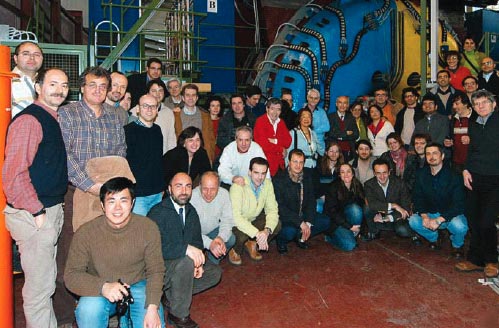
On 16 March, operation of the K Long Experiment (KLOE) detector ended after 23 months of continuous running at the DAFNE collider at Frascati. During this time the detector collected an integrated luminosity of 2.3 fb-1, corresponding to the observation of some 6.2 billion Φ decays. These data are in addition to the 450 pb-1 sample collected in shorter runs in 2000, 2001 and 2002.
DAFNE, the Frascati Φ-factory, has been performing increasingly well, delivering 200 pb-1 a month by the end of 2005. The efforts by the DAFNE and KLOE teams to ensure good data-taking conditions have resulted in their collecting a large homogeneous data sample in terms of machine background, beam energy and detector performance. Smooth trigger and data-acquisition operations, and continuous running of detector calibration ensured high-quality data.
KLOE has many unique aspects, in particular detector performance, the special environment at the Φ factory, the unique possibility of kaon species tagging, an open trigger and complete recording of all data. These allow the physics investigated to include such varied topics as precision measurements of kaon properties, the study of scalar mesons and the measurement of the hadronic cross-section at less than 1 GeV, which is necessary for calculating the muon anomaly. The Φ-meson decays are also a copious source of η and η’ mesons.
With the analysis of 450 pb-1 of data, KLOE has reached accuracies of a fraction of 1% in the measurements of the kaon absolute branching ratios and lifetimes. The results have already removed a problem with the unitarity of the quark-mixing matrix that dates back more than 30 years. The new data set will lead to improvements of all published results, especially in the Ks sector, and to new measurements of the poorly known hadronic cross-section near threshold.
DAFNE will resume operation by the FINUDA collaboration in a few months to investigate hypernuclei. Plans to upgrade the collider to DAFNE2 and the detector to KLOE2 are being studied.
The tracker for the CMS experiment at CERN passed an important milestone in March when the first cosmic-muon tracks were observed in one of the end caps. CMS is one of the two large multi-purpose detectors being constructed at the Large Hadron Collider. Its tracker system, comprising a barrel detector and two end caps, contains 25,000 silicon-microstrip sensors covering 210 m2, with 9.6 million electronic readout channels. Its construction involves teams from the whole of Europe and the US, with the final assembly at CERN.
The two tracker end caps (TECs) feature silicon-strip modules mounted on wedge-shaped carbon-fibre support plates, or “petals”. Up to 28 modules are arranged in radial rings on both sides of these plates; one eighth of an end cap is populated with 18 petals and is called a “sector”.
One of the TECs, TEC+, is being constructed at the RWTH (Rheinisch-Westfälische Technische Hochschule) Aachen and testing began earlier this year. A total of 400 silicon-strip modules are read out simultaneously, using close-to-final readout and power-supply components and data-acquisition software. The first sector has already been thoroughly tested, demonstrating a channel inefficiency of less than 1% and common-mode noise of only 25% of the intrinsic noise.
To understand the behaviour of the TEC sector better, including the response to real particles, basic functionality testing was followed by a run with cosmic muons. Thousands of tracks have been recorded and will be used to study tracking performance and to exercise various track-alignment algorithms.
The next important step will be to test the first sector under CMS operating conditions, with the silicon modules working at a temperature of less than -10 °C. The remaining seven sectors will then be assembled and in autumn the TEC+ will be delivered to CERN.
Almost every current theoretical model of neutrino masses introduces sterile (“right-handed”) fields, which mix with the ordinary (“left-handed”) neutrinos. Ordinary neutrinos have no electrical charge and interact through the weak force, but there may also exist rogue sterile neutrinos that feel only gravity. Most models make these new particles very heavy, while also trying to explain the small masses of ordinary neutrinos. Now Peter Biermann of the Max Planck Institut for Radioastronomy, Bonn, and Alexander Kusenko of University of California, Los Angeles, have suggested that if some of the sterile neutrinos are relatively light, they could resolve several astrophysical puzzles. In particular, sterile neutrinos with kilo-electron-volt (keV) masses could account for dark matter, the origin of the rapid motion of observed pulsars and re-ionization of the universe (Biermann and Kusenko 2006).
These relatively light sterile neutrinos were the topic of a recent workshop, Sterile Neutrinos in Astrophysics and Cosmology, held in Crans Montana in March. The meeting looked not only at how keV sterile neutrinos can solve a variety of problems in astrophysics, but also at how their existence might be detected.
Dark-matter sterile neutrinos could decay into a lighter neutrino and an X-ray photon, and this seems to be the most promising path to discovery. The workshop brought together particle physicists and X-ray observers, who presented the current limits and discussed ways to search for dark-matter neutrino decays. One important feature of dark matter in the form of the sterile neutrinos is the smoothing of structures on small scales. This “warm” dark matter – in contrast with the “cold” and “hot” alternatives – would be indistinguishable from cold dark matter on large scales, but it would yield stellar structures with the smallest size relative to the dark-matter particle mass. Recent studies of dwarf spheroid satellite galaxies have reported seeing the minimal halo size, indicative of warm dark matter.
The same decays into X-ray photons happening in the early universe could have produced enough ionization to catalyse a rapid production of molecular hydrogen, which is the most important cooling agent for primordial gas. Enriched with molecular hydrogen, haloes of gas would cool and collapse, forming the first stars. These stars could have re-ionized the universe, in agreement with observations of the Wilkinson Microwave Anisotropy Probe.
The role of sterile neutrinos in pulsars originates in supernova explosions, where sterile neutrinos with a mass of several keVs from the cooling nascent neutron star would be emitted preferentially in one direction, set by the star’s magnetic field. Although the neutrinos would not interact with the magnetic field, they would scatter off fermions polarized along the magnetic field in the neutron star. The anisotropy of sterile-neutrino emission would be sufficient to give the neutron star a recoil velocity of hundreds of kilometres a second. This agrees with observations of pulsars – magnetized rotating neutron stars – all of which have very large velocities. The origin of these velocities is a long-standing puzzle, which would have a simple explanation if sterile neutrinos exist.
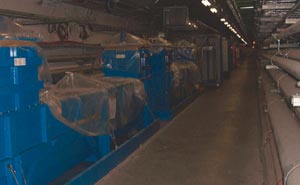
As the many pieces of the Large Hadron Collider (LHC) and its experiments come together at CERN, Canada’s contributions to the project are moving into their final positions. One of the hadronic end-cap calorimeters built at the Tri-University Meson Facility (TRIUMF) was recently installed in the ATLAS detector, and the first of the resistive twin-aperture quadrupoles for the “beam cleaning” regions in the LHC, designed at TRIUMF and built by Alstom Canada Inc, should be installed in the tunnel in June. However, the pulse-forming networks (PFNs) for the LHC injection kickers will soon become the first components from Canada to be completely installed.
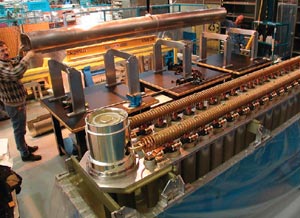
The LHC will have fast-pulsed magnet systems – the kickers – to inject the two proton (or heavy-ion) beams into the main ring. Two pulsed systems are required, each comprising four magnets, four PFNs and four high-voltage thyratron-based switches. Each PFN consists of two 28 cell, 10 Ω lines connected in parallel at their ends. To kick the beam buckets from the Super Proton Synchrotron into the LHC ring, each system must produce a magnetic field pulse of 1.3 T.m strength, with a rise time of not more than 900 ns, an adjustable flattop duration up to 7.86 μs, and a fall time of not more than 3 μs. The total ripple in the field must be less than ±0.5%.
The energy in a PFN is provided by a resonant-charging power supply (RCPS), which is used to reduce as much as possible the number of untriggered discharges of the thyratrons. The performance of the electrical circuit of the complete system, including a 66 kV RCPS and a 5 Ω PFN, was carefully simulated, and components were selected for the PFN on the basis of theoretical models in which a ripple of less than ±0.1% was attained.
As part of the Canadian contribution to the LHC, TRIUMF has built and tested in-house five RCPSs and nine PFNs. After shipment to CERN, the RCPSs and PFNs are thoroughly tested before insertion into the tunnel sections where injection into the LHC will occur. Installation began in May 2005, and the final systems should be installed this spring.
The first measuring period for external users at the vacuum ultraviolet free-electron laser (VUV-FEL), the new ultraviolet and X-ray radiation source at DESY, ended successfully on 27 February. Now the facility is gearing up for its second run in May.
The facility’s centre-piece is the 300 m long FEL, which is the world’s first – and until 2009, only – source of intense laser radiation at VUV and soft X-ray wavelengths. In January 2005, it generated its first laser pulses with a 32 nm wavelength, the shortest wavelength ever achieved with a FEL, and then started up for users in August. It is available for research groups from all over the world for experiments in areas such as cluster physics, solid-state physics, plasma research and biology. Four experimental stations are currently available, at which different instruments can be operated alternately.
Since the official start-up in August, a total of 14 research teams from 10 countries have carried out experiments ranging from generating and measuring plasmas to the first investigations of experimental methods for studying complex biomolecules, which will later be used at the European X-ray FEL (XFEL). As expected, the laser pulses of the VUV-FEL are shorter than 50 fs. This allows researchers to trace various processes on extremely short time scales by taking time-resolved “snapshots” of the reaction process. Investigating such time-resolved processes with radiation of short wavelengths is one of the most important new applications of this kind of X-ray laser.
Before user experiments resume in May, the DESY team is carrying out machine studies to improve the stability of the facility, increase the energy of the laser pulses, and shorten the wavelength of the radiation to around 15 nm. At the same time, various studies are being done to prepare for the planned XFEL, which will be 3.4 km long and generate even shorter wavelengths, down to 0.085 nm, when it comes into operation in 2013. The VUV-FEL should produce its shortest wavelength of 6 nm in 2007, after an additional accelerator module is installed.
NASA’s Wilkinson Microwave Anisotropy Probe (WMAP) collaboration has finally released new observations of cosmic microwave background (CMB) radiation with updated results on the nature and origin of the universe. Three times more data and improved analyses give strong constraints on all cosmological parameters and provide evidence supporting the inflation scenario.
The long silence following the release of the first-year WMAP results in February 2003
(see CERN Courier April 2003 p11) has been the subject of much speculation. Did the team find a problem affecting these results? Did they find something extraordinary? Are they in great trouble with instrumental effects or foreground emission for which they cannot properly account? In fact none of these was the case, the WMAP science team simply wanted to have the most reliable results to be published together. This eventually happened without much prior notice on 16 March at 1700h GMT. Within minutes, the press release, images and the four scientific papers were all available on the Web. In view of the amount of information in the 280 pages submitted to the Astrophysical Journal, it is easy to see that this could not have been prepared much faster.
The addition of two years of observations did not lead to a revolution in the field, but rather confirmed and refined the results of the first year. As well as the CMB’s thermal fluctuations, the complementary polarization data have now been released. Combining the WMAP data with all kinds of other observational constraints from different missions and experiments, it seems that the main cosmological parameters are now well determined assuming cold dark matter (CDM) together with a cosmological constant (ΔCDM).
Specifically, the universe is 13.8 billion years old and its current expansion rate is characterized by a Hubble constant, H0 = 71±2 km/s/Mpc. Baryonic matter (basically atoms) constitutes only 4.4±0.3% of the matter-energy content of the universe, the rest being CDM of unknown nature (22±2%) and dark energy (74±2%). The combination of data from WMAP and the Supernova Legacy Survey gives a strong constraint on the equation of state of dark energy, w = -0.97±0.08, which leaves not much freedom for something – like phantom energy if w<-1 or quintessence if w>-1 – other than a pure cosmological constant (see CERN Courier May 2003 p13). This result does not rely much on the assumption of a spatially flat universe, which is well confirmed by the observations anyway. The epoch of re-ionization by the first stars is now found to be at a redshift of 7-12 , which is later by a factor of two than suggested by the earlier data. Finally, the results yield an upper limit of 0.68 eV for the sum of the neutrino masses.
What is really new in these latest results is the ability to constrain inflation models based on the full-sky polarization map. According to the inflationary scenario, the origin of the CMB fluctuations are quantum fluctuations scaled up by a factor of 1030 during the first instants (∼10-34 s) after the Big Bang. In the simplest inflationary models this would lead to a roughly scale-invariant spectrum of density fluctuations corresponding to a power-law index of n = 1 or slightly less. This is exactly what was found with the new WMAP data, which yield n = 0.94±0.02, showing a small but significant deviation from scale invariance in the sense that the largest-sized fluctuations are the strongest. The opposite behaviour was predicted by more complicated hybrid models, which now appear to be ruled out. This result also implies that primordial gravitational waves would have a relatively high amplitude not far below the current detection threshold. Detecting their signature in the CMB polarization map would be a stunning confirmation of inflation and is therefore an important goal for ESA’s Planck mission to be launched in 2008.
Last year was a time for rejuvenation and building at CERN as a major part of the accelerator complex was shut down while preparations for the Large Hadron Collider (LHC) took place. During the shutdown, which started in November 2004 and continued throughout 2005, the Proton Synchrotron (PS) and the Super Proton Synchrotron (SPS) began an extensive renovation programme that will continue into the next decade. The LHC will depend on the injector complex that feeds it to deliver reliable and top-performance beams when it starts up in 2007. This comprises Linac2, Linac3, the PS Booster, the Low Energy Ion Ring (LEIR) and the PS and SPS.
The programme to renovate the main magnets of the PS, which has been operating since 1959, benefited from the long shutdown. The oldest accelerator of the injector complex had shown signs of its age, going offline for two weeks in 2003 when two magnets failed. The magnets were replaced, but to ensure it is in good condition when the LHC is turned on, the PS and CERN’s other accelerators in the LHC injector chain started a consolidation programme. By renovating parts that are at the end of their useful life and updating obsolete components and systems, the consolidation programme intends to identify and resolve potential problems before operations are affected.
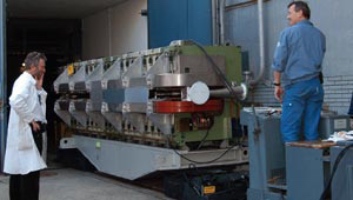
Wear and tear in the PS, which was still equipped with many of its original components, resulted from radiation degrading the materials and mechanical fatigue from pulsed magnetic forces. During 2005, 25 of the 100 main magnets were removed, renovated and re-installed in the PS tunnel. To move the 35-tonne magnets from the tunnel to the workshop in nearby building 180, the 45-year-old PS locomotive was restored. In the workshop, teams from the Budker Institute of Nuclear Physics (BINP) in Novosibirsk, supervised by specialists from CERN, replaced the coils and pole-face windings and re-glued loose laminations. After testing, the renovated magnets were re-installed in the tunnel and re-aligned, ready for start-up in April 2006.
The SPS has also shown signs of age. In 2005, leaks appeared in the hydraulic circuits of some of the accelerator’s dipoles, but after a thorough investigation, a way was found to make repairs. Those repairs and other upgrades will be completed during the 2006-07 shutdown.
New construction
The SPS is almost the last link in the chain that will supply beams to the LHC. The final connection will be made by two transfer lines, TI 2 and TI 8, that will take beams from the SPS. TI 8 was commissioned in 2004, and progress continued on TI 2 during 2005, with components installed and tested up to some 250 m before the shaft where the LHC magnets start the underground journey to their final locations. Upstream of TI 2, the beam extraction in the long straight section of the SPS has been converted into a fast extraction. Four upgraded kicker magnets have been installed to deflect the beam into the gap of existing septum magnets, which bend the beam horizontally out of the SPS ring. New extraction protection devices have also been installed to cope with the high-intensity beam for the LHC.
The recent shutdown also allowed time to work on Linac3 and LEIR. Together, they will provide heavy-ion beams to the LHC experiments in 2008. LEIR is the successor to the Low Energy Antiproton Ring and reuses much of the former machine’s equipment. At the beginning of 2005, Linac3 was equipped with a new 14.5 GHz electron cyclotron resonance ion source (ECRIS) to increase the beam intensity. The configuration of the source was based on R&D done under a European Framework 5 project and the source itself was supplied by the Commissariat à l’Energie Atomique, Grenoble. In spring 2005 a beam was transported successfully from Linac3 to LEIR through the transfer line, which had been almost completely rebuilt.
LEIR itself was installed last summer and commissioning began when the first beam (of O4+ ions) was run in October. Preparation then began for the first studies of electron cooling, using collisions with an electron beam in a section of LEIR to reduce the dimensions of the ion beam. This focuses the beam and frees space to accumulate several pulses from Linac3 in LEIR. The cooling system, built by BINP, has been commissioned with electrons and the strong perturbations its magnetic system has on the ion beam have been corrected. The first cooling measurements took place at the end of the 2005 run, and the goal is to complete commissing in 2006.
The new control centre
While various teams worked on improvements needed for different aspects of the LHC’s operation, others were working to bring control of the future accelerator complex together in one room. The new CERN Control Centre (CCC) began operating on 1 February 2006 and was officially inaugurated on 16 March in a ceremony with members of the CERN Council.
The CCC, a sleek, futuristic room filled with a multitude of monitoring screens, combines the control rooms of all the laboratory’s accelerators, as well as piloting cryogenics and technical infrastructures. The new centre has 39 control consoles laid out in four zones, one dedicated to each of the technical infrastructure, the PS complex, the SPS and the LHC. The cryogenics consoles are positioned between the LHC zone and the technical infrastructure zone. During peak operation periods there could be up to 13 operators working on any one shift, not counting the many experts responsible for assisting them. Built and installed in just 15 months, the centre is the first part of the LHC project to start up. The operators for accelerator testing are already on site, as the machines spring back into life.
By bringing together all of the operators and facets of the LHC injector chain, the CCC will guarantee a high-quality beam. It will also manage the beams to other experimental facilities at CERN. Similar to a rail network that uses the same infrastructure to send passengers towards various destinations, the accelerators of CERN can transport several beams simultaneously and adapt each one to a given facility. The PS, for example, can prepare beams for the LHC while also feeding the Antiproton Decelerator (AD) and fixed-target experiments at the SPS. This multitasking is an important feature of accelerator and beam operations at CERN.
Now the machines are all coming back to life. The Isotope Separator On Line facility (ISOLDE) already started operation in April. Serviced by the PS Booster, ISOLDE had run during 2005, when it received record numbers of protons from the booster, as the PS and SPS were not operational. The PS service to the East Hall is scheduled to recommence on 22 May, and the AD should start up on 6 June. As of 15 June the SPS will provide the beam for the North Area, where several fixed-target experiments will be ready and waiting. On 29 May however, a major new project will come to life as commissioning begins for the CERN Neutrinos to Gran Sasso project. This facility will mark a new phase in the 30 years of the SPS when it delivers protons to generate a beam of neutrinos that will travel underground 730 km to the Gran Sasso Laboratory in Italy. It will continue the tradition of neutrino beams at CERN, which began with the PS and then moved to the SPS, and will test the recent improvements to the accelerator complex as the countdown continues towards the LHC start-up.
To provide the best experiences, we use technologies like cookies to store and/or access device information. Consenting to these technologies will allow us to process data such as browsing behavior or unique IDs on this site. Not consenting or withdrawing consent, may adversely affect certain features and functions.
Functional
Always active
The technical storage or access is strictly necessary for the legitimate purpose of enabling the use of a specific service explicitly requested by the subscriber or user, or for the sole purpose of carrying out the transmission of a communication over an electronic communications network.
Preferences
The technical storage or access is necessary for the legitimate purpose of storing preferences that are not requested by the subscriber or user.
Statistics
The technical storage or access that is used exclusively for statistical purposes.The technical storage or access that is used exclusively for anonymous statistical purposes. Without a subpoena, voluntary compliance on the part of your Internet Service Provider, or additional records from a third party, information stored or retrieved for this purpose alone cannot usually be used to identify you.
Marketing
The technical storage or access is required to create user profiles to send advertising, or to track the user on a website or across several websites for similar marketing purposes.