Comsol -leaderboard other pages

Topics

Higgs: The Invention and Discovery of the ‘God Particle’

By Jim Baggott
Oxford University Press
Hardback: £14.99 $24.95

CCboo1_10_12

Jim Baggott is the author of The Quantum Story, an exceptionally interesting and detailed “biography” of quantum physics, very nicely exposed over almost 500 pages. Having had the pleasure of reviewing this wonderful book for the CERN Courier, I was quite happy to learn, through a text by Steven Weinberg that appeared on 9 July this year on The New York Review of Books (NYRB) website, that Baggott had written a new book, succinctly titled Higgs. However, I was perplexed to realize that the new book had been finished just two days after the seminar at CERN on 4 July, when the ATLAS and CMS collaborations announced “the discovery of a new particle that seems to be the long-sought Higgs particle” (to quote Weinberg). Indeed, most of the book had been written well before, in anticipation of the day when the discovery would be announced.

Unfortunately, I became rather disappointed soon after getting my hands on the new book. Apart from Weinberg’s “foreword” (most of it available through the NYRB blog) and from the final chapters, most of the book left me with a feeling of “déjà vu“, constantly reminding me of pages from The Quantum Story. As the author writes in the preface, “the present book is based, in part, on that earlier work”. Some sentences were refurbished and some (not all) minor mistakes were corrected, but if you have read the original you will feel that much of the new book is a “remake”. At least Baggott has added a few Feynman diagrams, which were clearly lacking in The Quantum Story, such as the one relating the GIM mechanism to the dimuon decay of the neutral kaons, but a lot more illustrations (and a few equations) could have been included to facilitate the understanding of certain narratives.

The final three chapters of Higgs, written specifically for the new book, should have gone through an extra round of editing to eliminate several imperfections. For instance, the general reader will be puzzled when reading that the CMS collaboration is led by Guido Tonelli (page 188), that the CMS spokesperson is Tejinder Virdee (page 189) and that Joe Incandela is “acting as spokesperson for CMS” (page 215); the three sentences were no doubt correct when they were written but producing a good book implies more than copy/pasting sentences written over a period of several years. In general, the original chapters provide enjoyable reading but some details reveal that the author followed the action from far away and, in a few instances, became sidetracked by blog-driven animation. This constitutes an eye-opening experience for some readers (such as myself). Having followed the reality of the discovery as an insider and now seeing how things are written up in a popular-science book will allow me to assess the kind of “acceptance correction” that I should apply to analogous descriptions of the many things of which I have no direct knowledge. As an aside, I was amused to see that Baggott decided to illustrate the LHC’s achievements using a dimuon mass distribution that I helped to prepare but astonished to see that an error was introduced in the CMS Higgs plot when restyled for inclusion in the book. Things were really done too much in a hurry.

If you are looking for a good book to read over the end-of year break, I highly recommend The Quantum Story, a dense plot with heroic characters, covering the fantastic odyssey of quantum physics. But how many of us have crossed paths with Einstein, Bohr, Pauli or Dirac? It is refreshing to read books about present-day physics and physicists, where one can enjoy the plot and recognize the main characters. In that respect, Higgs is an interesting alternative and has the advantage of being much faster to read. Another option for people specifically interested in reading about the “hunt for the God particle”, is Massive, by Ian Sample, an easy-to-read, lively book that gives a fast-paced and well humoured overview of the history behind and surrounding the Higgs boson, until mid-2010, although the reader needs to be patient and ignore the annoying detail of seeing CERN written as Cern and RHIC as Rick … oh, well.

I am looking forward to reading more books about the LHC experiments and their discoveries, concerning Higgs physics and other topics, written by people who made those experiments and those discoveries. These are important issues and they deserve being treated by professionals with direct knowledge of the inside action, who can provide much more information – and much more accurately – than (award-winning) popular-science authors.
De-squeezed beams for ALFA and TOTEM

CCnew1_10_12

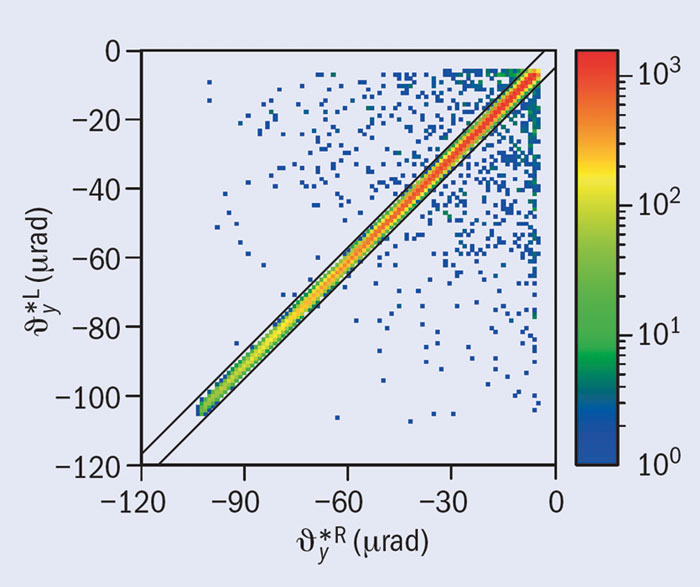
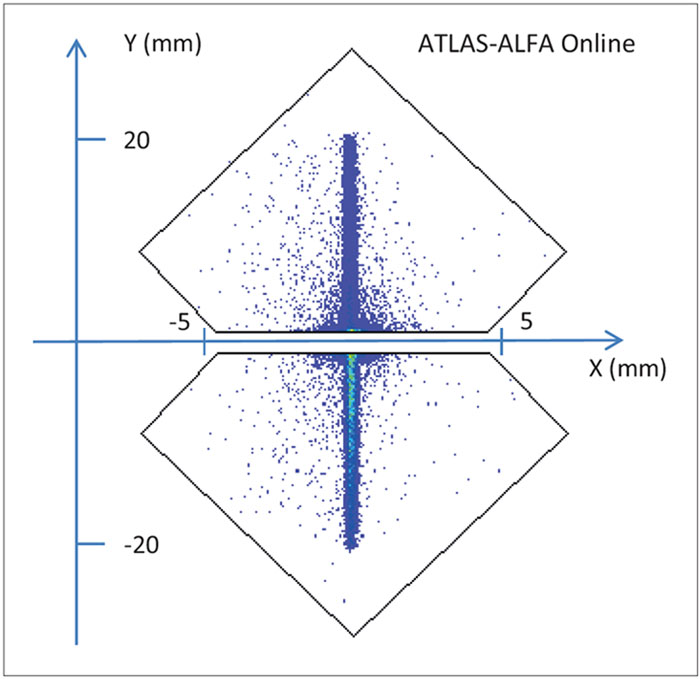
Following tests in September, a short, dedicated run at the end of October provided “de-squeezed” beams to the ALFA and TOTEM experiments, allowing new measurements of the elastic proton–proton cross-section.

To squeeze the beam and so maximize the number of collisions, LHC beams at full energy typically have a value of β* – the distance to the point where the beam is twice as wide as it is at the interaction point – 0.60 m. However, squeezing to a small beam increases the angular beam divergence such that elastic proton–proton scattering at small angles cannot be observed.

CCnew2_10_12

The TOTEM experiment has measured the elastic proton–proton cross-section in previous dedicated runs, resulting in a determination of the total proton–proton cross-section using the optical theorem. To observe the contribution of electromagnetic interaction (Coulomb scattering) and its interference with the nuclear component to the elastic cross-section, scattering angles of the order of 5 μrad have to be reached. Since the Coulomb scattering cross-section is known theoretically, its measurement also gives access to an independent determination of the absolute luminosity of the LHC.

For this recent special run, a new record value of β* = 1000 m was reached, making the beams at interaction points 1 and 5 almost parallel. The angular divergence of the beams at the interaction points was reduced by a factor of 40 compared with low-beta (high-luminosity) operation. These special settings allowed the ALFA and TOTEM experiments – at points 1 and 5, respectively – to measure proton–proton scattering angles down to the microradian level. The experiments’ Roman Pots were moved as close as 0.87 mm to the centre of the beam, which contained three bunches of 1011 protons each. At that distance the beam halo is intense and had to be reduced by an optimized collimation procedure that allowed a reduction of the halo background by a factor of 1000. This configuration enabled data-taking in good conditions for about an hour and, for the first time, ALFA and TOTEM could measure the elastic scattering in the Coulomb-nuclear interference region.

For future runs at 13 TeV, optics with β* of around 2 km will have to be developed. This will require the installation of additional quadrupole power cables in the LHC tunnel.

The Republic of Cyprus becomes CERN associate member state

On 5 October, CERN’s director-general, Rolf Heuer, and the minister of education and culture of the Republic of Cyprus, George Demosthenous, signed an agreement under which the Republic of Cyprus will become an associate member state in the pre-stage to membership. Before it comes into force, the agreement has to be ratified by the Parliament of Cyprus.

In the early 1990s, physicists from the Republic of Cyprus took part in the L3 experiment at CERN’s Large Electron Positron collider before joining the CMS collaboration in 1995. A memorandum of understanding was signed between the University of Cyprus and CMS in 1999 under which Cypriot physicists have contributed to the development of the solenoid magnet and of the CMS electromagnetic calorimeter. They are also involved in the physics analyses of the CMS experiment, including certain searches for the Higgs boson and beauty quarks.

The Republic of Cyprus is the third country to accede to the status of associate member state in the pre-stage to membership, following Israel in 2011 and Serbia earlier this year.

First results from proton–lead colliding beams

On 12 September, during a short, highly successful pilot run, the LHC operated with protons in one beam and lead ions in the other, so providing the LHC experiments with their first proton–nucleus collision data and opening new horizons for the heavy-ion community at CERN. During these few hours of pilot running, the ALICE experiment collected about 2 million events, sufficient not only to check the readiness of the detector for the long proton-ion run scheduled for the beginning of 2013, but also to perform a first analysis of the data and produce important physics results.

After the start of the heavy-ion physics programme in 2010, the LHC experiments obtained many striking results related to the formation of the hot and dense hadronic state of matter emerging from the collisions of lead nuclei. This state – the quark–gluon plasma (QGP) – is expected to manifest itself through various signatures, such as the suppression of high-energetic jets in the medium, collective particle motion, enhancement of strange-particle production and suppressed quarkonia production. In addition, surprising scaling effects were observed in the particle multiplicity compared with measurements at lower energies. However, given the complexity of the lead–lead (PbPb) colliding system, an important step in the quest for QGP lies in decoupling the effects of cold nuclear matter that arise at the initial stage of the collisions.

The proton–nucleus system represents the perfect benchmark for studying these effects because the colliding components are elementary and give rise to processes where the effects of the medium produced in the collision are either small or even totally absent. The collisions are also interesting because they allow the exploration of nuclear parton distributions in the region of small parton fractional momenta, which are so far unmeasured. Proton–nucleus collisions can therefore provide the data needed to understand better the properties of PbPb collisions at the energy of the LHC. The study of the dense initial state also provides access to a completely new QCD regime where the parton densities are expected to be saturated.

CCnew5_10_12

Using the newly acquired data, the ALICE collaboration has been able to measure the charged-particle multiplicity density in proton–lead (pPb) collisions at a centre-of-mass energy of √sNN = 5.02 TeV (ALICE collaboration 2012a). Figure 1 compares this measurement with two main groups of theoretical models. The first group consists of models that incorporate nuclear modification – for example, shadowing – of the initial parton distributions; the second includes various saturation models. While the current experimental and theoretical precision is not sufficient for a detailed comparison, the figure shows that the data are described best by the model where the gluon shadowing parameter (sg) is tuned to previous experimental data at lower energies. Saturation models predict much steeper dependence on the pseudorapidity, which is not confirmed by the measurement.

CCnew4_10_12

Another important result from the analysis of the proton–nucleus data concerns the charged-particle transverse-momentum spectrum and the corresponding nuclear-modification factor (ALICE collaboration 2012b). The latter is calculated using the proton–proton data at collision energies of 2.76 TeV and 7 TeV as reference (figure 2). The result clearly indicates little or no modification of the production of charged particles with transverse momentum greater than 2 GeV/c, thus confirming that the suppression of high-energy jets in PbPb collisions is not a result of cold nuclear-matter effects. The comparison with the available theoretical predictions suggests that the models require further development because they have difficulties in describing the multiplicity and the transverse-momentum spectrum simultaneously.

Measurement of photons stimulates quest for QGP temperature

One of the classic signals expected for a quark–gluon plasma (QGP) is the radiation of “thermal photons”, with a spectrum reflecting the temperature of the system. With a mean-free path much larger than nuclear scales, these photons leave the reaction zone created in a nucleus–nucleus collision unscathed. So, unlike hadrons, they provide a direct means to examine the early hot phase of the collision.

However, thermal photons are produced throughout the entire evolution of the reaction and also after the transition of the QGP to a hot gas of hadrons. In the PbPb collisions at the LHC, thermal photons are expected to be a significant source of photons at low energies (transverse momenta, pT, less than around 5 GeV/c). The experimental challenge in detecting them comes from the huge background of photons from hadron decays, predominantly from the two-photon decays of neutral pions and η mesons.

CCnew7_10_12

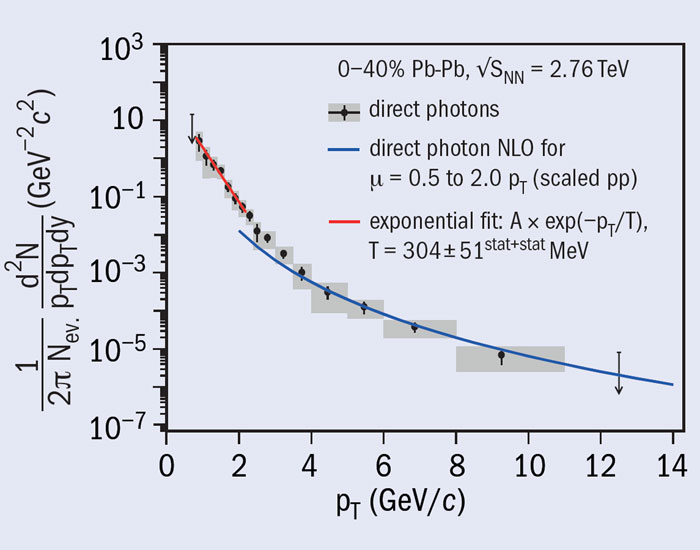
The ALICE experiment has measured photons produced in central PbPb collisions at a centre-of-mass energy per colliding nucleon pair, √sNN = 2.76 TeV, by reconstructing with the time-projection chamber the tracks of e+e pairs produced by the conversion of photons in the inner detectors. The same sample of photons was also used to measure the pT spectrum of neutral pions. The analysis found an excess of direct photons of around 15% for 1 < pT < 5 GeV/c compared with the calculated decay-photon yields from neutral pions, η mesons and other mesons, with a somewhat larger excess at higher pT.

Direct photons are defined as photons not coming from decays of hadrons, so photons from initial hard parton-scatterings (prompt photons and photons produced in the fragmentation of jets) – i.e. processes already present in proton–proton collisions – contribute to the signal. Indeed, for pT greater than around 4 GeV/c, the measured spectrum agrees with that for photons from initial hard scattering obtained in a next-to-leading-order perturbative QCD calculation. For lower pT, however, the spectrum has an exponential shape and lies significantly above the expectation for hard scattering, as the figure shows.

The inverse slope parameter measured by ALICE, TLHC = 304 ± 51 (stat.+syst.) MeV, is larger than the value observed in gold–gold collisions at √sNN = 0.2 TeV at Brookhaven’s Relativistic Heavy-Ion Collider (RHIC), TRHIC = 221 ± 19 (stat.) ± 19 (syst.) MeV. In typical hydrodynamic models, this parameter corresponds to an effective temperature averaged over the time evolution of the reaction. The measured values suggest initial temperatures well above the critical temperature of 150–160 MeV (approx. 1.8 × 1012 K) at which the transition between ordinary hadronic matter and the QGP occurs. The ALICE measurement also indicates that the LHC has produced the hottest piece of matter ever formed in a laboratory.

Leptons on the trail of the unexpected

Searches in LHC data that do not depend on specific theoretical models provide a valuable complement to optimized, model-dependent searches because they have the capacity to uncover hints of the completely unexpected. In this spirit, the ATLAS collaboration has recently looked for events with like-sign leptons and three or more leptons, using the full 2011 LHC data set of nearly 5 fb–1, in the pursuit of signs of new physics. Unfortunately, no excess events compared against the Standard Model have been observed. However, the analyses have provided the information needed to set limits on a range of models and to set limits on the production of doubly charged Higgs bosons.

Prompt like-sign lepton pairs are rarely produced in Standard Model processes but they may be produced by fourth-generation quarks, supersymmetry, universal extra dimensions or processes in non-Standard Model Higgs models or new models. A recent study by ATLAS selected isolated electrons and muons and divided the events into dielectron, dimuon, and electron-muon categories. This analysis yielded upper limits on the cross-section of anomalous production of like-sign lepton pairs ranging between 1.7 fb and 64 fb (ATLAS 2012a). An extension to the analysis set limits on the production of doubly charged Higgs bosons decaying to pairs of electrons or muons (ATLAS 2012b).

CCnew9_10_12

Events with three or more prompt leptons in the final state are also rare in the Standard Model. A recent search for multilepton events by ATLAS identified isolated electrons, isolated muons and hadronically decaying taus and found only 1827 events with three or more leptons. These events were divided into four categories; depending on whether or not a Z boson was reconstructed from two opposite-charge electrons or muons in the event, and whether or not a tau candidate was present.

The figure shows results for these four categories: the limits on the number of events from non-Standard Model sources have been calculated and converted into limits on the “visible cross-section”, i.e. the cross-section that is observable after event selection. The limits on the visible cross-section are given as a function of increasing lower bounds on the missing transverse momentum, a quantity that may be large in models with new physics. The smallest lower bound, “X”, is 0 GeV for the off-Z channels (no reconstructed Z) and 20 GeV for the on-Z channels (with reconstructed Z). Limits are shown for events with more than 100 GeV of transverse momenta for the jets in the event (HTjets); an upcoming publication includes the corresponding limits for lower values of HTjets and other variables of interest. These visible cross-section limits can be converted into upper limits on the cross-section for many specific models, including the doubly charged Higgs and new theories yet to come.

CMS homes in on the heaviest quark

The top quark is the heaviest point-like particle known. It weighs about as much as an atom of tungsten yet is an elementary building block of the Standard Model of particle physics. Its mass is one of the model’s important parameters and is directly related via radiative corrections to the masses of the W and Higgs bosons. Precise knowledge of the top quark’s mass is therefore extremely valuable to constrain theoretical models.

The CMS collaboration has measured the top-quark mass by exploiting all possible final states originating from different decays of W bosons produced in the decays of top quarks. Final states where the W boson decays into leptons are particularly “clean” (see figure). Such events are selected by requiring energetic jets in the central region of the CMS detector, of which at least one must be compatible with originating from a bottom quark (“b-tagged jet”), together with one or two isolated and high-energy leptons. The selected samples are extremely pure in top-quark-pair events, with estimated purities greater than 95% for events containing at least one electron or a muon.

CCnew11_10_12

For hadronically decaying W bosons, the reconstruction techniques make use of kinematic fits to improve the energy resolution and the likelihood methods that can handle the combinatorial ambiguities in finding the triplet of jets corresponding to the top-quark decay. The use of b-tagging helps considerably in constraining these ambiguities further. For dilepton events, the presence of two neutrinos accompanying the charged leptons from the W-boson decays requires alternative techniques.

All of the methods and channels used give consistent measurements of the top-quark mass. The results are now fully dominated by uncertainties other than statistical, with major contributions coming from the uncertainty associated with the jet-energy scale and how well the Monte Carlo simulations model the details of the top decay. The best single measurement of the mass of the top quark, from the e/μ+jets channel, results in a statistical uncertainty of 0.4 GeV and a systematic uncertainty of around 1 GeV.

The combined CMS measurement, accounting for correlations between uncertainties obtained in the individual channels, yields a total uncertainty of about 1 GeV. This result is already competitive (and in agreement) with the combined measurement from the CDF and DØ experiments at Fermilab’s Tevatron, as the figure shows. For a further reduction of the uncertainty, it will become important to employ novel measurement techniques.

CCnew12_10_12

The CMS collaboration has also measured the difference in mass between the top quark and its antiquark – an important test of the symmetry between matter and antimatter. This is done by splitting the sample of events with e/μ+jets into two subsamples with opposite lepton charges. The difference in quark–antiquark masses is compatible with zero with an uncertainty of about 0.5 GeV. This is the best precision on this mass difference to date.

After more than 15 years of precision top physics at the Tevatron, the baton in the race to understand nature’s heaviest quark has now passed to the LHC. With an uncertainty on the top-quark mass of 1 GeV, CMS is now at the forefront of precision physics in the top sector.

LHCb reports first 5σ observation of charm mixing

The large cross-section for charm production at the LHC, and the geometry and instrumentation of the LHCb detector, provide samples of charmed hadrons far larger than those accumulated by previous experiments. These allow the Standard Model to be tested by studying various interesting phenomena such as CP violation and mixing in D0 mesons.

The electroweak force can cause D0 mesons (consisting of a charm quark and an anti-down quark) to transform into their antiparticle, D0 (anti-charm and down), and back. Such “flavour oscillations” or “mixing” have been observed and studied in detail in K0, B0 and Bs0 mesons. In the charm system, however, the period of the oscillations is so long – over one hundred times the average lifetime of a D0 meson – that although the BaBar, Belle and CDF collaborations have reported strong evidence of the effect, none of them has been able to claim an unambiguous observation.

CCnew14_10_12

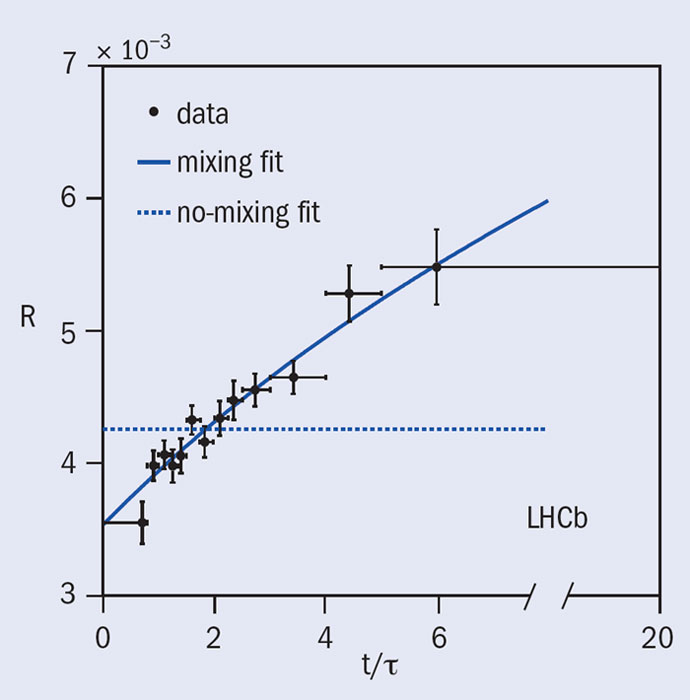
One of the best channels to search for charm mixing is the decay D0 → Kπ. The initial flavour can be identified by the charge of the accompanying pion in the decay D*+→D0π+ or D*–D0π. The mixing effect appears as a decay-time dependence of the ratio R between the number of reconstructed “wrong-sign” (WS) and “right-sign” (RS) processes: D0→K+π and D0→Kπ+, respectively, and their charge conjugates. The WS process can proceed either by a Cabibbo-suppressed decay or through flavour oscillation followed by a favoured decay. In the absence of mixing, R will be constant as a function of the D0 decay time, t, while, in the case of mixing, it is predicted to be an approximately parabolic function of t. Determining R in bins of t therefore allows a measurement of the mixing parameters, while also cancelling many potential sources of systematic uncertainty.

The figure shows the ratio WS/RS, measured by the LHCb experiment, as a function of decay time, from a total of 36,000 WS and 8.4 million RS decays selected from the 1.0 fb–1 of data recorded in 2011. The horizontal dashed line shows the no-mixing hypothesis; the solid line is the best fit to data when mixing is allowed. The clear time-dependence observed excludes the no-mixing hypothesis by 9.1σ. The oscillation parameters are determined with uncertainties about a factor two smaller than in previous measurements.

Since the Standard Model predictions for the mixing parameters have large uncertainties, the next step will be to focus on cleaner observables to search for possible contributions from new physics. In particular, LHCb is now well placed to investigate whether there is a CP-violating contribution to the oscillations, in contrast to the Standard Model expectation. This will be achieved by studying charm mixing in this and other decay channels and exploiting the large increase in data following the successful 2012 LHC run.

XMM-Newton discovers new source of cosmic rays

Researchers using the European X-ray astronomy satellite XMM-Newton have discovered a new source of low-energy cosmic rays in the vicinity of the Arches cluster, near the centre of the Milky Way. Their origin differs from that of higher-energy cosmic rays that originate in the explosions of supernovae.

Low-energy cosmic rays with kinetic energy less than half a billion electronvolts are not detected at Earth, since the solar wind prevents them from entering the heliosphere. Therefore little is known about their chemical composition and flux outside the solar system.

V Tatischeff, A Decourchelle and G Maurin, from the institutes of CNRS and CEA in France began by studying the X-ray emission that should theoretically be generated by low-energy cosmic rays in the interstellar medium. They then looked for signs of this in X-ray data collected by XMM-Newton since its launch in 1999. By analysing the properties of the X-ray emission of interstellar iron recorded by the satellite, they found the signature of a large population of fast-moving ions in the vicinity of the Arches cluster, about 100 light-years from the centre of the Milky Way. The stars in this cluster are travelling together at approximately 700,000 km/h. The cosmic rays are in all likelihood produced in the high-speed collision of the star cluster with a gas cloud in its path.

This is the first time that a major source of low-energy cosmic rays has been discovered outside the solar system. It shows that the shock waves of supernovae are not the only objects that can cause mass acceleration of atomic nuclei in the galaxy. These findings should make it possible to identify new sources of ions in the interstellar medium, and may lead to a better understanding of the effects of these energetic particles on star formation.

RIKEN gets clear view of element 113

Researchers at the RIKEN Nishina Center for Accelerator-based Science have obtained the most unambiguous data to date on element 113. A chain of six consecutive α decays, produced in experiments at the RIKEN Radioisotope Beam Factory, conclusively identifies the element through connections to well known daughter nuclides.

In the experiment at the RIKEN Linear Accelerator Facility in Wako, near Tokyo, Kosuke Morita and his team fired zinc ions travelling at 10% the speed of light at a thin target of bismuth and used a custom-built gas-filled recoil ion separator coupled to a position-sensitive semiconductor detector to identify the reaction products. On 12 August they detected the production of a very heavy ion followed by a chain of six consecutive α decays, which they identified as the products of an isotope of element 113. The chain began with the decay to roentgenium-274 (element 111) and ended in mendelevium-254 (element 101).

The team previously detected element 113 in experiments conducted in 2004 and 2005, but were then able to identify only four α decays followed by spontaneous fission of dubnium-262 (element 105), which is not a well known process. The decay chain detected in the latest experiments takes an alternative route via α-decay, the data indicating that the dubnium decayed into lawrencium-258 (element 103) and finally into mendelevium-254. The decay of dubnium-262 to lawrencium-258 is well known and provides unambiguous proof that element 113 is the origin of the chain.

bright-rec iop pub iop-science physcis connect