Comsol -leaderboard other pages

Topics

The changing world of EPJC

CCvie1_03_13

As the field of high-energy physics moves inexorably towards full open access, under the SCOAP3 agreement, it is worth noting a fact that is often overlooked by the scientific community, namely the concomitant affirmation of the role of scientific journals. Indeed, journals will continue to stand – if not for primary dissemination of information, for the continued, independent and, yes, competitive and occasionally controversial quality assessment. An ecosystem of dedicated journals is precisely what this requires, on top of open pre-“print” archives of equally undisputed role.

Yet, looking at the broader landscape of physics and beyond, open access has quite naturally also brought other changes, namely the emergence of “community journals”. By including a variety of kinds of article, these break with the traditional scheme of long established journals, which are typically devoted to single article types, such as letters, regular articles, technical papers or reviews. To promote and foster this development is precisely the aim of The European Physical Journal C – Particles and Fields (EPJC), where all types of publications relevant to the field of high-energy physics (including astroparticle physics and cosmology) are considered.

EPJC has recently seen a series of significant changes in its editorial board. Since January, Jos Engelen (a former research director at CERN) is the new editor-in-chief of the “Experimental Physics” section. He succeeds Siggi Bethke, who successfully co-ordinated this section of the journal until the end of 2012. A few months earlier, the board of theoretical physics editors of EPJC was significantly enlarged. In addition to the traditional board of editors covering the area of “Phenomenology of the Standard Model and Beyond” (now called Theory-I), which Gino Isidori has co-ordinated since the end of 2011, Ignatios Antoniadis (the current head of the Theory Unit at CERN) has taken charge of a largely new board of editors covering the areas of gravitation, astroparticle physics and cosmology, general aspects of quantum field theories and alternatives (Theory II).

The latter developments take into account in particular the ongoing rapid “merger” of accelerator-based particle physics with astroparticle physics and cosmology. The next step for our journal will thus be to reach out to experimental non-accelerator physics to provide a first unified platform as a “community journal” in this further extended sense.

Next to letters, regular articles and reviews (tutorial, specialist, technical, topical scientific meeting summaries), EPJC is particularly keen to develop its “tools” section. Neither theory nor experiment in the traditional sense, this section is a platform for publishing computational, statistical and engineering physics of immediate and close relevance for understanding technical or interpretational aspects of theoretical and experimental particle physics.

Last but not least, there is another aspect by which EPJC wishes to stand out, namely in terms of quality assessment. Taking a lead from Karl Popper, science is a social enterprise and humans react quite differently depending on whether they are solicited personally to comment on quality and relevance or just passively, e.g. as recipients of mailing lists or other automated systems.

At EPJC, three independent levels exist to ensure quality control, each mediated by direct communication as peers in the field: the editors-in-chief, the editorial board and the referees. All of them will have been involved in the assessment and decision-making process for every single paper, ensuring a personal, unbiased and fair implementation of the refereeing process, which remains at the core of the activity of any reputable journal.

SCOAP3

The SCOAP3 consortium (Sponsoring Consortium for Open Access Publishing in Particle Physics), which aims to convert journals in high-energy physics to open access, has chosen two Springer journals to participate in the initiative. They are the Journal of High-Energy Physics, published for the International School for Advanced Studies (SISSA) in Trieste, Italy, and The European Physical Journal C, published with Società Italiana di Fisica. The selection is the result of an open and transparent tender process run by CERN for the benefit of SCOAP3, in which journal quality, price and publishing services were taken into account

El ecologista nuclear

By Juan José Gómez Cadenas Espasa Calpe
Paperback: €22.95

Also published as:
L’ambientalista nucleare
Springer
Paperback: €25

E-book: €22.99
The Nuclear Environmentalist
Springer
Paperback: £24.99 €29.07
E-book: £25.99 €26.99

Juan José Gómez Cadenas is the director of the Neutrino Physics Group at Valencia University but is best known by the general public as a novelist – in 2008 he wrote Materia Extraña, a scientific thriller (The incurable attraction of physics) – and as an expert in science popularization. Even in a purely scientific environment he is able to deliver information in a most enjoyable way, as I found when I attended a scientific talk that he gave at CERN.

CCboo2_01_13

This same ease in communicating is recognizable in El ecologista nuclear, his book about the topic of renewable and green energy and the role of the nuclear energy. I read the Italian edition of the book and although I noticed that the translation was not always perfect and, especially in some cases, that it did not improve the quality of the reading, I really enjoyed the book and its factual approach to this delicate and controversial topic.

Gómez Cadenas makes his point of view clear in the first chapter: “All that glitters is not green.” This could shock the uninitiated because it immediately leads the reader to face “the problem”: climate change is a “bomb (that) has been activated” and humankind is “playing with fire”. The author does not just present this scenario as an opinion. Rather, he justifies all of his statements with graphs, scientific data and evidence.

The chapters that follow are a journey through the various solutions to the problem, in which he makes a strong case for the use of nuclear energy. Using data and graphs, he successfully proves that “safe” nuclear power is the only viable solution. I emphasize the word “safe” because this is the delicate point that matters most to the general public. Unlike other authors, instead of avoiding talking about the problem of safety, Gómez Cadenas discusses it openly, with constant reference to scientific data.

I like the book; I like the author’s open and honest approach, his competence and his rigorous summaries of a global problem that concern us all. I would recommend reading it before voting for any topic related to the energy problem on our planet.

Flavor Physics at the Tevatron: Decay, Mixing and CP Violation Measurements in proton-antiproton Collisions

By Thomas Kuhr
Springer Hardback: £117 €137.10
Paperback: £109 €119.19

The Tevatron collider operated by Fermilab close to Chicago was – until the LHC at CERN took over – the most powerful particle accelerator on Earth, colliding protons and antiprotons with, finally, a centre-of-mass energy of almost 2 TeV. Among many interesting results, the key discovery was the observation of the top quark by the CDF and DØ collaborations in 1995. In pp– collisions, huge numbers of B and D mesons are also produced, offering sensitive probes for testing the quark-flavour sector of the Standard Model, which is described by the Cabibbo-Kobayashi-Maskawa (CKM) matrix. A closely related topic concerns violation of the charge-parity (CP) symmetry, which can be accommodated through a complex phase in the CKM matrix. Physics beyond the Standard Model may leave footprints in the corresponding observables.

CCboo1_01_13

In this branch of particle physics, the key aspect addressed at the upgraded Tevatron (Run-II) was the physics potential of the B0s mesons, which consist of an anti-bottom quark and a strange quark. Since these mesons and their antiparticles were not produced in the e+e B factories that operated at the Υ(4S) resonance, they fall in the domain of B-physics experiments at hadron colliders, although the Belle experiment could get some access to these particles with the KEK B-factory running at the Υ(5S) resonance. Since the Tevatron stopped operation in autumn 2011, the experimental exploration of the B0s system has been fully conducted at the LHC, with its B-decay experiment LHCb.

The CDF and DØ collaborations did pioneering work in B physics, which culminated in the observation of B0s – B–0s mixing in 2006, first analyses of CP-violating observables provided by the decay B0s → Jψφ around 2008, and intriguing measurements of the dimuon charge asymmetry by DØ in 2010, which probes CP violation in B0s –  B0s oscillations.

The author of this book has been a member of the CDF collaboration for many years and gives the reader a guided tour through the flavour-physics landscape at the Tevatron. It starts with historical remarks and then focuses on the quark-flavour sector of the Standard Model with the CKM matrix and the theoretical description of mixing and CP violation, before discussing the Tevatron collider, its detectors and experimental techniques. After these introductory chapters, the author brings the reader in touch with key results, starting with measurements of lifetimes and branching ratios of weak b-hadron decays and their theoretical treatment, followed by a discussion of flavour oscillations, where B0s – B0s mixing is the highlight. An important part of the book deals with various manifestations of CP violation and the corresponding probes offered by the B0s system, where B0s → Jψφ and the dimuon charge-asymmetry are the main actors. Last, rare decays are discussed, putting the spotlight on the B0s → μ+μ– channel, one of the rarest decay processes that nature has to offer. While the book has a strong focus on the B0s system, it also addresses Λb decays and charm physics.

This well written book with its 161 pages is enjoyable to read and offers a fairly compact way to get an overview of the B-physics programme conducted at the Tevatron in the past decade. A reader familiar with basic concepts of particle physics should be able to deal easily with the content. It appears suited to experimental PhD students making first contact with this topic, but experienced researchers from other branches of high-energy physics may also find the book interesting and useful. Topics such as the rare decay B0s → μ+μ, which has recently appeared as a first 3.5σ signal in the data from LHCb, and measurements of CP violation in B0s decays will continue to be hot topics in the LHC physics programme during this decade, complementing the direct searches for new particles at the ATLAS and CMS detectors.

Proton–ion collisions: the final challenge

CCnew1_01_13

In the last beam period before a two-year shutdown, the LHC began 2013 with a challenge: proton–ion collisions. Following a trial run in September, the machine went into full operation beyond its design specification, producing head-on collisions of protons with lead nuclei from mid-January to mid-February. At 5 TeV per colliding nucleon pair, the gain in collision energy is a factor of 25 above previous collisions of a similar type, making it one of the largest such gains in the history of particle accelerators.

Commissioning this new and almost unprecedented mode of collider operation was a major challenge for both the teams behind the LHC and its injector chain. The LHC configuration had to be modified quickly before and during the short run to achieve a number of physics goals.

Nonetheless, on 11 January, single bunches of protons and lead nuclei were injected into the LHC and successfully ramped to full energy. Over the following night the LHC-operations and beam-physics teams sprang into action to commission and measure the optics through a completely new sequence to squeeze the beams at collision. Interventions on the power and cryogenics systems slowed down the commissioning plan but by 20 January stable beams had been achieved with 13 bunches per beam.

In the next fill of the machine, the first bunch-trains were injected, leading to stable beams with 96 bunches of protons and 120 of ions. This important fill allowed the study of “moving”, long-range beam–beam encounters. Stationary long-range encounters occur in proton–proton or lead–lead runs, when bunches in the two beams “see” one another as they travel in the same vacuum chamber on either side of the experiments. The situation becomes more complicated with proton–lead collisions because the long-range encounters move as a result of the different revolution times of the two species – a key feature of proton–lead operation.

At injection energy, lead ions travel more slowly than protons and complete eight fewer turns a minute round the LHC (674,721 turns compared with 674,729 turns for protons). As a result, the two beams – and their RF systems – run independently at different frequencies. Once the energy has been ramped up, the frequency differences become small enough for the RF systems to be locked together in a non-trivial process known as “cogging”.

During the first cogging exercises, high beam-losses triggered beam dumps. This was later found to be caused by an improper synchronization of the two RF frequencies, and careful fine-tuning of the cogging process overcame the problem. After the cogging exercise and throughout the physics fill, the beams run “off-momentum” with opposite offsets to their orbits, requiring special corrections of the beam optics.

The full filling-scheme with 338 bunches in both beams was injected and successfully ramped on 21 January. In addition, the teams achieved a record lead-bunch intensity in the LHC thanks to the excellent performance of both the machine and the injectors. From 24 January onwards the machine was running routinely with stable beams of 338 bunches of protons in ring 1 (clockwise) and lead ions in ring 2. On 1 February, the beams were swapped so that ALICE, inherently an asymmetrical detector, could take data in both directions. A number of issues with cogging and squeezing made this beam reversal challenging, with the machine providing collisions between 192 ion bunches with 216 proton bunches for some days before the operators attempted to reach 338 bunches in each beam by the end of the run on 11 February.

Despite the short time-frame of this asymmetrical run, all seven LHC experiments were able to take data. On a good day, fills had peak luminosity at the beginning of the collisions of around 1029 s–1 cm–2 in ALICE, ATLAS and CMS. Integrated luminosity was well above expectations at around 2 nb–1 a day for each of these experiments. This bodes well for the experimental analysis that will continue to go from strength to strength as the LHC enters its first long shutdown to consolidate and improve this impressive machine.

Source of lead ions

CCnew2_01_13

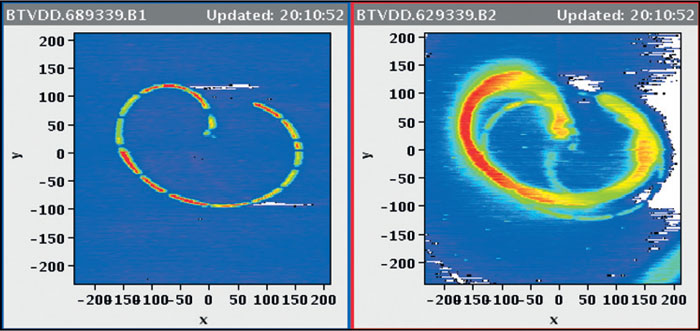
Every so often the source of the lead ions has to be replaced. A small sliver of solid isotopically pure 208Pb is placed in a ceramic crucible that sits in an “oven” casing at the end of a metal rod. The metal is heated to around 800°C and ionized to become plasma. Ions are then extracted from the plasma and accelerated. Depending on the beam intensity, in stable running the accelerator chain consumes about 2 mg of lead every hour – a tiny amount, but 10 g costs some SwFr12,000 (approx US$13,000). In this image the position of the oven is being measured inside the source for Linac 3.

ALICE and ATLAS find intriguing ‘double ridge’ in proton–lead collisions

In analysing data from last year’s test run with proton–lead collisions in the LHC, the ALICE collaboration, followed almost immediately and independently by the ATLAS collaboration, have announced a surprising observation in the way that particles emerge from the high-energy collisions. Here the two collaborations report on their results.

To prepare for the recent LHC run with collisions of protons and lead ions, the LHC team performed a test run for a few hours last September. During this run the ALICE experiment recorded close to two million events, which have already led to new results (CERN Courier December 2012 p6). Now, after an in-depth analysis, the ALICE collaboration has made the surprising observation of a double “ridge” structure in the correlation of particles emerging from the proton–lead collisions. This follows the observation by the CMS collaboration, using data from the same test run, of a “near-side” ridge-like correlation structure elongated in pseudorapidity – a measure of the angle an emerging particle takes relative to the direction of the beam (CERN Courier January/February 2013 p9).

The analysis performed by the ALICE collaboration characterizes two-particle angular correlations as a function of the event activity, which is quantified by the multiplicity, measured in a pair of forward scintillator detectors. The correlations are determined by counting the number of associated particles as a function of their difference in azimuth (Δφ) and pseudorapidity (Δη) with respect to a trigger particle, in bins of this particle’s transverse momentum pT, trig and associated transverse momentum pT,assoc.

On the “near side” (Δφ≈0), the separation of an Δη-elongated ridge structure from the contribution of a jet to the correlation is straightforward because the jet peak is concentrated around Δη= 0. It is more difficult on the “away side” (Δφ≈π) because both structures are elongated in Δη and not easily separable by selecting on Δη. Experimentally, however, the near-side jet peak shows only a weak evolution with event multiplicity. So by subtracting the correlations at different event multiplicities from one another, it is possible to remove the jet-like contribution of the correlation to a large extent and to quantify modifications as a function of event multiplicity.

Figure 1 shows the two-particle correlation of low-multiplicity events subtracted from that of high-multiplicity events. It reveals a distinct excess in the correlation, which forms two ridges along Δη. The ridge on the near side, qualitatively similar to the one observed by CMS, is accompanied by a second ridge of similar magnitude on the away side, which is observed for the first time.

Such double-ridge structures are typically found in collisions of heavy ions and have their origins in collective phenomena occurring in the quark–gluon plasma that is created. However, these phenomena are not generally thought to occur in proton–lead collisions, where the size of the collision region is expected to be too small to allow the development of significant collective effects.

The projection of figure 1 onto Δφ allows the yield and width of the near-side and away-side ridges to be quantified above a constant baseline. Figure 2 presents the ridge yield for different event multiplicities. It is remarkable that the near- and away-side yields always agree within uncertainties for a given sample despite the absolute values changing substantially with event multiplicity and pT interval. Such a tight correlation between the yields suggests a common underlying physical origin for the two ridges. The extracted widths on the near side and the away side agree with each other within 20% and show no significant dependence on pT, which suggests that the observed ridge is not of jet origin.

This intriguing and unexpected result still needs to be explained theoretically. Models that produce almost identical near- and away-side ridges are based on the colour-glass condensate framework or on hydrodynamical calculations that assume collective effects to occur also in proton–lead collisions. Whatever the origin may be, this observation has opened the window on a novel phenomenon. Further analysis of the high-statistics proton–lead data promises to yield exciting results.

Further reading

ALICE collaboration 2013 Phys. Lett. B 719 29.

Studies of two-particle correlations in high-multiplicity proton–proton and proton–lead collisions at the LHC have shown a phenomenon frequently referred to as the “ridge”. The ridge is a result of correlated production of particles at small relative-azimuthal angle (Δφ) over a wide range of relative pseudorapidity (Δη). Using data from the highly successful pilot proton–lead run on 12 September 2012, ATLAS has shown that the ridge has an identical twin resulting from correlated production of particles that are back-to-back in azimuth.

To observe this twin, ATLAS had to remove background in the two-particle correlation function arising from hard scattering processes, momentum conservation and low-momentum resonance decays. Two-particle correlations were measured as a function of the proton–lead total transverse energy (ΣET) detected in one of the ATLAS forward calorimeters. The contribution of the background to the two-particle correlations was found to be independent of ΣET. As a result, the background could be measured in low-ΣET proton–lead collisions, which have little contribution from the ridge, and then subtracted from the two-particle correlation function in high-ΣET collisions.

The left and right panels in the figure (above) show the two-particle correlation function before and after background subtraction, respectively. Before subtraction, the correlation function includes: a jet peak near Δφ = 0, Δη = 0; the previously observed ridge; and a broad structure arising from particles recoiling from the jet. The subtraction procedure removes the recoil contribution and nearly all of the jet peak, leaving behind two symmetrical ridges, extending over +/–5 units of Δη. The strength of the correlation increases with the transverse momentum of the particles over the measured pT range, 0 < pT < 6 GeV.

The presence of such a symmetrical ridge had been predicted by QCD calculations invoking the colour-glass condensate, which describes the gluon content of a high-energy nucleus in the saturation regime. Alternative calculations that model the system formed in proton–lead collision as a “near perfect fluid” have also predicted a symmetrical ridge arising from final-state collective motion similar to that observed in lead–lead collisions. The data collected during the recent 2013 high-luminosity proton–lead run should provide a way to resolve this theoretical ambiguity. The good news is that either explanation will represent a ground-breaking advance in the understanding of high-energy proton–nucleus collisions.

Further reading

ATLAS collaboration 2012 arXiv:1212.5198 [hep-ex], submitted to Phys. Rev. Lett.

First measurements of electroweak boson fusion

In proton collisions at the LHC, vector boson fusion (VBF) happens when quarks from each one of the two colliding protons radiate W or Z bosons that subsequently interact or “fuse” as in the Feynman diagram shown where two W bosons fuse to produce a Z boson. Each quark radiating a weak boson exchanges four-momentum, Q2, of around m2Z, m2W in the t-channel. In this way, the two quarks scatter away from the beamline, typically inside the acceptance of the detector where they can be detected as hadronic jets. The distinctive signature of VBF is therefore the presence of two energetic hadronic jets (tagging jets), predominantly in the forward and backward directions with respect to the proton beamline.

CCnew9_01_13

The study of VBF production of the Z boson is an important benchmark in establishing the presence of these processes in general and to cross-check measurements of Higgs VBF, where the radiated bosons fuse to form a Higgs boson. However, the VBF production of Z bosons has some intriguing differences with respect to that of Higgs bosons. In VBF Z-boson production, a large number of other purely electroweak non-VBF processes can lead to an identical final state and play an important role: they yield large negative interferences with the VBF production, which are related to the very foundations of the Standard Model. This situation makes VBF production of Z bosons more complicated but also more interesting.

CCnew11_01_13

An additional and peculiar feature of VBF and all other purely electroweak processes is that no QCD colour is exchanged in the processes. This leads to the expectation of a “rapidity gap”, or suppressed hadronic activity between the two tagging jets, which can also be identified in these events.

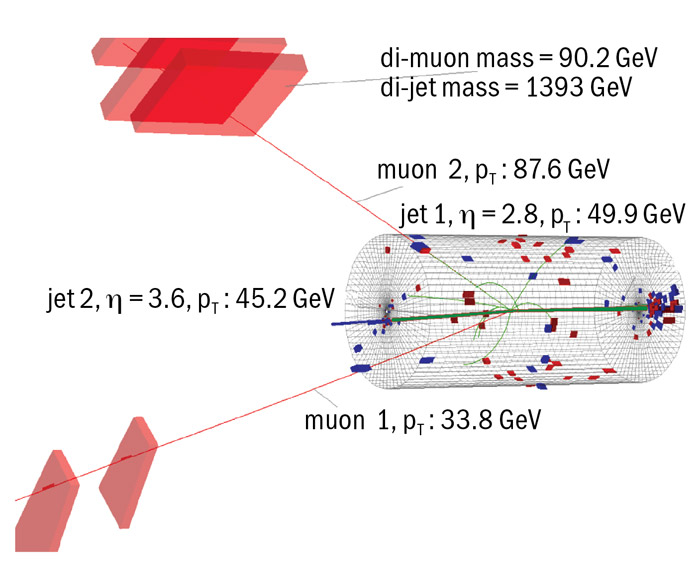
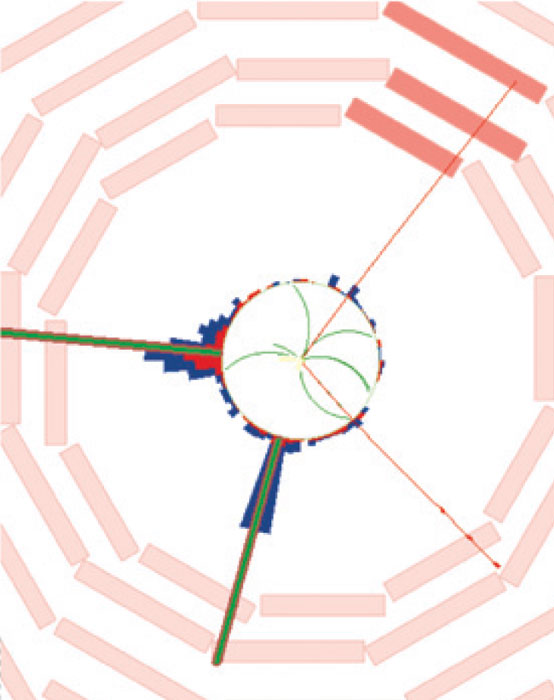
The CMS collaboration has searched for the pure electroweak production of a Z boson in association with two jets in the 7 TeV proton–proton collision data from 2011. They have analysed both dielectron and dimuon Z decays. The leptons are required to have transverse momenta pT > 20 GeV/c and pseudorapidity |η| < 2.4; in addition, the dilepton invariant-mass is required to be consistent with that of the Z boson. The two associated tagging jets are reconstructed with two alternative algorithms (“particle flow” and “jet-plus-track”) and are required to be within |η| < 3.6 and have pT > 65 GeV/c (for the leading jet) and 40 GeV/c (subleading jet).

CCnew10_01_13

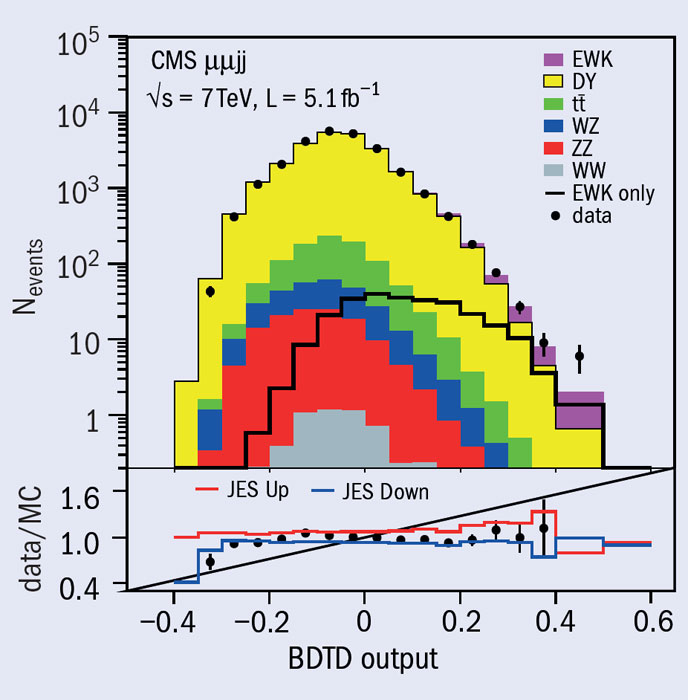
Selected events are passed to a multivariate boosted decision tree (BDT) that is trained to separate signal events from the large background stemming from the Z bosons produced via the Drell-Yan process and associated with two jets from additional QCD radiation. The BDT makes use of the full kinematic information of the three-body (Z+2jets) final state and of internal composition properties of the jet, which can discriminate if the jet originates from a gluon or a light quark. Figure 2a shows output distributions of the BDT for data and different simulated background components, as well as the simulated signal (purple) for selected dimuon Z decays. A fit to the BDT output distribution was used to measure the signal cross-section, σ(EWK Z+2jets) = 154 ± 24 (stat.) ± 46 (exp. syst.) ± 27 (th. syst.) ± 3 (lum.) fb. This is in good agreement with the theoretical expectation of 166 fb calculated at next-to-leading order precision.

CCnew12_01_13

The hadronic activity in the rapidity interval between the two tagging jets and the radiation patterns of the selected Z boson events with two forward jets have also been measured and are in good agreement with the expectations.

LHCb pins down X(3872) quantum numbers

One of the most interesting discoveries of the past decade is that of an unconventional hadron, the X(3872), by the Belle experiment (Belle 2003). Its decay to J/ψπ+π indicates that it is charmonium-like but its narrow width and mass above the threshold for decay to open charm do not fit any of the spectrum of predicted cc states. Several experiments have since confirmed this observation, in different production mechanisms and decay modes. In parallel to these experimental investigations, many theoretical interpretations have been put forward but the fundamental question remains open of whether the X(3872) is a quark–antiquark meson or a more exotic state.

CCnew13_01_13

When any new resonance is observed it is mandatory to determine its quantum numbers. The observation of the decay X(3872)→J/ψγ fixed the charge conjugation: C = +1. However, angular analyses left two possibilities for JPC: 1++ and 2–+ (CDF 2007). Exotic models where the X(3872) is a DD* molecule or a tetraquark state predict JPC = 1++.

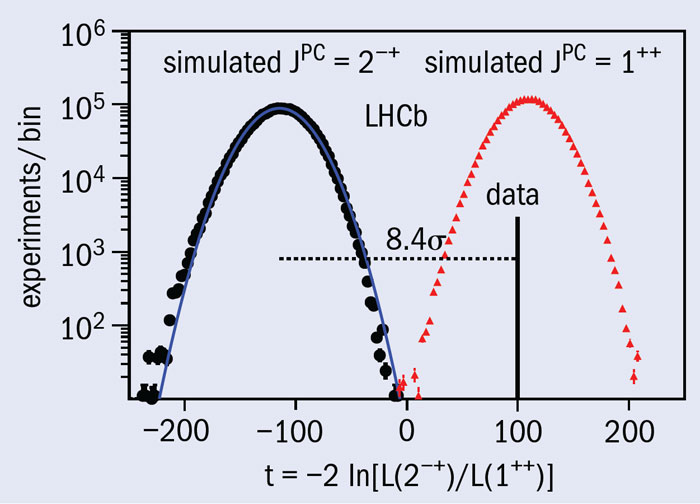
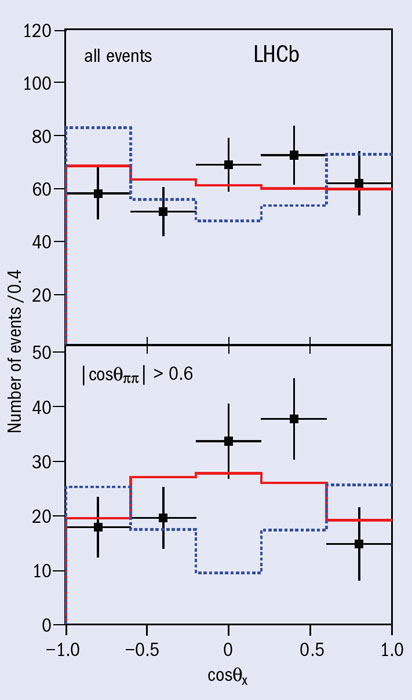
The LHCb collaboration has now reported an analysis of the decay chain B+ → X(3872)K+ → J/ψπ+πK+, with J/ψ → μ+μ, where they use all five angular variables to maximize the separation power between the hypotheses of 1++ and 2–+. The analysis uses the data sample of 1.0 fb–1 that LHCb collected during 2011, which contains 313 ± 26 B+ → X(3872)K+ decays. As figure 1 shows, the outcome of the multidimensional likelihood fit prefers JPC = 1++ with more than 8σ significance. Compared with previous analyses, the measurement benefits from larger statistics but importantly also makes use of the full angular information, which improves the ability to use correlations between angular variables to separate the two hypotheses (figure 2 shows an example).

CCnew15_01_13

This result rules out explanations of the X(3872) as the ηc2(11D2) state. Instead, it favours more exotic interpretations. However, distinguishing between molecular and tetraquark models will require studies of complementary decay modes. The 2.0 fb–1 data sample that LHCb accumulated during 2012, as well as the larger samples that will be recorded in future LHC runs, will allow the collaboration to keep on the trail of these and other puzzles in heavy-flavour spectroscopy.

AEgIS installation completed

Despite first being described over three centuries ago, gravity remains one of the least understood of the fundamental forces. At CERN’s recently completed AEgIS experiment, a team is setting out to examine its effects on something much less familiar: antimatter.

CCnew16_01_13

Located in the experimental hall at the Antiproton Decelerator (AD), the AEgIS experiment is designed to make the first direct measurement of Earth’s gravitational effect on antimatter. By sending a beam of antihydrogen atoms through very thin gratings, the experiment will be able to measure how far the antihydrogen atoms fall and in how much time – giving the AEgIS team a measurement of the gravitational coupling. The team finished putting all of the elements of the experiment together by the end of 2012, but they will have to wait for two years for beams to return to the AD hall following the Long Shutdown (LS1), which has just begun.

To make progress in the meantime, the AEgIS team has decided to try out the experiment with hydrogen instead of antihydrogen. By replacing antiprotons with their own proton source, the team will be able to manufacture its own hydrogen beam to use for commissioning and testing the set-up. Surprisingly, carrying out the experiment with hydrogen will be more difficult technically than with antihydrogen. Another challenge will be in the production of the positronium that will be used in creating the hydrogen. The positronium needs to be moving fast enough to ensure that it does not decay before it meets the protons/antiprotons, but not so fast as to pass the protons/antiprotons altogether. The AEgIS team will be carrying out this commissioning during the coming months, opening up their set-up next month to make any necessary adjustments and to install a hydrogen detector and proton source.

• For more, see the article in CERN Bulletin.

Pulsar exhibits puzzling switches in state

Astronomers have detected simultaneous X-ray and radio-mode switches in co-ordinated observations of a pulsar. Pulsed X-ray emission is only present in states of weak radio emission. This indicates a rapid global change in the magnetosphere, which challenges current emission theories.

Pulsars were discovered in 1967 as flickering sources of radio waves and were soon interpreted as being rotating, strongly magnetized neutron stars. The radiation is thought to be emitted by high-energy particles moving along the lines of magnetic field. As the emission is concentrated in two cones emerging from the magnetic poles, the source behaves like a lighthouse. We see a pulse each time that the radiation beam is pointed towards the Earth. This happens at the spin frequency of the neutron star because the rotation and magnetic axes are generally misaligned.

Among the thousands of known pulsars, only a small fraction has been detected in X-rays or gamma-rays (CERN Courier September 2006 p13 December 2008 p9). The X-ray emission can be steady or pulsed. The steady X-ray emission is high for young neutron stars and decreases as their surface temperature falls. The pulsed emission suggests that X-ray-emitting hot-spots are located at the magnetic poles.

Astronomers know of only a handful of old pulsars that shine in X-rays. One of them is PSR B0943+10, which is five million years old. This source also switches suddenly between a radio-bright and a radio-quiet state at intervals of several hours. It is therefore a prime target to investigate the X-ray behaviour associated with changes of the radio mode. This idea was suggested by a team led by Wim Hermsen of the Netherlands Institute for Space Research (SRON) and the Astronomical Institute “Anton Pannekoek” of the University of Amsterdam. It then took them five years to convince the time-allocation committee to schedule some long periods of observation with ESA’s X-ray Multi-Mirror Mission (XMM-Newton) satellite co-ordinated with radio telescopes.

The satellite performed six observations of six hours each on PSR B0943+10 at the end of 2011. Radio-data were gathered at the same time by the Indian Giant Metrewave Radio Telescope (GMRT) and the international Low-Frequency Array (LOFAR) in the Netherlands. The result of the campaign was completely unexpected. The X-ray emission was found not to follow the states of radio brightness. On the contrary, it was observed to be weak when the source is bright in radio emission and vice versa.

The timing and spectral analysis of the XMM-Newton data offered yet more surprises. The source was found to pulsate in X-rays only during the X-ray-bright phase corresponding to the quiet-radio state. During this phase, the X-ray emission appears to be the sum of two components: a pulsating component consisting of thermal X-rays, which is seen to switch off during the X-ray-quiet phase; and a persistent one consisting of non-thermal X-rays.

The results suggest that the entire magnetosphere around the pulsar is switching from one state to another within a few seconds. The rapidity of this change is puzzling but it is not the only issue. The observed radio and X-ray behaviour is predicted by neither of the leading models for pulsar emission.

Hermsen and his team plan to repeat the same study for another pulsar that has similar radio properties but with a different geometrical configuration. This will allow them to test whether the viewing angle with respect to the magnetic and rotational axes has an effect on the properties of the X-ray emission. In the meantime, theorists will be busy investigating possible physical mechanisms that could cause the observed sudden and drastic changes to the pulsar’s magnetosphere.

bright-rec iop pub iop-science physcis connect