Although the CMS experiment was designed primarily for precise measurements in proton–proton (pp) collisions, in recent years it has demonstrated exceptional capabilities in studying interactions of heavy nuclei. At Quark Matter 2014, the CMS collaboration presented a wealth of new results from their heavy-ion physics programme. The most recent analyses focus on collisions of protons on lead ions (pPb), delivered by the LHC in early 2013.
At the forefront of such studies, CMS continues its investigation of the surprising “ridge phenomenon”. This long-range particle correlation had previously been observed in nucleus–nucleus (AA) collisions and is interpreted as evidence of the hydrodynamic expansion of the quark–gluon plasma (QGP) created in these collisions. Lighter collision systems such as pp and pPb were not expected to produce a dense enough environment to produce such a flow effect, which is thought to arise from the fluid-like behaviour of the QGP. Nevertheless, a similar correlation was observed in collisions with high particle multiplicity in both systems (CMS collaboration 2013).
Previous measurements focused mainly on correlations between particle pairs. However, it is important to address whether the ridge observed in pPb collisions is really collective in nature, and this can be achieved by looking into correlations among a larger number of particles. Flow effects are measured typically by looking at the azimuthal anisotropy of particle momenta using a Fourier decomposition. Figure 1 shows the magnitude of the second Fourier harmonic (v2), as a function of total particle multiplicity, extracted using a multiparticle cumulant expansion, as well as using Lee–Yang zeros, a technique that probes the correlations among all particles in the event. That v2 shows little dependence on the number of particles used in the correlation supports the interpretation of long-range correlations as a collective effect.
Further insight into long-range correlations might be gained by exploring their “hadro-chemistry”. The CMS silicon tracking system is well suited to identifying hadrons that contain strange quarks, such as the K0s meson and Λ baryon, via their decay topologies. Figure 2 (left) shows a clear dependence on species when comparing v2 for K0s, Λ and non-identified charged particles in high-multiplicity pPb events. Within about 10–15%, the data (figure 2, right) are found to obey a scaling relation first seen in AA collisions, whereby the v2 per constituent quark is independent of particle species for the same transverse kinetic energy per constituent quark. In AA collisions, such a scaling is typically interpreted as evidence of flow developed at a very early time, before the quarks combine into final-state hadrons.
In addition to their role in elucidating collective effects in small systems, pPb collisions serve as an important reference for phenomena observed in PbPb collisions. Observables intended to probe the QGP might also be influenced by the initial state of the colliding nuclei. Nuclear effects on the parton distribution functions (PDFs) can be constrained with pPb collisions, i.e. in the absence of an extended QGP final state.
Shortly after the first pPb collisions were recorded, CMS demonstrated sensitivity to nuclear effects on the PDFs via a measurement of the dijet rapidity shift (CMS collaboration 2014). In addition to jets, electroweak bosons are excellent observables for studying PDFs, because their production can be calculated precisely and they can be measured to high precision, given sufficient data. For the rapidity range measured by CMS, the production of Z bosons is sensitive to the parton distributions at large Q2 and Bjorken x in the range 10–3–10–1, a kinematical region that is largely unexplored by previous measurements.
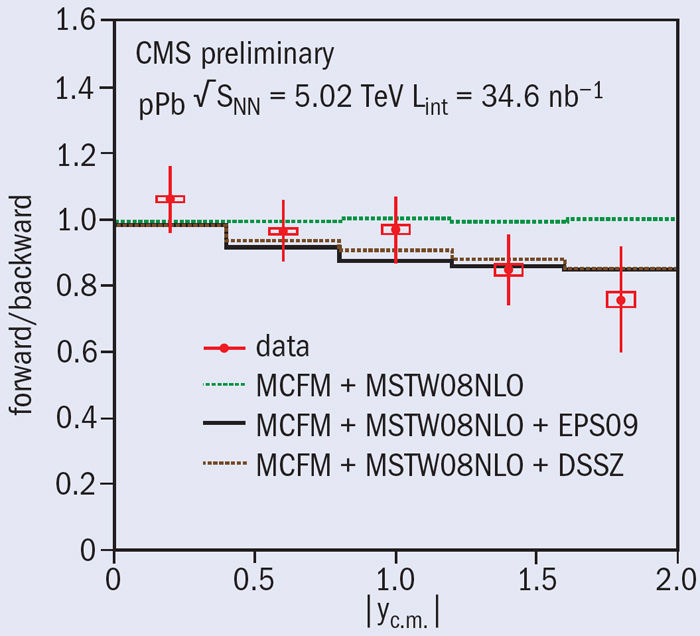
In analysing the 2013 pPb data, the collaboration found more than 2000 Z bosons via their decays to muon pairs. Figure 3 shows the ratio of Z production at forward and backward rapidity in pPb collisions, where forward is the direction of the incident proton. The data are compared to next-to-leading order perturbative calculations produced with the MCFM generator, without and with the nuclear modifications to the parton distributions expected for two different parameterizations of nuclear effects (EPS09 and DSSZ). The data show an indication of the forward–backward asymmetry expected from these calculations. In conjunction with Z boson measurements in the electron channel, as well as other observables such as photons and W bosons, LHC data will soon begin to dominate knowledge of the nuclear parton distributions in some regions of x and Q2.
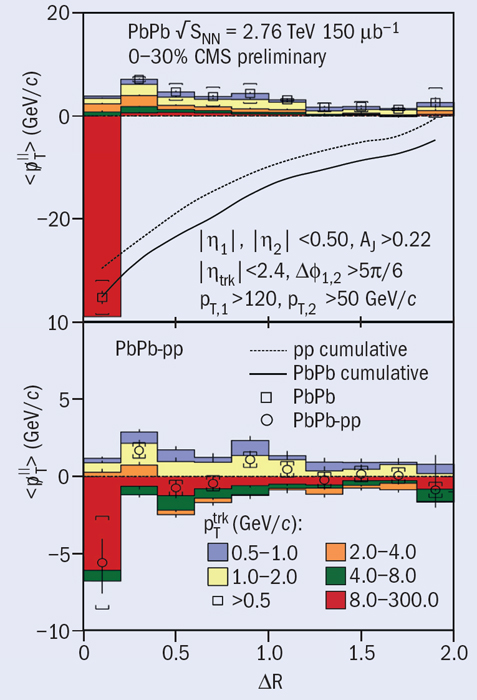
In addition to the pPb studies, CMS continues to perform increasingly detailed studies of the jet-quenching phenomenon, which gives rise to the striking dijet pT asymmetries observed in PbPb collisions (CMS collaboration 2011). Tracing the fate of energy lost by hard-scattered partons in the dense QGP remains a fascinating challenge for the field. To investigate this in more detail, CMS looks at correlations of charged particles with asymmetric dijets in central collisions. To avoid sensitivity to the bulk of particle production, which is largely unrelated to the jets, the vector sum of the transverse momenta with respect to the dijet axis is considered. This “missing pT” is shown in figure 4 (top) as a function of the radial distance from the jets in central collisions for all charged particles, as well as individually for different ranges of pT, for the 30% most central PbPb collisions. The missing-pT analysis allows the first detailed study of the angular dependence of the momentum balance up to large distances from the jet axis (ΔR = 1.8). By evaluating the difference with respect to the same distribution from pp collisions (figure 4, bottom), the angular pattern of the energy flow is shown to be comparable, although it exhibits a large shift in the momentum spectrum of radiated particles in PbPb collisions. The pattern of energy flow provides the most direct window into the dynamics of the jet–QGP interaction observed yet.
Since the quark model was first conceived 50 years ago, physicists have been searching for “exotic” hadrons – strongly interacting particles that are neither quark–antiquark pairs (mesons) nor three-quark states (baryons). Now the LHCb collaboration has published results that for the first time unambiguously demonstrate the exotic nature of one of the candidate exotic hadrons – the Z(4430). At the same time, LHCb’s measurements show that the f0(500) and the f0(980) states cannot be four-quark states (tetraquarks), contrary to what has long been suggested.
The first evidence for the Z(4430) came in 2008 from the Belle collaboration at KEK’s B-factory, KEKB. It appeared as a narrow peak in the ψ΄π– mass distribution in B → ψ΄Kπ– decays. With negative charge, the Z(4430) cannot be a charmonium state, raising the possibility that it could be a multiquark state, for example ccud.
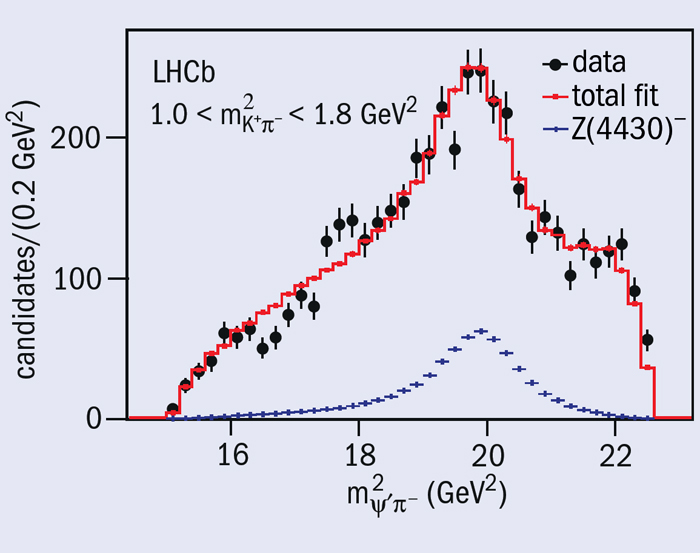
LHCb has now analysed about 25,200 decays of the kind B0→ ψ΄Kπ–, ψ΄ → μ+μ– in data corresponding to an integrated luminosity of 3 fb−1 of proton–proton collisions at the LHC at centre-of-mass energies of 7 and 8 TeV. The collaboration observes the Z(4430) in the ψ΄π– mass distribution with a significance of at least 13.9σ, and determines the quantum numbers JP to be 1+, by ruling out 0–, 1–, 2+ and 2– at more than 9.7σ (LHCb collaboration 2014a). While this emphatically confirms the evidence from Belle, the LHCb analysis also establishes the resonant nature of the observed state. Its Argand diagram (figure 2) shows unambiguously that the Z(4430) really is a particle. Moreover, with a minimal quark content of ccud, it must be a tetraquark state.
In a related analysis, LHCb has also studied the decay B0 →J/ψπ+π−, extracting the invariant mass of the π+π− pairs. While this clearly reveals a peak corresponding to the f0(500) meson, there is no evidence for the f0(980). This rules out at 8σ the production of the f0(980) at the rate expected for tetraquarks, which would lead to a much smaller difference in the production rates for the two f0 mesons. However, the f0(980) is clearly visible in the corresponding π+π− invariant mass distribution for the decay B0s →J/ψπ+π−. The absence of the f0(980) in B0 decays and its presence in B0s decays in addition to the presence of the f0(500) only in the B0 decays is exactly what is expected if these states are normal quark–antiquark states (LHCb collaboration 2014b).
The Standard Model is currently the best theory there is of the subatomic world, but it fails to answer several fundamental questions, for example: why are the strengths of the fundamental interactions so different? What makes the Higgs boson light? What is dark matter made of? Such questions have led to the development of theories beyond the Standard Model, of which the most popular is supersymmetry (SUSY). In its most minimalistic form, SUSY predicts that each Standard Model particle has a partner whose spin differs by ½ and an extended Higgs sector with five Higgs bosons. SUSY’s symmetry between bosons and fermions stabilizes the mass of scalar particles, such as the Higgs boson and also the new scalar partners of the Standard Model fermions at high energy. If, as suggested by some theorists, the new particles have a conserved SUSY quantum number (denoted R-parity), the lightest SUSY particle (LSP) cannot decay and primordial LSPs might still be around, forming dark matter.
Two charginos, χ~±1,2, and four neutralinos, χ~01,2,3,4 – collectively referred to as electroweakinos – are the SUSY partners of the five Higgs and the electroweak gauge bosons. Based on arguments that try to accommodate the light mass of the Higgs boson in a “natural”, non-fine-tuned manner, the lightest electroweakinos are expected to have masses in the order of a few hundred giga-electron-volts. The lightest chargino, χ~±1, and the next-to-lightest neutralino, χ~02, can decay into the LSP, χ~01, plus multilepton final states via superpartners of neutrinos (sneutrinos, ν~) or charged leptons (sleptons, l~), or via Standard Model bosons (W, Z or Higgs). If SUSY exists in nature at the tera-electron-volt scale, electroweakinos could be produced in the LHC collisions.
The ATLAS collaboration’s searches for charginos, neutralinos and sleptons use events with multiple leptons and missing transverse momentum from the undetected LSP. The two-lepton (e, μ) search has dedicated selections that target the production of l~ l~, χ~±1χ~∓1 and χ~±1χ~02 through their decays via sleptons or W and Z bosons. Meanwhile, the three-lepton (e, μ, τ) analysis searches for χ~±1χ~02 decaying either via sleptons, staus (the SUSY partner of the τ), W and Z bosons, or W and Higgs bosons. Charginos and neutralinos decaying via Standard Model bosons are more challenging to search for than the decays via sleptons, owing to the smaller branching ratio into leptons. The main backgrounds in the two(three)-lepton search are WZ and Z+jets (tt) production, and these are modelled using Monte Carlo simulation and data-driven methods, respectively.
ATLAS has found no significant excess beyond the Standard Model expectation in either the two or three-lepton SUSY searches. This null result can be used to set exclusion limits on SUSY models, narrowing down where SUSY might exist in nature. For example, the two-lepton analysis sets the first direct limits in a simplified SUSY model of χ~±1χ~∓1, where the chargino decays 100% of the time to a W boson. The selections based on the presence of hadronically decaying τ particles in the three-lepton analysis set exclusion limits for χ~±1χ~02 decaying via W and Higgs bosons.
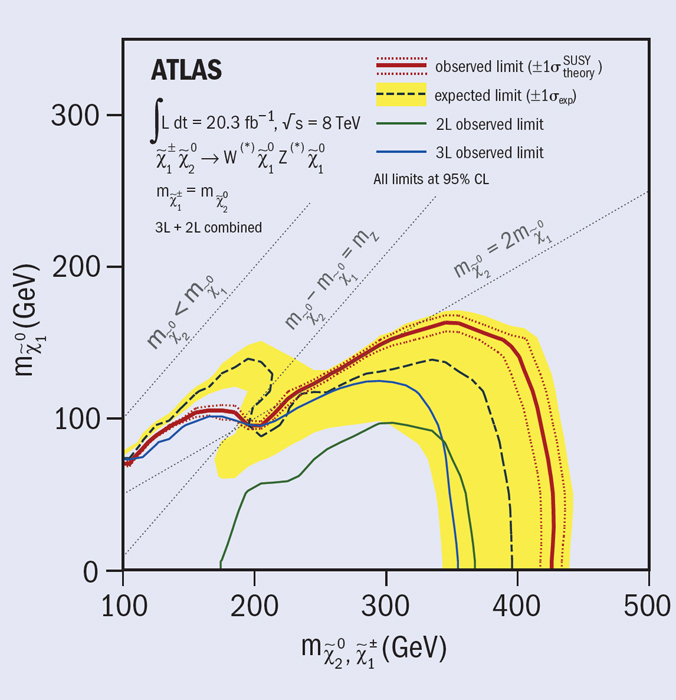
In some cases, the results of two or more analyses can be combined to strengthen the exclusion limits in a particular SUSY model. This is done for the two and three-lepton searches in a simplified SUSY model of χ~±1χ~02, where the χ~±1 and χ~02 are assumed to decay exclusively via W and Z bosons (figure 1). On its own, the two-lepton analysis excludes χ~±1 and χ~02 masses from 170–370 GeV, while the three-lepton analysis excludes masses from 100–350 GeV. By combining the two searches, the exclusion limit is pushed out much further to χ~±1 and χ~02 masses of 415 GeV for a massless χ~01 (figure 2).
So far, no evidence for SUSY has been observed with the first dataset collected by ATLAS. However, in 2015 the LHC will collide protons at higher energies and rates than ever before. This will be an exciting time as exploration of unchartered territories of higher-mass SUSY particles and rarer signatures begins.
A team of US astronomers has taken unprecedented images of the intergalactic medium (IGM) – the diffuse gas that connects galaxies throughout the universe. These first pictures of the IGM were obtained with the Cosmic Web Imager (CWI), an instrument designed and built at the California Institute of Technology (Caltech). It opens the way for a deeper understanding of how galaxies form via accretion of gas from the IGM.
Since the late 1980s and early 1990s, theoreticians have predicted that primordial gas from the Big Bang is not spread uniformly throughout space, but is instead distributed in channels that span galaxies and flow between them. This “cosmic web” is a network of filaments crisscrossing one another over the vastness of space and back through time, to an era when galaxies were first forming and stars were being produced at a rapid rate. The visualization of this sponge-like structure of dark matter and gas has become familiar with the advent of numerical simulations of structure formation (CERN Courier September 2007 p11). However, actual observation of this filamentary structure is very difficult. It is only recently that a filament of dark matter was found between two clusters of galaxies (CERN Courier September 2012 p14). Detecting much smaller filaments feeding early galaxies is another challenge.
The usual way to probe the IGM is to look for Lyman-α absorption in the spectrum of a distant quasar. A series of hydrogen clouds along the line of sight to the quasar will produce distinct absorption lines at wavelengths corresponding to the redshift – a measure of the cosmic distance – of each cloud. However, analysis of this “Lyman-α forest” of quasar absorption lines probes the gas distribution in only one direction, so it is not possible to use this method to infer the spatial distribution of the gas clouds.
To overcome this limitation, Christopher Martin at Caltech conceived and developed the CWI. This novel instrument has been designed to detect faint Lyman-α emission from extended regions with redshifts between 1.5 and 4. It is an integral-field spectrograph mounted on the 200 inch (5.1 m) Hale Telescope at the Palomar Observatory. The instrument takes pictures at many different wavelengths simultaneously, yielding a data cube with the image of a small portion of the sky on one side and high-resolution spectroscopic information along the third axis. The data cube can then be sliced to search for spatial structures emitting a narrow, redshifted Lyman-α line.
The first results from the CWI have now been published in two articles. A first paper describes the observation of a narrow filament of gas flowing towards the quasar QSO 1549+19. The ultraviolet emission of the quasar photo-ionizes the gas and therefore induces the observed Lyman-α emission. The filament is about one-million light-years long and its infall motion is suggested by the progressive increase of the velocity dispersion of the gas towards the quasar. Another target was a Lyman-α emission cloud, found to be surrounded by three filaments of gas that are probably feeding a protogalactic disc with a size about three times that of the Milky Way.
Both objects observed by the CWI date to approximately two-thousand-million years after the Big Bang, a time of rapid star formation in galaxies. They have been chosen because of unusually bright Lyman-α emission. To observe the average intergalactic medium everywhere, Martin’s group is now developing the Keck Cosmic Web Imager (KCWI) – a more sensitive and versatile version of the CWI – for use at the Keck Observatory on top of Mauna Kea in Hawaii.
Today, neutron research takes place either at nuclear reactors or at accelerator-based sources. For a long time, reactors have been the most powerful sources in terms of integrated neutron flux. Nevertheless, accelerator-based sources, which usually have a pulsed structure (SINQ at PSI being a notable exception), can provide a peak flux during the pulse that is much higher than at a reactor. The European Spallation Source (ESS) – currently under construction in Lund – will be based on a proton linac that is powerful enough to give a higher integrated useful flux than any research reactor. It will be the world’s most powerful facility for research using neutron beams, when it comes into full operation early in the next decade. Although driven by the neutron-scattering community, the project will also offer the opportunity for experiments in fundamental physics, and there are plans to use the huge amount of neutrinos produced at the spallation target for neutrino physics.
The story of the ESS goes back to the early 1990s, with a proposal for a 10 MW linear accelerator, a double compressor ring and two target stations. The aim was for an H– linac to deliver alternate pulses to a long-pulse target station and to the compressor rings. The long-pulse target was to receive 2-ms long pulses from the linac, while multiturn injection into the rings would provide a compression factor of 800 and allow a single turn of 1.4 μs to be extracted to the short-pulse target station.
This proposal was not funded, however, and after a short hiatus, new initiatives to build the ESS appeared in several European countries. By 2009, three candidates remained: Hungary (Debrecen), Spain (Bilbao) and Scandinavia (Lund). The decision to locate the ESS near Lund was taken in Brussels in May 2009, after a competitive process facilitated by the European Strategy Forum for Research Infrastructures and the Czech Republic’s Ministry of Research during its period of presidency of the European Union. In this new incarnation, the proposal was to build a facility with a single long-pulse target powered by a 5 MW superconducting proton linac (figure 1). The neutrons will be released from a rotating tungsten target hit by 2 GeV protons emerging from this superconducting linac, with its unprecedented average beam power.
Neutrons have properties that make them indispensable as tools in modern research. They have wavelengths and energies such that objects can be studied with a spatial resolution between 10–10 m and 10–2 m, and with a time resolution between 10–12 s and 1 s. These length- and time-scales are relevant for dynamic processes in bio-molecules, pharmaceuticals, polymers, catalysts and many types of condensed matter. In addition, neutrons interact quite weakly with matter, so they can penetrate large objects, allowing the study of materials surrounded by vacuum chambers, cryostats, magnets or other experimental equipment. Moreover, in contrast to the scattering of light, neutrons interact with atomic nuclei, so that neutron scattering is sensitive to isotope effects. As an extra bonus, neutrons also have a magnetic moment, which makes them a unique probe for investigations of magnetism.
Neutron scattering also has limitations. One of these is that neutron sources are weak compared with sources of light or of electrons. Neutrons are not created, but are “mined” from atomic nuclei where they are tightly bound, and it costs a significant amount of energy to extract them. Photons, on the other hand, can be created in large amounts, for instance in synchrotron light sources. Experiments at light sources can therefore be more sensitive in many respects than those at a neutron source. For this reason, the siting of ESS next to MAX IV – the next-generation synchrotron radiation facility currently being built on the north-eastern outskirts of Lund – is important. Thanks to its pioneering magnet technology, MAX IV will be able to produce light with higher brilliance than at any other synchrotron light source, while the ESS will be the most powerful neutron source in the world.
The ESS will provide unique opportunities for experiments in fundamental neutron physics that require the highest possible integrated neutron flux. A particularly notable example is the proposed search for neutron–antineutron oscillations. The high neutron intensity at the ESS will allow sufficient precision to make neutron experiments complementary to efforts in particle physics at the highest energies, for example at the LHC. The importance of the low-energy, precision “frontier” has been recognized widely (Raidal et al. 2008 and Hewett et al. 2012), and an increasing number of theoretical studies have exploited this complementarity and highlighted the need for further, more precise experimental input (Cigliano and Ramsey-Musolf 2013).
In addition, the construction of a proton accelerator at the high-intensity frontier opens possibilities for investigations of neutrino oscillations. A collaboration is being formed by Tord Ekelöf and Marcos Dracos to study a measurement of CP violation in neutrinos using the ESS together with a large underground water Cherenkov detector (Baussen et al. 2013).
The main components
The number of neutrons produced at the tungsten target will be proportional to the beam current, and because the total production cross-section in the range of proton energies relevant for the ESS is approximately linear with energy, the total flux of neutrons from the target is nearly proportional to the beam power. Given a power of 5 MW, beam parameters have been optimized with respect to cost and reliability, while user requirements have dictated the pulse structure. Table 1 shows the resulting top-level parameters for the accelerator.
The linac will have a normal-conducting front end, followed by three families of superconducting cavities, before a high-energy beam transport brings the protons to the spallation target. Because the ESS is a long-pulse source, it can use protons rather than the H– ions needed for efficient injection into the accumulator ring of a short-pulse source.
Figure 2 illustrates the different sections of the linac. In addition to the ion source on a 75 kV platform, the front end consists of a low-energy beam transport (LEBT), a radio-frequency quadrupole that accelerates to 3.6 MeV, a medium-energy beam transport (MEBT) and a drift-tube linac (DTL) that takes the beam to 90 MeV.
The superconducting linac, operating with superfluid helium at 2 K, starts with a section of double-spoke cavities having an optimum beta of 0.50. The protons are accelerated to 216 MeV in 13 cryomodules, each of which has two double-spoke cavities. Medium- and high-beta elliptical cavities follow, with geometric beta values of 0.67 and 0.92. The medium-beta cavities have six cells, the high-betas have five cells. In this way, the two cavity types have almost the same length, so that cryomodules of the same overall design can be used in both cases to house four cavities. Figure 3 shows a preliminary design of a high-beta cryomodule, with its four five-cell cavities and power couplers extending downwards.
Nine medium-beta cryomodules accelerate the beam to 516 MeV, and the final 2 GeV is reached with 21 high-beta modules. The normal-conducting acceleration structures and the spoke cavities run at 352.21 MHz, while the elliptical cavities operate at twice the frequency, 704.42 MHz. After reaching their full energy, the protons are brought to the target by the high-energy beam transport (HEBT), which includes rastering magnets that produce a 160 × 60 mm rectangular footprint on the target wheel.
The design of the proton accelerator – as with the other components of the ESS – has been carried out by a European collaboration. The ion source and LEBT have been designed by INFN Catania, the RFQ by CEA Saclay, the MEBT by ESS-Bilbao, the DTL by INFN Legnaro, the spoke section by IPN Orsay, the elliptical sections again by CEA Saclay, and the HEBT by ISA Århus. During the design phase, additional collaboration partners included the universities of Uppsala, Lund and Huddersfield, NCBJ Świerk, DESY and CERN. Now the collaboration is being extended further for the construction phase.
A major cost driver of the ESS accelerator centres on the RF sources. Klystrons provide the standard solution for high output power at the frequencies relevant to the ESS. For the lower power of the spoke cavities, tetrodes are an option, but solid-state amplifiers have not been excluded completely, even though the required peak powers have not been demonstrated yet. Inductive output tubes (IOTs) are an interesting option for the elliptical cavities, in particular for the high-beta cavities, where the staged installation of the linac still allows for a few years of studies. While IOTs are more efficient and take up less space than klystrons, they are not yet available for the peak powers required, but the ESS is funding the development of higher-power IOTs in industry.
Neutron production
The ESS will use a rotating, gas-cooled tungsten target rather than, for instance, the liquid-mercury targets used at the Spallation Neutron Source in the US and in the neutron source at the Japan Proton Accelerator Research Complex. As well as avoiding environmental issues that arise with mercury, the rotating tungsten target will require the least amount of development effort. It also has good thermal and mechanical properties, excellent safety characteristics and high neutron production.
The target wheel has a diameter of 2.5 m and consists of tungsten elements in a steel frame (figure 4). The tungsten elements are separated by cooling channels for the helium gas. The wheel rotates at 25 rpm synchronized with the beam pulses, so that consecutive pulses hit adjacent tungsten elements. An important design criterion is that the heat generated by radioactive decay after the beam has been switched off must not damage the target, even if all active cooling systems fail.
With the ESS beam parameters, every proton generates about 80 neutrons. Most of them are emitted with energies of millions of electron volts, while most experiments need cold neutrons, from room temperature down to some tens of kelvins. For this reason, the neutrons are slowed down in moderators containing water at room temperature and super-critical hydrogen at 13–20 K before being guided to the experimental stations, which are known as instruments. The construction budget contains 22 such instruments, including one devoted to fundamental physics with neutrons.
The ESS is an international European collaboration where 17 European countries (Sweden, Denmark, Norway, Iceland, Estonia, Latvia, Lithuania, Poland, Germany, France, the UK, the Netherlands, the Czech Republic, Hungary, Switzerland, Italy and Spain) have signed letters of intent. Negotiations are now taking place to distribute the costs between these countries.
The project has now moved into the construction phase, with ground breaking planned for summer this year.
Sweden and Denmark have been hosting the ESS since the site decision, and a large fraction of the design study that started then was financed by Sweden and Denmark. The project has now moved into the construction phase, with ground breaking planned for summer this year.
According to the current project plans, the accelerator up to and including the medium-beta section will be ready by the middle of 2019. Then, the first protons will be sent to the target and the first neutrons will reach the instruments. During the following few years, the high-beta cryomodules will be installed, such that the full 5 MW beam power will be reached in 2022.
The neutron instruments will be built in parallel. Around 40 concepts are being developed at different laboratories in Europe, and the 22 instruments of the complete ESS project will be chosen in a peer-reviewed selection process. Three of these will have been installed in time for the first neutrons. The rest will gradually come on line during the following years, so that all will have been installed by 2025.
The construction budget of ESS amounts to €1,843 million, half of which comes from Sweden, Denmark and Norway. The annual operating costs are estimated to be €140 million, and the cost for decommissioning the ESS after 40 years has been included in the budget. The hope, however, is that the scientific environment that will grow up around ESS and MAX IV – and within the Science Village Scandinavia to be located in the same area – will last longer than that.
To paraphrase lines from the title song of a well-known film: “If there’s something big in your neighbourhood, who ya gonna call?” If the neighbourhood is particle physics, then it could well be Jim Yeck, who delights in seeing things built. This enthusiasm has underpinned his leadership of a number of successful big scientific infrastructure projects in the US, including the important US hardware contribution to the LHC and the ATLAS and CMS experiments.
Yeck’s first exposure to big science projects was as a graduate engineer in the late 1980s at the Princeton Plasma Physics Laboratory, where there was a proposal to build the $300 million Compact Ignition Tokomak. However, in 1989 the project was cancelled, because plasma ignition could not be guaranteed and the international ITER initiative was on the horizon. “It was a formative experience,” says Yeck, and instead of nuclear fusion, he found himself working on risk assessment for large science projects, which was to prove valuable for his future career.
In the autumn of 1990, he was asked by the US Department of Energy (DOE) to become the project manager for the construction of the Relativistic Heavy-Ion Collider (RHIC) at Brookhaven National Laboratory. Like its ancestor – the Intersecting Storage Rings at CERN – RHIC was built with two interlaced rings, but broke new ground by incorporating 1740 superconducting magnets, most of which were made in industry. Looking back, Yeck points out that the project was approved in a different era, “when you knew you had issues that you would have to work out later”. Basically underfunded, it was built against a background of tight budget constraints. “Such a project needs strong leadership, which we had in Nick Samios, the lab director, Satoshi Ozaki, the project director, and others,” he says.
Yeck remained with RHIC until the autumn of 1997, when the US was in the final stages of signing an agreement to contribute to building hardware for the LHC and the ATLAS and CMS experiments, and to become an Observer State of CERN. The DOE and the National Science Foundation (NSF) appointed him project director for this $531 million contribution, which comprised $200 million from the DOE for the LHC accelerator, and $331 million from the DOE and the NSF for ATLAS and CMS. At the time more than 550 US scientists from nearly 60 universities and six of the DOE’s national laboratories were involved.
“This was on the heels of the cancellation of the SSC [the Superconducting Super Collider] and the community recognized that it was imperative that the LHC should work and that the US should be part of it,” Yeck recalls. “People rallied together – it was beautiful.” There were to be many difficult issues to resolve and compromises to be made, but with a background in engineering rather than particle physics, Yeck had the advantage of being a clearly defined “enabler”, with no bias.
In late 2003, with the LHC’s progress on firm ground, Yeck moved on again, to become director of a rather different astroparticle-physics project. The IceCube Neutrino Observatory at the South Pole is not only at an exotic location with an international collaboration, it is run principally by the University of Wisconsin, and Yeck says that it interested him to show that a university can take on leadership of a large infrastructure project. IceCube was funded to the tune of $280 million, in this case mostly by the NSF, who had less experience of big projects than the DOE. There was also the interesting logistical challenge of constructing and operating the huge 1 km3 detector at the South Pole.
The old model of a country going it alone doesn’t work for such projects
Jim Yeck
During the long construction phase linked to summers at the South Pole, Yeck agreed to help launch construction of the National Synchrotron Light Source II back at Brookhaven, and served as deputy project director in the years 2006–2008. Then, 10 years after taking on IceCube, he made his latest change – to another kind of facility, another continent, and a different user community. In March 2013 he became chief executive officer (CEO) of the European Spallation Source (ESS), taking over from the first CEO, Colin Carlile.
The ESS will serve a research community dispersed across many fields of science, with potential users numbering in the thousands. “The old model of a country going it alone doesn’t work for such projects,” says Yeck. Instead, the ESS is furthering the approach of bringing many nations to work together, and with 17 partner countries it is approaching CERN in terms of the number of members. Using an analogy that should appeal to physicists, Yeck says: “CERN is an existence proof, and others have drawn on this. But the initial conditions have to be right.” When setting up rules for the governance of the new facility, ESS based many of the principles on those established 60 years ago for CERN.
Yeck’s experience has taught him what is important in making a success of such a project: “The facility has to be a priority for the scientific community”, he says. “If you don’t have that foundation, it’s a problem. Then you need commitments and a strong role from the facility host. And the leadership has to see itself as enabling the success of others.” A particular challenge of the ESS is that it is new in more ways than one – a new organization on a green-field site, much like CERN was in 1954. “Such an organization needs experienced people who can catalyse the successful efforts of many,” says Yeck. “We also have to establish realistic goals – it’s a case of putting experience over hope.”
The ESS management has been working hard during the past year on a realistic plan, which was reviewed in November by a committee of 33 members from a broad community, chaired by CERN’s Mario Nessi. Yeck learnt to appreciate the value of such reviews during his time in the US. “If you have problems, you can also seek collective ownership of solutions,” he explains. “And there will be problems. To pretend that you are not going to have them is a big mistake.” However, Yeck is a man who delights in seeing things built and the ESS is no exception. “It’s fantastically challenging, with contributions from many people,” he says, “but that’s what’s captivating.”
1952: The first meeting of the provisional CERN Council on 15 February 1952, with key people including Sir Ben Lockspeiser, Edoardo Amaldi, Felix Bloch, Lew Kowarski, Cornelis Bakker and Niels Bohr (at the back).
1953: The convention establishing the organization was signed, subject to ratification, by the representatives of 12 future member states, at the sixth session of the CERN Council in Paris on 29 June–1 July.
Could this be the first photo taken of the CERN site? Recently found in the archives, this montage shows the road from Meyrin as it crosses the border into France – now close to the location of the main entrance into CERN.
1953: The edition of 30 October of the newspaper La Suisse shows Albert Picot from the State of Geneva and members of CERN Council visiting the site of the future laboratory the day before. Geneva was selected as the site for CERN at the third Council session in Amsterdam in October 1952, and the choice was approved by a referendum in the Canton of Geneva in June 1953, by 16,539 votes to 7332.
1954: The Villa de Cointrin at the airport in Geneva was the first seat for CERN’s management and administrative offices. It is still visible through fences today.
1954: By November, the foundations of the machine hall and experimental halls for the Synchrocylcotron, CERN’s first accelerator, were taking the shape of a rigid “raft”.
From time to time, great experimental progress in particle physics suddenly reveals a crisis in theoretical physics. This happened in the early 1960s when a plethora of hadrons had been discovered, while strong-interaction theory dealt with analytical properties of the S matrix and a number of phenomenological models. At that time, Murray Gell-Mann, who had just introduced the notion of quarks, seconded by Georg Zweig, argued for focusing on “a higher-energy accelerator so that we can do more experiments over the next generation and really learn more about the basic structure of matter” (Gell-Mann 1967). The current situation is not so different.
At the LHC, the Standard Model is being subjected to a thorough confirmation, including the remarkable completion of its particle contents with the discovery of a Higgs boson. Important as these results are, however, there is still no indication of the existence of the long-predicted supersymmetric particles or of Kaluza–Klein resonances below a mass scale of about a tera-electron-volt, or of other new phenomena. Of course, the hope is that in the coming years the LHC will discover new physics in exploring the next higher-energy domain with increased luminosity. Yet, to discover all hidden treasures when entering unknown territory, it is a wise strategy to prepare for all possibilities and not to rely on a few choices only.
In this spirit, investigations of electron–proton (ep) and electron–ion (eA) collisions at high energies offer an important prospect, complementary to proton–proton (pp) and electron–positron (ee) collisions. So far, the only collider to exploit the ep configuration was HERA at DESY, where results from the H1 and ZEUS experiments provided much of the base of current LHC physics and also led to surprising results, for example on the momentum distributions of partons inside the proton. Building on the conceptual design study for the Large Hadron Electron Collider (LHeC) – an electron-beam upgrade to the LHC – CERN’s management decided recently to investigate these possibilities more deeply. It has established an International Advisory Committee (IAC) to report to the director-general, with the mandate to provide “…scientific and technical direction for the physics potential of the ep/eA collider, both at the LHC and FCC [the proposed Future Circular Collider complex], as a function of the machine parameters and of a realistic detector design, as well as for the design and possible approval of an energy recovery linac (ERL) test facility at CERN…”. Furthermore, the advisory committee should offer “assistance in building the international case for the accelerator and detector developments as well as guidance to the resource, infrastructure and science policy aspects…”. Chaired by Herwig Schopper, the IAC comprises 12 eminent scientists from three continents, together with CERN’s director for research and computing, Sergio Bertolucci, and the director for accelerators and technology, Frederick Bordry, as well as the co-chairs of the newly established LHeC Co-ordination Group, Oliver Brüning and Max Klein.
One of the IAC’s first major activities was to hold a well-attended workshop on the LHeC, its physics, and the accelerator and detector development, at Chavannes-de-Bogis in January this year. At the meeting, Stefano Forte classified deep-inelastic scattering (DIS) physics at the energy frontier – which becomes accessible with ep collisions using the LHC’s proton beam (figure 1) – into three major areas. One area consists of high-precision measurements of the Standard Model, with the experimental and theoretical programme aiming for a per mille determination of the strong coupling constant, αs, and the reduction of uncertainties in searches at the High Luminosity LHC (HL-LHC) at high mass scales as prime examples. A second area concerns exploration of the parameter space, with Higgs physics – including the challenging decays into b and c quarks (figure 2) – as the obvious and most important element. The cross-section for such processes at the LHeC would be about 200 fb, enabling unique measurements of the Higgs properties from WW–H and ZZ–H production in ep scattering. With its unprecedented precision in determination of the parton distributions and of the strong coupling, the LHeC could assist in transforming the LHC into a precision Higgs factory. Lastly, there is what Forte called “serendipity”, meaning room for “known or unknown” discoveries. Indeed, a big step to higher energy with perhaps 1000 times the luminosity of HERA could lead not only to new insights but to breakthroughs, especially in the understanding of QCD.
Given the exploration of novel QCD phenomena such as quark–gluon plasma in heavy-ion collisions at the LHC – and also because HERA never scattered electrons off deuterons or heavier ions – a programme of electron–ion physics at the LHeC collider would be of great interest. It would extend the kinematic range in terms of four-momentum transfer squared, Q2, and the inverse of Bjorken-x, by nearly four orders of magnitude. This could reveal unexpected phenomena and would put the understanding of the partonic structure of the neutron and nuclei, and the exploration of high-density matter, on firmer theoretical ground.
The vision of a 50 TeV proton (and about 20 TeV lead-ion) beam from the FCC opens a further horizon to future DIS measurements, which, for example, would access contact-interaction scales of a few hundreds of tera-electron-volts, could study lepton–quark resonances should these exist, and determine the Higgs self-coupling based on an inclusive Higgs-production cross-section of 2pb, which is much larger than the “Higgs-strahlung” cross-section at the International Linear Collider or the electron–positron FCC (FCC-ee).
A unique strength of the LHeC rests on the prospect of measuring parton distributions much more accurately than previously and of unfolding them without symmetry assumptions for the first time. This would remove a substantial part of the uncertainty of Higgs production in pp collisions, which dominantly occurs proportional to the square of the gluon distribution (xg) times the strong coupling constant. The measurement of Higgs production across a larger rapidity range in pp scattering at the FCC extends down to extremely small values of Bjorken-x. In this range, which is also of interest for ultra-high-energy neutrino scattering, the extrapolations of the current xg parameterizations no longer have any basis, and they differ hugely. Moreover, it is expected that nonlinear gluon–gluon effects set in, possibly leading to a saturation of gluon-dominated interaction cross-sections. The clarification of the laws of parton evolution at Bjorken-x < 10–4, most likely leading to the end of validity of the linear so-called DGLAP evolution equations, is impossible without a DIS programme of the kind considered here, and is essential for the pursuit of a sound programme in pp physics at the energy frontier at CERN.
The Higgs discovery has led to a reconsideration of the luminosity needs at the LHeC – a further focus of the Chavannes workshop. The conceptual design report (CDR) was directed at achieving an instantaneous luminosity of about 1033 cm–2 s–1 in synchronous ep and pp operations at the LHC (LHeC Study Group 2012). A substantial increase of this value is desirable, with the goal of producing 105 Higgs bosons across a 10-year period of operation. This would open the route to a 1% precision measurement of the decay H → bb, thanks to the clean final-state signature and the absence of pile-up. Such an increase of luminosity might be possible owing to the beam brightness of the HL-LHC, which is expected to be 2–3 times higher than assumed in the CDR, through doubling the electron-beam current to 10–20 mA and also by reducing the focusing of the proton beam in the ep interaction region. It is one of the goals of the new ep study initiated by CERN to understand the implications of high-intensity ep operation on the design of the interaction region and on the simultaneous operation of the LHC envisaged.
It has always been the tradition at CERN to plan a long time ahead carefully
A deeper study of the possibility for an ep and eA collider at CERN shows that development of the technique of energy recovery is necessary. This is possible when the maximum energy beam is decelerated with a phase shift in the same superconducting RF cavity structure used for acceleration. An energy-recovery linac provides a unique opportunity to achieve high energy and high luminosity by efficient use of the available power. In the case of the LHeC design, a beam power of about 25 MW is used. This would correspond to a power of almost 1 GW if there were no energy recovery. In conjunction with the renewed study of ep at CERN, the decision has been made to design and build a set of two cryogenic superconducting RF-cavity modules in collaboration with experts at Jefferson Lab in the US and at Mainz University (figure 3). About 7 m long, one module comprises four cavities of a five-cell low-loss shape with a higher-order-mode coupler and supply end-can. The design is for a frequency of 802 MHz, with a few modules to be built for test purposes at CERN and Jefferson Lab and for the MESA project at Mainz. In a workshop last year, 802 MHz was chosen as a more-or-less optimum value for beam stability, cavity dimensions, RF power, dynamic losses, etc, and in view of the LHC and choices for the FCC developments also.
The two cryo-cavity modules could serve as the initial building blocks for an ERL test facility at CERN – the LTFC (figure 4). Its design, scheduled for 2015, is being undertaken in international collaboration. This test facility would have a variety of important goals: the development of superconducting RF at CERN under realistic operational beam conditions, with high gradients for continuous-wave operation (< 20 MV/m) and of high quality (Q0 > 1010); the development of high-current electron sources, which are also required for the FCC-ee; and further applications, such as magnet quench tests in a low-radiation environment and detector tests with an electron beam on-site of up to 1 GeV energy.
In addition to the many topics in deep-inelastic scattering that can be studied with the LHeC and the hadron–electron FCC (FCC-he), there is also an intimate relationship between ep physics and physics at pp and ee colliders. This was already evident when HERA, the Tevatron, the Large Electron–Positron Collider and the SLAC Linear Collider explored the Fermi scale. It is clear, not only from the example of Higgs studies, that this will also be the case at the energy scales of the LHC and the proposed FCC hh-ee-he complex. A new energy-frontier ep and eA project would naturally exploit the major investments in hadron beams at CERN. It would not become a flagship activity for CERN, since it would reside essentially at one experimental location, which could not satisfy the majority of the particle-physics community. However, such a project would provide a complementary window for the main upgrade programmes and would potentially lead into the distant future.
It has always been the tradition at CERN to plan a long time ahead carefully, with the result that all big projects were achieved on time and to budget, and were also scientifically and technically successful. This is one of the secrets of CERN’s success. Close co-operation between theory, experiments and technology was always essential for this to work. One aim of this article is to encourage collaboration on the test facility, on the accelerator, on the ep/eA detector being designed, and on the understanding and evaluation of an electron–proton and electron–ion physics programme at the energy and intensity frontier at CERN that would be worth pursuing.
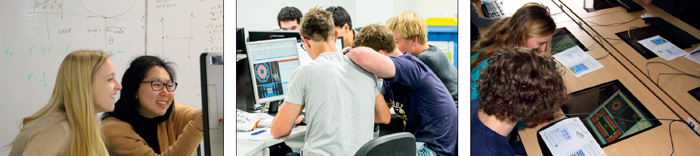
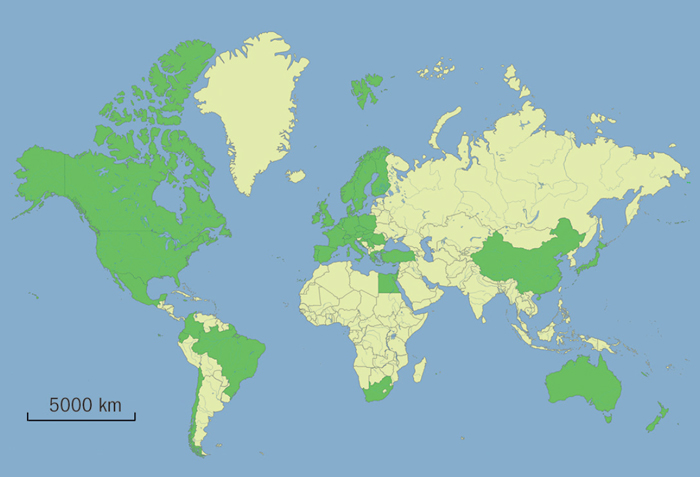
The International Masterclasses (IMCs) began in 2005 as an initiative of what was then the European Particle Physics Outreach Group (EPPOG). Since then, EPPOG has become the International Particle Physics Outreach Group (IPPOG), and the masterclasses have grown steadily beyond a group of IPPOG member countries. This year, the 10th edition of the IMCs included 200 institutions in 41 countries worldwide. Several of the initiatives have attracted new partners, including some from the Middle East and Latin America, enabling IMCs to be held in diverse locations – from Israel and Palestine to South Africa, and from New Zealand to Ecuador – in addition to the many sites in Europe and North America. Now, well into the LHC era, the masterclasses use fresh data from the world’s biggest particle accelerator, as collected by the four big experiments.
All of the LHC collaborations involved acknowledge the potential – and the success – of educational programmes that bring important discoveries at the LHC to high-school students by providing large samples of the most recent data. For example, 10% of the 8-TeV ATLAS “discovery” data are available for students to search for a Higgs boson; CMS approved 13 Higgs candidates in the mass region of interest, which are mixed with a more abundant sample of W and Z events, for “treasure hunt” activities; ALICE data allow students to study the relative production of strange particles, which could be a tell-tale signal of quark–gluon plasma production; LHCb teaches students how to measure the lifetime of the D meson; and particles containing b and c quarks are studied extensively to shed light on the mystery of antimatter in the universe.
Students quickly master real event-display programmes
Students quickly master real event-display programmes – such as iSpy-online, Hypatia and Minerva – software tools and analysis methods. First, they practice particle identification by exploiting the characteristic signals left by particles in various detector elements, where electrons, muons, photons and jets are recognizable. They go on to select and categorize events, and then proceed with measurements. Typically, two students analyse 50–100 events, before joining peers to combine and discuss data with the tutors at their local IMC institution. Then they join students at several other locations to combine and discuss all of the data from that day in a video conference from CERN or Fermilab (see table 1).
The IMCs make five measurements available. Typically, a local institution selects one that their physicists have deep knowledge of, guaranteeing that experts are available to talk to the students about what they know best.
The ATLAS Z-path measurement relies on invariant mass for particle identification. It is first applied to measure the mass and width of the Z boson, and of the J/ψ and ϒ mesons. These parameters are all inferred from the decay products – pairs of e+e– or μ+μ– leptons. When a hypothetical new heavy gauge boson, Z´, is mixed with the data, the simulated signal shows up in the dilepton mass distribution. The students apply the same technique to di-photons and pairs of dileptons to search for decays of a Higgs boson to γγ and ZZ*, leading to a four-lepton final state.
The ATLAS W-path deals with the structure of the proton and the search for a Higgs boson. Students look for a W-boson decaying into a charged lepton and a neutrino (missing energy), and build the charge ratio NW+/NW–. The simple view of a proton structure of uud quarks leads to a naive approximation of NW+/NW– = 2. The presence of sea quarks and gluons complicates the picture, bringing the ratio down to around 1.5, compatible with the measurements by ATLAS and CMS. The next challenge is to study events containing W+W– pairs, which are characterized by two oppositely charged leptons and neutrinos. Decays of a Higgs boson to W+W– would enhance the distribution of the azimuthal angle between the charged leptons at low values.
The CMS measurement is called “WZH” for the W, Z, and Higgs bosons. Based on the signatures of leptonic decays, students determine whether each event is a W candidate, a Z candidate, a Higgs candidate, or background. For W bosons, they use the curvature of the single measurable lepton track to decide if it is a W+ or W– and so derive the charge ratio of W-boson production. They can also characterize events as having a muon or an electron to measure the electron-to-muon ratio. For Z and Higgs candidates, students put the invariant masses of lepton and dilepton pairs, respectively, in a mass plot. They discover the Z and Higgs peaks, including a few other resonances they might not have expected.
ALICE’s ROOT-based event-display software enables students to reconstruct strange particles (Ks, Λ, Λ) decaying to ππ and pπ. As a second step, they analyse large event samples from lead collisions in different regions of centrality, and normalize to the mean number of nucleons participating in the collision for each centrality region. Data from proton collisions and from lead-ion collisions lead to a measurement of the relative production of strangeness, which the students compare with theoretical predictions.
All of these educational packages are tuned and expanded to follow the LHC’s “heartbeats”
The LHCb measurement allows students to extract the lifetime of the D0 meson after having studied and fitted an invariant-mass distribution of identified kaons and pions. The next step is to compare and discuss properties of D0 and D0 decays.
All of these educational packages are tuned and expanded to follow the LHC’s “heartbeats”. The intention is for the IMCs to bring measurements for new discoveries in the coming years.
A model for science education
The IMCs have led to other masterclass initiatives. National programmes bring masterclasses to students in areas far from the research institutes that host the international programme. In several countries, programmes for teachers’ professional development include masterclass elements, as does CERN’s national teacher programme. Masterclasses also reach locations other than schools, such as science centres or museums, and other fields of physics, including astroparticle and nuclear physics, have embarked on national and international masterclass programmes.
The largest national programme is the German four-level “Netzwerk Teilchenwelt”, which has been active since 2010. In its basic level, more than 100 young facilitators, mostly PhD and Masters’ students from 24 participating universities and research centres, take CERN’s data to schools. Throughout the year, on at least every other school day, a local masterclass takes place somewhere in Germany. Annually, about 4000 students are invited to further qualification and specialization levels in the network, which can lead to their own research theses. Another example is the Greek “mini-masterclasses” at high-schools, which are usually combined with virtual LHC visits where students link with a physicist at the ATLAS or CMS experimental areas.
Elements of particle-physics masterclasses for teachers’ professional development have become standard in most of the national teacher programmes at CERN and in countries such as Austria, France, Germany, Greece, Italy and the US. Masterclasses for the general public have taken place in science centres in Norway and Germany.
Other physics fields are also using the masterclasses as a model for physics education and science communication. For example, in the UK, nuclear-physics masterclasses cover nuclear fusion and stellar nucleosynthesis. Astroparticle physics is also joining the masterclass scene. In Germany, the Netzwerk Teilchenwelt hosts masterclasses that use data from the Pierre Auger Observatory to reconstruct cosmic showers or energy spectra, or data on cosmic muons that the students take themselves using Cherenkov or scintillation detectors. Since 2012, students at the Notre Dame Exoplanet Masterclass in the US have used data and tools from the Agent Exoplanet citizen science project run by the Las Cumbres Observatory Global Telescope Network to measure characteristics of exoplanets from their effects on the light curves of stars that they orbit during a transit. New international masterclasses on the search for very high-energy cosmic neutrinos at the IceCube Neutrino Observatory at the South Pole will connect three countries in May 2014, with more countries joining in 2015.
Behind the scenes
An international steering group manages the IMCs in close co-operation with IPPOG. Co-ordination is provided through the Technische Universität (TU) Dresden and the QuarkNet project in the US, and funding is provided by institutions in Europe (CERN, the European Physical Society and TU Dresden) and the US (the University of Notre Dame and Fermilab). While the co-ordination based at TU Dresden is responsible for the whole of Europe, Africa and the Middle East, co-ordination through QuarkNet covers North and South America, Australia and Oceania and the Far East. Co-ordinators are in close contact with all of the participating institutions. They issue circulars, create the schedule, maintain websites, provide orientation and integrate new institutions into the IMCs. As QuarkNet is a US programme for teachers’ professional development, the co-ordination also includes visiting and preparing educators at schools and at IMC institutions.
One of the highlights of the IMCs is the final video conference, where students present and combine their results
One of the highlights of the IMCs is the final video conference, where students present and combine their results with other student groups and moderators at CERN or Fermilab. Co-ordinators take special care to create the schedule so that every video conference is an international collaboration that lets the students explore part of the daily life of a particle physicist, doing science across borders. Young physicists at CERN and Fermilab moderate the sessions and represent the face of particle physics to the students. The co-ordinators maintain excellent collaboration with the moderators, for example arranging training and monitoring video conferences.
IPPOG – an umbrella for more
The IMCs in the LHC era are a major activity of IPPOG, a network of scientists, educators and communication specialists working worldwide in informal science education and outreach for particle physics. Through IPPOG, the masterclasses profit from scientists taking an active role, conveying the fascination of fundamental research and thereby reaching young people. IPPOG offers a reliable and regular discussion forum and information exchange, enabling worldwide participation. In addition to organizing the IMCs and hosting a collection of recommended tools and materials for education and outreach, IPPOG facilitates participation in a variety of activities such as CERN’s new Beam Line for Schools project and the celebrations for the organization’s 60th anniversary.
IPPOG is poised to support recommendations outlined in the 2013 update to the European Strategy for Particle Physics and the US Community Summer Study 2013, to engage a greater proportion of the particle-physics community in communication, education and outreach activities. This engagement should be supported, facilitated, widened and secured by measures that include training, encouragement and recognition. Many individuals, groups and institutions in the particle-physics community reach out to members of the public, teachers and school students through a variety of activities. IPPOG can help to lower the barriers to engagement in such activities and make a coherent case for particle physics.
International collaboration in physics was born in Europe, after the Second World War, to explore subnuclear particle physics. An entirely new world, unveiled by the interactions of cosmic rays in the Earth’s atmosphere, could be studied only with particle accelerators so big that no country in Europe could afford to build them. The vision of distinguished European scientists and statespersons led to CERN’s creation in 1954.
In the 1980s a mutation took place as CERN entered the era of the Large Electron Positron (LEP) collider. The experiments needed large human and financial resources, which CERN could not provide. Universities and their associated countries formed large-scale collaborations, with extensive funds for the construction and operation of detectors and to support the travel of professors and students to collect and translate into new physics the data produced at LEP. This phenomenon has since repeated itself, on a larger scale, with the LHC. Today CERN has more than 10,000 “users” from around the world.
At the end of 2003, Juan Antonio Rubio, Verónica Riquer and I realized that a major obstacle for Latin American scientists to take part in experiments at the LHC was the lack of regular funds for their, and their students’, mobility. The outcome was the High-Energy physics Latin-American European Network – HELEN – financed by ALFA, a programme created by the European Union (EU) to facilitate the scientific interchange between Europe and Latin America.
High-energy physics already had a considerable tradition in Latin America. In the early 1930s, Manuel Sandoval Vallarta in Mexico discovered the “east-west effect”, which showed that cosmic rays are charged particles. (Bruno Rossi obtained a similar result with an expedition in Africa.) Cesar Lattes and Beppo Occhialini created a vital school in experimental particle physics in Brazil, which produced important physicists such as Roberto Salmeron, Alberto Santoro and many others. On the theory side, Marcos Moshinski made significant contributions to group theory in nuclear physics, and the beginning of the Standard Model witnessed important results by José Leite Lopez, Juan José Gianbiagi, Carlos Guido Bollini, Miguel Virasoro and many others. Richard Feynman’s lectures in Rio had a profound influence, and the efforts of Leon Lederman definitely oriented the experimental school in South America towards Fermilab.
The aim with HELEN was to change the tendency to work with the US, which had been only marginally affected by the participation of Brazilian groups in LEP. Among the objectives for mobility, we listed training of the younger generations, through participation in advanced experiments, and access to technological benefits in accelerator, detector and information technology. The result was a network of 22 universities from eight Latin American countries, 16 universities from six European countries, CERN and the Pierre Auger Observatory in Argentina.
Starting in July 2005 and ending in April 2009, HELEN enabled mobility totalling 1596 man months, mainly from Latin America to Europe, but also from Europe to Latin America, and within Latin America – where the grants helped to foster collaboration. The total cost was €3.0 million, with €2.7 million coming through EU support.
The exciting adventure of creating a Latin-American community in the scientific heart of Europe started in January 2006, with the arrival at CERN of the first HELEN grant-holders from Latin America. Several events were organized by HELEN in Argentina and in Mexico to transfer CERN technologies in accelerator physics and computing. For example, members of the CMS collaboration travelled to Brazil to help set up an LHC Computing Grid Tier-2 centre for CMS at the Rio de Janeiro State University and in Sao Paulo.
Prompted by the success of HELEN, in 2009 we proposed a new project that started in February 2011 – the European Particle physics Latin-American NETwork (EPLANET), funded by the EU in the Marie Curie Actions of the 7th Framework Programme. Supported by EPLANET, professors and graduate students can participate in the exciting research that began at the LHC in 2010, when the first physics run started.
The objective of EPLANET is to train scientific personnel in the collaborating institutions through participation in world-class experiments performed at CERN and the Pierre Auger Observatory. The rules of the Framework Programme allowed the admission of only four countries from Latin America – namely Argentina, Brazil, Chile and Mexico. CERN has provided additional funds to continue the collaboration with Colombia, Peru and Venezuela that started with HELEN.
All in all, HELEN and EPLANET are perceived in the high-energy physics community as unprecedented and successful efforts to integrate the particle-physics communities of Europe and Latin America. HELEN made possible the full participation of Latin American groups in the LHC experiments and as a consequence, Latin American physicists contributed to the discovery of a Higgs boson by the ATLAS and CMS experiments. Now, EPLANET continues to promote sustainable collaboration between Europe and Latin America in high-energy physics and its associated technologies. I am confident that the two initiatives will have a major impact on multilateral Latin America–EU co-operation.
To provide the best experiences, we use technologies like cookies to store and/or access device information. Consenting to these technologies will allow us to process data such as browsing behavior or unique IDs on this site. Not consenting or withdrawing consent, may adversely affect certain features and functions.
Functional
Always active
The technical storage or access is strictly necessary for the legitimate purpose of enabling the use of a specific service explicitly requested by the subscriber or user, or for the sole purpose of carrying out the transmission of a communication over an electronic communications network.
Preferences
The technical storage or access is necessary for the legitimate purpose of storing preferences that are not requested by the subscriber or user.
Statistics
The technical storage or access that is used exclusively for statistical purposes.The technical storage or access that is used exclusively for anonymous statistical purposes. Without a subpoena, voluntary compliance on the part of your Internet Service Provider, or additional records from a third party, information stored or retrieved for this purpose alone cannot usually be used to identify you.
Marketing
The technical storage or access is required to create user profiles to send advertising, or to track the user on a website or across several websites for similar marketing purposes.