Comsol -leaderboard other pages

Topics

LHC cold and preparing for beam

Following a longer than usual technical stop, which began in December last year to allow for the replacement of the CMS inner tracker, all eight sectors of the Large Hadron Collider (LHC) have been cooled to their operating temperature of 1.9 K. The machine is now being prepared for the return of proton beams in May.

During the extended year-end technical stop (EYETS), one full sector of the LHC – lying between the ATLAS and ALICE experiments – was warmed up to room temperature to replace of one of its 15 m-long superconducting dipoles, which had exhibited abnormal behaviour on a few occasions during the 2016 physics run. The rest of the machine was maintained at 20 K. To make sure none of the LHC’s precious liquid-helium coolant would be lost during the EYETS interventions, the machine was emptied and its 130-tonne supply was temporarily stored on the surface.

Following the successful replacement and reconnection of the dipole magnet, pre-cooling of the sector to 80 K started on 17 February using 1200 tonnes of liquid nitrogen carried by 60 thermally insulated trucks, and was completed by 4 March. The re-filling of the arcs with liquid helium started about one week later, with electrical quality-assurance tests taking place at the end of the month. Powering tests took place during April, with the machine check-out scheduled for mid-April and the start of commissioning with beam during the first week of May.

Several other changes were made during the EYETS, not only to the LHC but also to the injectors. The PS Booster (PSB) underwent a massive de-cabling campaign, which has paved the way for the installation of new equipment for the LHC Injector Upgrade (LIU) project in the coming years. In response to a vacuum leak that developed in the SPS internal beam dump in April last year, a new internal beam dump was designed and constructed in record time and installed in the SPS. This will allow the SPS to reach its full performance again for the 2017 run, and in particular will lift the limit on the number of bunches for the LHC from 96 to 288 per SPS extraction.

With the LHC handed from the engineering department to the operations group on 14 April, the second phase of LHC Run 2 will soon be under way, with first collisions due approximately end of May.

Crab cavities promise brighter collisions

As the Large Hadron Collider (LHC) gears up for its 2017 restart, teams in the background at CERN and around the world are making rapid progress towards a major LHC upgrade due to be operational from 2025. A significant milestone towards the High-Luminosity LHC (HL-LHC), which will boost the number of proton–proton collisions, was passed in late February with the first tests of a new accelerator structure called a crab cavity.

Increasing the luminosity of the LHC, which is a measure of its collision rate, requires new magnets located on either side of the LHC detectors that squeeze the incoming proton beams into tighter bunches and force them to cross one another at a steeper angle. These upgraded inner-triplet quadrupoles for the HL-LHC, prototypes of which have recently been completed at CERN and in the US, have larger apertures than the present LHC magnets and are based on more advanced niobium-tin superconducting technology (CERN Courier March 2017 p23).

Crab cavities are essential to fully exploit the inner-triplet upgrade, since they allow the crossing angle of the proton beams to be compensated so as to maximise their overlap at the collision points. Constructed from high-purity niobium sheets, the HL-LHC crab cavities will operate at 2 K to reach their nominal performance. Unlike the accelerating RF cavities currently used at the LHC, which accelerate protons in their direction of motion, the crab cavities give the bunches a time-dependent transverse kick in the plane perpendicular to their motion to improve “luminosity levelling”.

So far, two superconducting crab cavities have been manufactured at CERN and RF tests at 2 K performed in a superfluid helium bath. The first cavity tests demonstrated a maximum transverse kick voltage exceeding 5 MV, surpassing the nominal operational voltage of 3.4 MV. This kick voltage corresponds to extremely high electric and magnetic fields on the cavity surfaces: 57 MV/m and 104 mT, respectively. By the end of 2017, the two crab cavities will have been inserted into a specially designed cryomodule that will be installed in the Super Proton Synchrotron (SPS) to undergo validation tests with proton beams. This will be the first time that a crab cavity has ever been used for manipulating proton beams, and a total of 16 cavities (eight near ATLAS and eight near CMS) will be required for the HL-LHC project.

Sterile neutrinos in retreat

An experiment in Korea designed to search for light sterile neutrinos has published its first results, further constraining the possible properties of such a particle. Even though the number of light neutrinos cannot exceed three, it is still possible to have additional neutrinos if they are “sterile”. Such particles, which are right-handed singlets under the electromagnetic, strong and weak interactions, are predicted by extensions of the Standard Model and would reveal themselves by altering the rate of oscillation between the three standard neutrino flavours. An early hint for such a state came from observations of the mixing between electron and muon neutrinos by the LSND experiment, although more recent results from other experiments are so far inconclusive.

The NEOS detector is a Gd-loaded liquid scintillator located just 24 m from the core of the 2.8 GW Hanbit nuclear power plant in South Korea, which generates a high flux of antineutrinos. Based on precise measurements of an antineutrino energy spectrum over an eight-month period, the NEOS team found no evidence for oscillations involving sterile neutrinos. On the other hand, the team recorded a small excess of antineutrinos above an energy of around 5 MeV that is consistent with anomalies seen at longer-baseline neutrino experiments.

With no strong evidence for “3 + 1” neutrino oscillations, the new results set stringent upper limits on the θ14 mixing angle (see figure) of sin214 less than 0.1 for Δm241 ranging from 0.2–2.3 eV2 at 90% confidence level. The results further improve the constraints to the LSND anomaly parameter space, say the team. With the NEOS experiment now completed, the team is discussing a further reactor neutrino programme using commercial reactors to be built in the near future in Korea.

GBAR falls into place

On 1 March, the first component of a new CERN experiment called GBAR (Gravitational Behaviour of Antihydrogen at Rest) was installed: a 1.2 m-long linear accelerator that will be used to generate positrons. Located in the Antiproton Decelerator (AD) hall, GBAR is the first of five experiments that will be connected to the new ELENA deceleration ring and it is specifically designed to measure the effect of gravity on antihydrogen atoms. The experiment will use antiprotons supplied by ELENA and positrons created by the linac to produce antihydrogen ions, which will be slowed almost to a standstill using lasers and then allowed to fall under gravity over a vertical distance of 20 cm.

Although antimatter is not expected to fall “up”, detecting even the tiniest difference between the rate at which matter and antimatter fall would have profound implications for fundamental laws such as Einstein’s equivalence principle. Two further experiments that are based at the AD, AEGIS and ALPHA, are also studying the effect of gravity on antimatter. First results on anti-ion production are expected next year, with gravity studies following later.

ATLAS pushes SUSY beyond 2 TeV

The ATLAS experiment has released several new results in its search for supersymmetry (SUSY) using the full 13 TeV LHC data set from 2015 and 2016, obtaining sensitivity for certain new particles with masses exceeding 2 TeV.

ATLAS

SUSY is one of the most studied extensions of the Standard Model (SM) and, if realised in nature, it would introduce partners for all the SM particles. Under the assumption of R-parity conservation, SUSY particles would be pair-produced and the lightest SUSY particle (LSP) would be stable. The strongly produced partners of the gluon and quarks, the gluino and squarks, would decay to final states containing energetic jets, possibly leptons, and two LSPs. If the LSP is only weakly interacting, which would make it a dark-matter candidate, it would escape the detector unseen, resulting in a signature with missing transverse momentum.

A recent ATLAS analysis [1] searched for this signature, while a second [2] targets models where each gluino decays via the partner of the top quark (the “stop”), producing events with many jets originating from a b quark (b jets). Both analyses find consistency with SM expectations, excluding squarks and gluinos from the first two generations at 95% confidence level up to masses of 2 TeV (see figure). Pair-produced stops could decay to final states containing up to six jets, including two b jets, or through the emission of a Higgs or Z boson. Two dedicated ATLAS searches [3, 4] find no evidence for these processes, excluding stop masses up to 950 GeV.

SUSY might alternatively be manifested in more complicated ways. R-parity violating (RPV) SUSY features an LSP that can decay and hence evade missing transverse momentum-based searches. Moreover, SUSY particles could be long-lived or metastable, leading to unconventional detector signatures. Two dedicated searches [5, 6] for the production of gluino pairs and stop pairs decaying via RPV couplings have recently been studied by ATLAS, both looking for final states with multiple jets but little missing transverse momentum. In the absence of deviations from background predictions, strong exclusion limits are extracted that complement those of R-parity conserving scenarios.

The production of metastable SUSY particles could give rise to decay vertices that are separated by from the proton–proton collision point in a measurable way. An ATLAS search [7] based on a dedicated tracking and vertexing algorithm has now ruled out large regions of the parameter space of such models. A second search [8] exploited the new layer of the ATLAS pixel tracking detector to identify short track segments produced by particles decaying close to the LHC beam pipe, yielding sensitivity to non-prompt decays of SUSY charginos with lifetimes of the order of a nanosecond. The result constrains an important class of SUSY models where the dark-matter candidate is the partner of the W boson.

The ATLAS SUSY search programme with the new data set is in full swing, with many more signatures being investigated to close in on models of electroweak-scale supersymmetry.

CMS inches to the top of the Higgs-coupling mountain

CCnew7_04_17

The discovery of the Higgs boson in 2012, a fundamentally new type of scalar particle, has provided the particle-physics community with a new tool with which to search for new physics beyond the Standard Model (SM). Originally discovered via its decay into two photons or four leptons, the SM Higgs boson is also predicted to interact with fermions with coupling strengths proportional to the fermion masses. The top quark, being the heaviest elementary fermion known, has the largest coupling to the Higgs boson. Precise measurements of such processes therefore provide a sensitive means to search for new physics.

The top-Higgs coupling is crucial for the production of Higgs bosons at the LHC, since the process with the largest production cross-section (gluon–gluon fusion) proceeds via a virtual top-quark loop. In this sense, Higgs production itself provides indirect evidence for the top-Higgs coupling. Direct experimental access to the top-Higgs coupling, on the other hand, comes from the study of the associated production of a Higgs boson and a top-quark pair. This production mode, while proceeding at a rate about 100 times smaller than gluon fusion, provides a highly distinctive signature in the detector, which includes leptons and/or jets from the decay of the two top quarks.

Combined ATLAS and CMS results on ttH production based on the LHC’s Run 1 data set showed an intriguing excess: the measured rate was above the SM prediction with a statistical significance corresponding to 2.3σ. With the increase of the LHC energy from 8 to 13 TeV for Run 2, the ttH production cross-section is expected to increase by a factor four – putting the ttH analyses in the crosshairs of the CMS collaboration in its search for new physics.

CMS

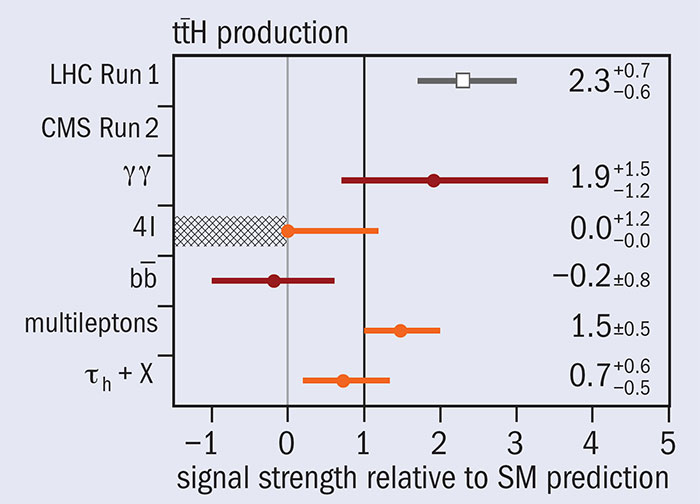
Compared to the first evidence for Higgs production in 2012, namely Higgs-boson decays into clean final states containing two photons or four leptons, the ttH process is much more rare, and the expected signal yields in these modes are just a few events. For this reason, searches for ttH production have been driven by the higher sensitivity achieved in Higgs decay modes with larger branching fractions, such as H  bb, H  WW, and H ττ. The search in the H  bb final state is challenging because of the large background from the production of top-quark pairs in association with jets, and the results are currently limited by systematic and theoretical uncertainties.

A compromise between expected signal yield and background uncertainty can be obtained from final states containing leptons. Such analyses target Higgs decays to WW*, ZZ* and ττ pairs, and make use of events with two same-sign leptons or more than three light leptons produced in association with b-quark jets from top-quark decays. Multivariate techniques allow the background due to jets misidentified as leptons to be reduced, while similar algorithms provide discrimination against irreducible background from tt + W and tt + Z production. Events with reconstructed hadronic τ-lepton decays are studied separately.

The latest results of ttH searches at CMS (see figure) show that we are on the verge of measuring this crucial process with sufficient precision to confirm or disprove the previous observed excess. With a larger data set it should be possible to have clear evidence for ttH production by the end of Run 2.

LHCb brings cosmic collisions down to Earth

In an effort to improve our understanding of cosmic rays, the LHCb collaboration has generated high-energy collisions between protons and helium nuclei similar to those that take place when cosmic rays strike the interstellar medium. Such collisions are expected to produce a certain number of antiprotons, and are currently one of the possible explanations for the small fraction of antiprotons (about one per 10,000 protons) observed in cosmic rays outside of the Earth᾿s atmosphere. By measuring the antimatter component of cosmic rays, we can potentially unveil new high-energy phenomena, notably a possible contribution from the annihilation or decay of dark-matter particles.

In the last few years, space-borne detectors devoted to the study of cosmic rays have dramatically improved our knowledge of the antimatter component. Data from the Alpha Magnetic Spectrometer (AMS-02), which is attached to the International Space Station and operated from a control centre at CERN, published last year are currently the most precise and provide the antiproton over proton fraction up to an antiproton energy of 350 GeV (CERN Courier December 2016 p26). The interpretation of these data is currently limited by poor knowledge of the antiproton production cross-sections, however, and no data are available so far on antiproton production in proton–helium collisions.

LHCb physicists were able to mimic cosmic collisions between 6.5 TeV protons and at-rest helium nuclei

The LHCb’s recently installed internal gas target “SMOG” (System for Measuring Overlap with Gas) provides the unique possibility to study fixed-target proton collisions at the unprecedented energy offered by the LHC, with the forward geometry of the LHCb detector well suited for this configuration. The SMOG device allows a tiny amount of a noble gas to be injected inside the LHC beam pipe near the LHCb vertex detector region. The gas pressure is less than a billionth of atmospheric pressure so as not to perturb LHC operations, but this is sufficient to observe hundreds of millions of beam–gas collisions per hour. By operating SMOG with helium, LHCb physicists were able to mimic cosmic collisions between 6.5 TeV protons and at-rest helium nuclei – a configuration that closely matches the energy scale of the antiproton production observed by space-borne experiments. Data-taking was carried out during May 2016 and lasted just a few hours.

LHCb’s advanced particle-identification capabilities were used to determine the yields of antiprotons, among other charged particles, in the momentum range 12–110 GeV. A novel method has been developed to precisely determine the amount of gas in the target: events are counted where a single electron elastically scattered off the beam is projected inside the detector acceptance. Owing to their distinct signature, these events could be isolated from the much more abundant interactions with the helium nuclei. The cross-section for proton–electron elastic scattering is very well known and allows the density of atomic electrons to be computed.

The result for the antiproton production has been compared to the most popular cosmic-ray models describing soft hadronic collisions, revealing significant disagreements with their predictions. The accuracy of the LHCb measurement is below 10% for most of the accessible phase space, and is expected to contribute to the continuous progress in turning high-energy astroparticle physics into a high-precision science.

ALICE reveals dominance of collective flow

The study of the anisotropic flow in heavy-ion collisions at the LHC, which measures the momentum anisotropy of the final-state particles, has been effective in characterising the extreme states of matter produced in such collisions. Much evidence of collective anisotropic flow and the production of a quark–gluon plasma (QGP) in heavy-ion collisions has already been reported. However, ALICE recently devised a new technique to test for the collective nature of the flow using measurements of differential transverse-momentum correlators, P2. These quantities measure the degree of correlation between the momenta of produced particles and are used to probe the evolution of the QGP fireball produced in heavy-ion collisions. For specific dynamic processes, one can derive how the shape and strength of momentum correlations is related to those of particle-number correlations.

ALICE

Collective-flow models posit that the enormous energy density achieved in heavy-ion collisions generates large pressure gradients that drive the expansion of the QGP fireball. In non-central collisions, the nuclear overlap region is anisotropic and approximately almond shaped, with the longer axis oriented perpendicular to the reaction plane formed by the impact parameter and the beam direction. This produces pressure gradients that are largest in the reaction plane. Particle production thus becomes an anisotropic and collective process mostly determined by the orientation relative to the reaction plane. The anisotropy in the transverse plane is quantified in terms of Fourier coefficients (vn), whose values depend on the initial spatial anisotropy of the fireball as well as pressure gradients. If the geometry of the system and the pressure gradients dominate correlations of produced particles, one expects a specific scaling relation between vn[P2] coefficients of momentum correlations and the regular flow coefficients vn. The presence of other sources of particle correlation, generically called non-flow, are expected to break this simple scaling, however.

ALICE has now found that the scaling relation between vn[P2] and regular vn coefficients is well verified for particle pairs with a minimum separation of 0.9 unit of rapidity (figure, right panel), but breaks down for shorter intervals (left panel) where non-flow effects such as resonance decays and jet fragmentation play an important role. The observed scaling at rapidity greater than 0.9 thus confirms that collective flow determined by the geometry of the collision system dominates the correlation dynamics in heavy-ion collisions at the LHC. ALICE also observed, in the five per cent most central collisions, that the third-order coefficients v3[P2] are larger than the second-order coefficients, v2[P2]. Such coefficient hierarchy is also observed in particle-number correlations but only for the two per cent most central collisions. The observable P2 thus provides better sensitivity to initial state fluctuations that engender finite third-harmonic values.

Dark-matter surprise in early universe

New observations using ESO’s Very Large Telescope (VLT) in Chile indicate that massive, star-forming galaxies in the early universe were dominated by normal, baryonic matter. This is in stark contrast to present-day galaxies, where the effects of dark matter on the rotational velocity of spiral galaxies seem to be much greater. The surprising result, published in Nature by an international team of astronomers led by Reinhard Genzel at the Max Planck Institute for Extraterrestrial Physics in Germany, suggests that dark matter was less influential in the early universe than it is today.

Whereas normal matter in the cosmos can be viewed as brightly shining stars, glowing gas and clouds of dust, dark matter does not emit, absorb or reflect light. This elusive, transparent matter can only be observed via its gravitational effects, one of which is a higher speed of rotation in the outer parts of spiral galaxies. The disc of a spiral galaxy rotates with a velocity of hundreds of kilometres per second, making a full revolution in a period of hundreds of millions of years. If a galaxy’s mass consisted entirely of normal matter, the sparser outer regions should rotate more slowly than the dense regions at the centre. But observations of nearby spiral galaxies show that their inner and outer parts actually rotate at approximately the same speed.

It is widely accepted that the observed “flat rotation curves” indicate that spiral galaxies contain large amounts of non-luminous matter in a halo surrounding the galactic disc. This traditional view is based on observations of numerous galaxies in the local universe, but is now challenged by the latest observations of galaxies in the distant universe. The rotation curve of six massive, star-forming galaxies at the peak of galaxy formation, 10 billion years ago, was measured with the KMOS and SINFONI instruments on the VLT, and the results are intriguing. Unlike local spiral galaxies, the outer regions of these distant galaxies seem to be rotating more slowly than regions closer to the core – suggesting they contain less dark matter than expected. The same decreasing velocity trend away from the centres of the galaxies is also found in a composite rotation curve that combines data from around 100 other distant galaxies, which have too weak a signal for an individual analysis.

Genzel and collaborators identify two probable causes for the unexpected result. Besides a stronger dominance of normal matter with the dark matter playing a much smaller role, they also suggest that early disc galaxies were much more turbulent than the spiral galaxies we see in our cosmic neighbourhood. Both effects seem to become more marked as astronomers look further back in time into the early universe. This suggests that three to four billion years after the Big Bang, the gas in galaxies had already efficiently condensed into flat, rotating discs, while the dark-matter halos surrounding them were much larger and more spread out. Apparently it took billions of years longer for dark matter to condense as well, so its dominating effect is only seen on the rotation velocities of galaxy discs today.

This explanation is consistent with observations showing that early galaxies were much more gas-rich and compact than today’s galaxies. Embedded in a wider dark-matter halo, their rotation curves would be only weakly influenced by its gravity. It would be therefore interesting to explore whether the suggestion of a slow condensation of dark-matter halos could help shed light on this mysterious component of the universe.

Editor’s note

After 13 years as the Courier’s Astrowatch contributor, astronomer Marc Türler is moving to pastures new. We thank him for his numerous lively columns keeping readers up to date with the latest astro results.

bright-rec iop pub iop-science physcis connect