Introduction to Neutrino and Particle Physics: From Quantum Field Theory to the Standard Model and Beyond, by Giulia Ricciardi, Springer
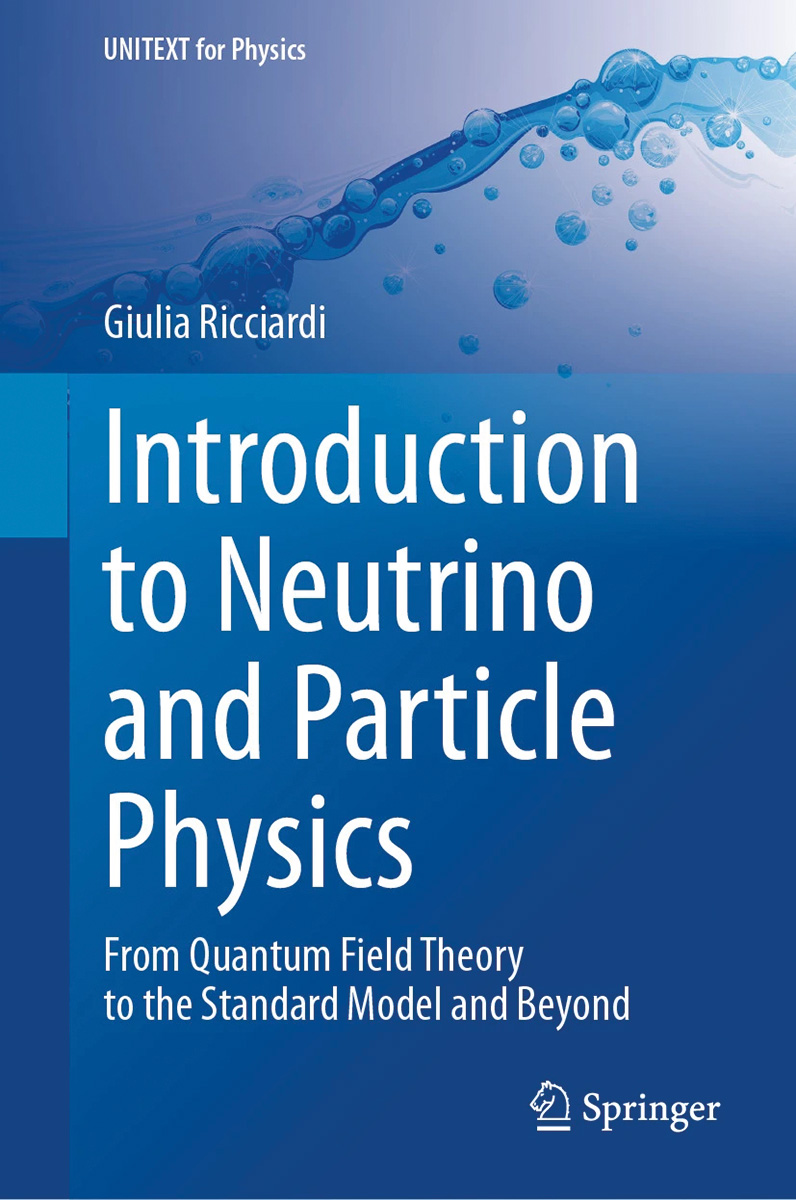
Neutrino physics is a vibrant field of study, with spectacular recent advances. To this day, neutrino oscillations are the only experimental evidence of physics beyond the Standard Model, and, 25 years after this discovery, breathtaking progress has been achieved in both theory and experiment. Giulia Ricciardi’s new textbook provides a timely new resource in a fast developing field.
Entering this exciting field of research can be intimidating, thanks to the breadth of topics that need to be mastered. As well as particle physics, neutrinos touch astroparticle physics, cosmology, astrophysics, nuclear physics and geophysics, and many neutrino textbooks assume advanced knowledge of quantum field theory and particle theory. Ricciardi achieves a brilliant balance by providing a solid foundation in these areas, alongside a comprehensive overview of neutrino theory and experiment. This sets her book apart from most other literature on the subject and makes it a precious resource for newcomers and experts alike. She provides a self-contained introduction to group theory, symmetries, gauge theories and the Standard Model, with an approach that is both accessible and scientifically rigorous, putting the emphasis on understanding key concepts rather than abstract formalisms.
With the theoretical foundations in place, Ricciardi then turns to neutrino masses, neutrino mixing, astrophysical neutrinos and neutrino oscillations. Dirac, Majorana and Dirac-plus-Majorana mass terms are explored, alongside the “see-saw” mechanism and its possible implementations. A full chapter is devoted to neutrino oscillations in the vacuum and in matter, preparing the reader to explore neutrino oscillations in experiments, first from natural sources, such as the Sun, supernovae, the atmosphere and cosmic neutrinos; a subsequent chapter then covers reactor and accelerator neutrinos, giving a detailed overview of the key theoretical and experimental issues. Ricciardi avoids a common omission in neutrino textbooks by addressing neutrin–nucleus interactions – a fast developing topic in theory and a crucial aspect of interpreting current and future experiments. The book concludes with a look at the current research and future prospects, including a discussion of neutrino-mass measurements and neutrinoless double-beta decay.
The clarity with which Ricciardi links theoretical concepts to experimental observations is remarkable. Her book is engaging and eminently enjoyable. I highly recommend it.