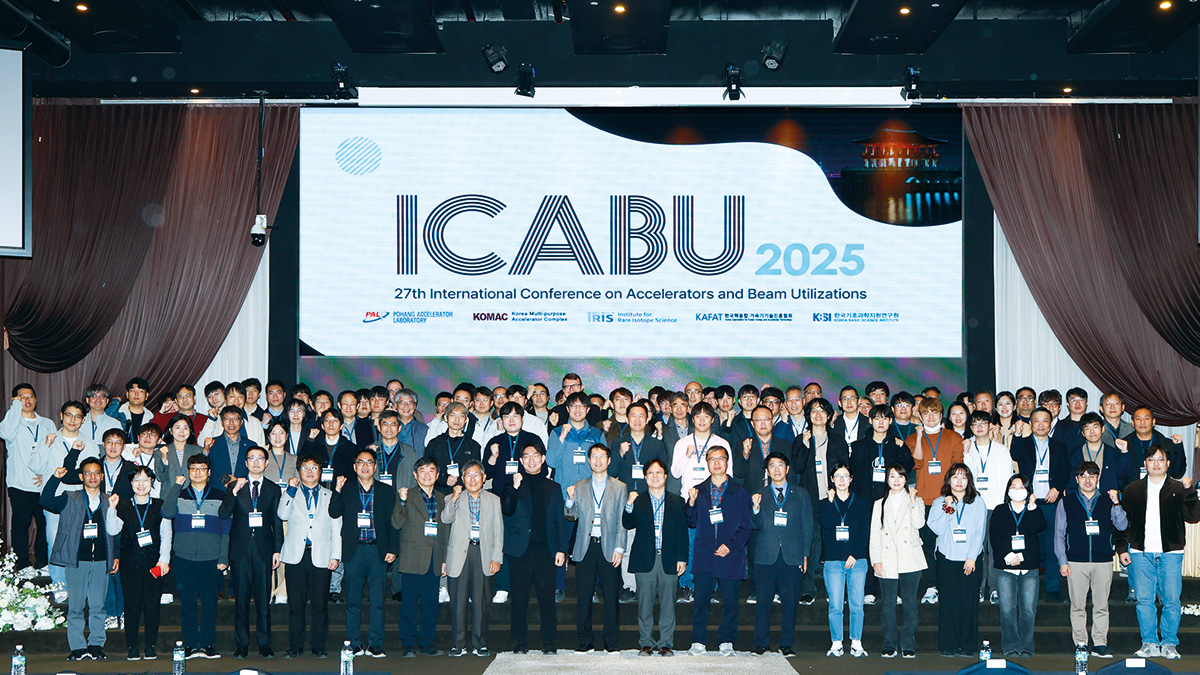
The 27th International Conference on Accelerators and Beam Utilizations (ICABU2025) attracted 300 experts to Pohang, South Korea, from 12 to 14 November 2025. Once a small fishing village, Pohang has developed into a major research hub and now hosts more than 22 R&D institutions. These include Pohang University of Science and Technology (POSTECH), the Pohang Accelerator Laboratory – home to the 3 GeV PLS-II synchrotron radiation source and PAL-XFEL hard X-ray free-electron laser – and the Asia-Pacific Center for Theoretical Physics. ICABU itself began in 1997 as the International Proton Accelerator Workshop, hosted by the Korea Atomic Energy Research Institute. Since 2009, it has grown into an international conference.
Particle beams are becoming increasingly important to materials engineering. Yunseok Kim (Sungkyunkwan University) discussed how helium-ion irradiation can be used to manipulate hafnium oxide, a material widely employed as an insulating layer in modern microelectronics. In very thin films, hafnium oxide can sustain a switchable electric polarisation that allows information to be stored, known as ferroelectricity. Yet, this state is normally fragile. Kim showed that controlled irradiation with low-energy helium ions can introduce and rearrange atomic-scale defects in the crystal lattice, stabilising the polarised state.
The meeting also addressed applications in nuclear medicine. A team from the Institute for Rare Isotope Science (IRIS) reported progress towards a domestic production route for the therapeutic alpha-emitter actinium-225, based on irradiation of thorium-232 targets with 50–70 MeV protons. Actinium-225 is both expensive and scarce, with current clinical use relying heavily on imports. Even an initial domestic supply would improve clinical availability and support the wider adoption of targeted alpha therapies.
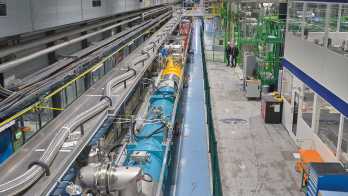
Alongside applications, there was also a focus on progress in accelerator hardware itself
Alongside applications, contributions also focused on progress in accelerator hardware itself. Garam Hahn (PAL) and collaborators reported on a compact 5 T magnet system based on high-temperature superconductors (see p30). Operating without liquid cryogens, it is designed to shift the wavelength of synchrotron radiation, since stronger magnetic fields force tighter beam curvature and raise the characteristic photon energy. The system drew substantial attention from the accelerator-technology community, as it has the potential to increase high-energy photon brilliance by many orders of magnitude.
Beyond technical developments, ICABU2025 also addressed the evolving policy landscape for large-scale research infrastructure. In South Korea, the Korea Large Accelerator Act was recently established to manage, support and govern large accelerator facilities. Dongsoo Jang, deputy director of the Ministry of Science and ICT (MSIT), outlined strategies aimed at improving coordination, access and long-term planning across the country’s accelerator infrastructure.
Next year, the event will be hosted by the Korea Multi-purpose Accelerator Complex (KOMAC) and held in Gyeongju. Often described as a “museum without walls,” Gyeongju is one of Korea’s most historic cities and a symbol of cultural diplomacy, aligning well with the spirit of ICABU.