Over the past decade, many theoretical and experimental landscapes have shifted substantially. Traditional paradigms such as supersymmetry and extra dimensions – once the dominant drivers of LHC search strategies – have gradually given way to a more flexible, signature-oriented approach. The modern search programme is increasingly motivated by signals rather than full theories, providing an interesting backdrop for the return of the SEARCH conference series, which last took place in 2016. The larger and more ambitious 2025 edition attracted hundreds of participants to CERN from 20 to 24 October.
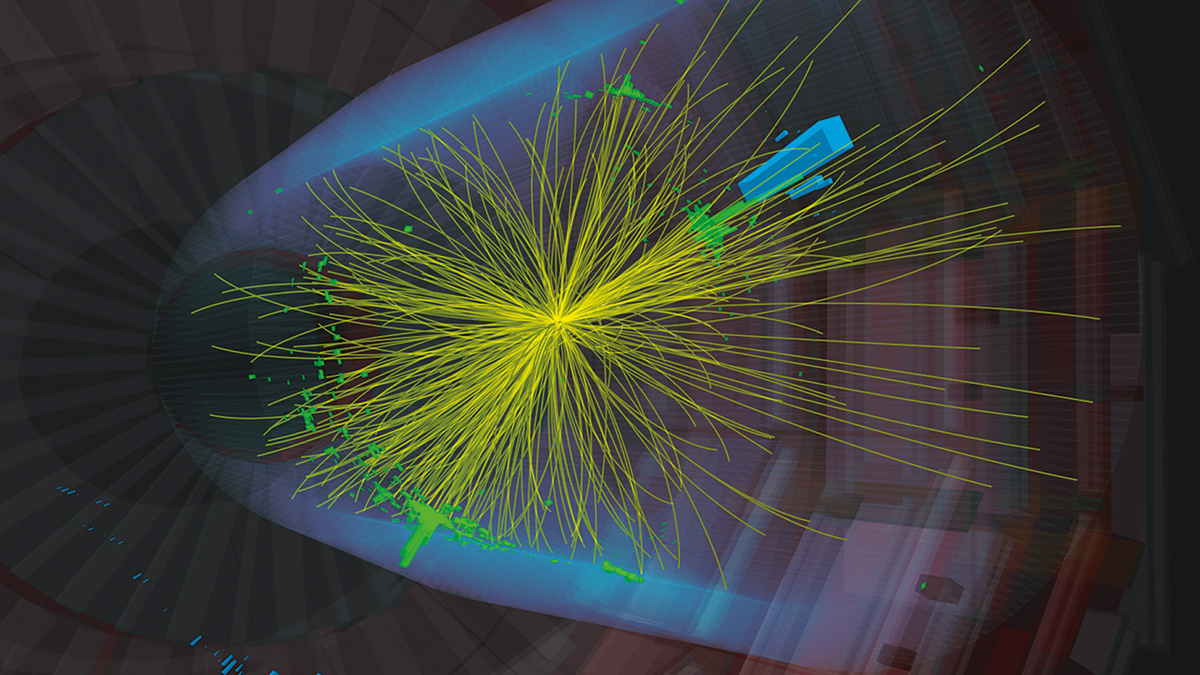
The workshop highlighted how much progress ATLAS and CMS have made in searches for long-lived particles, hidden-valley scenarios (see “Soft cloud” figure) and a host of other unconventional possibilities that now occupy centre stage. Although these ideas were once considered exotic, they have become natural extensions of models connected to cosmology, dark matter and electroweak symmetry breaking. Their experimental signatures are equally rich: displaced vertices, delayed showers, emerging jets or unusual track topologies that demand a rethinking of reconstruction strategies from the ground up.
Deep learning
The most transformative change since previous editions of SEARCH is the integration of AI-based algorithms into every layer of analysis. Deep-learning-driven b-tagging has dramatically increased sensitivity to final states involving heavy flavour, while machine learning is being embedded directly into hardware trigger systems to identify complex event features in real time. This is not technological novelty for its own sake: these tools directly expand the discovery reach of the experiments.
Novel ideas in reconstruction also stood out. Talks showcased how muon detectors can be repurposed as calorimeters to detect late-developing showers, and how tracking frameworks can be adapted to capture extremely displaced tracks that were once discarded as outliers. Such techniques illustrate a broader cultural shift: expanding the search frontier now often comes from reinterpreting detector capabilities in creative ways.
The most transformative change since previous editions of SEARCH is the integration of AI-based algorithms into every layer of analysis
Anomaly detection – the use of unsupervised or semi-supervised deep-learning models to identify data that deviate from learned patterns – was another major focus. These methods, used both offline and in level-one triggers, enable model-agnostic searches that do not rely on an explicit beyond-the-Standard-Model target. Participants noted that this is especially valuable for scenarios like quirks in dark-sector models, where realistic event-generation tools still do not exist. In these cases, anomaly detection may be the only feasible path to discovery.
The rising importance of precision was another theme threading through the discussions. The detailed understanding of detector performance achieved in recent years is unprecedented for a hadron collider. CMS’s muon calibration, which is crucial for its W-mass analysis, and ATLAS’s record-breaking jet-calibration accuracy exemplify the progress. This maturity opens the possibility that new physics could first appear as subtle deviations rather than as striking anomalies. As the era of the High-Luminosity LHC approaches, the upcoming additions of precision timing layers and advanced early-tracking capabilities will further strengthen this dimension of the search programme.
The workshop also provided a platform to explore connections between collider searches and other experimental efforts across particle physics. Strong first-order phase transitions, relevant to electroweak baryogenesis, motivated renewed interest in an additional scalar that would modify the Higgs potential. Such a particle could lie anywhere from the MeV scale up to hundreds of GeV – often below the mass ranges targeted by standard resonance searches. Alternative data-taking strategies such as data scouting and data parking offer new opportunities to probe this wide mass window systematically.
Complementarity with flavour physics at LHCb, long-lived particle searches at FASER, and precision experiments seeking electric dipole moments, axion-like particles and other ultralight states, was also highlighted. In a moment without an obvious theoretical favourite, this diversification of experimental approaches is a key strategic strength.
New directions in science are launched by new tools much more often than by new concepts
A recurring sentiment was that the LHC remains a formidable discovery machine, but the community must continue pushing its tools beyond their traditional boundaries. Many discussions at SEARCH 2025 echoed a famous remark by Freeman Dyson: “New directions in science are launched by new tools much more often than by new concepts.” The upcoming upgrades to ATLAS and CMS – precision timing, enhanced tracking earlier in the trigger chain and high-granularity readout – exemplify the kinds of new tools that can reshape the search landscape.
If SEARCH 2025 underscored the need to explore new signatures, technologies and experimental ideas, it also highlighted an equally important message: we must not lose sight of the physics questions that originally motivated the LHC programme. The hierarchy problem, the apparent fine tuning of quantum corrections to the Higgs mass that prevent it rising to the Planck scale, remains unresolved, and supersymmetry continues to offer its most compelling and robust solution by stabilising it through partner particles. With the dramatic advances in reconstruction, triggering and analysis techniques, and with the enormous increase in recorded data from Run 1 through Run 3, the time is ripe to revitalise the inclusive SUSY search programme. A comprehensive, modernised SUSY effort should be a defining element of the combined ATLAS and CMS legacy physics programme, ensuring that the field fully exploits the discovery potential of the LHC dataset accumulated so far.