Robert Brandenberger argues that the unchanging cosmological constant of the ΛCDM model is theoretically problematic.
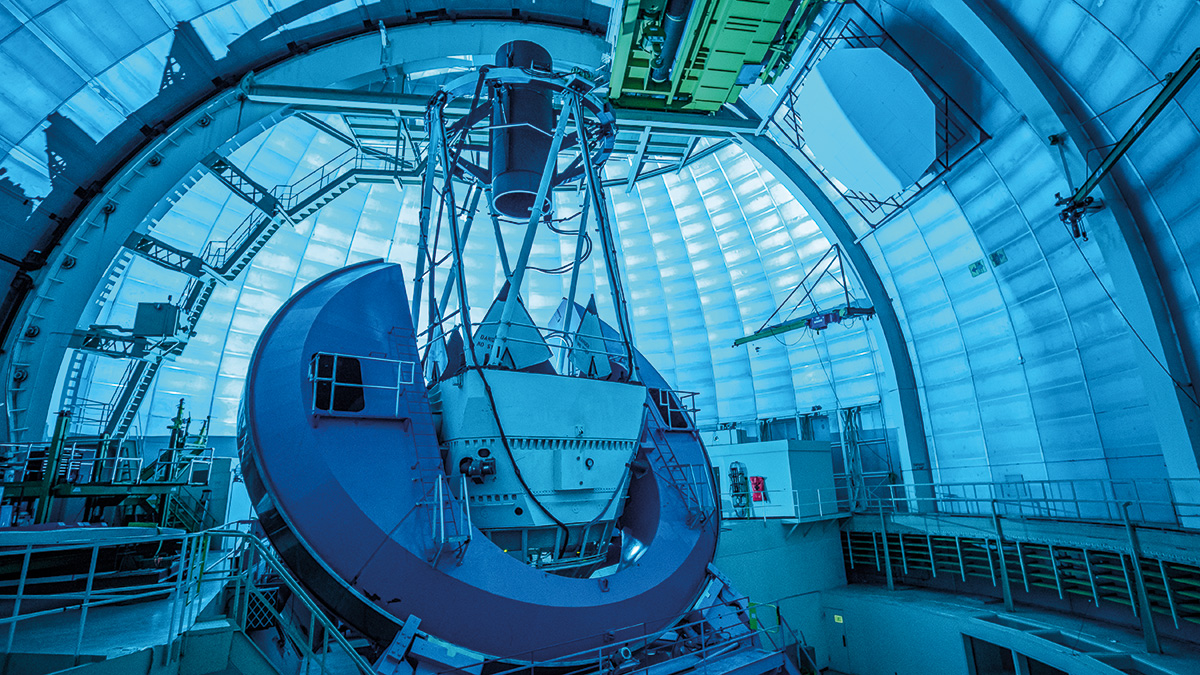
In the late 1990s, observational evidence accumulated that the universe is currently undergoing an accelerating expansion. Its cause remains a major mystery for physics. The term “dark energy” was coined to explain the data, however, we have no idea what dark energy is. All we know is that it makes up about 70% of the energy density of the universe, and that it does not behave like regular matter – if it is indeed matter and not a modification of the laws of gravity on cosmological scales. If it is matter, then it must have a pressure density close to p = –ρ, where ρ is its energy density. The cosmological constant in Einstein’s equations for spacetime acts precisely this way, and a cosmological constant has therefore long been regarded as the simplest explanation for the observations. It is the bedrock of the prevailing ΛCDM model of cosmology – a setup where dark energy is time-independent. But recent observations by the Dark Energy Spectroscopic Instrument provide tantalising evidence that dark energy might be time-dependent, with its pressure slightly increasing over time (CERN Courier May/June 2025 p11). If upcoming data confirm these results, it would require a paradigm shift in cosmology, ruling out the ΛCDM model.
Mounting evidence
From the point of view of fundamental theory, there are at least four good reasons to believe that dark energy must be time-dependent and cannot be a cosmological constant.
The first piece of evidence is well known: if there is a cosmological constant induced by a particle-physics description of matter, then its value should be 120 orders of magnitude larger than observations indicate. This is the famous cosmological constant problem.
A second argument is the “infrared instability” of a spacetime induced by a cosmological constant. Alexander Polyakov (Princeton) has forcefully argued that inhomogeneities on very large length scales would gradually mask a preexisting cosmological constant, making it appear to vary over time.
Recently, other arguments have been put forwards indicating that dark energy must be time-dependent. Since quantum matter generates a large cosmological constant when treated as an effective field theory, it should be expected that the cosmological constant problem can only be addressed in a quantum theory of all forces. The best candidate we have is superstring theory. There is mounting evidence that – at least in the regions of the theory under mathematical control – it is impossible to obtain a positive cosmological constant corresponding to the observed accelerating expansion. But one can obtain time-dependent dark energy, for example in quintessence toy models.
Recent observations provide tantalising evidence that dark energy might be time-dependent
The final reason is known as the trans-Planckian censorship conjecture. As the nature of dark energy remains a complete mystery, it is often treated as an effective field theory. This means that one expands all fields in Fourier modes and quantises each field as a harmonic oscillator. The modes one uses have wavelengths that increase in proportion to the scale of space. This creates a theoretical headache at the highest energies. To avoid infinities, an “ultraviolet cutoff” is required at or below the Planck mass. This must be at a fixed physical wavelength. In order to maintain this cutoff in an expanding space, it is necessary to continuously create new modes at the cutoff scale as the wavelength of the previously present modes increases. This implies a violation of unitarity. If dark energy were a cosmological constant, then modes with wavelength equal to the cutoff scale at the present time would become classical at some time in the future, and the violation of unitarity would be visible in hypothetical future observations. To avoid this problem, we conclude that dark energy must be time-dependent.
Because of its deep implications for fundamental physics, we are eagerly awaiting new observational results that will shine more light on the issue of the time-dependence of dark energy.
Further reading
R Brandenberger 2025 arXiv:2503.17659.