A report from the LHCb experiment.
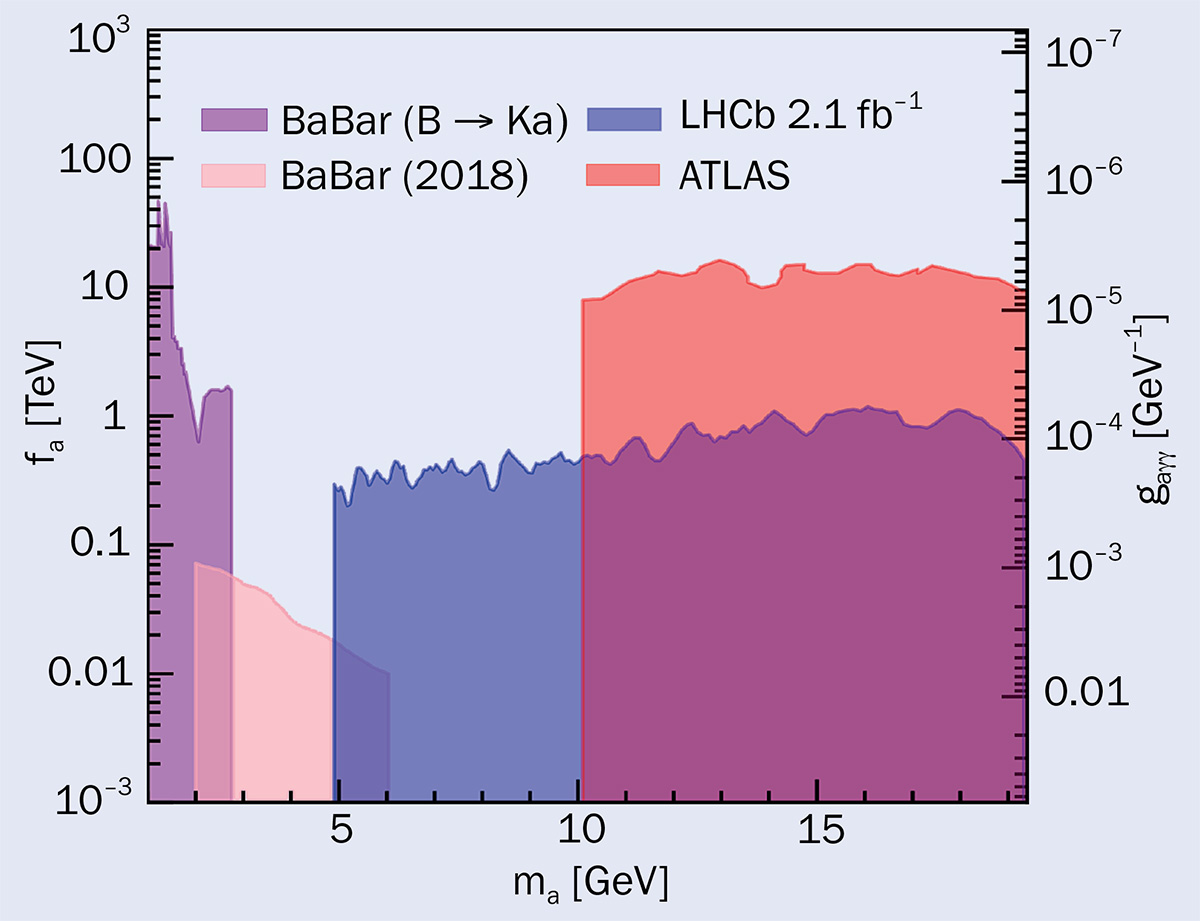
Fig. 1. Limits on the ALP decay constant fa and its coupling to photons gaγγ, as a function of ALP mass ma. Results from the LHCb analysis (blue) are compared to two measurements from BaBar (pink and purple) and one from ATLAS (red). The shaded parameter space is excluded at 95% confidence. Credit: LHCb Collab. 2025 arXiv:2507.14390
Axion-like particles (ALPs) are some of the most promising candidates for physics beyond the Standard Model. At the LHC, searches for ALPs that couple to gluons and photons have so far been limited to masses above 10 GeV due to trigger requirements that reduce low-energy sensitivity. In its first ever analysis on purely neutral final states, the LHCb collaboration has now extended this experimental reach and set new bounds on the ALP parameter space.
When a global symmetry is spontaneously broken, it gives rise to massless excitations called Goldstone bosons, which reflect the system’s freedom to transform continuously without changing its energy. It is thought that ALPs may arise via a similar mechanism, acquiring a small mass though, as they originate from symmetries that are only approximate. Depending on the underlying theory, they could contribute to dark matter, solve the strong-CP problem, or mediate interactions with a hidden sector. Their coupling to known particles varies across models, leading to a range of potential experimental signatures. Among the most compelling are those involving gluons and photons.
Thanks to the magnitude of the strong coupling constant, even a small interaction with gluons can dominate the production and decay of ALPs. This makes searches at the LHC challenging since low-energy jets in proton–proton collisions are often indistinguishable from the expected ALP decay signature. In this environment, a more effective approach is to focus on the photon channel and search for ALPs that are produced in proton–proton collisions – mostly via gluon–gluon fusion – and that decay into photon pairs. These processes have been investigated at the LHC, but previous searches were limited by trigger thresholds requesting photons with large momentum components transverse to the beam. This is particularly restrictive for low-mass ALPs, whose decay products are often too soft to pass these thresholds.
The new search, based on Run-2 data collected in 2018, overcomes this limitation by leveraging the LHCb detector’s flexible software-based trigger system, lower pile-up and forward geometry. The latter enhances sensitivity to products with a small momentum component transverse to the beam, making it well suited to probe resonances in the 4.9 to 19.4 GeV mass region. This is the first LHCb analysis of a purely neutral final state, hence requiring a new trigger and selection strategy, as well as a dedicated calibration procedure. Candidate photon pairs are identified from two high-energy calorimeter clusters, produced in isolation from the rest of the event, which could not originate from charged particles or neutral pions. ALP decays are then sought using maximum likelihood fits that scan the photon-pair invariant mass spectrum for peaks.
No photon-pair excess is observed over the background-only hypothesis, and upper limits are set on the ALP production cross-section times decay branching. These results constrain the ALP decay rate and its coupling to photons, probing a region of parameter space that has so far remained unexplored (see figure 1). The investigated mass range is also of interest beyond ALP searches. Alongside the main analysis, the study targeted two-photon decays of B0(s) and the little-studied ηb meson, almost reaching the sensitivity required for its detection.
The upgraded LHCb detector, which began operations with Run 3 in 2022, is expected to deliver another boost in sensitivity. This will allow future analyses to benefit from the extended flexibility of its purely software trigger, significantly larger datasets and a wider energy coverage of the upgraded calorimeter.
Further reading
LHCb Collab. 2025 arXiv:2507.14390.