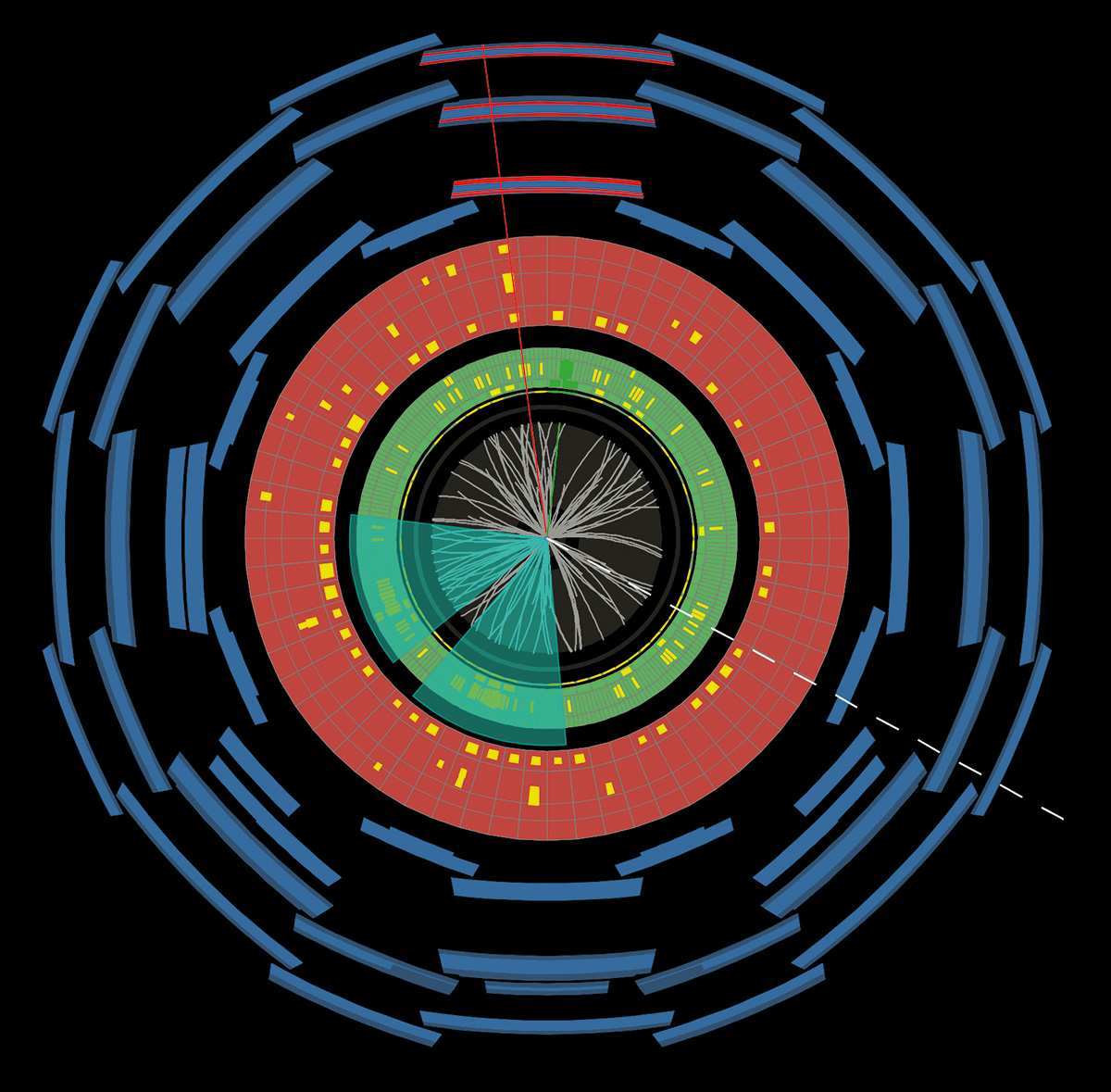
At the LHC, almost all top–antitop pairs are produced in a smooth invariant-mass spectrum described by perturbative QCD. In March, the CMS collaboration announced the discovery of an additional 1% localised near the energy threshold to produce a top quark and its antiquark (CERN Courier May/June 2025 p7). The ATLAS collaboration has now confirmed this observation.
“The measurement was challenging due to the small cross section and the limited mass resolution of about 20%,” says Tomas Dado of the ATLAS collaboration and CERN. “Sensitivity was achieved by exploiting high statistics, lepton angular variables sensitive to spin correlations, and by carefully constraining modelling uncertainties.”
Toponium
The simplest explanation for the excess appears to be a spectrum of “quasi-bound” states of a top quark and its antiquark that are often collectively referred to as toponium, by reference to the charmonium and bottomonium states discovered in the November Revolution of 1974 (see “Memories of quarkonia“). But there the similarities end. Thanks to the unique properties of the most massive fundamental particle yet discovered, toponium is expected to be exceptionally broad rather than exceptionally narrow in energy spectra, and to disintegrate via the weak decay of its constituent quarks rather than via their mutual annihilation.
“Historically, it was assumed that the LHC would never reach the sensitivity required to probe such effects, but ATLAS and CMS have shown that this expectation was too pessimistic,” says Benjamin Fuks of the Sorbonne. “This regime corresponds to the production of a slowly moving top–antitop pair that has time to exchange multiple gluons before one of the top quarks decays. The invariant mass of the system lies slightly below the open top–antitop threshold, which implies that at least one of the top quarks is off-shell. This contrasts with conventional top–antitop production, where the tops are typically produced far above threshold, move relativistically and do not experience significant non-relativistic gluon dynamics.”
While CMS fitted a pseudo-scalar resonance that couples to gluons and top quarks – the essential features of the ground state of toponium – the new ATLAS analysis employs a model recently published by Fuks and his collaborators that additionally includes all S-wave excitations. ATLAS reports a cross-section for such quasi-bound excitations of 9.0 ± 1.3 pb, consistent with CMS’s measurement of 8.8 ± 1.3 pb. ATLAS’s measurement rises to 13.9 ± 1.9 pb when applying the same signal model as CMS.
Future measurements of top quark–antiquark pairs will compare the threshold excess to the expectations of non-relativistic QCD, search for the possible presence of new fields beyond the Standard Model, and study the quantum entanglement of the top and antitop quarks.
“At the High-Luminosity LHC, the main objective is to exploit the much larger dataset to go beyond a single-bin description of the sub-threshold top–antitop invariant mass distribution,” says Fuks. “At a future electron–positron collider, the top–antitop threshold scan has long been recognised as a cornerstone measurement, with toponium contributions playing an essential role.”
For Dado, this story reflects a satisfying interplay between theorists and the LHC experiments.
“Theorists proposed entanglement studies, ATLAS demonstrated entangled top–antitop pairs and CMS applied spin-sensitive observables to reveal the quasi-bound-state effect,” he says. “The next step is for theory to deliver a complete description of the top–antitop threshold.”
Further reading
ATLAS Collab. 2025 ATLAS-CONF-2025-008.
B Fuks et al. 2025 Eur. Phys. J. C 85 157.