Applying the Standard Model (SM) to early cosmological times leads to an uninhabitable universe, with tiny and equal amounts of matter and antimatter. Yet the universe is habitable and the local universe strongly matter-dominated. Observations of the diffuse gamma-ray background and cosmic microwave background show no evidence for the presence of antimatter on large scales and rule out a matter–antimatter symmetric universe.
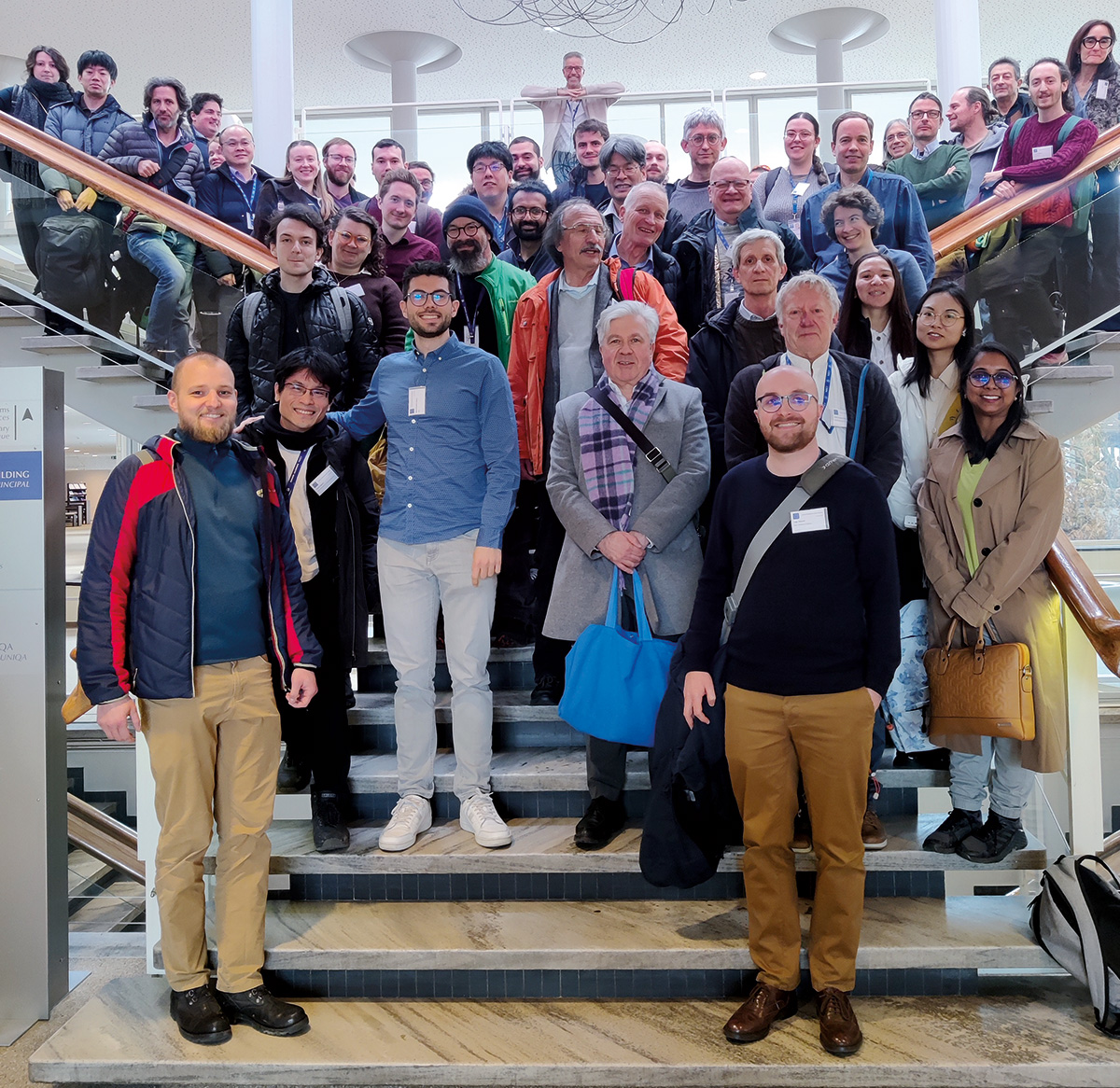
From 19 to 22 January, 80 particle physicists, astronomers and cosmologists gathered at CERN for the first “All that Antimatters in the Universe” workshop to explore the frontier between the laboratory and astrophysical perspectives on the matter–antimatter asymmetry of the universe.
Broad panorama
Julia Harz (Mainz University) reviewed a broad panorama of baryogenesis models in which physics beyond the SM produces a homogeneous matter excess within the first seconds after the Big Bang, before light elements are synthesised. She highlighted their features and potential tests and constraints, including searches at colliders like the LHC and indirectly with experiments such as those looking for neutrinoless double-beta decays.
Questioning our assumptions about antimatter was a central thread of the workshop, with several presentations highlighting non-standard baryogenesis models that allow domains of antimatter to survive the Big Bang, as well as others in which antimatter is hidden in compact nuggets that could also constitute dark matter. A lively discussion explored how to hunt for these scenarios using astrophysical and cosmological observables. For example, spectral distortions of the cosmic microwave background could indicate energy injections from matter–antimatter annihilation in the early universe. Observations at 21 cm-wavelengths offer another probe: these signals trace neutral hydrogen during the cosmic-dawn epoch, when the first stars and galaxies formed, and could reveal anomalous heating or ionisation patterns characteristic of antimatter annihilation.
Questioning assumptions about antimatter was a central thread of the workshop
The discrete symmetries of charge conjugation (C), parity (P) and time reversal (T) have been central to particle physics since the discovery that nature violates them individually, yet their combined action (CPT) appears to be preserved in all standard interactions. In a particularly sharp presentation, Gabriela Barenboim (University of Valencia) stressed that while much attention is devoted to the search for differences in the interactions between particles and antiparticles through CP-symmetry violation, the more fundamental possibility of CPT violation remains largely unexplored. Unlike CP violation, which can occur within the Standard Model, any breakdown of CPT symmetry would signal new physics and could manifest as differences in the intrinsic properties of particles and antiparticles, including their masses and lifetimes.
Leading stress-tests of CPT symmetry are now carried out at CERN’s Antimatter Factory (AF), whose experiments presented an array of impressive results at the workshop. Eric Hunter (CERN) highlighted the potential of boosting the yield of antihydrogen formation at the AF experiments, showing how this could improve our knowledge of antimatter physics enormously. Improved yields of antimatter replicas of naturally occurring matter-based atoms would enable higher precision tests of key electromagnetic transitions and gravitational interactions of antimatter.
Much attention went to antimatter in cosmic rays. Primary cosmic rays are particles accelerated at astrophysical sources such as supernova remnants and injected into the galaxy, whereas secondary cosmic rays are produced when those primaries collide with gas and dust in the interstellar medium. In standard galactic cosmic-ray models, antimatter is purely a secondary product of the interactions of primary cosmic rays with the interstellar medium. However, the AMS-02 experiment operating on the International Space Station has firmly established a positron excess requiring a primary source, possibly pulsars. AMS-02 antiproton data also show some anomalies, but uncertainties in the propagation models and interaction cross-sections remain large.
Mind the GAPS
Complementary searches for cosmic-ray antimatter are also carried out by balloon-borne experiments. Principal investigator Chuck Hailey (Columbia University) described how the GAPS balloon experiment, uniquely suited to probe low-energy antiprotons, antideuterons and antihelium, reported its first data from a 25-day flight completed in early 2026. The specificity of GAPS is the exploitation of the characteristic X-ray emission produced by short-lived bound states between antimatter nuclei and ordinary atoms, which results in excellent particle-identification and background-rejection capabilities.
The atmosphere at the workshop was excellent, with participants curious to learn from other communities and expand their horizons everywhere that antimatter matters in the universe, from the cosmos to the lab, via astrophysical systems. While antimatter still holds many mysteries, All that Antimatters in the Universe brought us one step closer to answering them.