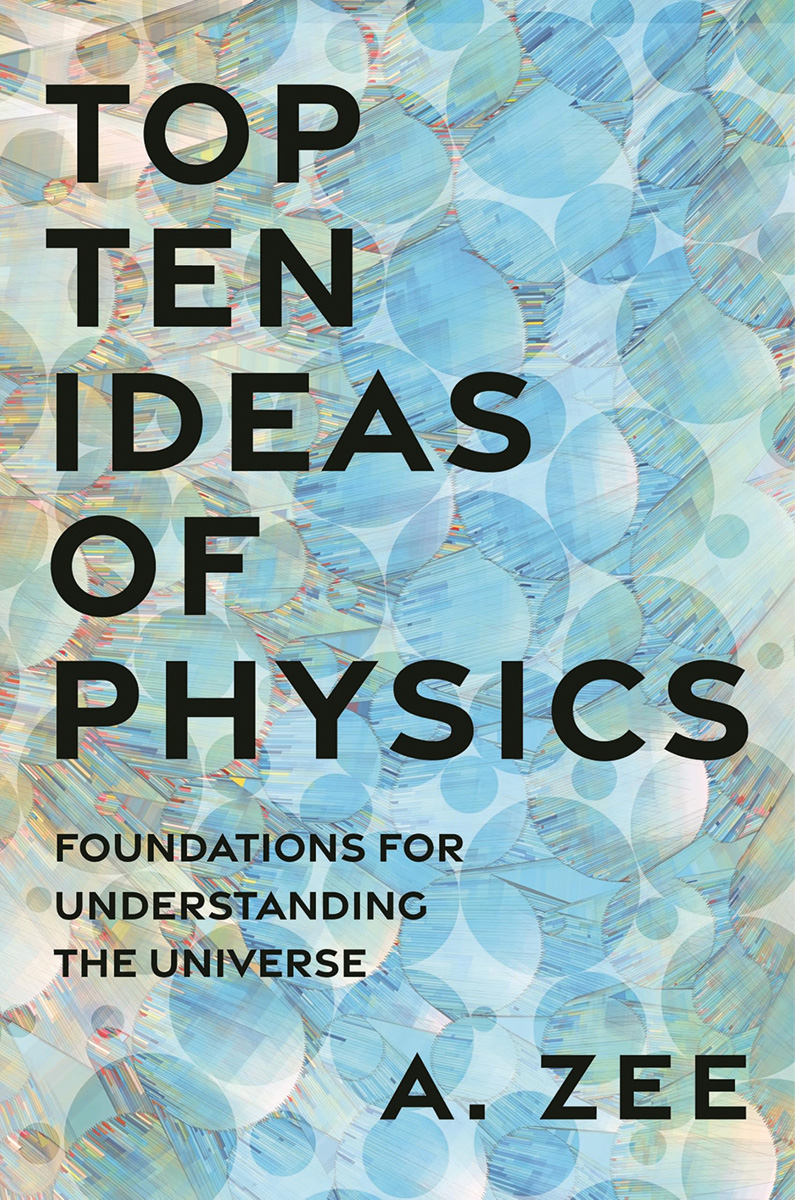
Top Ten Ideas of Physics: Foundations for Understanding the Universe, by Anthony Zee, Princeton University Press

Reading a book is like swimming. The first lengths are the worst: the water is cold, the shoulders stiff, every stroke a negotiation. Then, somewhere around the fourth or fifth length, the muscles warm, water simply becomes the medium you are in, and the resistance turns into something that carries you. All swimmers count their lengths, but all lose count at some point, when the mind slips its moorings and you surface two or three lengths later with no idea how you got there. Top Ten Ideas of Physics by Anthony Zee, of the Kavli Institute for Theoretical Physics in Santa Barbara, is like that. You come to it stiff and for a page or two you feel the cold. Then the prose warms around you and you stop counting.
In the prologue, Zee declares an aim different from that of most books of this kind. Readers looking for the latest results, he says, should go to the web. While the market might ask for black holes and whatever anomaly is at three sigma, Zee has written about ideas that have long stopped being news. What earns an idea a chapter is not novelty, nor even beauty, but that people have leaned on it very hard for very long and it has not given way. The author has evidently been pondering for many years which 10 ideas in physics to include and how to describe them.
The order of the top 10 is neither historical nor pedagogical. It is an argument. The first two entries, that the world is comprehensible and that the laws are the same across space and time, are not laws at all, but the conditions under which physics is possible. Zee is right to give them the two shortest chapters, since one cannot derive the fact that the world is comprehensible. One notices, with Einstein, that it inexplicably is, and gets to work. Ontology follows, in the chapters on quantum mechanics and fields, and then structure, in those on symmetry, space–time and unification. A chapter on why mathematics works sits comfortably only because it arrives after seven chapters of evidence. The book then turns to entropy and, last of all, the action.
Ending on the action is the boldest decision in the book and, in my opinion, the correct one. Most accounts treat the principle of least action as a third-year undergraduate technicality. Zee makes it the climax, and opens the chapter by admitting that he finds it astonishing and mysterious. That gives the reader permission to be astonished too, and it implies a serious claim: the deepest thing we know is not what the world is made of, but the form in which its laws are written.
Quantum mechanics gets 44 pages, Einstein 42, fields 35, while the two opening principles get 14 and 13. Two-fifths of the book is quantum mechanics, field theory and general relativity. The imbalance tells the reader where Zee’s own work has been, and is itself a good reason to read the book. Chapters four and six are built on two of his earlier textbooks, Quantum Field Theory in a Nutshell and Einstein Gravity in a Nutshell, and there the writing stops being exposition and becomes testimony. When Zee describes the quantum fields as murmuring and telling one another how to dance, he is not decorating. That is the picture he himself works with.
On a practical note, chapters one and two work better as a retrospective frame than as an introduction. I would therefore suggest reading the prologue, jumping to chapter three, then coming back. And there is nothing on holography, on the information problem, on cosmological tensions. Zee warned us at the beginning, and the exclusion is likely to keep the book readable in 20 years.
At the end one holds 10 sentences, each short enough to remember and general enough to use. A reader who finishes with those in place has learnt more physics than one who finishes a fatter book with a head full of analogies.
What keeps swimmers swimming is neither the first length nor the last. It is the middle, the part one cannot account for afterwards, when the counting has failed and something in the mind has gone off duty. A book that induces that state is doing something that has nothing to do with the transfer of information, and Zee’s does. Through the long central stretch, the counting stops, and one is in the company of somebody who has thought about this for 40 years and has finally decided which 10 things matter.