A report from the CMS experiment.
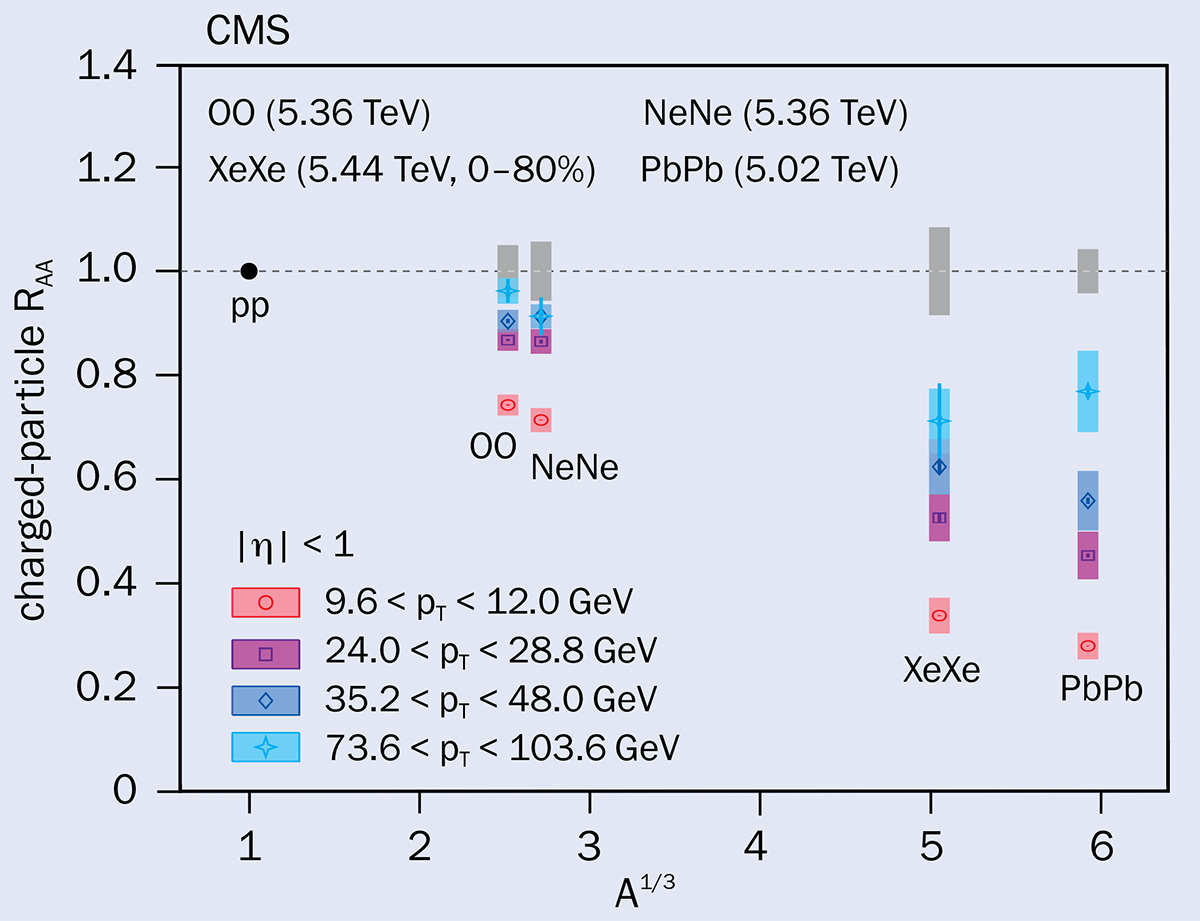
When atomic nuclei collide at the LHC, they produce tiny droplets of quark–gluon plasma (QGP) and energetic partons plough through it, slowing down in the process. In a new analysis, the CMS collaboration compared high transverse momentum (pT) particle yields in oxygen–oxygen, neon–neon, xenon–xenon and lead–lead collisions, with the nucleon numbers of the colliding particles increasing in the sequence 16 < 20 < 129 < 208. The results suggest a steady growth of parton energy loss with the size of the colliding system.
High-pT particles come from the fragmentation of quarks and gluons produced in the earliest hard scatterings of a collision. As these partons cross the QGP, they interact with the medium and radiate, losing energy in the process. This is one of the clearest signatures of QGP formation. How much energy partons lose depends on how far they travel inside the medium, which in turn grows with the size of the colliding nuclei. Although firmly established in xenon–xenon and lead–lead collisions, the precise way this quenching depends on the path length is not yet fully understood.
Light-ion collisions provide a controlled way to vary the system size and isolate this path-length dependence. In July 2025, the LHC delivered its first ever oxygen–oxygen and neon–neon collisions (CERN Courier November/December 2025 p8). The CMS collaboration analysed the data from this dedicated one-week run to perform a systematic study of high-pT charged-particle suppression across multiple collision systems.
The analysis combines existing measurements in oxygen–oxygen, xenon–xenon and lead–lead collisions with the first measurement of the charged-particle nuclear modification factor, RAA, in neon–neon collisions at a centre-of-mass energy of 5.36 TeV per nucleon pair. The observable RAA quantifies how particle yields deviate from expectations based on proton–proton collisions. The four systems were analysed using identical pT-intervals, enabling a consistent comparison across systems.
The results should help inform the choice of ion species
For smaller nuclei, such as oxygen and neon, many experimental uncertainties shared with the proton–proton reference largely cancel, for example, those related to tracking. This leads to particularly precise measurements of RAA across a wide pT range, which is difficult to achieve in larger systems. Combined with the wide span of nuclear sizes, this precision enables a more direct assessment of how parton energy loss depends on in-medium path length.
For a fixed transverse momentum interval, the suppression increases smoothly with system size, from light to heavy ion collisions (see figure 1). Conversely, for a given nuclear system, the suppression is stronger at lower transverse momenta and progressively weakens as it increases. Expressed in terms of the cube root of the nucleon number, which is proportional to the nuclear radius, the results follow a simple ordering with the size of the system, offering a natural framework to test the evolution of energy loss with system size.
The data indicate that nuclear suppression develops gradually as the nuclear system grows, consistent with a picture in which partons interact with QGP droplets whose extent and density evolve smoothly across collision systems. Calculations that omit energy loss show little variation with system size and do not describe the observed suppression, whereas models that include it qualitatively reproduce the observed trend within uncertainties. The data, presented this way, offer a guide for further improvements on their A-dependence.
This study places new quantitative constraints on parton-energy-loss mechanisms and on the emergence of QGP-like behaviour in small nuclear systems. The results should help guide future theoretical developments and inform the choice of ion species in upcoming heavy-ion studies at the LHC.
Further reading
CMS Collab. 2026 arXiv:2602.21325.