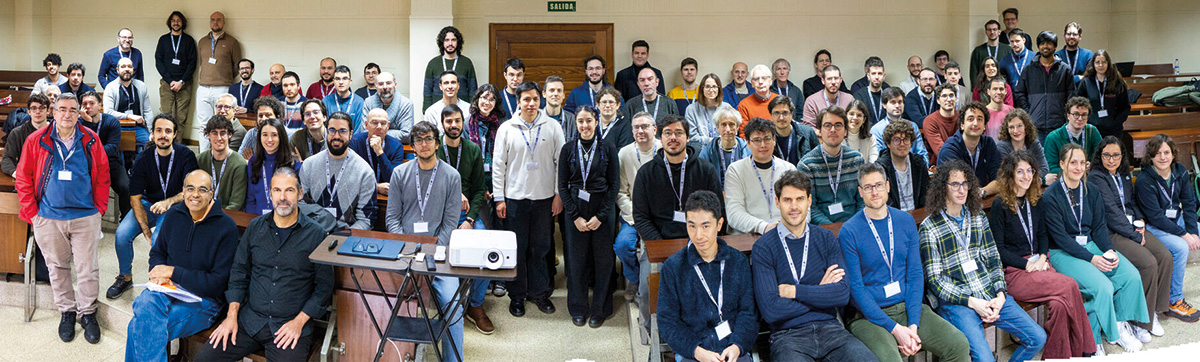
One hundred researchers gathered in Santiago de Compostela from 21 to 23 January for Iberian Strings, the annual meeting of the vibrant Spanish and Portuguese string theory community. From the idea that black holes may test quantum gravity to the new, string-inspired ways of organising quantum field theories using symmetries and defects, the programme offered a broad overview of where string theory and holography currently sit. What stood out was the extent to which very different problems are now being tackled with a shared set of theoretical tools.
Black holes remain a clean laboratory for probing ideas about quantum gravity. Decades of work have shown they behave much like ordinary thermodynamic systems, with quantities such as temperature and entropy. A central question is how this simple large-scale behaviour arises from an underlying quantum description. Vijay Balasubramanian (University of Pennsylvania) emphasised that the challenge is not only reproducing the familiar area law – which links entropy to the area of the event horizon – but also understanding what different semiclassical calculations are really describing.
Calculations under control
One way to address this problem is to count the quantum states that give rise to a black hole’s entropy. To make progress, researchers often focus on settings where calculations are under better control. Gabriel Cardoso (IST Lisbon) discussed BPS black holes, highly symmetric solutions that allow precise calculations using holography. Stefano Trezzi (University of Barcelona) showed that near-extremal black holes, systems close to a zero-temperature limit, exhibit a universal near-horizon behaviour that provides a clean setting to study how quantum effects modify the semiclassical picture.
So much for static black holes; what about their evolution in time? Marija Tomašević (CERN) suggested that quantum effects can form a horizon where classical gravity would predict a naked singularity. Pablo A Cano (University of Murcia) and Marina David (KU Leuven) explored instead how black holes react when they are perturbed, emitting gravitational waves as they settle back to equilibrium through a process known as ringdown. Across these contributions, the focus was on separating what can be understood within controlled semiclassical calculations from what requires genuinely microscopic, quantum-gravitational input.
Some particle theories may have been gravity all along. And vice versa. These seemingly disparate worlds, with particle beams and colour confinement in one (particle physics) and curved spacetime in the other (gravity), may simply be two languages for the same physics. To translate between them, the particle side must live in one fewer dimension. Just as a hologram stores a 3D image on a 2D plate, a gravitational theory in D dimensions may be exactly equivalent to a non-gravitational quantum field theory in D–1 dimensions. This holographic correspondence is central to modern approaches to quantum gravity. The focus at the workshop was on its more applied uses, as a controlled way to learn about dynamics at strong coupling.
Elias Kiritsis (University of Crete) provided a concrete example. Using familiar spacetime physics, he studied how strongly interacting quantum systems respond to gentle deformations at low temperature, a standard probe of transport. In this setting, quantum effects can modify quantities such as the ratio of viscosity to entropy density beyond the semiclassical value.
To round the picture, Francesco Nitti (APC Paris), explored holographic models in which varying the curvature of spacetime can affect confinement, while Shota Komatsu (CERN) presented an overview of matrix-model methods in holography, emphasising how they can provide tractable descriptions of strong-coupling dynamics in specific regimes, such as large-N limits. Following ’t Hooft, theorists often treat the number of colours in an SU(N) gauge theory as a tunable parameter, providing a controlled simplification of strongly coupled dynamics.
Black holes remain a clean laboratory for probing ideas about quantum gravity
Working in simplified settings can be an effective way to make progress. In holography, a quantum field theory in two dimensions can map to a three-dimensional spacetime with a negative cosmological constant. Symmetries then constrain the gravity side, allowing us to pose – and sometimes answer – questions that would be far harder to tackle in higher dimensions or less symmetric settings. In this spirit, Stéphane Detournay (Université Libre de Bruxelles) showed how near-extremal black holes themselves can behave like two-dimensional systems, where effects due to thermodynamics, symmetry and quantum corrections can often be disentangled cleanly.
Rapid progress in understanding generalised symmetries and defects was a hot topic. Guillermo Arias-Tamargo (Imperial College London) described how recent work on non-invertible symmetries in non-linear sigma models pushes beyond the traditional picture of symmetries as simple group actions on local fields. In this modern framework, symmetries are realised through extended objects, such as defects or interfaces. Tracking how observables transform across these structures provides concrete constraints on the dynamics and phases of the theory.
A particularly sharp application came from José Calderón Infante (Caltech), who used defect-based arguments to rule out global shift symmetries in quantum gravity. Interfaces also featured prominently as physically meaningful probes, naturally connecting abstract symmetry ideas to concrete quantities such as boundary degrees of freedom and entropy-like measures – as discussed by Carlos Hoyos (Universidad de Oviedo).
The meeting covered a wide range of active topics, but controlled semiclassical arguments, low-dimensional holographic models and defect-based symmetry arguments resurfaced throughout the programme. In that sense, Iberian Strings provided an overview not only of open questions but also of modern methods.