Long-established in accelerator physics, bent crystals are now being explored as tools to measure the fundamental properties of short-lived charm baryons.
Soviet accelerator physicists were the first to bend particle beams using bent crystals. Under controlled conditions, the technique can produce beam deflections equivalent to those generated by magnetic fields of hundreds of tesla, far exceeding the limits of superconducting magnets.
Even more strikingly, genuinely enormous magnetic fields also arise in a more subtle way. At LHC energies, the electric fields between crystal planes are Lorentz-boosted into effective magnetic fields of hundreds to thousands of tesla in the rest frame of passing particles. This opens up some unique possibilities for particle physics: probes of new physics once limited to long-lived particles in conventional, orders-of-magnitude weaker magnets may now come within reach for short-lived baryons.
A bobsleigh on a track
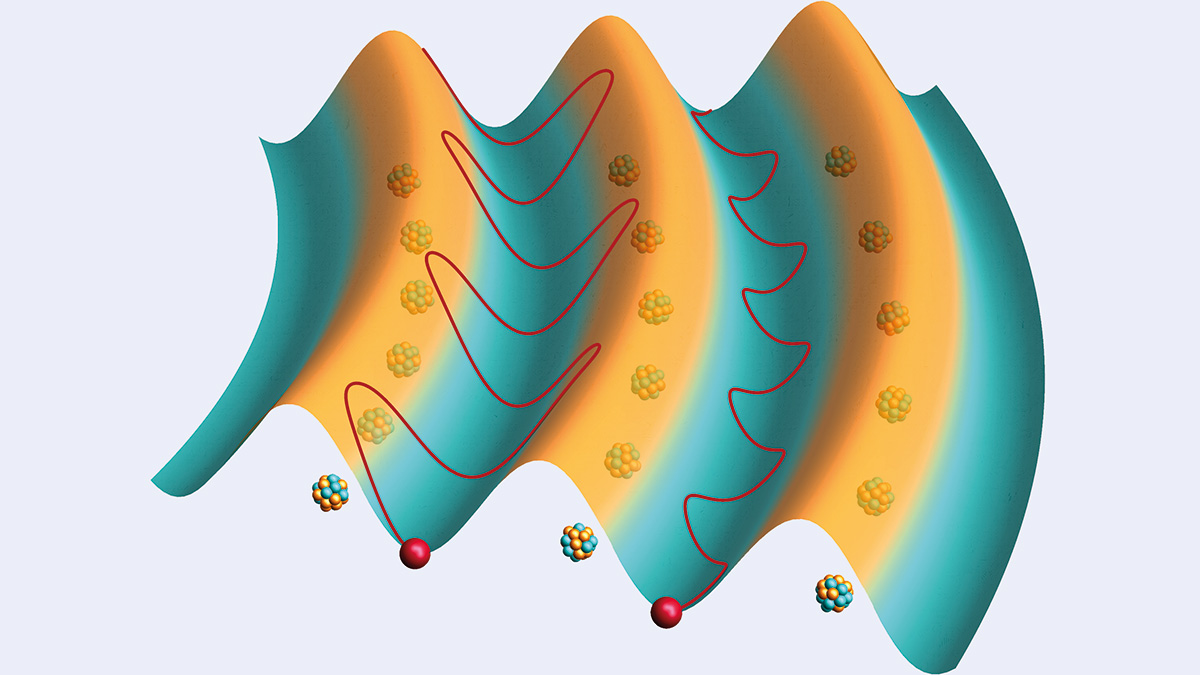
Energy loss and multiple scattering are the fate of most charged particles in matter. If carefully aligned to particle trajectories, crystals can be an exception: as positively charged particles fly past nuclei in the planes of the crystal lattice, they experience an averaged electrostatic potential that channels them between the crystal planes. Provided they don’t have enough transverse energy to cross the potential barrier to a neighbouring crystal plane, the particles oscillate between the atomic planes like a bobsleigh on a track (see “Guided paths” figure). If the crystal is mechanically bent, the entire track curves, steering the particles along with it.
Crystal channelling was predicted in simulations by Robinson and Oen in 1963, experimentally confirmed the same year by Piercy, and given its theoretical foundation by Lindhard in 1965. The idea of using bent crystals for beam control was first proposed in 1976 by Tsyganov. Proof-of-principle experiments at JINR Dubna in 1979 demonstrated the channelling of 8.4 GeV protons, achieving deflections equivalent to an 81-tesla magnetic field, and practical applications followed soon after.
A key modern application of bent crystals is the selective extraction of particles from the beam halo rather than the beam core, to produce a secondary beam. Crystal-based beam extraction was demonstrated up to 8.4 GeV at JINR in Dubna in 1984, then with higher energy protons at IHEP Protvino in 1989, and at CERN’s Super Proton Synchrotron (SPS) in 1993. Later in that decade, Fermilab’s Tevatron extracted beam particles using crystals at a record energy of 900 GeV.
Bent crystals are also used in modern accelerators’ collimation systems to deflect stray particles in the beam halo into shielding blocks that safely absorb them. The exploration of bent crystals for beam collimation began in the 1990s at Brookhaven National Laboratory and Fermilab, but the field underwent a step change in 2006 with the experimental observation of volume reflection at Petersburg Nuclear Physics Institute. This advance was enabled by new manufacturing techniques for high-quality bent silicon crystals. Predicted in the mid-1980s by Taratin and Vorobiev, volume reflection occurs when a particle is coherently deflected by the collective field of bent crystal planes without becoming trapped in a channel, effectively rebounding from the planar potential barrier.
Crystal clear
These breakthroughs motivated the UA9 Collaboration and experts in beam collimation to undertake a systematic programme of crystal-based beam manipulation at the SPS. This effort culminated in 2023, when crystal collimation became an operational reality at the LHC (see “Heavy-ion collimation” figure).
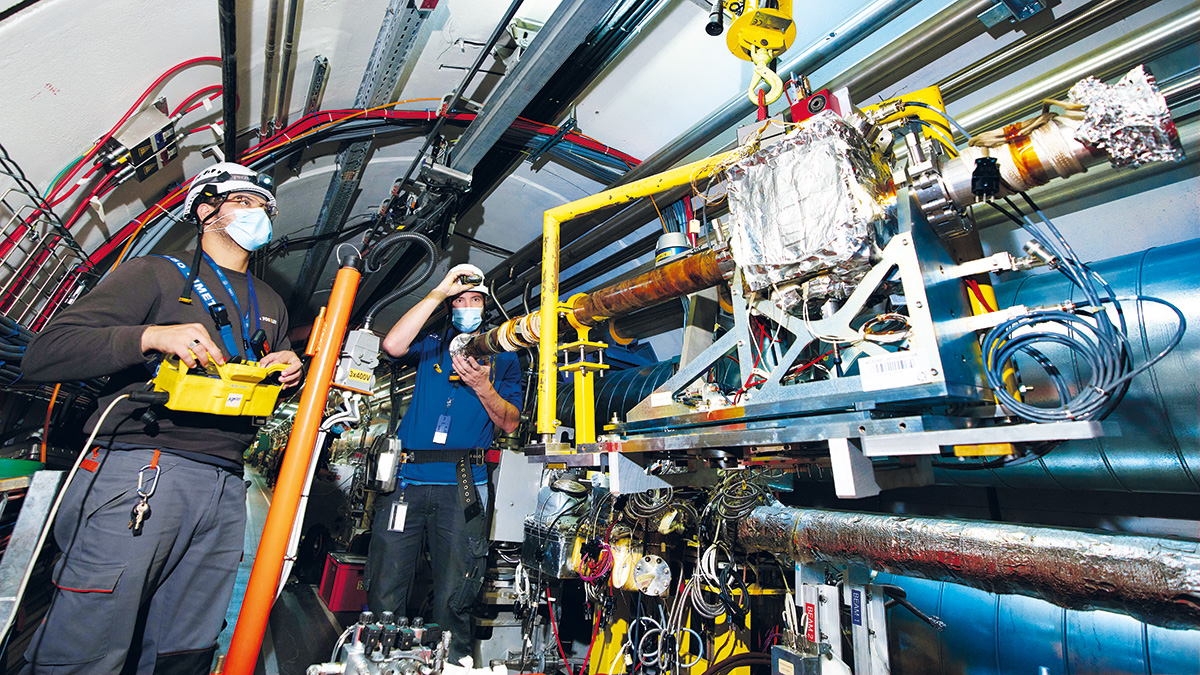
This technique addressed a critical limitation of heavy-ion operation: conventional amorphous collimators fragment heavy nuclei into lighter ions, some of which escape the collimation system and can quench downstream superconducting magnets. Bent crystals, by contrast, coherently and deterministically steer beam halo particles onto dedicated absorbers. As a result, crystal collimation was demonstrated to reduce heavy-ion beam losses at LHC magnets by factors of 5 to 13 compared with standard collimation.
New frontiers
The success of TeV-scale beam collimation at the LHC laid the groundwork for another ambitious goal: using bent crystals in the LHC not just to steer beams, but also to probe the spin of short-lived particles. In the intense internal fields between crystal atomic planes, a particle’s spin behaves much like a spinning top in a gravitational field. Rather than simply tipping over, the top’s angular momentum rotates slowly – precesses – under the action of a torque. In close analogy, the magnetic moment of a relativistic particle traversing a bent crystal precesses under the torque generated by the effective magnetic field experienced in its rest frame.
In 1992, the E761 collaboration used the fixed-target proton beam from the Tevatron to perform the first experimental demonstration of the effect by measuring the magnetic moment of the Σ+ hyperon (uus). This pioneering work used two 4.5 cm-long bent silicon crystals to induce spin precession, proving that the technique could effectively substitute for massive conventional magnets.
Bent crystals could open new frontiers in particle physics at the LHC
Bent crystals could open new frontiers in particle physics at the LHC. The TWOCRYST collaboration is exploring whether the technique can be extended to study the spin of short-lived charm baryons. The idea dates back to 1996, when Samsonov extended the E761 findings to charm baryons and demonstrated that despite their extremely short lifetimes, the intense effective fields of bent crystals could induce measurable spin precession. In 2016, Scandale and Stocchi proposed to use this technique to measure the magnetic dipole moments of charm baryons at the LHC.
The lightest charm baryon, the Λc+ (udc), has an extremely short lifetime of roughly 200 femtoseconds. Even at 1 TeV, it only travels a few centimetres before decaying. The magnetic fields needed to study its spin precession cannot be provided by conventional magnets, but are well within reach if bent crystals are used. If produced at a fixed target, a clean sample of its decays to a proton, a kaon and a pion can be obtained via tracking and invariant-mass reconstruction, with decay angles yielding spin information.
Such measurements promise a unique opportunity to explore QCD at the interface between heavy and light quarks. Measurements of its spin precession would also provide exceptional sensitivity to a possible electric dipole moment – a potential signature of physics beyond the Standard Model. The ALADDIN (An LHC Apparatus for Direct Dipole moments INvestigation) experimental proposal aims to measure the electromagnetic dipole moments of charm baryons, the Λc+ and the Ξc+ (usc), using a double-crystal scheme in the LHC. In this concept, a first bent crystal extracts a small fraction of the LHC beam halo and guides 7 TeV protons onto a fixed target located inside the LHC vacuum pipe, producing, amongst other particles, the charm baryons of interest. The particles would then impinge on a second bent crystal, whose intense inter-planar fields would induce a measurable spin precession.
Such an experiment must deal with challenging demands on the crystal alignment. Channelling only occurs if particles enter a crystal within a narrow angular range, known as the Lindhard angle, which decreases with increasing beam energy. At TeV energies in the LHC, this angle is only a few microradians, meaning that misalignments far smaller than the width of a human hair over a metre are sufficient to suppress channelling entirely. This alignment will be particularly challenging for ALADDIN, which will rely on protons that have scattered off the primary collimators.
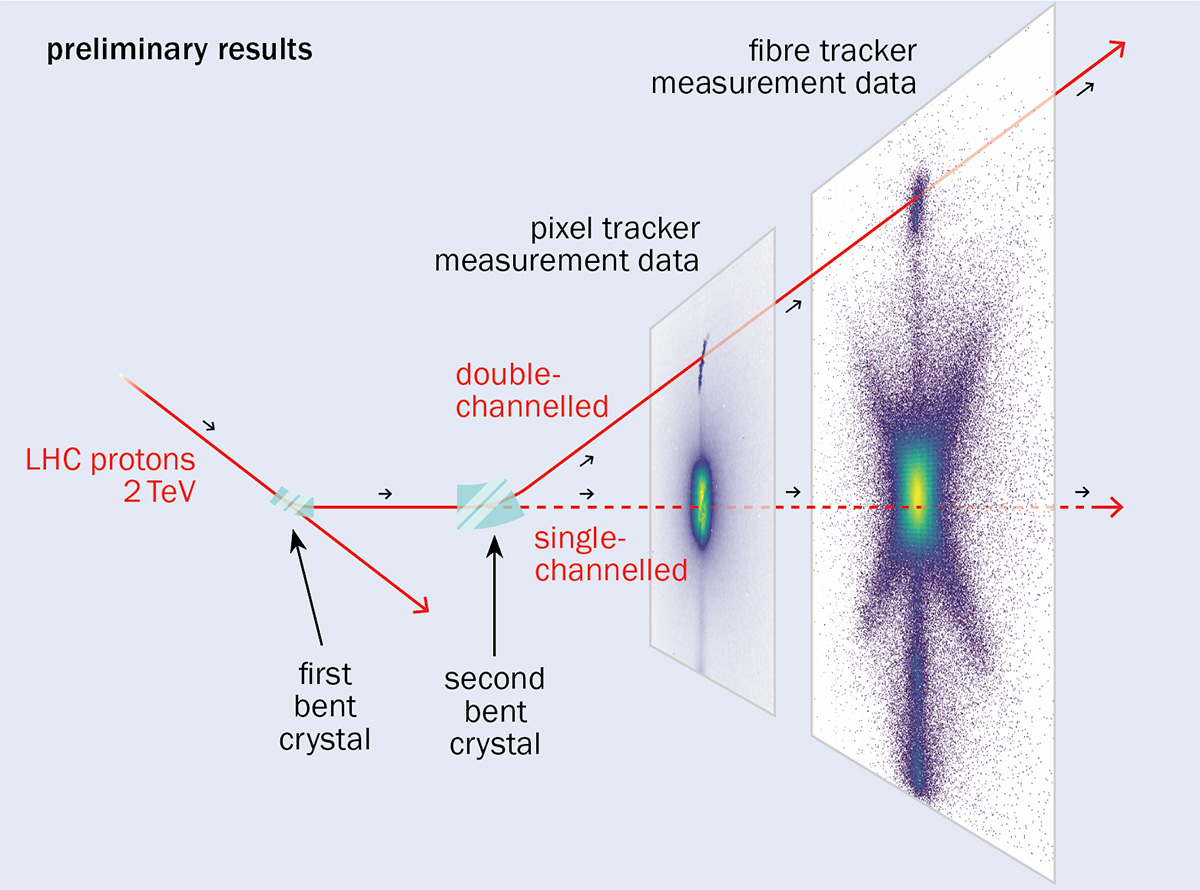
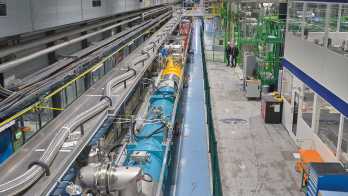
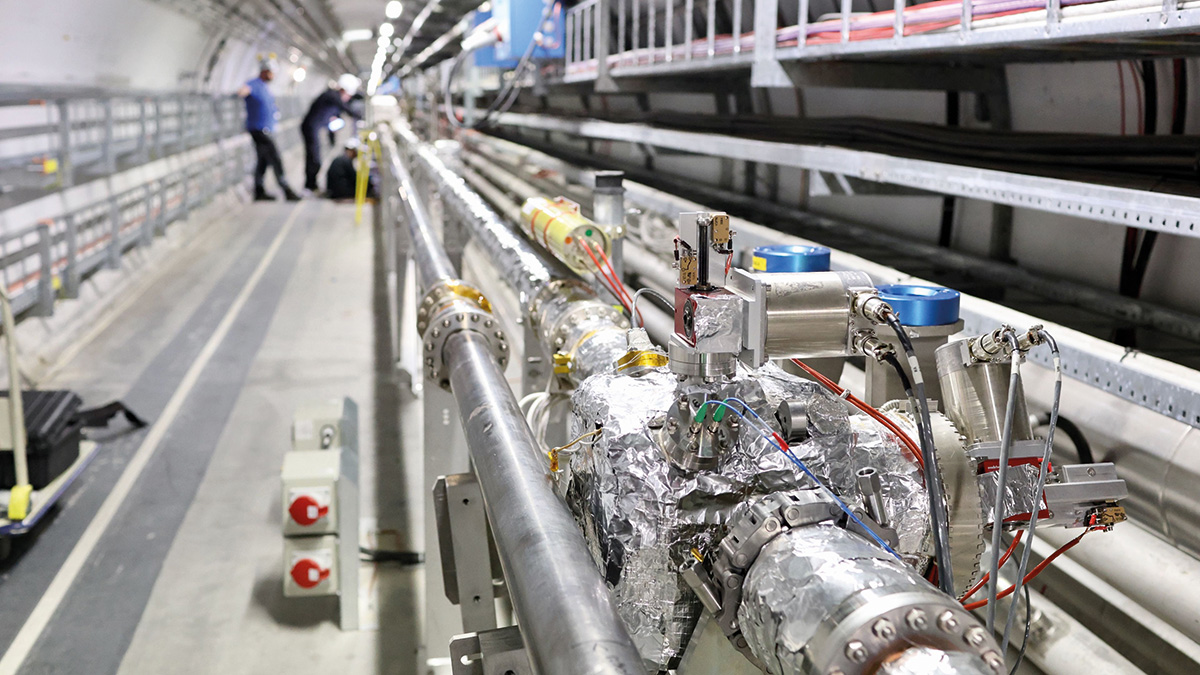
TWOCRYST was installed at Insertion Region 3 (IR3) in early 2025 (see “Halo extraction” figure). The experiment marks a significant leap in complexity compared to previous LHC crystal tests. Last year, the experiment successfully channelled LHC protons through two crystals (see “Double channelling” figure). These measurements marked the first controlled deployment of a double-crystal setup in the LHC, demonstrating the technique at 450 GeV, 1 and 2 TeV – a new world record, surpassing the 270 GeV achieved by the UA9 collaboration at the SPS and corresponding to an equivalent magnetic field of 600 tesla. Preliminary analyses of the recorded data indicate that more than 20% of protons were channelled successfully at 1 TeV.
Bent crystals have come a long way since the pioneering experiments at JINR Dubna in 1979. TWOCRYST’s demonstration of double-channelling at a record energy of 2 TeV represents an important step toward using the technique for precision particle-physics measurements with bent crystals at the LHC.
Measurements of spin precession have long played a central role in particle physics, providing deep insights into fundamental interactions and symmetries. The anomalous magnetic moments of the proton and neutron – measured in the 1930s and 1940s – remained unexplained for decades until the emergence of the quark model in the 1960s. While conventional magnet-based techniques remain highly effective for relatively long-lived particles such as the muon (CERN Courier March/April 2025 p21), particles as short-lived as charm baryons have so far remained experimentally inaccessible. The results from TWOCRYST suggest that bent crystals may allow the first direct experimental probe of electromagnetic dipole moments in charm baryons, opening a new window on QCD dynamics and offering a sensitive test for physics beyond the Standard Model.