A report from the ATLAS experiment.
Rare, unobserved decays of the Higgs boson are natural places to search for new physics. At the EPS-HEP conference, the ATLAS collaboration presented new improved measurements of two highly suppressed Higgs decays: into a pair of muons; and into a Z boson accompanied by a photon. Producing a single event of either H → μμ or H → Zγ → (ee/μμ) γ at the LHC requires, on average, around 10 trillion proton–proton collisions. The H → μμ and H → Zγ signals appear as narrow resonances in the dimuon and Zγ invariant mass spectra, atop backgrounds some three orders of magnitude larger.
In the Standard Model, the Brout–Englert–Higgs mechanism gives mass to the muon through its Yukawa coupling to the Higgs field, which can be tested via the rare H → μμ decay. An indirect comparison with the well-known muon mass, determined to 22 parts per billion, provides a stringent test of the mechanism in the second fermion generation and is a powerful probe of new physics. With a branching ratio of just 0.02%, and a large background dominated by the Drell–Yan production of muon pairs through virtual photons or Z bosons, the inclusive signal-over-background ratio plunges to the level of one part in a thousand. To single out its decay signature, the ATLAS collaboration employed machine-learning techniques for background suppression and generated over five billion Drell–Yan Monte Carlo events at next-to-leading-order accuracy in QCD, all passed through the full detector simulation. This high-precision sample provides templates to refine the background model and minimise bias on the tiny H → μμ signal.
The Higgs boson can decay into a Z boson and a photon via loop diagrams involving W bosons and heavy charged fermions, like the top quark. Detecting this rare process would complete the suite of established decays into electroweak boson pairs and offer a window on physics beyond the Standard Model. To reduce QCD background and improve sensitivity, the ATLAS analysis focused on Z bosons further decaying into electron or muon pairs, with an overall branching fraction of 7%. This additional selection reduces the event rate to about one in 10,000 Higgs decays, with an inclusive signal-over-background ratio at the per-mille level. The low momenta of final-state particles, combined with the high-luminosity conditions of LHC Run 3, pose additional challenges for signal extraction and suppression of Z + jets backgrounds. To enhance signal significance, the ATLAS collaboration improved background modelling techniques, optimised event categorisation by Higgs production mode, and employed machine learning to boost sensitivity.
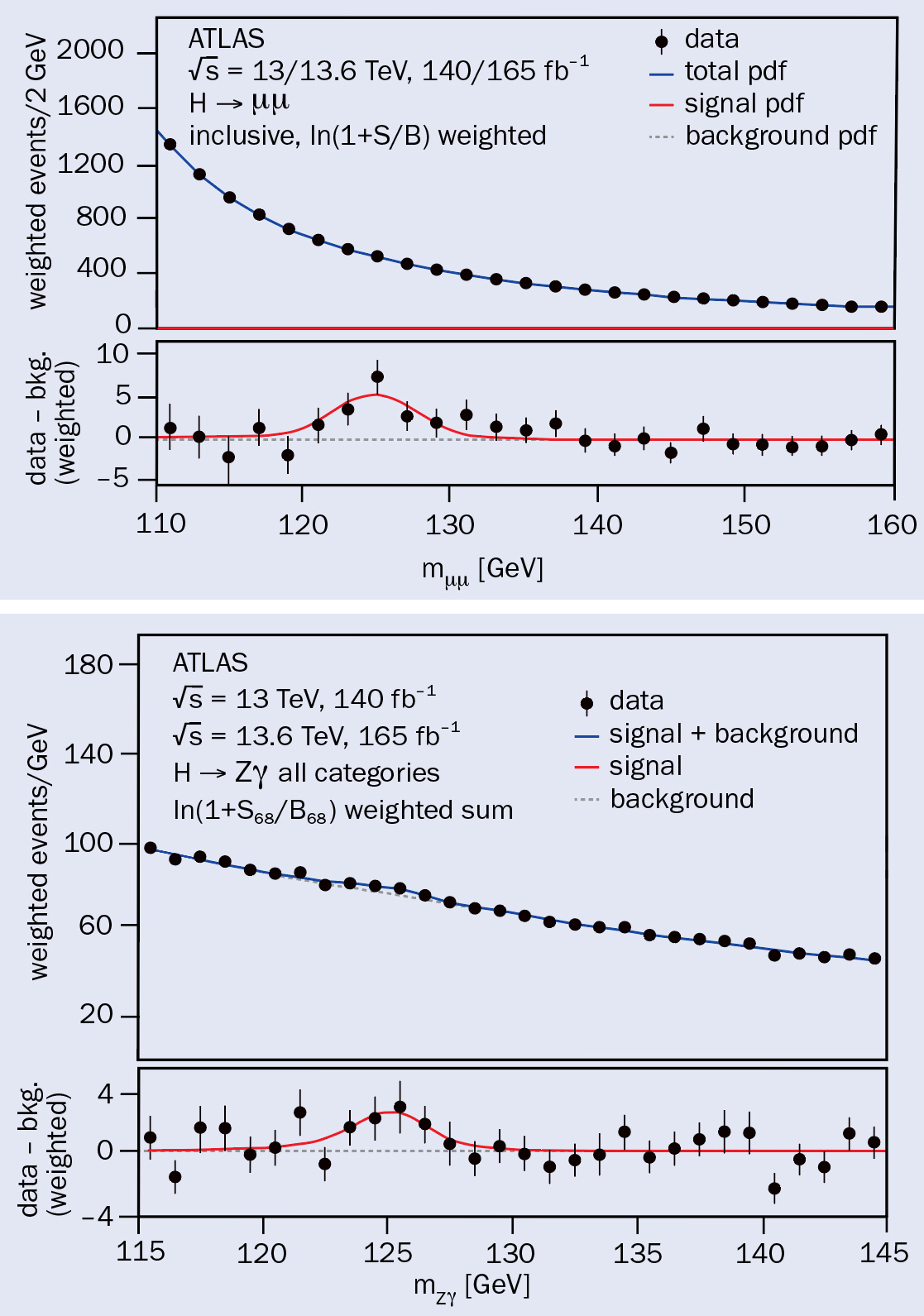
The two ATLAS searches are based on 165 fb–1 of LHC Run 3 proton–proton collision data collected between 2022 and 2024 at √s = 13.6 TeV, with a rigorous blinding procedure in place to prevent biases. Both channels show excesses at the Higgs-boson mass of 125.09 GeV, with observed (expected) 2.8σ (1.8σ) significance for H to μμ and 1.4σ (1.5σ) for H to Zγ. These results are strengthened by combining them with 140 fb–1 of Run-2 data collected at √s = 13 TeV, updating the H → μμ and H → Zγ observed (expected) significances to 3.4σ (2.5σ) and 2.5σ (1.9σ), respectively (see figure 1). The measured signal strengths are consistent with the Standard Model within uncertainties.
These results mark the ATLAS collaboration’s first evidence for the H → μμ decay, following the earlier claim by CMS based on Run-2 data (see CERN Courier September/October 2020 p7). Meanwhile, the H → Zγ search achieves a 19% increase in expected significance with respect to the combined ATLAS–CMS Run-2 analysis, which first reported evidence for this process. As Run 3 data-taking continues, the LHC experiments are closing in on establishing these two rare Higgs decay channels. Both will remain statistically limited throughout the LHC’s lifetime, with ample room for discovery in the high-luminosity phase.
Further reading
ATLAS Collab. 2025 arXiv:2507.03595.
ATLAS Collab. 2025 arXiv:2507.12598.