A report from the LHCb experiment.
Proton–proton collisions at the LHC fling quarks and gluons out at massive energies. As they radiate and split into ever more partons, the strong force confines them into sprays of hadrons called jets. The total momentum of a jet, split among its components, approximates that of the initial quark or gluon, which cannot be accessed directly. By tracking how much of a jet’s momentum each hadron carries, the LHCb collaboration has now compared how charm, beauty and light quarks hadronise.
While the production and radiation of individual quarks and gluons can be treated perturbatively, their conversion into hadrons occurs in the non-perturbative regime and cannot be calculated from first principles. Instead, the transition is described using phenomenological probability distributions, called fragmentation functions, which encode how a quark of a given flavour produces specific hadrons. Measuring the content and structure of jets, as well as their kinematic properties, can help constrain these functions.
Previously, the LHCb collaboration measured observables sensitive to fragmentation functions in samples dominated by light-quark-initiated jets. The same measurements were recently carried out for charm- and beauty-quark-initiated jets, allowing a direct comparison of hadronisation across three different jet flavour categories at a single experiment. The light-quark sample was obtained by selecting jets produced nearly back-to-back with a Z boson. In such events, the single parton initiating the jet is typically a gluon or a light quark. In the forward kinematic region accessible to the LHCb detector, where one incoming parton often carries a large fraction of the proton momentum, the proportion of light-quark jets gets further enhanced. Samples of predominantly charm- and beauty-quark-initiated jets were instead obtained using a dedicated flavour-tagging algorithm, which makes use of LHCb’s excellent performance at heavy flavour identification and reconstruction.
The new measurements allow a direct comparison of hadronisation across three different jet flavour categories
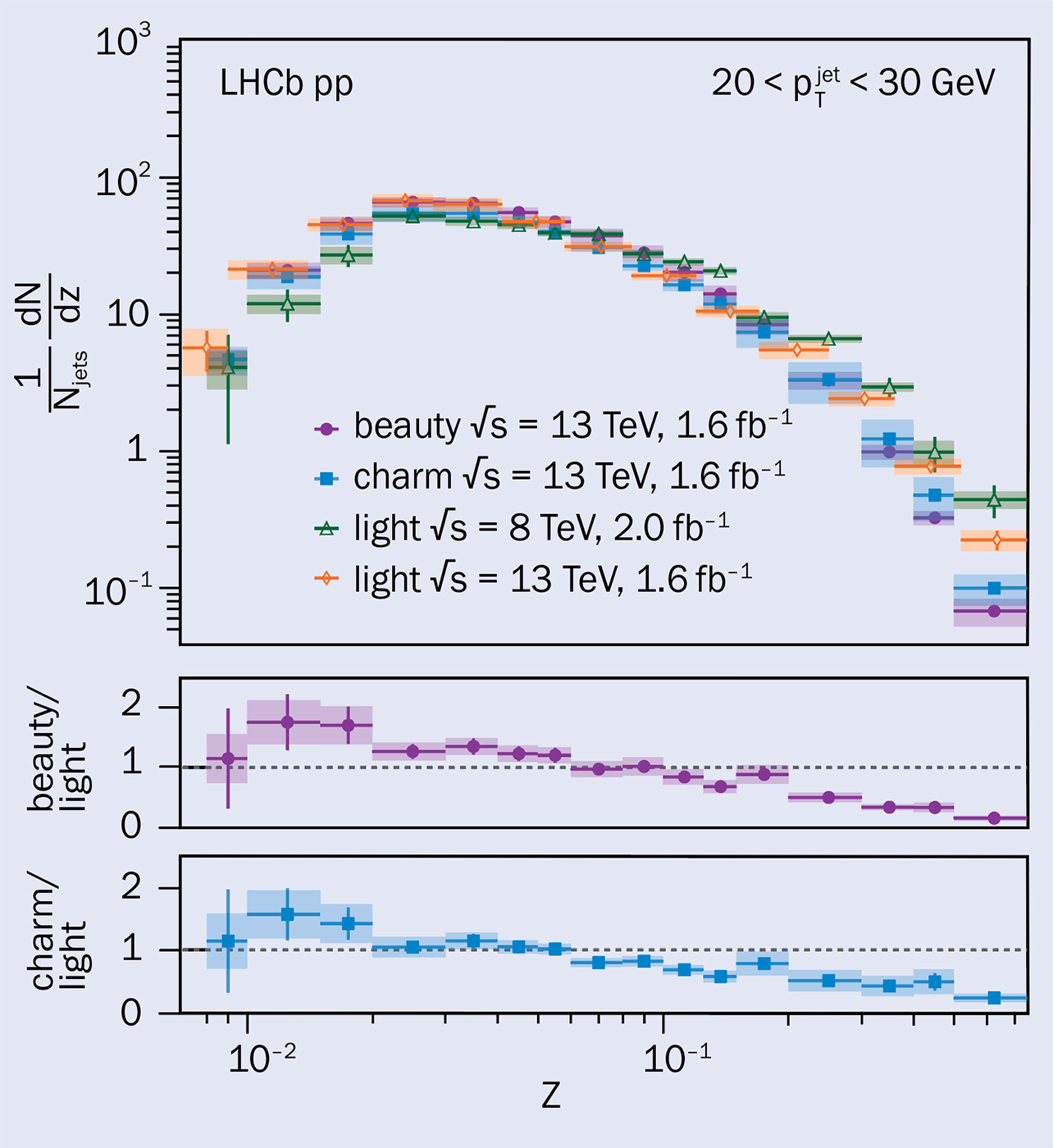
A key observable for constraining fragmentation functions is the longitudinal momentum fraction z, defined as the share of jet momentum carried by a hadron along its axis. With respect to their light-quark analogues, heavy-quark-initiated jets appear suppressed at high z, consistent with the leading heavy-flavour hadron carrying most of the jet momentum (see figure 1).
Previous measurements of the hadronisation of a heavy quark into a single heavy-flavour hadron showed that this hadron carries most of the parent quark’s momentum. The new LHCb analysis extends this picture to the full multi-hadron structure of heavy-quark-initiated jets and is consistent with single-hadron measurements: relatively few charged hadrons possess a large fraction of the jet momentum – a result compatible with the heavy-flavour hadron carrying most of it. This result demonstrates the complementarity of single- and multi-hadron measurements, which are both necessary to fully understand high-energy hadronisation.
The analysis also measured the transverse momentum of the hadron with respect to the jet axis, which is sensitive to transverse-momentum-dependent fragmentation functions. Experimental constraints on these functions remain limited, yet they are crucial in reconstructing a three-dimensional description of hadronisation.
Further reading
LHCb Collab. 2025 arxiv:2511.10216.