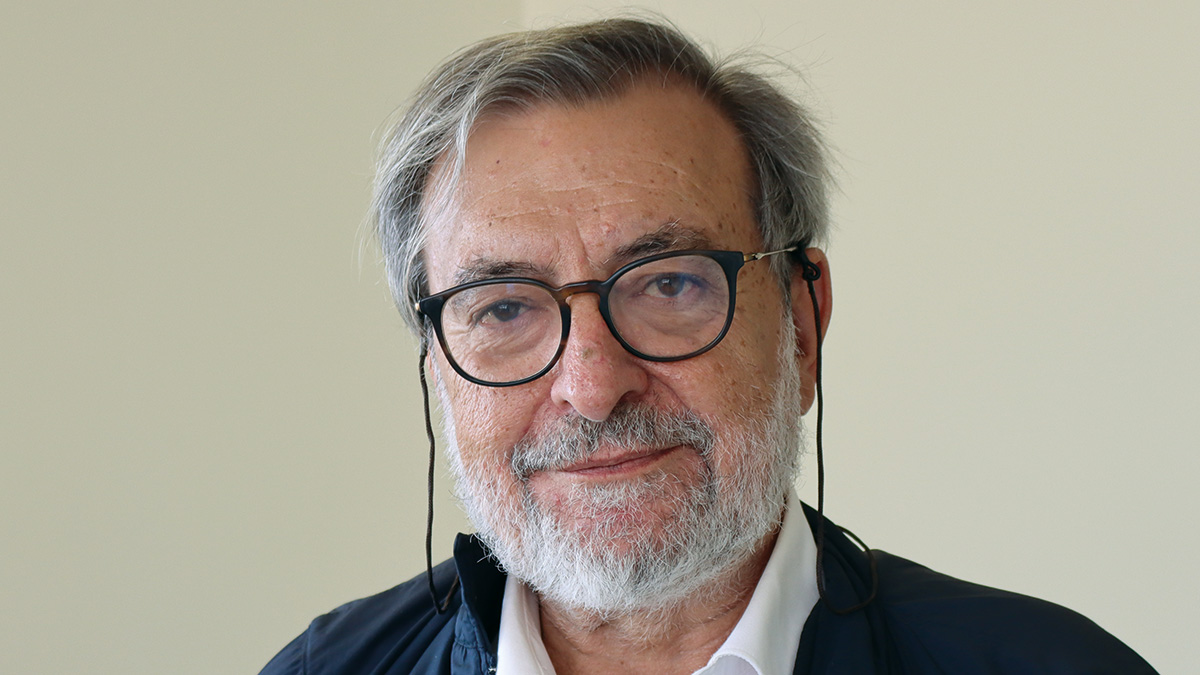
César Gómez, whose deep contributions to gauge theory and quantum gravity were matched by his scientific leadership, passed away on 7 April 2025 after a short fight against illness, leaving his friends and colleagues with a deep sense of loss.
César gained his PhD in 1981 from Universidad de Salamanca, where he became professor after working at Harvard, the Institute for Advanced Study and CERN. He held an invited professorship at the Université de Genève between 1987 and 1991, and in this same year, he moved to Consejo Superior de Investigaciones Científicas (CSIC) in Madrid, where he eventually became a founding member of the Instituto de Física Teórica (IFT) UAM–CSIC. He became emeritus in 2024.
Among the large number of topics he worked on during his scientific career, César was initially fascinated by the dynamics of gauge theories. He dedicated his postdoctoral years to problems concerning the structure of the quantum vacuum in QCD, making some crucial contributions.
Focusing in the 1990s on the physics of two-dimensional conformal field theories, he used his special gifts to squeeze physics out of formal structures, leaving his mark in works ranging from superstrings to integrable models, and co-authoring with Martí Ruiz-Altaba and Germán Sierra the book Quantum Groups in Two-Dimensional Physics (Cambridge University Press, 1996). With the new century and the rise of holography, César returned to the topics of his youth: the renormalisation group and gauge theories, now with a completely different perspective.
Far from settling down, in the last decade we discover a very daring César, plunging together with Gia Dvali and other collaborators into a radical approach to understand symmetry breaking in gauge theories, opening new avenues in the study of black holes and the emergence of spacetime in quantum gravity. The magic of von Neumann algebras inspired him to propose an elegant, deep and original understanding of inflationary universes and their quantum properties. This research programme led him to one of his most fertile and productive periods, sadly truncated by his unexpected passing at a time when he was bursting with ideas and projects.
César’s influence went beyond his papers. After his arrival at CSIC as an international leader in string theory, he acted as a pole of attraction. His impact was felt both through the training of graduate students, as well as by the many courses he imparted that left a lasting memory on the new generations.
Contrasting with his abstract scientific style, César also had a pragmatic side, full of vision, momentum and political talent. A major part of his legacy is the creation of the IFT, whose existence would be unthinkable without César among the small group of theoretical physicists from Universidad Autónoma de Madrid and CSIC who made a dream come true. For him, the IFT was more than his research institute, it was the home he helped to build.
Philosophy was a true second career for César, dating back to his PhD in Salamanca and strengthened at Harvard, where he started a lifelong friendship with Hilary Putnam. The philosophy of language was one of his favourite subjects for philosophical musings, and he dedicated to it an inspiring book in Spanish in 2003.
Cesar’s impressive and eclectic knowledge of physics always transformed blackboard discussions into a delightful and fascinating experience, while his extraordinary ability to establish connections between apparently remote notions was extremely motivating at the early stages of a project. A regular presence at seminars and journal clubs, and always conspicuous by his many penetrating and inspiring questions, he was a beloved character among graduate students, who felt the excitement of knowing that he could turn every seminar into a unique event.
César was an excellent scientist with a remarkable personality. He was a wonderful conversationalist on any possible topic, encouraging open discussions free of prejudice, and building bridges with all conversational partners. He cherished his wife Carmen and daughters Ana and Pepa, who survive him.
Farewell, dear friend. May you rest in peace, and may your memory be our blessing.