Free neutrons have a lifetime of about 880 seconds, yet a longstanding tension between two measurement techniques continues to puzzle the neutron-physics community. The most precise averages from beam experiments and magnetic-bottle traps yield 888.1 ± 2.0 s and 877.8 ± 0.3 s, respectively – roughly corresponding to a 5σ discrepancy.
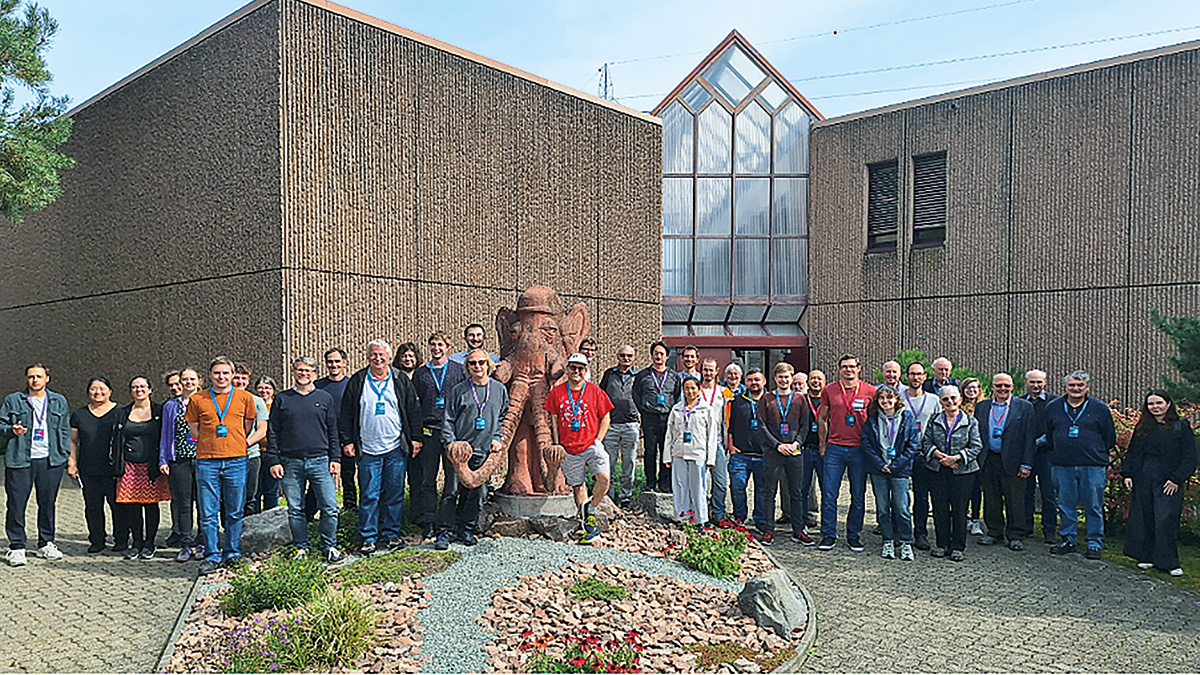
On 13 September 2025, 40 representatives of all currently operating neutron-lifetime experiments came together at the Paul Scherrer Institute (PSI) to discuss the current status of the tension and the path forward. Geoffrey Greene (University of Tennessee) opened the workshop by reflecting on five decades of neutron-lifetime measurements from the 1960s to the present.
The beam method employs cold-neutron beams, with protons from neutron beta-decays collected in a magnetic trap and counted. The lifetime is then inferred from the ratio of proton counts to neutron flux. Fred Wietfeldt (Tulane University) highlighted the huge efforts undertaken at the National Institute of Standards and Technology (NIST) in Gaithersburg, most importantly on the absolute calibration of the neutron detector.
Susan Seestrom (Los Alamos National Laboratory) described today’s most precise experiment, the UCNτ experiment at Los Alamos National Laboratory, which uses the magnetic-bottle trap method. It confines ultracold neutrons (UCNs) via their magnetic and gravitational interaction and counts the surviving ones at different times. She also provided an outlook on its next phase, UCNτ+, with increased statistics goals. The τSPECT experiment at PSI’s UCN facility is also based on magnetic confinement of neutrons and has recently started data taking, but has distinct differences. As explained by Martin Fertl from Johannes Gutenberg-University Mainz, τSPECT uses a double-spin-flip method to increase the UCN filling of the purely magnetic trap, and a detector moving in and out of the storage volume to first remove slightly higher-energetic neutrons before storage, and then measures the surviving neutrons in situ after storage.
Kenji Mishima (University of Osaka) presented the neutron-lifetime experiment at J-PARC, based on a new principle: the detection of the charged decay products in an active time-projection-chamber, where the neutrons are captured on a small 3He admixture. This experiment’s systematics are entirely different from those of previous efforts and may offer a unique contribution to the field. Other studies largely excluded the possibility that the beam–bottle discrepancy could be explained by hypothetical exotic decay channels or other non-standard processes.
New results from LANL, NIST, J-PARC and PSI should clarify the currently puzzling situation in the coming years.