A report from the ALICE experiment.
Strangeness production in high-energy hadron collisions is a powerful tool for exploring quantum chromodynamics (QCD). Unlike up and down, strange quarks are not present as valence quarks in colliding protons and neutrons, and must therefore appear through interactions. They are, however, still light enough to be abundantly produced at the LHC.
Over the past 15 years, the ALICE collaboration has shown that the abundance of strange over non-strange hadrons grows with event multiplicity in all collision systems. In particular, high-multiplicity proton–proton (pp) collisions display a significant strangeness enhancement, reaching saturation levels similar to those in heavy-ion collisions. In one of the most precise studies of strange-to-non-strange hadron production to date, the ALICE collaboration has reported its recent results from pp and lead–lead collisions at the LHC.
Strange hadrons (Ks0, Λ, Ξ, Ω) were reconstructed from their weak-decay topologies. Candidates were then selected by applying geometrical and kinematic cuts, estimating and subtracting backgrounds, and correcting the resulting distributions using detector-response simulations. The analyses were carried out at a centre-of-mass energy per nucleon pair of 5.02 TeV and span a wide multiplicity range, from 2 to 2000 charged particles at mid-rapidity.
To better understand how strangeness is produced, the collaboration has taken a significant step by measuring the probability distribution of forming a specific number of strange particles of the same species per event. This study, based on event-by-event strange-particle counting, moves beyond average yields and probes higher orders in the strange-particle production probability distribution. To account for the response of the detector, each candidate is assigned a probability of being genuine rather than background, and a Bayesian unfolding method iteratively corrects for particles that were missed or misidentified to reconstruct the true counts. This provides a novel technique for testing theoretical strangeness-production mechanisms, particularly in events characterised by a significant imbalance between strange and non-strange particles.
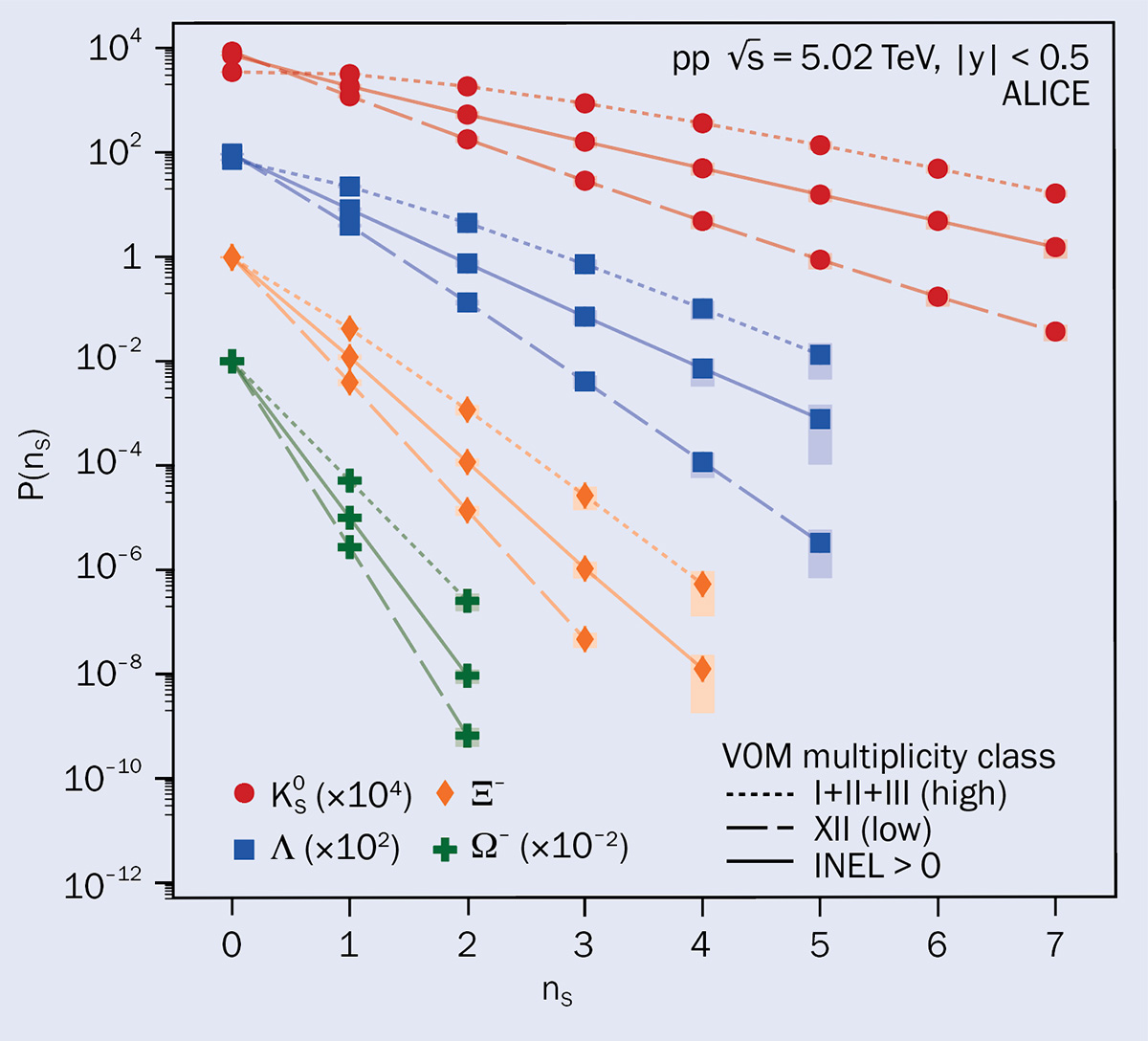
Exploiting a large dataset of pp collisions, the probability of producing n particles of a given species S (S = Ks0, Λ, Ξ– or Ω–) per event, P(nS), could be determined up to a maximum of nS = 7 for Ks0, nS = 5 for Λ, nS = 4 for Ξ and nS = 2 for Ω (see figure 1). An increase of P(nS) with charged-particle multiplicity is observed, becoming more pronounced for larger n, as reflected by the growing separation between the curves corresponding to low- and high-multiplicity classes in the high-n tail of the distributions.
The average production yield of n particles per event can be calculated from the P(nS) distributions, taking into account all possible combinations that result in a given multiplet. This makes it possible to compare events with the same or a different overall strange quark content that hadronise into various combinations of hadrons in the final state. While the ratio between Ω triplets to single Ks0 shows an extreme strangeness-enhancement pattern up to two orders of magnitude across multiplicity, comparing hadron combinations that differ in up- and down-quark content but share the same total s-quark content (for instance, Ω singlets compared to Λ triplets) helps isolate the part of the enhancement unrelated to strangeness.
Comparisons with state-of-the-art phenomenological models show that this new approach greatly enhances sensitivity to the underlying physics mechanisms implemented in different event generators. Together with the traditional strange-to-pion observables, the multiplicity-differential probability distributions of strange hadrons provide a more detailed picture of how strange quarks are produced and hadronise in high-energy collisions, offering a stringent benchmark for the phenomenological description of non-perturbative QCD.
Further reading
ALICE Collab. 2025 arXiv:2511.10306.
ALICE Collab. 2025 arXiv:2511.10360.
ALICE Collab. 2025 arXiv:2511.10413.