Since the Big Bang, primordial density perturbations have continually merged and grown to form ever larger structures. This “hierarchical” model of galaxy formation has withstood observational scrutiny for more than four decades. However, understanding the emergence of the earliest galaxies in the first few hundred million years after the Big Bang has remained a key frontier in the field of astrophysics. This is also one of the key science aims of the James Webb Space Telescope (JWST), launched on Christmas Day in 2021.
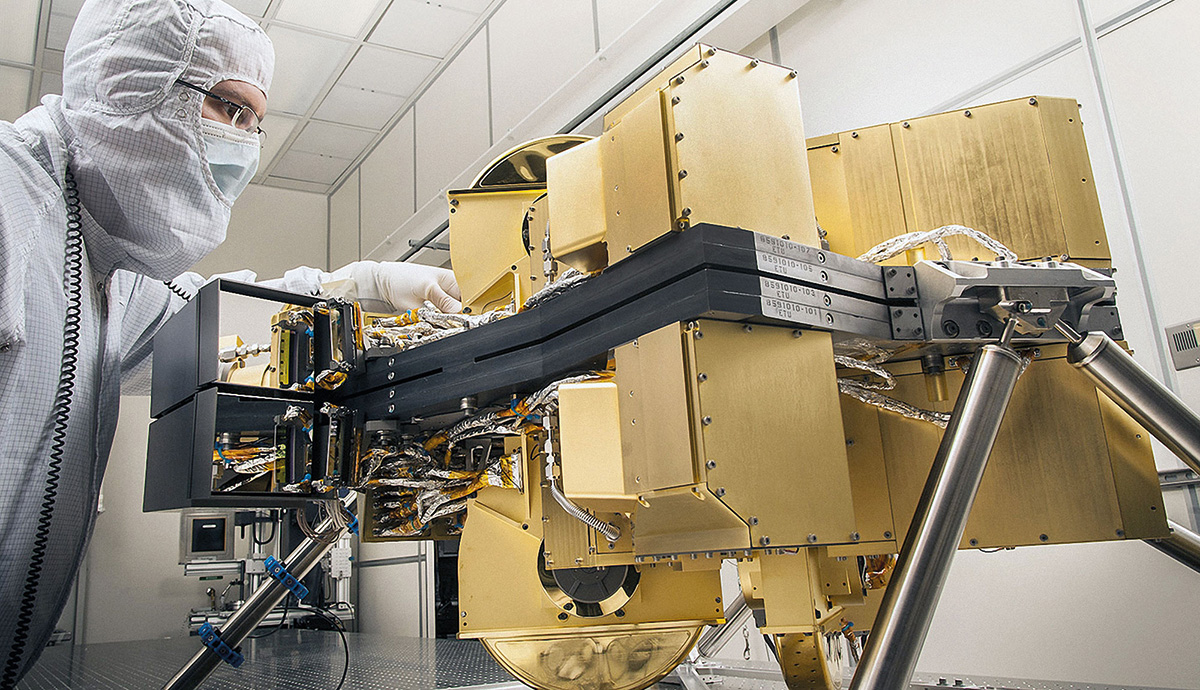
Its large, cryogenically-cooled mirror and infrared instruments let it capture the faint, redshifted ultraviolet light from the universe’s earliest stars and galaxies. Since its launch, the JWST has collected unprecedented samples of astrophysical sources within the first 500 million years of the Big Bang, utterly transforming our understanding of early galaxy formation.
Stellar observations
Tantalisingly, JWST’s observations hint at an excess of galaxies very bright in the ultra-violet (UV) within the first 400 million years, as compared to expectations from early formation within the standard Lambda Cold Dark matter model. Given that UV photons are a key indicator of young star formation, these observations seem to imply that early galaxies in any given volume of space were overly efficient at forming stars in the infancy of the universe.
However, extraordinary claims demand extraordinary evidence. These puzzling observations have come under immense scrutiny in confirming that the sources lie at the inferred redshifts, and do not just probe over-dense regions that might preferentially host galaxies with high star-formation rates. It could still be the case that the apparent excess of bright galaxies is cosmic variance – a statistical fluctuation caused by the relatively small regions of the sky probed by the JWST so far.
Such observational caveats notwithstanding, theorists have developed a number of distinct “families” of explanations.
UV photons are readily attenuated by dust at low redshifts. If, however, these early galaxies had ejected all of their dust, one might be able to observe almost all of the intrinsic UV light they produced, making them brighter than expected based on lower-redshift benchmarks.
Bias may also arise from detecting only those sources powered by rapid bursts of star formation that briefly elevate galaxies to extreme luminosities.
Extraordinary claims demand extraordinary evidence
Several explanations focus on modifying the physics of star formation itself, for example regarding “stellar feedback” – the energy and momentum that newly formed stars inject back into their surrounding gas, that can heat, ionise or expel gas, and slow or shut down further star formation. Early galaxies might have high star-formation rates because stellar feedback was largely inefficient, allowing them to retain most of their gas for further star formation, or perhaps because a larger fraction of gas was able to form stars in the first place.
While the relative number of low- and high-mass stars in a newly formed stellar population – the initial mass function (IMF) – has been mapped out in the local universe to some extent, its evolution with redshift remains an open question. Since the IMF crucially determines the total UV light produced per unit mass of star formed, a “top-heavy” IMF, with a larger fraction of massive stars compared to that in the local universe, could explain the observations.
Alternatively, the striking ultraviolet light may not arise solely from ordinary young stars – it could instead be powered by accretion onto black holes, which JWST is finding in unexpected numbers.
Alternative cosmologies
Finally, a number of works also appeal to alternative cosmologies to enhance structure formation at such early epochs, invoking an evolving dark-energy equation of state, primordial magnetic fields or even primordial black holes.
A key caveat involved in these observations is that redshifts are often inferred purely from broadband fluxes in different filters – a technique known as photometry. Spectroscopic data are urgently required, not only to verify their exact distances but also to distinguish between different physical scenarios such as bursty star formation, an evolving IMF or contamination by active galactic nuclei, where supermassive black holes accrete gas. Upcoming deep observations with facilities such as the Atacama Large Millimeter/submillimeter Array (ALMA) and the Northern Extended Millimeter Array (NOEMA) will be crucial for constraining the dust content of these systems and thereby clarifying their intrinsic star-formation rates. Extremely large surveys with facilities such as Euclid, the Nancy Grace Roman Space Telescope and the Extremely Large Telescope will also be crucial in surveying early galaxies over large volumes and sampling all possible density fields.
Combining these datasets will be critical in shedding light on this unexpected puzzle unearthed by the JWST.