For a global challenge like environmental sustainability, the only panacea is international cooperation. In September, the Sustainability Working Group, part of the Laboratory Directors Group (LDG), took a step forward by publishing a report for standardising the evaluation of the carbon impact of accelerator projects. The report challenges the community to align on a common methodology for assessing sustainability and defining a small number of figures of merit that future accelerator facilities must report.
“There’s never been this type of report before,” says Maxim Titov (CEA Saclay), who co-chairs the LDG Sustainability Working Group. “The LDG Working Group consisted of representatives with technical expertise in sustainability evaluation from large institutions including CERN, DESY, IRFU, INFN, NIKHEF and STFC, as well as experts from future collider projects who signed off on the numbers.”
The report argues that carbon assessment cannot be left to the end of a project. Instead, facilities must evaluate their lifecycle footprint starting from the early design phase, all the way through construction, operation and decommissioning. Studies already conducted on civil-engineering footprints of large accelerator projects outline a reduction potential of up to 50%, says Titov.
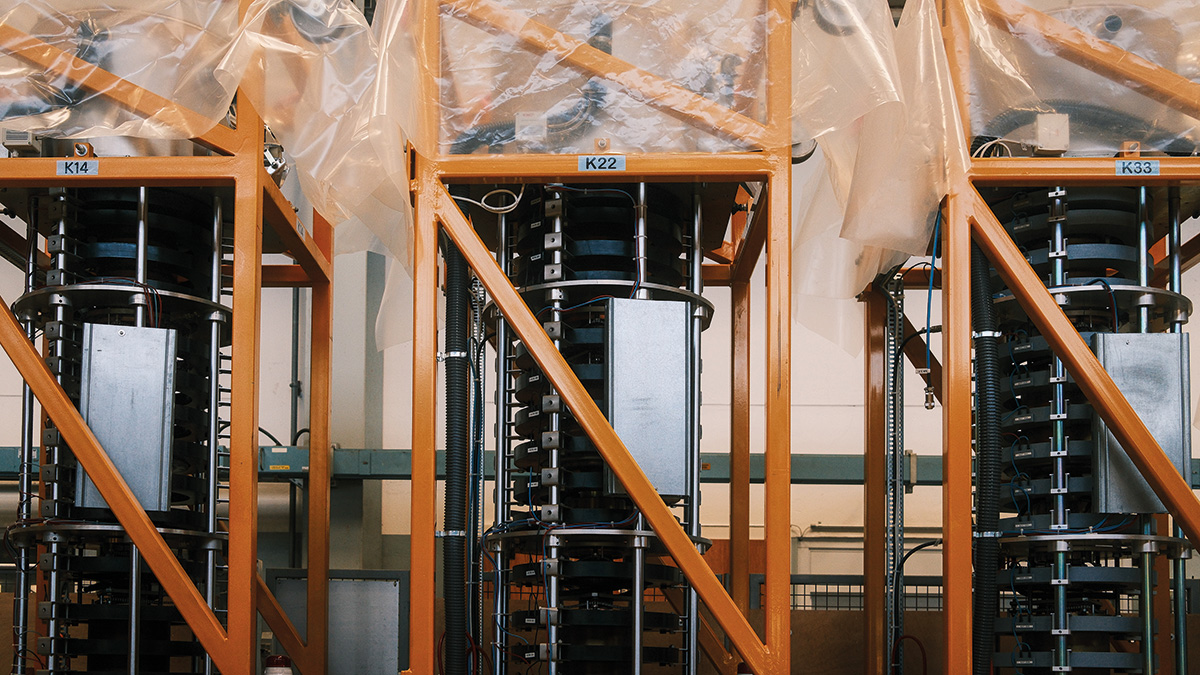
In terms of accelerator technology, the report highlights cooling, ventilation, cryogenics, the RF cavities that accelerate charged particles and the klystrons that power them, as the largest sources of inefficiency. The report places particular emphasis on klystrons, and identifies three high-efficiency designs currently under development that could boost the energy efficiency of RF cavities from 60 to 90% (CERN Courier May/June 2025 p30).
Carbon assessment cannot be left to the end of a project
The report also addresses the growing footprint of computing and AI. Training algorithms on more efficient hardware and adapting trigger systems to reduce unnecessary computation are identified as ways to cut energy use without compromising scientific output.
“You need to perform a life-cycle assessment at every stage of the project in order to understand your footprint, not just to produce numbers, but to optimise design and improve it in discussions with policymakers,” emphasises Titov. “Conducting sustainability assessments is a complex process, as the criteria have to be tailored to the maturity of each project and separately developed for scientists, policymakers, and society applications.”
Established by the CERN Council, the LDG is an international coordination body that brings together directors and senior representatives of the world’s major accelerator laboratories. Since 2021, the LDG has been composed of five expert panels: high-field magnets, RF structures, plasma and laser acceleration, muon colliders and energy-recovery linacs. The Sustainability Working Group was added in January 2024.
Further reading
C Bloise et al. 2025 arXiv:2509.11705.