The nature of dark matter remains one of the greatest unresolved questions in modern physics. While ground-based experiments persist in their quest for direct detection, astrophysical observations and multi-messenger studies have emerged as powerful complementary tools for constraining its properties. Stars across the Milky Way and beyond – including neutron stars, white dwarfs, red giants and main-sequence stars – are increasingly recognised as natural laboratories for probing dark matter through its interactions with stellar interiors, notably via neutron-star cooling, asteroseismic diagnostics of solar oscillations and gravitational-wave emission.
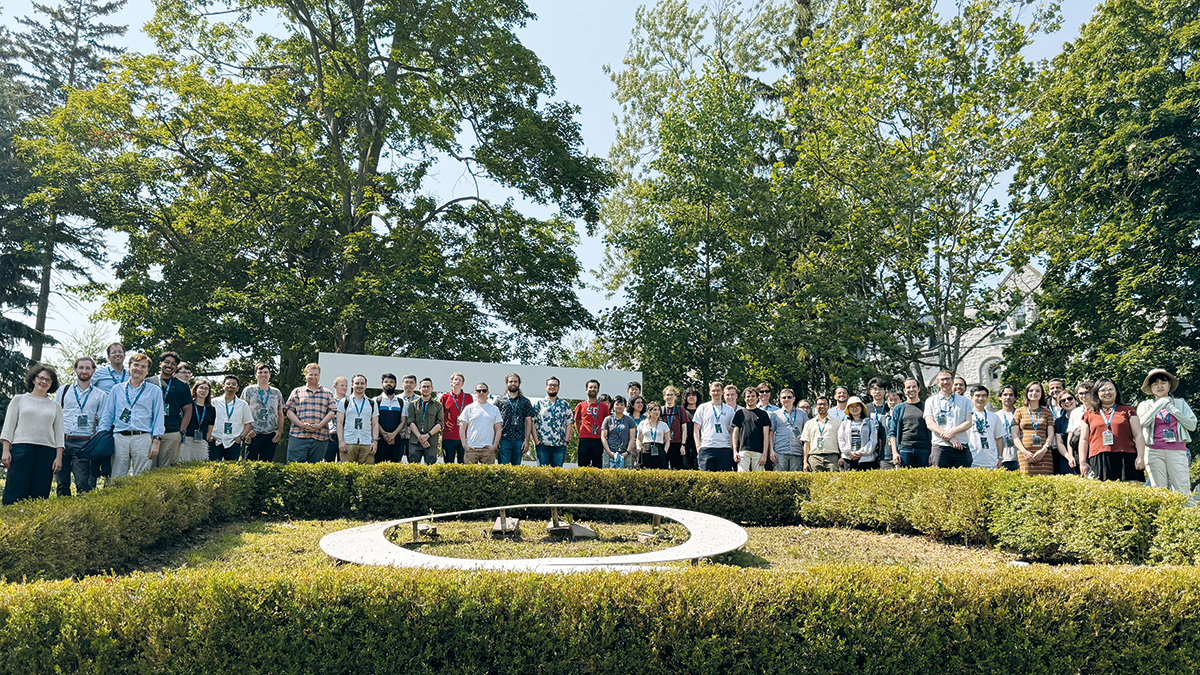
The international conference Dark Matter and Stars: Multi-Messenger Probes of Dark Matter and Modified Gravity (ICDMS) was held at Queen’s University in Kingston, Ontario, Canada, from 14 to 16 July. The meeting brought together around 70 researchers from across astrophysics, cosmology, particle physics and gravitational theory. The goal was to foster interdisciplinary dialogue on how observations of stellar systems, gravitational waves and cosmological data can help shed light on the dark sector. The conference was specifically dedicated to exploring how astrophysical and cosmological systems can be used to probe the nature of dark matter.
The first day centred on compact objects as natural laboratories for dark-matter physics. Giorgio Busoni (University of Adelaide) opened with a comprehensive overview of recent theoretical progress on dark-matter accumulation in neutron stars and white dwarfs, highlighting refinements in the treatment of relativistic effects, optical depth, Fermi degeneracy and light mediators – all of which have shaped the field in recent years. Melissa Diamond (Queen’s University) followed with a striking talk with a nod to Dr. Strangelove, exploring how accumulated dark matter might trigger thermonuclear instability in white dwarfs. Sandra Robles (Fermilab) shifted the perspective from neutron stars to white dwarfs, showing how they constrain dark-matter properties. One of the authors highlighted postmerger gravitational-wave observations as a tool to distinguish neutron stars from low-mass black holes, offering a promising avenue for probing exotic remnants potentially linked to dark matter. Axions featured prominently throughout the day, alongside extensive discussions of the different ways in which dark matter affects neutron stars and their mergers.
ICDMS continues to strengthen the interface between fundamental physics and astrophysical observations
On the second day, attention turned to the broader stellar population and planetary systems as indirect detectors. Isabelle John (University of Turin) questioned whether the anomalously long lifetimes of stars near the galactic centre might be explained by dark-matter accumulation. Other talks revisited stellar systems – white dwarfs, red giants and even speculative dark stars – with a focus on modelling dark-matter transport and its effects on stellar heat flow. Complementary detection strategies also took the stage, including neutrino emission, stochastic gravitational waves and gravitational lensing, all offering potential access to otherwise elusive energy scales and interaction strengths.
The final day shifted toward galactic structure and the increasingly close interplay between theory and observation. Lina Necib (MIT) shared stellar kinematics data used to map the Milky Way’s dark-matter distribution, while other speakers examined the reliability of stellar stream analyses and subtle anomalies in galactic rotation curves. The connection to terrestrial experiments grew stronger, with talks tying dark matter to underground detectors, atomic-precision tools and cosmological observables such as the Lyman-alpha forest and baryon acoustic oscillations. Early-career researchers contributed actively across all sessions, underscoring the field’s growing vitality and introducing a fresh influx of ideas that is expanding its scope.
The ICDMS series is now in its third edition. It began in 2018 at Instituto Superior Técnico, Portugal, and is poised to become an annual event. The next conference will take place at the University of Southampton, UK, in 2026, followed by the Massachusetts Institute of Technology in the US in 2027. With increasing participation and growing international interest, the ICDMS series continues to strengthen the interface between fundamental physics and astrophysical observations in the quest to understand the nature of dark matter.