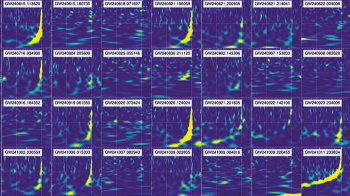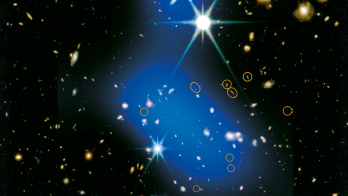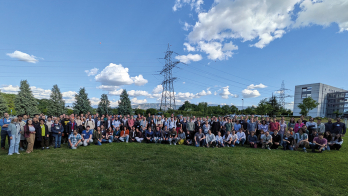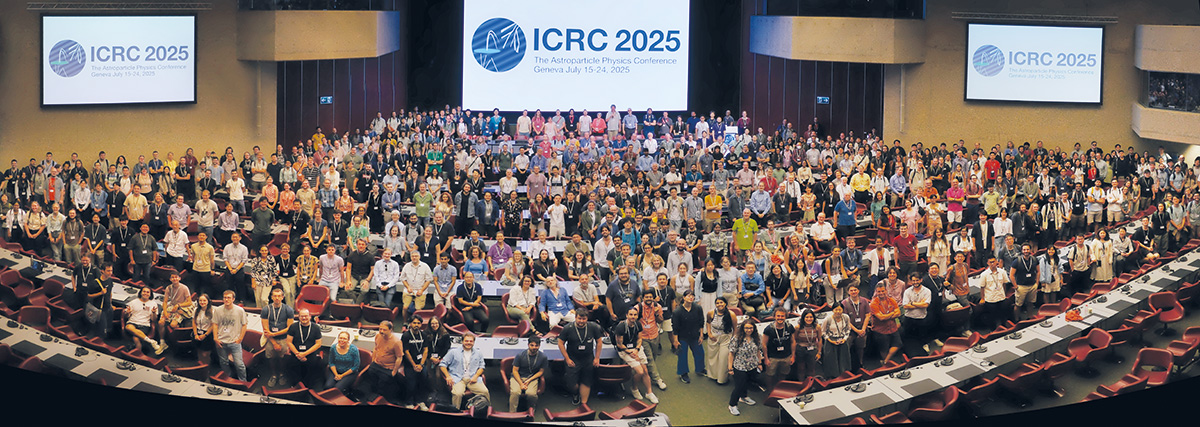
The 39th edition of the International Cosmic Ray Conference (ICRC), a key biennial conference in astroparticle physics, was held in Geneva from 15 to 24 July. Plenary talks covered solar, galactic and ultra-high-energy cosmic rays. A strong multi-messenger perspective combined measurements of charged particles, neutrinos, gamma rays and gravitational waves. Talks were informed by limits from the LHC and elsewhere on dark-matter particles and primordial black-holes. The bundle of constraints has improved very significantly over the past few years, allowing more meaningful and stringent tests.
Solar modelling
The Sun and its heliosphere, where the solar wind offers insights into magnetic reconnection, shock acceleration and diffusion, are now studied in situ thanks to the Solar Orbiter and Parker Solar Probe spacecraft. Long-term PAMELA and AMS data, spanning over an 11-year solar cycle, allow precise modelling of solar modulation of cosmic-ray fluxes below a few tens of GeV. AMS solar proton data show a 27-day periodicity up to 20 GV, caused by corotating interaction regions where fast solar wind overtakes slower wind, creating shocks. AMS has recorded 46 solar energetic particle (SEP) events, the most extreme reaching a few GV, from magnetic-reconnection flares or fast coronal mass ejections. While isotope data once suggested such extreme events occur every 1500 years, Kepler observations of Sun-like stars indicate they may happen every 100 years, releasing more than 1034 erg, often during weak solar minima, and linked to intense X-ray flares.
The spectrum of galactic cosmic rays, studied with high-precision measurements from satellites (DAMPE) and ISS-based experiments (AMS-02, CALET, ISS-CREAM), is not a single power law but shows breaks and slope changes, signatures of diffusion or source effects. A hardening at about 500 GV, common to all primaries, and a softening at 10 TV, are observed in protons and He spectra by all experiments – and for the first time also in DAMPE’s O and C. As the hardening is detected in primary spectra scaling at the same rigidity (charge, not mass) as in secondary-to-primary ratios, they are attributed to propagation in the galaxy and not to source-related effects. This is supported by secondary (Li, Be, B) spectra with breaks about twice as strong as primaries (He, C, O). A second hardening at 150 TV was reported by ISS-CREAM (p) and DAMPE (p + He) for the first time, broadly consistent – within large hadronic-model and statistical uncertainties – with indirect ground-based results from GRAPES and LHAASO.
A strong multi-messenger perspective combined measurements of charged particles, neutrinos, gamma rays and gravitational waves
Ratios of secondary over primary species versus rigidity R (energy per unit charge) probe the ratio of the galactic halo size H to the energy-dependent diffusion coefficient D(R), and so measure the “grammage” of material through which cosmic rays propagate. Unstable/stable secondary isotope ratios probe the escape times of cosmic rays from the halo (H2/D(R)), so from both measurements H and D(R) can be derived. The flattening evidenced by the highest energy point at 10 to 12 GeV/nucleon of the 10Be/9Be ratio as a function of energy, hints at a possibly larger halo than previously believed beyond 5 kpc, to be tested by HELIX. AMS-02 spectra of single elements will soon allow separation of the primary and secondary fractions for each nucleus, also based on spallation cross-sections. Anomalies remain, such as a flattening at ~7 TeV/nucleon in Li/C and B/C, possibly indicating reacceleration or source grammage. AMS-02’s 7Li/6Li ratio disagrees with pure secondary models, but cross-section uncertainties preclude firm conclusions on a possible Li primary component, which would be produced by a new population of sources.
The muon puzzle
The dependency of ground-based cosmic-ray measurements on hadronic models has been widely discussed by Boyd and Pierog, highlighting the need for more measurements at CERN, such as the recent proton-O run being analysed by LHCf. The EPOS–LHC model, based on the core–corona approach, shows reduced muon discrepancies, producing more muons and a heavier composition, namely deeper shower maxima (+20 g/cm2) than earlier models. This clarifies the muon puzzle raised by Pierre Auger a few years ago of a larger muon content in atmospheric showers than simulations. A fork-like structure remains in the knee region of the proton spectrum, where the new measurements presented by LHAASO are in agreement with IceTop/IceCube, and could lead to a higher content of protons beyond the knee than hinted at by KASCADE and the first results of GRAPES. Despite the higher proton fluxes, a dominance of He above the knee is observed, which requires a special kind of close-by source to be hypothesised.
Multi-messenger approaches
Gamma-ray and neutrino astrophysics were widely discussed at the conference, highlighting the relevance of multi-messenger approaches. LHAASO produced impressive results on UHE astrophysics, revealing a new class of pevatrons: microquasars alongside young massive clusters, pulsar wind nebulae (PWNe) and supernova remnants.
Microquasars are gamma-ray binaries containing a stellar-mass black hole that drives relativistic jets while accreting matter from their companion stars. Outstanding examples include Cyg X-3, a potential PeV microquasar, from which the flux of PeV photons is 5–10 times higher than in the rest of the Cygnus bubble.
Five other microquasars are observed beyond 100 TeV: SS 433, V4641 Sgr, GRS 1915 + 105, MAXI J1820 + 070 and Cygnus X-1. SS 433 is a microquasar with two gamma-ray emitting jets nearly perpendicular to our line of sight, terminated at 40 pc from the black hole (BH) identified by HESS and LHAASO beyond 10 TeV. Due to the Klein–Nishina effect, the inverse Compton flux above ~10 TeV is gradually suppressed, and an additional spectral component is needed to explain the flux around 100 TeV.
Gamma-ray and neutrino astrophysics were widely discussed at the conference
Beyond 100 TeV, LHAASO also identifies a source coincident with a giant molecular cloud; this component may be due to protons accelerated close to the BH or in the lobes. These results demonstrate the ability to resolve the morphology of extended galactic sources. Similarly, ALMA has discovered two hotspots, both at 0.28° (about 50 pc) from GRS 1915 + 105 in opposite directions from its BH. These may be interpreted as two lobes, or the extended nature of the LHAASO source may instead be due to the spatial distribution of the surrounding gas, if the emission from GRS 1915 + 105 is dominated by hadronic processes.
Further discussions addressed pulsar halos and PWNe as unique laboratories for studying the diffusion of electrons and mysterious as-yet-unidentified pevatrons, such as MGRO J1908 + 06, coincident with a SNR (favoured) and a PSR. One of these sources may finally reveal an excess in KM3NeT or IceCube neutrinos, proving their cosmic-ray accelerator nature directly.
The identification and subtraction of source fluxes on the galactic plane is also important for the measurement of the galactic plane neutrino flux by IceCube. This currently assumes a fixed spectral index of E–2.7, while authors like Grasso et al. presented a spectrum becoming as soft as E–2.4, closer to the galactic centre. The precise measurements of gamma-ray source fluxes and the diffuse emission from galactic cosmic rays interacting in the interstellar matter lead to better constraints on neutrino observations and on cosmic ray fluxes around the knee.
Cosmogenic origins
KM3NeT presented a neutrino of energy well beyond the diffuse cosmic neutrino flux of IceCube, which does not extend beyond 10 PeV (CERN Courier March/April 2025 p7). Its origin was widely discussed at the conference. The large error on its estimated energy – 220 PeV, within a 1σ confidence interval of 110 to 790 PeV – makes it nevertheless compatible with the flux observed by IceCube, for which a 30 TeV break was first hypothesised at this conference. If events of this kind are confirmed, they could have transient or dark-matter origins, but a cosmogenic origin is improbable due to the IceCube and Pierre Auger limits on the cosmogenic neutrino flux.