A report from the CMS experiment.
In addition to giving mass to elementary particles, the Brout–Englert–Higgs mechanism provides a testing ground for the fundamental symmetries of nature. In a recent analysis, the CMS collaboration searched for violations of charge–parity (CP) symmetry in the decays of Higgs bosons into two photons. The results set some of the strongest limits to date on anomalous Higgs-boson couplings that violate CP symmetry.
CP symmetry is particularly interesting as violations reveal fundamental differences in the behaviour of matter and antimatter, potentially explaining why the former appears to be much more abundant in the observed universe. While the Standard Model predicts that CP symmetry should be violated, the effect is not sufficient to account for the observed imbalance, motivating searches for additional sources of CP violation. CP symmetry requires that the laws of physics remain the same when particles are replaced by their corresponding antiparticles (C symmetry) and their spatial coordinates are reflected as in a mirror (P symmetry). In 1967, Andrei Sakharov established CP violation as one of three necessary requirements for a cosmic imbalance between matter and antimatter.
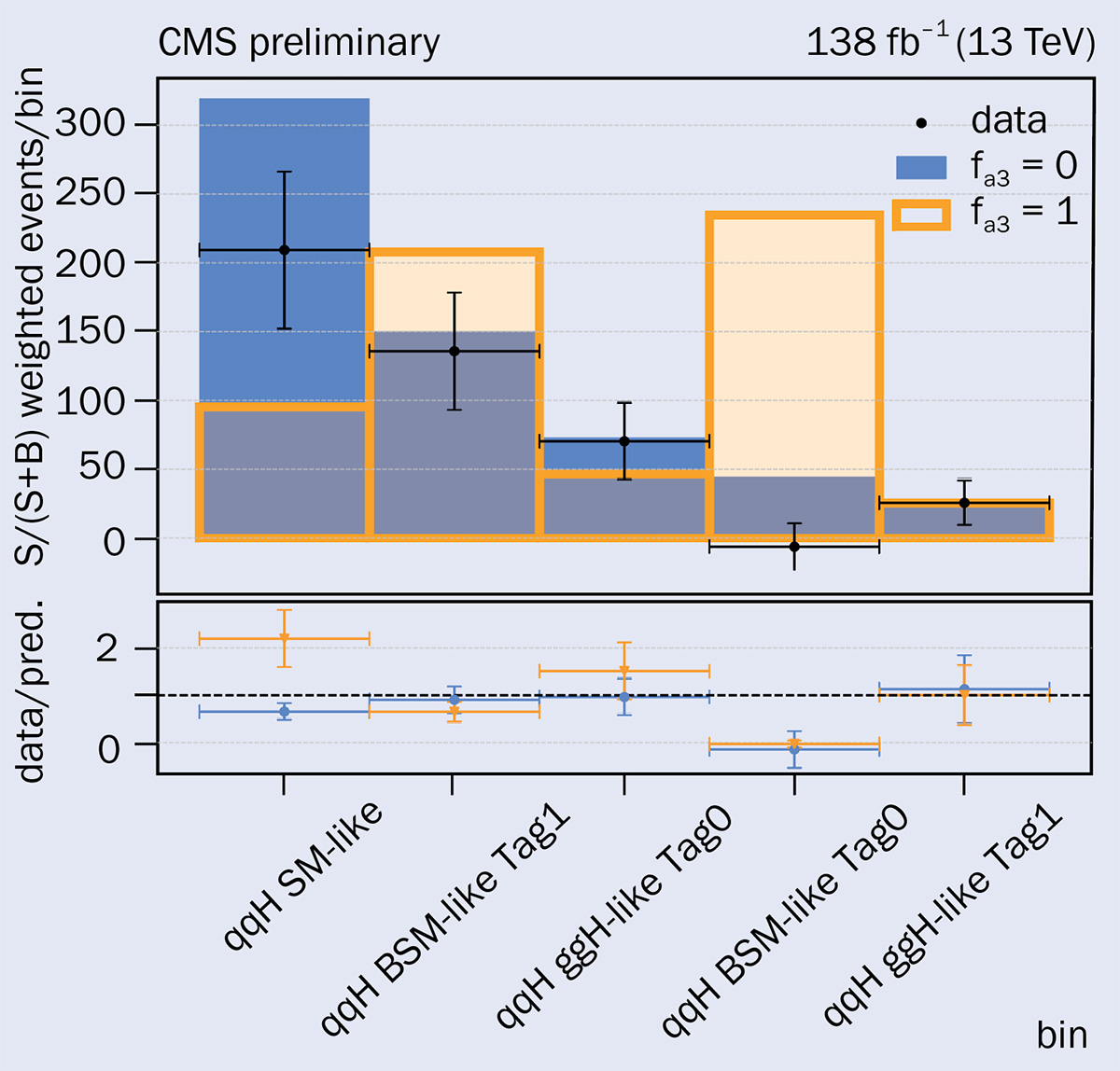
The CMS collaboration probed Higgs-boson interactions with electroweak bosons and gluons, using decays into two energetic photons. This final state is particularly precise: photons are well reconstructed thanks to the energy resolution of the CMS electromagnetic calorimeter and backgrounds can be accurately estimated. The analysis employed 138 fb–1 of proton–proton collision data at a centre-of-mass energy of 13 TeV and focused on two main channels. Electroweak production of the Higgs boson, via vector boson fusion (VBF) or in association with a W or Z boson (VH), tests the Higgs boson’s couplings to electroweak gauge bosons. Gluon fusion, which occurs through loops dominated by the top quark, is sensitive to possible CP-violating interactions with fermions. A full angular analysis was performed to separate different coupling hypotheses, exploiting both the kinematic properties of the photons from the Higgs boson decay and the particles produced alongside it.
The matrix element likelihood approach (MELA) was used to minimise the number of observables, while retaining all essential information. Deep neural networks and boosted decision trees classified events based on their topology and kinematic properties, isolating signal-like events from background or alternative new-physics scenarios. Events were then grouped into analysis categories, each optimised to enhance sensitivity to anomalous couplings for a specific production mode.
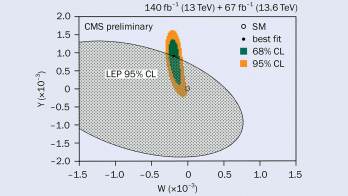
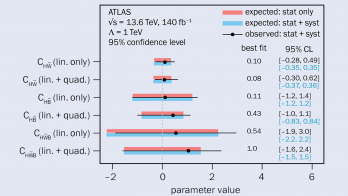
The data favour the Standard Model configuration, with no significant deviation from its predictions (see figure 1). By placing some of the most stringent constraints yet on CP-violating interactions between the Higgs boson and vector bosons, the study highlights how precise measurements in simple final states can yield insights into the symmetries governing particle physics. With the upcoming data from Run 3 of the LHC and the High-Luminosity LHC, CMS is well positioned to push these limits further and potentially uncover hidden aspects of the Higgs sector.
Further reading
CMS Collab. 2025 CMS-PAS-HIG-24-006.