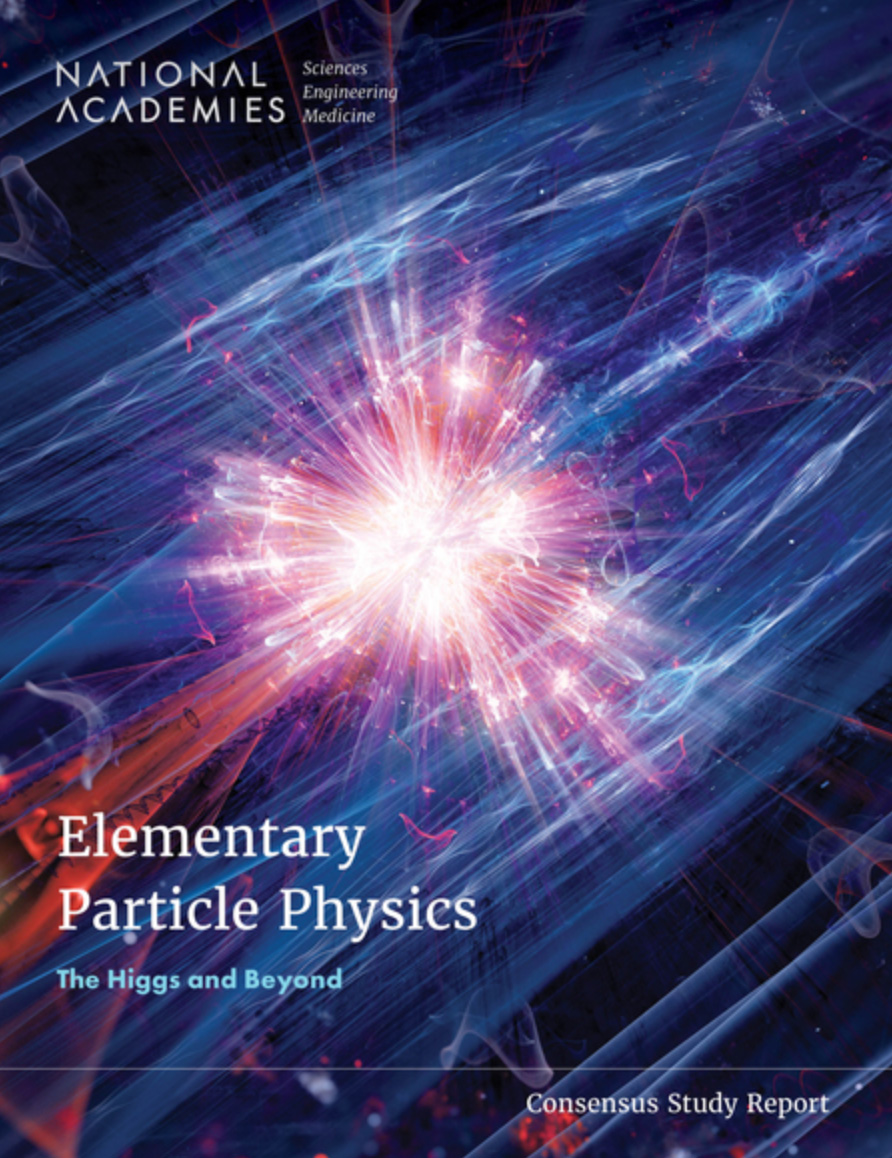
Big science requires long-term planning. In June, the US National Academies of Sciences, Engineering, and Medicine published an unprecedented 40-year strategy for US particle physics titled Elementary Particle Physics: The Higgs and Beyond. Its recommendations include participating in the proposed Future Circular Collider at CERN and hosting the world’s highest-energy elementary particle collider around the middle of the century (see “Eight recommendations” panel). The report assesses that a 10 TeV muon collider would complement the discovery potential of a 100 TeV proton collider.
“The shift to a 40-year horizon in the new report reflects a recognition that modern particle-physics projects and scientific questions are of unprecedented scale and complexity, demanding a much longer-term strategic commitment, international cooperation and investment for continued leadership,” says report co-chair Maria Spiropulu of the California Institute of Technology. “A staggered approach towards large research-infrastructure projects, rich in scientific advancement, technological breakthroughs and collaboration, can shield the field from stagnation.”
Eight recommendations
1. The US should host the world’s highest-energy elementary particle collider around the middle of the century. This requires the immediate creation of a national muon collider R&D programme to enable the construction of a demonstrator of the key new technologies and their integration.
2. The US should participate in the international Future Circular Collider Higgs factory currently under study at CERN to unravel the physics of the Higgs boson.
3. The US should continue to pursue and develop new approaches to questions ranging from neutrino physics and tests of fundamental symmetries to the mysteries of dark matter, dark energy, cosmic inflation and the excess of matter over antimatter in the universe.
4. The US should explore new synergistic partnerships across traditional science disciplines and funding boundaries.
5. The US should invest for the long journey ahead with sustained R&D funding in accelerator science and technology, advanced instrumentation, all aspects of computing, emerging technologies from other disciplines and a healthy core research programme.
6. The federal government should provide the means and the particle-physics community should take responsibility for recruiting, training, mentoring and retaining the highly motivated student and postdoctoral workforce required for the success of the field’s ambitious science goals.
7. The US should engage internationally through existing and new partnerships, and explore new cooperative planning mechanisms.
8. Funding agencies, national laboratories and universities should work to minimise the environmental impact of particle-physics research and facilities.
Source: National Academies of Sciences, Engineering, and Medicine 2025 Elementary Particle Physics: The Higgs and Beyond. Washington, DC: The National Academies Press.
The report is authored by a committee of leading scientists selected by the National Academies. Its mandate complements the grassroots-led Snowmass process and the budget-conscious P5 process (CERN Courier January/February 2024 p7). The previous report in this series, Revealing the Hidden Nature of Space and Time: Charting the Course for Elementary Particle Physics was published in 2006. It called for the full exploitation of the LHC, a strategic focus on linear-collider R&D, expanding particle astrophysics, and pursuing an internationally coordinated, staged programme in neutrino physics.
Two conclusions underpin the new report’s recommendations. The first identifies three workforce issues currently threatening the future of particle physics: the morale of early-career scientists, a shortfall in the number of accelerator scientists, and growing barriers to international exchanges. The second urges US leadership in elementary particle physics, citing benefits to science, the nation and humanity.