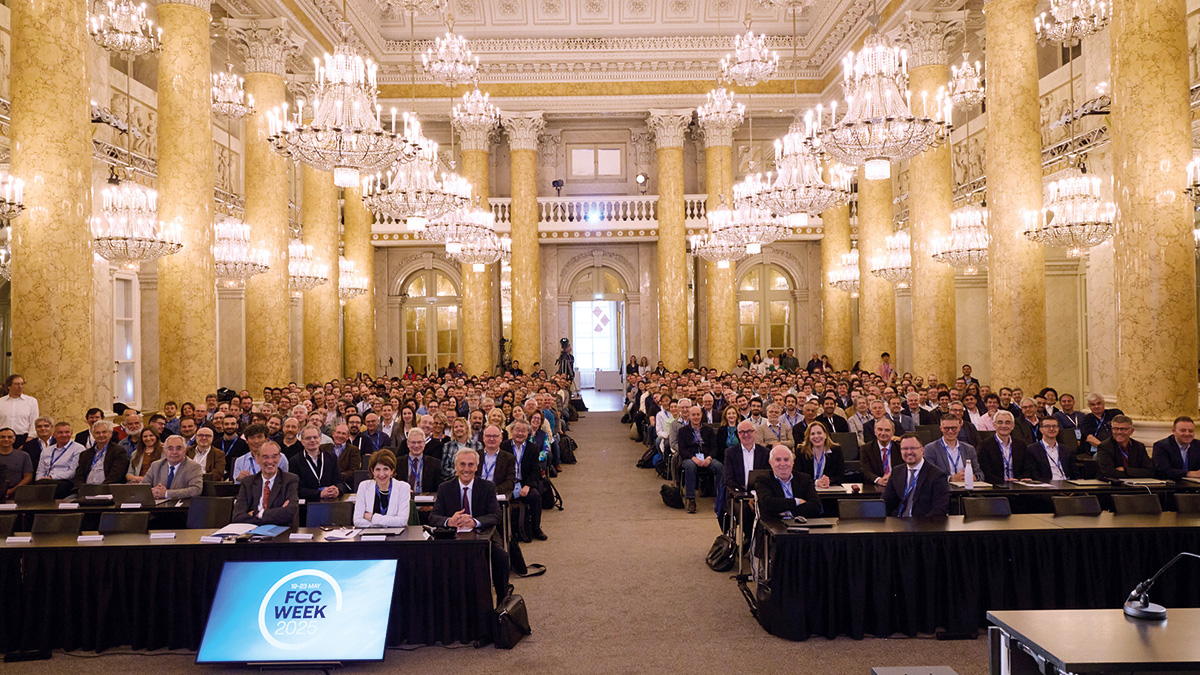
FCC Week 2025 gathered more than 600 participants from 34 countries together in Vienna from 19 to 23 May. The meeting was the first following the submission of the FCC’s feasibility study to the European Strategy for Particle Physics (CERN Courier May/June 2025 p9). Comprising three volumes – covering physics and detectors, accelerators and infrastructure, and civil engineering and sustainability – the study represents the most comprehensive blueprint to date for a next-generation collider facility. The next phase will focus on preparing a robust implementation strategy, via technical design, cost assessment, environmental planning and global engagement.
CERN Director-General Fabiola Gianotti estimated the integral FCC programme to offer unparalleled opportunities to explore physics at the shortest distances, and noted growing support and enthusiasm for the programme within the community. That enthusiasm is reflected in the growing collaboration: the FCC collaboration now includes 162 institutes from 38 countries, with 28 new Memoranda of Understanding signed in the past year. These include new partnerships in Latin America, Asia and Ukraine, as well as Statements of Intent from the US and Canada. The FCC vision has also gained visibility in high-level policy dialogues, including the Draghi report on European competitiveness. Scientific plenaries and parallel sessions highlighted updates on simulation tools, rare-process searches and strategies to probe beyond the Standard Model. Detector R&D has progressed significantly, with prototyping, software development and AI-driven simulations advancing rapidly.
In accelerator design, developments included updated lattice and optics concepts involving global “head-on” compensation (using opposing beam interactions) and local chromaticity corrections (to the dependence of beam optics on particle energy). Refinements were also presented to injection schemes, beam collimation and the mitigation of collective effects. A central tool in these efforts is the Xsuite simulation platform, whose capabilities now include spin tracking and modelling based on real collider environments such as SuperKEKB.
Technical innovations also came to the fore. The superconducting RF system for FCC-ee includes 400 MHz Nb/Cu cavities for low-energy operation and 800 MHz Nb cavities for higher-energy modes. The introduction of reverse-phase operation and new RF source concepts – such as the tristron, with energy efficiencies above 90% (CERN Courier May/June 2025 p30) – represent major design advances.
Design developments
Vacuum technologies based on ultrathin NEG coating and discrete photon stops, as well as industrialisation strategies for cost control, are under active development. For FCC-hh, high-field magnet R&D continues on both Nb3Sn prototypes and high-temperature superconductors.
Sessions on technical infrastructure explored everything from grid design, cryogenics and RF power to heat recovery, robotics and safety systems. Sustainability concepts, including renewable energy integration and hydrogen storage, showcased the project’s interdisciplinary scope and long-term environmental planning.
FCC Week 2025 extended well beyond the conference venue, turning Vienna into a vibrant hub for public science outreach
The Early Career Researchers forum drew nearly 100 participants for discussions on sustainability, governance and societal impact. The session culminated in a commitment to inclusive collaboration, echoed by the quote from Austrian-born artist, architect and environmentalist Friedensreich Hundertwasser (1928–2000): “Those who do not honour the past lose the future. Those who destroy their roots cannot grow.”
This spirit of openness and public connection also defined the week’s city-wide engagement. FCC Week 2025 extended well beyond the conference venue, turning Vienna into a vibrant hub for public science outreach. In particular, the “Big Science, Big Impact” session – co-organised with the Austrian Federal Economic Chamber (WKO) – highlighted CERN’s broader role in economic development. Daniel Pawel Zawarczynski (WKO) shared examples of small and medium enterprise growth and technology transfer, noting that CERN participation can open new markets, from tunnelling to aerospace. Economist Gabriel Felbermayr referred to a recent WIFO analysis indicating a benefit-to-cost ratio for the FCC greater than 1.2 under conservative assumptions. The FCC is not only a tool for discovery, observed Johannes Gutleber (CERN), but also a platform enabling technology development, open software innovation and workforce training.
The FCC awards celebrate the creativity, rigour and passion that early-career researchers bring to the programme. This year, Tsz Hong Kwok (University of Zürich) and Audrey Piccini (CERN) won poster prizes, Sara Aumiller (TU München) and Elaf Musa (DESY) received innovation awards, and Ivan Karpov (CERN) and Nicolas Vallis (PSI) were honoured with paper prizes sponsored by Physical Review Accelerators and Beams. As CERN Council President Costas Fountas reminded participants, the FCC is not only about pushing the frontiers of knowledge, but also about enabling a new generation of ideas, collaborations and societal progress.