The autumn 2009 HEPiX meeting was hosted by the Lawrence Berkeley National Laboratory (LBNL) National Energy Research Scientific Computer Center (NERSC) at the University of California campus in Berkeley. The meeting was held in a conference room on the hills above the town with a spectacular view over the San Francisco bayshore. Around 70 people attended from a variety of US, Canadian and European sites. Almost all of the presentations are available on Indico.

Summary

The key points can be summarized.
• Storage was by far the most popular subject in terms of submitted talks.
• There was an interesting presentation about the new Magellan project.
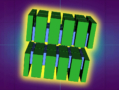
• The most intriguing presentation was a description of a 3D cube being proposed for computing at the FAIR project at GSI in Germany. A steel frame 26 m wide, long and high will house 1000 racks of computers.
• Another hot topic was virtualization.
• Also mentioned several times was research into using Graphics Processing Units (GPUs) for HEP computing.
• The acronym of the week was ARRA: American Recovery and Reinvestment Act. Grants are awarded for new projects and for spending in the US. The NERSC/ALCF Magellan project had received $32 m, Energy Sciences Network (ESnet) got $62 m for an "advanced networking initiative" to build a prototype 100 Gb network and Jefferson Lab $5 m for a lattice QCD project.
• The next meetings are 19–23 April 2010 in LIP, Lisbon, and autumn in Cornell (choice of three weeks under consideration, complicated by CHEP timing). The HEPiX board would like to hold the spring 2011 meeting in Asia after the success of the Taiwan meeting but need to identify a host site. Autumn 2011 is likely to be TRIUMF.

Some highlights

The Magellan project was briefly described in the opening talk given by Kathy Yelick, the director of NERSC. It is a $32 m project at NERSC and the Argonne Leadership Computing Facility (ALCF). The US Department of Energy (DoE) has decided to explore clouds for science computing. Can a cloud serve the DoE's mid-range computing needs? What part of the workload can be served on a cloud, what features are needed? How does a science computing cloud differ from a commercial cloud? The funds at NERSC will be used to acquire a 100 Teraflops cluster with petabyte-scale storage. Further details were given later in the week including a list of questions to be answered during the research.

Kathy also discussed the increasing power of processing chips and their growing parallelism, and concluded that single processors are not going to get much faster and memory per core will drop. Parallel flops are "free" but memory is expensive. Adding parallelism will be important for all applications. Power and energy costs will dominate and we will need to work with more experts on software, algorithms and applications. Finally she noted that she does not consider that virtualization will be the answer.

Despite the last comment, there were a notable number of talks on virtualization and one in particular – CERN/IT's "vision for the future" presentation, given by Tony Cass – created lots of discussion. One conclusion was that HEPiX can be an important vehicle for sites to share experiences and gradually help us grow towards a common offering for the experiments. The idea of a dedicated working group was raised. The board agreed and asked Tony to run it. The initial target will be experience sharing. The talk from Tony also asked whether we could imagine a virtualization service for the LCG users. He described a five-step process to get this working, which needs to be accepted by the experiment users and the local site management. He admitted, however, that steps four and five would be hard to achieve, at least in the short-term.

In brief

In the security sessions, two CERN/IT staff presented recent and ongoing vectors of attack concerning different security intrusions, denial of service and viral infections. Several of the system administrators in the audience were seen to squirm during these talks.

ITIL made its appearance at HEPiX for the first time with presentations from KIT/FZK in Karlsruhe, Fermilab and CERN.

There was also an update on Scientific Linux from Troy Dawson of Fermilab, one of the two principle authors. With the audience, he defined end dates for the support of versions 3 and 4 of Scientific Linux: October 2010.

From Intel Corporation, a senior engineer explained how the company is using the power and new features of its latest chips to dramatically improve the performance and turnaround of the computing centres, which are required in the modelling and simulation of the new chips under design.

One of the OpenAFS gatekeepers presented work being funded by the DoE and undertaken by his company to add new features and better performance to OpenAFS – for many years the main file system shared by HEP centres around the world. A plan is being put together to permit European input to be added to the mix. On the other hand, although it is still alive and well, tales of the Lustre file system seem to have reached a plateau.

Site-report updates

Finally, here are some highlights from the ever-popular site reports:
• Jefferson Lab is celebrating its 25th anniversary plus the approval of a 12 GB upgrade to its electron beam, and a $5 m grant for its Lattice QCD project.
• GSI is concentrating on the FAIR project. The first problem is the lack of physical space so it is proposing a 79 m 3D cube for stacking 1000 19 inch racks in a steel skeleton measuring 26 m on each side. It is expected to host 40,000 nodes. Within the cube, the racks will be stored such that there are gaps between racks for human access but the current working temperature within the cube is 30 °C, which does not make for a comfortable environment for the staff working in there, e.g. to change a disc.
• RAL's new computer centre is now fully operational and new Tier 1 procurements were shipped in along with elements of the existing Tier 1 over the summer.
• There has been a major upgrade to the INFN Tier 1 in Bologna this year, tripling the available rack space as well as greatly expanding the chiller and UPS capacity.
• TRIUMF just celebrated its 40th anniversary by adding three new member universities and confirming the funding of the super-conducting RF (SRF) electron linear accelerator (e-linac) project.
• IN2P3 in Lyon is planning a new building to house a 800 m2 computer room.
• NIKHEF's new data centre, built inside a room previously used as a library, is now operational with 47 racks and 400 KW of power, but troubles included a water leak.
• The INFN IPv6 working group continues its studies; they have an IPv6 addressing plan and they are ready to move to IPv6 "when necessary".
• At SLAC, the LCLS (Linac Coherent Light Source) had a spectacular start-up with 94% efficiency and the Fermi Gamma Ray Space Telescope is in orbit collecting data as expected, 15 billion events so far, 225 million of serious interest.

Useful links

HEPiX meeting website: http://indico.cern.ch/conferenceTimeTable.py?confId=61917.
HEPiX website: www.hepix.org.