 Read article 'Towards an unbiased digital world'
Towards an unbiased digital world
The European Union project Open Web Search aims to provide an unbiased and transparent alternative to commercial search engines.
 Read article 'Towards an unbiased digital world'
The European Union project Open Web Search aims to provide an unbiased and transparent alternative to commercial search engines.
 Read article 'Machine-learning speedup for HL-LHC'
AI tools developed for particle physics could also be game-changers in nuclear fusion, astrophysics, computer science and biology.
 Read article 'ALICE ups its game for sustainable computing'
Volker Lindenstruth goes behind the scenes of a completely new computing model that allows the ALICE collaboration to merge online and offline data processing into a single software framework.
 Read article 'Report explores quantum computing in particle physics'
Researchers from CERN, DESY, IBM Quantum and more than 30 other organisations plot a course for quantum computing in particle physics.
 Read article 'Event displays in motion'
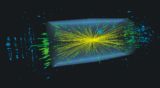
The LHC and the Higgs-boson discovery not only accelerated science, but also took event displays to a new level.
 Read article 'RadiaSoft rewrites the rulebook on modelling and optimisation of multi-stage accelerators'
“Robust software solutions that deliver step-function advances in accelerator design, engineering and research productivity.” Writ large, that’s the unifying goal shaping the day-to-day work of ...
 Read article 'End-to-end simulation of particle accelerators using Sirepo'
Watch this webinar now, to explore how to use Sirepo for linear accelerator simulations.
 Read article 'A powerful eye opener into the world of AI'
"Artificial Intelligence for High Energy Physics" showcases neat projects and detailed applications, finds Andreas Salzburger.
 Read article 'Combining quantum with high-energy physics'
Organised by the CERN Quantum Technology Initiative, the first International Conference on Quantum Technologies for High-Energy Physics assessed the opportunities ahead.
 Read article 'Connecting the dots with neural networks'
"Deep Learning for Physics Research" balances theory and practice, physics and programming, and foundations and state-of-the-art deep-learning concepts.