W Owen Lock 1927–2010


Following a long and cruel illness, which he and his family bore with great fortitude, Owen Lock died on 19 March 2010.

Owen was born on 8 August 1927 and grew up in Cirencester, England. In 1945 he won a state scholarship to study physics at the University of Bristol, where he graduated in 1948 with a first-class honours BSc. He joined the international group of Cecil Powell and colleagues, immediately after their Nobel prize-winning discovery of the π meson, and worked with the newly developed technique of photographic nuclear emulsions, which were exposed to cosmic rays in high-altitude balloon flights. Owen's numerous papers from that time include observations of the production and decays of µ, π and K mesons and their interactions with nuclei. He wrote a review article in Progress in Cosmic Ray Physics in 1951 and obtained his PhD in 1952. By then he had been, successively, secretary and chair of the Bristol branch of the Association of Scientific Workers and had joined the World Federation of Scientific Workers and the British Pugwash Movement.

Owen met his wife, Eleanor, in Bristol. They were married in 1952 and moved to Manchester, where Owen took up a research fellowship, working with Patrick Blackett on further investigations of K mesons. After five months he became a lecturer at the University of Birmingham in 1953. In addition to lecturing in the physics and extra-mural departments, he formed a group to expose nuclear emulsions to beams at the university's newly constructed 1 GeV proton synchrotron. There followed a rich series of papers on proton interactions with matter and the nuclear disintegrations they provoke. While in Birmingham he wrote a book, High Energy Nuclear Physics, which was subsequently translated into Russian, French and Polish.

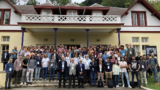
Having savoured the rich, international atmosphere of Powell's group in Bristol, Owen was attracted by CERN. He was awarded a research associateship in 1959, which led to a staff appointment in 1960, when he took over the joint leadership of the Nuclear Emulsion Group in the nuclear physics division. He was responsible for organizing the exposure of emulsions to beams from the Proton Synchrotron (PS), in conjunction with groups from all over Europe and beyond. He became, in turn, PS physics co-ordinator, secretary of the Emulsion Experiments Committee and secretary of the Nuclear Physics Research Committee. He initiated and organized the first Easter School for emulsion physicists, held in St Cergue in 1962 and repeated in 1963. This became the CERN School of Physics, held each year in a different CERN member state. Owen was subsequently responsible for the school's becoming a joint venture with JINR, Dubna, which was then in the USSR. Starting in 1970, the school was hosted alternately in eastern and western Europe.

The breadth of his human contacts and his rare organizational talent led Owen to transfer to the personnel division in 1965 to become head of the Fellows and Visitors Service. Already in 1962 he had started organizing conferences and in 1966 he became head of the Scientific Conference Secretariat and secretary to a working group, chaired by the director-general Bernard Gregory, on the European Space Research Organization (a forerunner of ESA). In 1970 he was appointed head of Education Services and deputy to the PE division leader until 1977, when he became personal assistant to John Adams, who was then executive director-general (at the time when Léon Van Hove was research director-general). He also became secretary of the board of directors and of the management board. He guaranteed continuity in this respect because he also fulfilled these roles under two subsequent directors-general, Herwig Schopper and Carlo Rubbia.

As early as 1965, Owen had accompanied Bernard Gregory to Moscow to negotiate an agreement with the State Committee for Atomic Energy on collaboration between the new Institute for High Energy Physics, in Protvino, and CERN. First contacts with China followed under Willibald Jentschke in 1971, which resulted in a visit by a Chinese delegation to CERN in 1973 and return visits in 1975 and 1977. These contacts led to co-operation agreements with China, signed by John Adams in 1979 and by Herwig Schopper in 1981 and 1985, during visits where Owen was the link-person. In 1976, the International Council of Scientific Unions founded what, in 1978, became the International Committee for Future Accelerators with John Adams as chairman and Owen as secretary. Under Carlo Rubbia, Owen became responsible for relations with central and eastern Europe, in addition to his ongoing contacts with China and India, which continued until his retirement in 1992. He was largely responsible for five countries acceding to full membership of CERN: Finland, Poland, Hungary, the Czech Republic and Slovakia.

Owen was highly educated and widely read, yet a modest person. Complementing his outstanding contributions to physics and scientific co-operation, he possessed deep convictions that led him to weld human contacts and friendships, encompassing people throughout the world. To his family and to those of us who experienced his generosity and had the privilege of being guided by him, an era has ended and we feel the loss. Our sympathy goes to his wife, Eleanor, and his four sons, Nicholas, Adrian, Evan and Eric.

His close friends.